Introduction
Foundation Model API Platforms are centralized services that allow developers and enterprises to access large pre-trained AI models via APIs. These platforms enable organizations to integrate advanced AI capabilities—such as natural language understanding, code generation, multimodal reasoning, and domain-specific analytics—without managing the infrastructure or training models themselves.
In 2026, foundation models have evolved beyond large language models. They now include multimodal, agentic, and domain-specialized variants, making reliable API access essential for modern applications. Organizations require platforms that can deliver AI at scale, integrate with workflows, and provide robust governance, observability, and security.
Real-world use cases include:
- Automating customer support and summarizing long documents.
- AI-assisted software development and code review.
- Enabling multimodal interactions in AR/VR, robotics, or digital assistants.
- Enterprise knowledge retrieval using connected vector databases.
- Generating marketing content, educational materials, and training data.
- Real-time analytics and insights on structured and unstructured datasets.
Evaluation criteria buyers should use:
- Model availability and flexibility (hosted, BYO, multi-model routing).
- Latency, throughput, and cost optimization mechanisms.
- Multimodal capabilities (text, image, audio, code).
- Guardrails and prompt-injection defenses.
- Data privacy, residency, and retention controls.
- Observability, tracing, and monitoring metrics.
- Integration options (SDKs, APIs, RAG connectors).
- Governance, auditability, and compliance support.
- AI evaluation and testing pipelines.
- Vendor support, ecosystem, and scalability.
Best for: CTOs, AI engineers, product teams, and enterprises seeking scalable AI with high compliance and performance.
Not ideal for: small projects with minimal AI usage, teams preferring fully open-source stacks without managed services, or organizations without API-integration capability.
What’s Changed in Foundation Model API Platforms
- Agentic workflows allow models to autonomously call APIs and chain tasks.
- Tool calling is now native: models can invoke external services securely.
- Multimodal inputs (text, images, audio, video) are standard.
- Evaluation and testing frameworks track hallucinations and reliability.
- Guardrails and prompt-injection defenses are embedded in APIs.
- Enterprise privacy controls include data residency and configurable retention.
- Cost and latency optimization through model routing and hybrid deployments.
- Observability dashboards monitor token usage, latency, and costs.
- BYO (Bring Your Own) models are supported alongside hosted models.
- Governance and compliance include automated reporting and policy enforcement.
- Integration-ready SDKs and connectors accelerate RAG pipelines.
- Real-time model versioning supports safe rollout of new checkpoints.
Quick Buyer Checklist (Scan-Friendly)
- Data privacy & retention: Configurable residency, deletion, and audit logs
- Model choice: Hosted vs BYO vs open-source, multi-model routing
- RAG / knowledge integration: Built-in connectors, vector DB compatibility
- ✅ Evaluation & testing: Offline evaluation, regression tests, human review
- ✅ Guardrails: Policy checks, prompt injection defenses
- ✅ Latency & cost controls: Model routing, throttling, quota management
- ✅ Auditability & admin controls: RBAC, SSO/SAML, logging
- ✅ Vendor lock-in risk: Evaluate abstraction and portability options
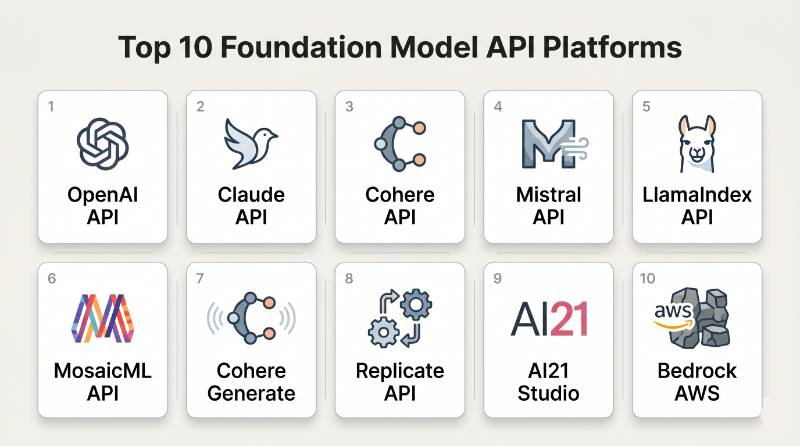
Top 10 Foundation Model API Platforms (Updated)
1- OpenAI API
One-line verdict: Best for enterprises and developers needing reliable, scalable, multimodal foundation models.
Short description: Provides access to GPT-based LLMs and multimodal models for text, code, and images, ideal for large-scale AI integration.
Standout Capabilities
- GPT-4-turbo and multimodal model access
- Built-in function calling for external tool integration
- Embeddings and retrieval-augmented generation (RAG)
- Rate limits and usage-based throttling
- Advanced safety filters and prompt injection detection
- Versioned endpoints for stable deployments
AI-Specific Depth
- Model support: Proprietary hosted models, BYO experimental Varies / N/A
- RAG / knowledge integration: Connects with vector DBs and document stores
- Evaluation: Prompt testing, regression, human review
- Guardrails: Policy filters, prompt-injection detection built-in
- Observability: Latency, token metrics, usage dashboards
Pros
- Highly reliable and scalable
- Broad multimodal and language support
- Strong developer ecosystem
Cons
- Usage cost can scale with volume
- Limited control over underlying weights
- Fine-tuning options restricted
Security & Compliance
- SSO/SAML, RBAC, audit logs, encryption
- Data residency and retention configurable
- Certifications: Not publicly stated
Deployment & Platforms
- Web, Windows, macOS, Linux
- Cloud-hosted
Integrations & Ecosystem
- Python, Node.js, Java, C# SDKs
- Plugins for RAG frameworks
- Embedding pipelines, workflow integrations
Pricing Model
- Usage-based, tiered enterprise plans
Best-Fit Scenarios
- Customer support automation
- Code generation and AI-assisted development
- Multimodal content generation
2- Claude API
One-line verdict: Suited for teams needing safer and steerable AI assistants with compliance-sensitive applications.
Short description: Claude API offers LLMs designed for alignment and controllable outputs, focused on enterprise deployments.
Standout Capabilities
- Constitutional AI for safer responses
- Contextual prompt steering and role-based responses
- High token limits per request
- Integrated safety and moderation filters
- Optimized for multi-turn reasoning
AI-Specific Depth
- Model support: Proprietary hosted
- RAG / knowledge integration: N/A
- Evaluation: Human feedback and alignment metrics
- Guardrails: Strong content safety filters
- Observability: Usage metrics, latency monitoring
Pros
- Safety-focused design
- High-context conversation support
- Compliance-friendly
Cons
- Fewer integrations than competitors
- Limited fine-tuning
- Latency on large requests
Security & Compliance
- RBAC, SSO/SAML, audit logging
- Encryption and retention controls
- Certifications: Not publicly stated
Deployment & Platforms
- Cloud-hosted
Integrations & Ecosystem
- REST API, SDKs
- Vector DB connectors for retrieval
- Developer libraries for Python and JS
Pricing Model
- Tiered, usage-based per token
Best-Fit Scenarios
- Customer-facing AI assistants
- Compliance-focused workflows
- Document summarization
3- Cohere API
One-line verdict: Ideal for NLP-focused enterprise applications requiring embeddings and retrieval-based AI.
Short description: Specializes in LLMs for text generation, embeddings, and RAG workflows.
Standout Capabilities
- Embedding vectors for semantic search
- Fine-tuning for domain adaptation
- Controllable text generation
- High throughput batch processing
- Integrated with vector DBs
AI-Specific Depth
- Model support: Proprietary hosted, BYO options
- RAG / knowledge integration: Vector DB support
- Evaluation: Offline evaluation, A/B testing
- Guardrails: Content filters
- Observability: Usage dashboards
Pros
- Strong embedding and RAG support
- Developer-friendly APIs
- Fine-tuning available
Cons
- Limited multimodal support
- Enterprise security varies
- Smaller community
Security & Compliance
- Encryption, RBAC, audit logs
- Certifications: Not publicly stated
Deployment & Platforms
- Cloud-hosted, Web API
Integrations & Ecosystem
- Python/JS SDKs
- Vector DBs: Pinecone, FAISS, Weaviate
- Workflow connectors
Pricing Model
- Usage-based token pricing, tiered plans
Best-Fit Scenarios
- Enterprise search
- Knowledge management
- NLP analytics
4- Mistral API
One-line verdict: Best for organizations needing open-weight foundation models with high transparency.
Short description: Provides open-weight LLMs for experimentation, research, and flexible AI integration.
Standout Capabilities
- Open-weight models
- High-context comprehension
- Multi-turn reasoning
- Lightweight deployment
- Community-driven improvements
AI-Specific Depth
- Model support: Open-source / BYO
- RAG / knowledge integration: Varies / N/A
- Evaluation: Offline benchmarks
- Guardrails: Basic filtering
- Observability: Varies / N/A
Pros
- Transparent, flexible
- High experimentation value
- Lightweight deployment
Cons
- Limited enterprise support
- Guardrails not robust
- Latency/scaling require engineering
Security & Compliance
- Varies / N/A
Deployment & Platforms
- Cloud, Self-hosted
- Python SDK
Integrations & Ecosystem
- Open-source libraries
- Custom pipelines
- Connectors to databases
Pricing Model
- Open-source, enterprise licensing available
Best-Fit Scenarios
- Research and experimentation
- Internal AI tools
- Custom AI applications
5- LlamaIndex API
One-line verdict: Suited for teams building retrieval-augmented applications with flexible document integration.
Short description: Connects LLMs to structured and unstructured data sources for RAG workflows.
Standout Capabilities
- Connectors to databases, PDFs, APIs
- Vector embeddings and semantic search
- RAG pipelines
- Modular SDKs
- Prompt templates
AI-Specific Depth
- Model support: Hosted / BYO
- RAG / knowledge integration: Full support
- Evaluation: Regression tests
- Guardrails: Configurable filters
- Observability: Token usage, latency, logging
Pros
- Excellent RAG support
- Developer-friendly
- Custom data pipelines
Cons
- Not a general-purpose LLM
- Requires additional model API
- Some latency on large datasets
Security & Compliance
- RBAC, audit logs, encryption
- Certifications: Not publicly stated
Deployment & Platforms
- Cloud-hosted, Python SDK
Integrations & Ecosystem
- Python, Node.js SDKs
- Vector DBs and document connectors
- Custom pipelines
Pricing Model
- Usage-based, open-source SDK
Best-Fit Scenarios
- Knowledge management
- Enterprise search
- Document AI pipelines
6- MosaicML API
One-line verdict: Ideal for enterprises needing high-performance, fine-tunable LLMs with deployment control.
Short description: Provides APIs for training and inference of large models, focusing on optimization and cost efficiency.
Standout Capabilities
- Fine-tuning LLMs
- Optimized inference pipelines
- Open-weight and proprietary models
- Cost-efficient scaling
- Cloud and on-prem support
AI-Specific Depth
- Model support: Open-source / BYO / Multi-model
- RAG / knowledge integration: Varies / N/A
- Evaluation: Prompt testing, regression
- Guardrails: Custom filters
- Observability: Token/cost metrics, latency
Pros
- High-performance fine-tuning
- Cost-efficient inference
- Flexible deployment
Cons
- Limited RAG integration
- Enterprise SDK requires engineering
- Smaller community
Security & Compliance
- RBAC, encryption, audit logs
- Certifications: Not publicly stated
Deployment & Platforms
- Cloud, Self-hosted
- Python SDK
Integrations & Ecosystem
- Cloud APIs and SDKs
- Model orchestration tools
Pricing Model
- Usage-based, enterprise licensing
Best-Fit Scenarios
- Fine-tuned AI
- Custom workflows
- Scalable enterprise AI
7- Cohere Generate
One-line verdict: Best for businesses needing controlled LLM text generation with embeddings for analytics or search.
Short description: Provides APIs for text generation and embeddings, emphasizing controllable outputs.
Standout Capabilities
- Generation with style control
- Embeddings for semantic search
- Vector DB integration
- Multi-turn reasoning
- Batch processing
AI-Specific Depth
- Model support: Proprietary / BYO
- RAG / knowledge integration: Vector DBs
- Evaluation: Offline evaluation
- Guardrails: Built-in filters
- Observability: Token metrics
Pros
- Reliable text generation
- Embedding + RAG support
- Developer-friendly
Cons
- Limited multimodal
- Less flexible for open-source
- Higher cost for scale
Security & Compliance
- RBAC, encryption, audit logs
- Certifications: Not publicly stated
Deployment & Platforms
- Cloud-hosted, Web API
Integrations & Ecosystem
- Vector DBs, SDKs, automation
Pricing Model
- Usage-based, tiered
Best-Fit Scenarios
- Semantic search
- Analytics
- Content generation
8- Replicate API
One-line verdict: Suited for developers and researchers needing easy deployment of multimodal models.
Short description: Enables running open-source models via API, including images, audio, and video.
Standout Capabilities
- One-click open-source model access
- Multimodal support
- Versioning for reproducibility
- Cloud-ready deployment
- Community-driven model library
AI-Specific Depth
- Model support: Open-source / BYO
- RAG / knowledge integration: N/A
- Evaluation: Offline testing
- Guardrails: Varies / N/A
- Observability: Varies / N/A
Pros
- Quick open-source deployment
- Multimodal capabilities
- Reproducible models
Cons
- Limited enterprise controls
- Guardrails minimal
- Latency variable
Security & Compliance
- Varies / N/A
Deployment & Platforms
- Cloud, Python SDK
Integrations & Ecosystem
- SDKs, model connectors, community updates
Pricing Model
- Usage-based, free open-source, optional enterprise
Best-Fit Scenarios
- Research
- Multimodal projects
- Rapid prototyping
9- AI21 Studio
One-line verdict: Best for developers needing high-quality natural language generation and comprehension.
Short description: API access to LLMs optimized for comprehension, text generation, and reasoning.
Standout Capabilities
- High-quality text generation
- Long context support
- Flexible prompt controls
- Embedding and semantic search
- Versioned models
AI-Specific Depth
- Model support: Proprietary hosted
- RAG / knowledge integration: Vector DB connectors
- Evaluation: Offline testing, A/B evaluation
- Guardrails: Content filters
- Observability: Usage dashboards
Pros
- Strong comprehension models
- High-context support
- Developer-friendly
Cons
- Limited multimodal
- Small ecosystem
- Enterprise integration needs engineering
Security & Compliance
- Encryption, RBAC
- Certifications: Not publicly stated
Deployment & Platforms
- Cloud, Web API
Integrations & Ecosystem
- SDKs, vector DB connectors, workflow automation
Pricing Model
- Usage-based per token
Best-Fit Scenarios
- Document summarization
- Text generation
- Knowledge management AI
10- Bedrock AWS
One-line verdict: Ideal for enterprises seeking scalable, managed foundation models with cloud-native integration.
Short description: Managed access to multiple foundation models without hosting, integrated with AWS ecosystem.
Standout Capabilities
- Managed multi-model access (Anthropic, AI21, Stability)
- AWS ecosystem integration
- Secure, scalable endpoints
- Fine-tuning and prompt engineering
- Logging, metrics, monitoring
AI-Specific Depth
- Model support: Hosted / multi-provider / BYO
- RAG / knowledge integration: AWS vector DBs
- Evaluation: Monitoring & offline evaluation via AWS tools
- Guardrails: Filters and policies
- Observability: CloudWatch, token usage, latency
Pros
- Enterprise-grade scalability
- Multi-model access
- Deep AWS integration
Cons
- AWS ecosystem dependency
- Costs may scale with usage
- Customization depends on vendor models
Security & Compliance
- IAM, RBAC, audit logging
- Encryption at rest and transit
- Certifications: Not publicly stated
Deployment & Platforms
- Cloud, AWS endpoints
- Python, Java, JS SDKs
Integrations & Ecosystem
- AWS Lambda, S3, RDS
- Vector DB integration
- Workflow pipelines, API SDKs
Pricing Model
- Usage-based, tiered enterprise
Best-Fit Scenarios
- Enterprise AI integration
- Multimodal projects
- Large-scale deployment
Comparison Table (Top 10)
| Tool Name | Best For | Deployment | Model Flexibility | Strength | Watch-Out | Public Rating |
|---|---|---|---|---|---|---|
| OpenAI API | Scalable multimodal apps | Cloud | Hosted | Reliability & ecosystem | Cost can scale | N/A |
| Claude API | Safety-focused AI assistants | Cloud | Hosted | Alignment & safety | Limited integrations | N/A |
| Cohere API | NLP and embeddings | Cloud | Hosted / BYO | RAG & embeddings | Limited multimodal | N/A |
| Mistral API | Open-weight experimentation | Cloud / Self-host | Open-source / BYO | Model transparency | Limited enterprise support | N/A |
| LlamaIndex API | RAG & knowledge pipelines | Cloud | Hosted / BYO | Data integration | Not general-purpose LLM | N/A |
| MosaicML API | Fine-tuned enterprise LLMs | Cloud / Self-host | BYO / Open-source | Performance & cost optimization | Limited RAG integrations | N/A |
| Cohere Generate | Controlled text generation | Cloud | Hosted / BYO | Embeddings + text generation | Limited multimodal | N/A |
| Replicate API | Multimodal open-source models | Cloud | Open-source | Easy deployment | Enterprise features limited | N/A |
| AI21 Studio | Text generation & comprehension | Cloud | Hosted | Long-context comprehension | Small ecosystem | N/A |
| Bedrock AWS | Enterprise cloud integration | Cloud | Multi-model / Hosted / BYO | Managed multi-model | AWS ecosystem dependency | N/A |
Scoring & Evaluation (Transparent Rubric)
Scoring is comparative across core features, reliability/evaluation, guardrails, integrations, ease-of-use, performance/cost, security/admin, and support. Weighted totals reflect suitability.
| Tool | Core | Reliability/Eval | Guardrails | Integrations | Ease | Perf/Cost | Security/Admin | Support | Weighted Total |
|---|---|---|---|---|---|---|---|---|---|
| OpenAI API | 10 | 9 | 9 | 10 | 9 | 8 | 9 | 8 | 9.0 |
| Claude API | 9 | 8 | 10 | 7 | 8 | 7 | 9 | 7 | 8.1 |
| Cohere API | 8 | 8 | 8 | 9 | 8 | 8 | 8 | 7 | 8.0 |
| Mistral API | 7 | 7 | 6 | 6 | 7 | 7 | 6 | 6 | 6.7 |
| LlamaIndex API | 8 | 8 | 7 | 9 | 8 | 7 | 7 | 7 | 7.8 |
| MosaicML API | 9 | 9 | 8 | 7 | 8 | 9 | 8 | 7 | 8.4 |
| Cohere Generate | 8 | 8 | 8 | 8 | 8 | 7 | 8 | 7 | 7.9 |
| Replicate API | 7 | 7 | 6 | 7 | 8 | 7 | 6 | 6 | 6.8 |
| AI21 Studio | 8 | 8 | 7 | 8 | 8 | 7 | 7 | 7 | 7.7 |
| Bedrock AWS | 9 | 9 | 9 | 9 | 8 | 8 | 9 | 8 | 8.7 |
Top 3 for Enterprise: OpenAI API, Bedrock AWS, MosaicML API
Top 3 for SMB: Claude API, Cohere API, Cohere Generate
Top 3 for Developers: LlamaIndex API, Mistral API, Replicate API
Which Tool Is Right for You?
Solo / Freelancer
- OpenAI API, Replicate API: lightweight, easy SDKs, low overhead
SMB
- Claude API, Cohere API, OpenAI API: balance cost, reliability, integration
Mid-Market
- MosaicML API, AI21 Studio, Bedrock AWS: scaling workflows, governance, multi-model
Enterprise
- OpenAI API, Bedrock AWS, MosaicML API: enterprise-grade reliability, SLA, multi-model
Regulated industries
- Bedrock AWS, Claude API, OpenAI API: configurable retention, privacy, audit logs
Budget vs premium
- Budget: Replicate API, Mistral API, LlamaIndex API
- Premium: OpenAI API, Bedrock AWS, MosaicML API
Build vs buy
- Build: only with internal MLOps expertise
- Buy: managed APIs save time, ensure safety, and simplify scaling
Implementation Playbook (30 / 60 / 90 Days)
30 Days: Pilot workflows, track latency, token usage, cost, and output quality.
60 Days: Harden security, integrate guardrails, expand data sources, establish observability.
90 Days: Optimize prompts, implement model routing, enforce governance, scale deployment, monitor performance.
Common Mistakes & How to Avoid Them
- Exposing sensitive data without proper encryption
- Skipping evaluation and offline testing
- Using APIs without guardrails
- Lack of observability for cost and latency
- Over-automation without human review
- Ignoring multi-model routing
- Vendor lock-in without abstraction
- Underestimating high-volume cost
- Neglecting compliance in regulated industries
- Using a single API for all workloads
- Poorly defined success metrics
- Mismanaging model versions or prompts
FAQs
Are my data and prompts private?
Encryption is standard; retention policies vary by vendor. Verify before production.
Can I bring my own models?
Some APIs (MosaicML, Mistral, OpenAI experimental) support BYO models.
How to integrate multiple models for tasks?
Use APIs with multi-model routing or orchestration features.
What guardrails protect against harmful outputs?
Top APIs include content filters, constitutional AI, prompt injection defense, and human-in-loop review.
How do I evaluate reliability?
Offline testing, regression prompts, and human evaluation measure hallucination and coherence.
Are multimodal inputs supported?
Yes, top APIs (OpenAI, Replicate, Bedrock) accept text, image, and audio inputs.
How to manage costs effectively?
Track token usage, implement routing, use quotas, and analyze high-volume workflows.
Can I switch APIs?
Yes, with proper abstraction to reduce lock-in.
Are there open-source alternatives?
Yes, Mistral and Replicate provide open-weight models for experimentation.
What deployment options exist?
Most platforms are cloud-hosted; some support self-hosting or hybrid deployments.
How do I integrate with enterprise data?
Use RAG-compatible connectors, vector DBs, and SDKs while ensuring security.
Do these APIs comply with regulations like HIPAA or SOC 2?
Configurable retention, RBAC, and audit logging exist; certifications often Not publicly stated.
Conclusion
Foundation Model API Platforms in 2026 unlock scalable, multimodal, and agentic AI capabilities for enterprises, SMBs, and developers. The right choice depends on scale, compliance, workload type, and governance needs. Open-source or BYO models suit experimentation, while OpenAI API, Bedrock AWS, and MosaicML provide enterprise-grade reliability. Implement these platforms carefully: evaluate outputs, enforce guardrails, monitor costs, and ensure observability. Key next steps are to shortlist APIs, pilot workflows, verify security and evaluation metrics, then scale deployments, enabling safe, effective, and ROI-positive adoption of foundation models.
#FoundationModels, #AIPlatform, #LLMAPI, #RAG, #EnterpriseAI
