Introduction
AI red teaming platforms help organizations deliberately attack their own artificial intelligence systems before real attackers, malicious users, or unexpected edge cases expose weaknesses. These tools simulate jailbreaks, prompt injection, sensitive-data extraction, unsafe tool use, hallucinations, policy violations, adversarial inputs, retrieval manipulation, and other failures across models, agents, chatbots, and multimodal applications.
AI red teaming has become more important as organizations move beyond basic chatbots into autonomous agents that access business systems, call external tools, retrieve private documents, execute workflows, and make decisions. A single vulnerable prompt, connector, retrieval source, or tool permission can create security, privacy, financial, or reputational risk.
Common use cases include testing customer-service assistants, validating financial or healthcare copilots, assessing RAG applications, checking autonomous agents, evaluating open-source models, and running security tests before production releases.
Buyers should evaluate attack coverage, model flexibility, agent testing, multimodal support, automation, reporting, privacy, deployment options, CI/CD integration, observability, remediation guidance, and enterprise administration.
Best for: AI engineers, security teams, red teams, governance leaders, compliance teams, model developers, enterprises, regulated organizations, and software companies deploying generative AI.
Not ideal for: teams experimenting with low-risk internal prototypes that do not process sensitive data, connect to business tools, or serve external users. In those cases, lightweight evaluation frameworks and manual testing may be sufficient initially.
What’s Changed in AI Red Teaming Platforms
- Agentic testing has become essential: Modern platforms must test tool calling, memory, planning, multi-step reasoning, permissions, and agent-to-agent communication rather than only individual prompts.
- Prompt injection testing now covers complete workflows: Effective testing examines retrieved documents, web content, uploaded files, plugins, APIs, and external tools.
- Continuous red teaming is replacing one-time assessments: Teams increasingly run adversarial tests whenever prompts, models, retrieval data, guardrails, or application logic change.
- Multimodal attack coverage is expanding: Images, audio, documents, diagrams, and mixed-media inputs can carry hidden instructions or bypass text-focused protections.
- Adaptive attacks are gaining importance: Advanced systems use attacker models that learn from failed attempts and generate new attack variations.
- RAG security is a dedicated testing area: Buyers now expect tests for document poisoning, retrieval manipulation, access-control failures, context leakage, and indirect prompt injection.
- Security and safety testing are converging: Platforms increasingly evaluate data leakage, cyber abuse, toxicity, discrimination, misinformation, policy violations, and operational failures together.
- Model-agnostic testing is becoming a requirement: Organizations want to compare hosted APIs, private models, open-source models, and routed multi-model architectures.
- Evidence and auditability matter more: Security and governance teams need reproducible tests, versioned results, risk classifications, ownership, and remediation records.
- Cost-aware testing is receiving more attention: Large adversarial campaigns can generate substantial model usage, making concurrency limits, caching, sampling, and budget controls important.
- Human review remains necessary: Automated scanners increase coverage, but skilled reviewers are still needed to validate findings and discover business-specific abuse cases.
- Red teaming is shifting left: Testing is moving into development, CI/CD pipelines, pre-release quality gates, and prompt-version workflows.
Quick Buyer Checklist
- Confirm whether the platform tests models, complete applications, RAG systems, agents, and multimodal inputs.
- Check whether it supports hosted models, open-source models, private endpoints, and custom providers.
- Review its coverage for jailbreaks, prompt injection, sensitive-data leakage, tool misuse, excessive agency, and unsafe outputs.
- Determine whether testing data is retained, used for training, or sent to external model providers.
- Verify whether local, self-hosted, private-cloud, or air-gapped deployment is available.
- Check whether custom policies, business rules, attack scenarios, and evaluation criteria can be added.
- Look for regression testing and CI/CD quality gates.
- Evaluate tracing, token usage, latency, failure evidence, and reproducibility.
- Confirm whether results include remediation guidance rather than only vulnerability counts.
- Review SSO, RBAC, audit logging, project isolation, retention controls, and administrative policies.
- Test reporting quality for developers, security teams, auditors, and executives.
- Measure false positives before adopting automated blocking or release gates.
- Check the platform’s support for OWASP, MITRE ATLAS, NIST, and internal risk taxonomies.
- Evaluate vendor lock-in and whether tests can be exported or executed independently.
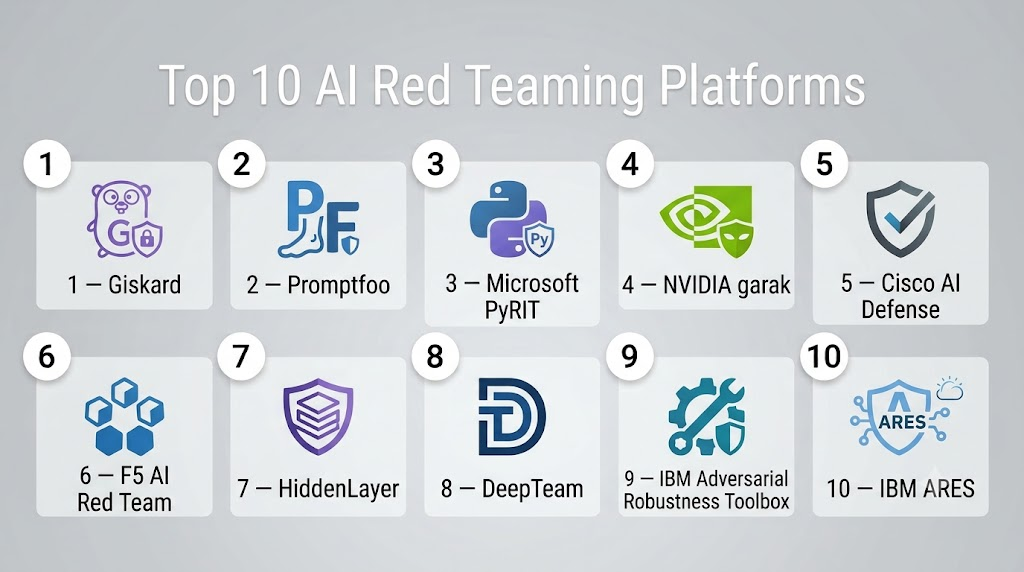
Top 10 AI Red Teaming Platforms
1 — Giskard
One-line verdict: Best for organizations that need collaborative AI evaluation, automated scanning, and continuous red teaming.
Short description:
Giskard provides tools for testing generative AI applications, agents, and machine learning systems. It combines automated vulnerability scanning, evaluation datasets, team collaboration, and continuous testing capabilities.
Standout Capabilities
- Automated red teaming for LLM applications and agents
- Continuous testing across model and application changes
- Test generation for safety, security, and reliability risks
- Collaborative interface for technical and nontechnical reviewers
- Custom evaluation datasets and business-specific tests
- Support for RAG and knowledge-based applications
- Regression testing for previously discovered failures
- Enterprise-oriented reporting and governance workflows
AI-Specific Depth
- Model support: Supports multiple hosted models, private endpoints, and custom application interfaces
- RAG / knowledge integration: Supports testing RAG applications, retrieved contexts, and knowledge-based agents
- Evaluation: Automated scans, test suites, regression tests, custom metrics, and human review
- Guardrails: Tests jailbreak resistance, prompt injection, harmful outputs, and policy failures
- Observability: Test histories, result tracking, vulnerability evidence, and comparative evaluation
Pros
- Combines red teaming with broader AI quality evaluation
- Accessible to engineering, governance, and business teams
- Strong fit for continuous testing and regression management
Cons
- Enterprise features may require commercial licensing
- Advanced configurations require AI evaluation expertise
- Automated findings still require manual validation
Security & Compliance
Enterprise security controls may include authentication, team permissions, project management, and deployment controls. Exact availability depends on the selected edition.
Certifications: Not publicly stated.
Deployment & Platforms
- Web interface and Python SDK
- Cloud and enterprise deployment options
- Self-hosted availability may vary by plan
- Windows, macOS, and Linux development environments
Integrations & Ecosystem
Giskard is designed to work with common LLM application stacks, model providers, custom APIs, and evaluation workflows.
- Python SDK
- REST-based application interfaces
- Hosted model providers
- Open-source model endpoints
- RAG pipelines
- CI/CD workflows
- Custom evaluators
Pricing Model
Open-source components may be available, while collaboration, continuous testing, governance, and enterprise capabilities generally use commercial plans. Exact pricing is not publicly stated.
Best-Fit Scenarios
- Continuously testing customer-facing AI agents
- Evaluating RAG applications before production
- Coordinating security, engineering, and governance reviews
2 — Promptfoo
One-line verdict: Best for developer teams seeking flexible, code-first red teaming and evaluation in CI/CD pipelines.
Short description:
Promptfoo is an open-source testing and red teaming framework for generative AI applications. It allows developers to define adversarial tests, compare model responses, test custom endpoints, and automate security checks during development.
Standout Capabilities
- Code-first configuration using version-controlled files
- Extensive vulnerability and attack plugin system
- Testing for agents, RAG systems, APIs, and chat interfaces
- Multi-turn and adaptive attack strategies
- Multimodal red teaming support
- Custom policies, graders, assertions, and attack goals
- Local execution and CI/CD integration
- Broad model-provider compatibility
AI-Specific Depth
- Model support: Hosted APIs, local models, open-source models, custom HTTP endpoints, and BYO providers
- RAG / knowledge integration: RAG poisoning, retrieval manipulation, indirect injection, and access-control testing
- Evaluation: Assertions, model-based grading, custom evaluators, regression suites, and comparative testing
- Guardrails: Tests jailbreaks, injection, policy bypass, unsafe output, and authorization failures
- Observability: Test results, latency, token usage, failure evidence, and comparative reports
Pros
- Highly flexible and developer-friendly
- Works well in automated software delivery pipelines
- Supports local testing and custom application interfaces
Cons
- Configuration can become complex at scale
- Governance workflows are less turnkey than enterprise platforms
- Results may require careful calibration to reduce false positives
Security & Compliance
Local execution can help teams control sensitive test data. Enterprise administration, authentication, and managed collaboration depend on the selected deployment.
Certifications: Not publicly stated.
Deployment & Platforms
- Command-line interface and browser-based reports
- Windows, macOS, and Linux
- Local, self-hosted, cloud, and hybrid workflows
- Containerized deployment may be supported through standard development practices
Integrations & Ecosystem
Promptfoo integrates with numerous hosted providers, local inference systems, application APIs, and CI/CD platforms.
- JavaScript and Python applications
- HTTP APIs
- Hosted LLM providers
- Local model runtimes
- Git-based workflows
- CI/CD pipelines
- Custom providers and graders
Pricing Model
Open-source core with commercial and enterprise offerings. Commercial pricing is not publicly stated.
Best-Fit Scenarios
- Adding LLM security tests to CI/CD
- Comparing guardrails across several models
- Testing custom agents, APIs, and RAG pipelines
3 — Microsoft PyRIT
One-line verdict: Best for security researchers building customized, repeatable, and human-guided AI attack campaigns.
Short description:
PyRIT is Microsoft’s open-source Python framework for identifying security and safety risks in generative AI systems. It helps red teams orchestrate attacks, transform prompts, score responses, store evidence, and reuse adversarial workflows.
Standout Capabilities
- Modular architecture for complex attack orchestration
- Multi-turn adversarial conversations
- Prompt transformations and attack converters
- Reusable datasets and attack templates
- Configurable scoring engines
- Memory system for experiment evidence
- Support for human-guided and automated campaigns
- Extensibility for emerging models and modalities
AI-Specific Depth
- Model support: Model-agnostic architecture with hosted, local, and custom targets
- RAG / knowledge integration: Possible through custom target and application integrations
- Evaluation: Automated scorers, custom classifiers, human review, and campaign evidence
- Guardrails: Designed to test jailbreaks, harmful content, prompt transformations, and policy bypass
- Observability: Stores prompts, responses, scores, attack paths, and experiment metadata
Pros
- Strong flexibility for specialist red teams
- Well suited to complex, adaptive attack research
- Open-source and extensible
Cons
- Requires Python and security expertise
- Not a complete turnkey governance platform
- Setup and reporting require more engineering than managed products
Security & Compliance
Security depends largely on how the framework, database, model endpoints, and surrounding infrastructure are deployed.
Certifications: N/A for the open-source framework.
Deployment & Platforms
- Python framework
- Scanner, framework, and graphical workflow options
- Windows, macOS, and Linux
- Self-hosted and custom cloud environments
Integrations & Ecosystem
PyRIT uses modular targets, scorers, prompt converters, datasets, and storage components.
- Python APIs
- Hosted LLM endpoints
- Local model services
- Custom target adapters
- Custom scoring systems
- Security research workflows
- Internal model gateways
Pricing Model
Open-source. Infrastructure, model usage, engineering, and managed deployment costs vary.
Best-Fit Scenarios
- Internal AI security research
- Customized multi-turn attack development
- Red teaming proprietary models and applications
4 — NVIDIA garak
One-line verdict: Best for technical teams needing an open-source vulnerability scanner for many generative AI models.
Short description:
Garak is an open-source vulnerability scanner for generative AI systems. It probes models for hallucination, data leakage, prompt injection, jailbreaks, misinformation, toxicity, and other undesirable behaviors.
Standout Capabilities
- Broad library of adversarial probes
- Vulnerability detectors aligned with probe categories
- Compatibility with multiple model families and endpoints
- Detailed machine-readable execution logs
- Batch scanning from the command line
- Extensible probes, generators, and detectors
- Useful for baseline model comparisons
- Integration with NVIDIA’s broader AI security ecosystem
AI-Specific Depth
- Model support: Hosted providers, open-source models, local systems, and custom generators
- RAG / knowledge integration: Limited native workflow coverage compared with application-focused tools
- Evaluation: Probe-based tests, detectors, result analysis, and repeatable scans
- Guardrails: Tests injection, jailbreaks, leakage, toxicity, harmful generation, and encoding bypasses
- Observability: Structured logs, probe results, detector outcomes, and analysis reports
Pros
- Open-source and actively extensible
- Strong vulnerability scanning coverage
- Useful for technical benchmarking and baseline testing
Cons
- Primarily command-line and engineering-focused
- Application and business-process testing may require customization
- Enterprise governance features are limited in the standalone project
Security & Compliance
Security is controlled by the environment in which the scanner runs and the model endpoints it accesses.
Certifications: N/A for the open-source project.
Deployment & Platforms
- Python command-line tool
- Windows support may vary by environment
- macOS and Linux
- Self-hosted, local, and cloud-based execution
Integrations & Ecosystem
Garak connects to multiple model generators and supports extensible testing components.
- Hosted model APIs
- Local inference servers
- Open-source model families
- Custom generators
- Custom probes
- Custom detectors
- NVIDIA AI tooling
Pricing Model
Open-source. Users pay for infrastructure, model calls, and engineering resources.
Best-Fit Scenarios
- Scanning open-source models before adoption
- Comparing model vulnerability profiles
- Building an internal automated security-testing toolkit
5 — Cisco AI Defense
One-line verdict: Best for enterprises seeking integrated AI validation, runtime controls, discovery, and security governance.
Short description:
Cisco AI Defense provides AI model and application validation alongside runtime protection and broader AI security controls. Its validation capabilities use automated red teaming to identify security, privacy, and safety vulnerabilities.
Standout Capabilities
- Automated model, application, and agent validation
- Large library of security and safety attack techniques
- Testing for prompt injection and privacy risks
- Agent and tool-use security validation
- Centralized vulnerability reporting
- Runtime guardrails and policy enforcement
- AI asset discovery and supply-chain visibility
- Enterprise security ecosystem integration
AI-Specific Depth
- Model support: Multiple enterprise model providers, applications, agents, and custom endpoints
- RAG / knowledge integration: Supports validation of AI applications and connected workflows
- Evaluation: Automated validation jobs, vulnerability analysis, and structured reporting
- Guardrails: Runtime policies, prompt-injection defenses, safety checks, and agent controls
- Observability: Central event visibility, validation results, policy events, and application monitoring
Pros
- Combines predeployment testing with runtime protection
- Strong enterprise administration and security integration
- Suitable for large AI portfolios and agentic systems
Cons
- May be more platform than smaller teams require
- Commercial licensing can be substantial
- Best value may depend on adoption of the wider Cisco ecosystem
Security & Compliance
Enterprise capabilities may include centralized administration, identity integration, policy management, APIs, and security event visibility.
Specific certifications and residency options vary by service and contract. Buyers should verify them directly.
Deployment & Platforms
- Web-based enterprise platform
- Cloud and hybrid enterprise environments
- API-based management
- Endpoint and deployment details vary by product edition
Integrations & Ecosystem
Cisco AI Defense is designed to connect AI validation, runtime enforcement, application discovery, and enterprise security operations.
- Management APIs
- Enterprise identity systems
- Security operations workflows
- Model and application endpoints
- Cloud AI services
- Agent and MCP environments
- Cisco security products
Pricing Model
Commercial enterprise pricing. Exact prices are not publicly stated.
Best-Fit Scenarios
- Securing a large enterprise AI portfolio
- Validating agents before production rollout
- Combining red teaming with runtime enforcement
6 — F5 AI Red Team
One-line verdict: Best for enterprises requiring adaptive adversarial testing connected to production-grade AI guardrails.
Short description:
F5 AI Red Team provides automated adversarial testing for AI models, applications, and agents. It focuses on simulating real-world attacks, identifying weaknesses, and helping organizations connect findings to defensive controls.
Standout Capabilities
- Agent-powered adversarial testing
- Adaptive and multi-step attack simulations
- Large and continuously updated attack library
- Testing for models, applications, and autonomous agents
- Security, safety, and privacy risk coverage
- Risk prioritization and remediation insights
- Integration with runtime guardrails
- Enterprise observability and governance options
AI-Specific Depth
- Model support: Multi-model and application-focused testing
- RAG / knowledge integration: Supports connected AI applications and knowledge workflows
- Evaluation: Automated attack campaigns, resilience analysis, and comparative results
- Guardrails: Integrates with real-time AI guardrail capabilities
- Observability: Risk dashboards, attack evidence, policy insights, and operational visibility
Pros
- Strong focus on adaptive adversarial behavior
- Connects testing with runtime defense
- Suitable for high-risk enterprise AI deployments
Cons
- Commercial product with nonpublic pricing
- May require specialist onboarding
- Smaller teams may not need the complete platform
Security & Compliance
Enterprise security and administrative controls are available, but exact SSO, retention, residency, and certification details should be verified during procurement.
Certifications: Not publicly stated.
Deployment & Platforms
- Web-based enterprise platform
- Cloud, private, and hybrid options may vary
- Application and model integration through supported interfaces
- Exact endpoint requirements vary by deployment
Integrations & Ecosystem
F5 AI Red Team is positioned within a wider AI security platform covering testing, guardrails, observability, and application protection.
- Model endpoints
- AI applications
- Agent workflows
- Runtime guardrails
- Enterprise observability
- Security operations
- Custom policy workflows
Pricing Model
Commercial enterprise pricing. Exact pricing is not publicly stated.
Best-Fit Scenarios
- Testing high-risk generative AI applications
- Connecting red-team findings to runtime controls
- Assessing adaptive attacks against autonomous agents
7 — HiddenLayer
One-line verdict: Best for security teams needing AI discovery, attack simulation, model scanning, and runtime protection.
Short description:
HiddenLayer offers a broad AI security platform that includes automated red teaming, attack simulation, model scanning, supply-chain security, guardrails, discovery, and runtime defense.
Standout Capabilities
- Automated adversarial testing
- Model and application attack simulation
- Agentic and MCP security coverage
- AI asset discovery
- Model supply-chain scanning
- Runtime threat detection
- Guardrail enforcement
- Security-focused remediation and reporting
AI-Specific Depth
- Model support: Models, applications, agents, machine learning systems, and enterprise AI assets
- RAG / knowledge integration: Application-level testing may cover retrieval and connected-data risks
- Evaluation: Automated security tests and vulnerability assessments
- Guardrails: Prompt injection, data leakage, unsafe behavior, and policy enforcement
- Observability: AI inventory, security findings, runtime events, and risk dashboards
Pros
- Broad coverage across the AI security lifecycle
- Strong orientation toward security operations teams
- Suitable for regulated and high-risk deployments
Cons
- Broader platform may require significant implementation planning
- Exact feature availability depends on product modules
- Pricing is not publicly stated
Security & Compliance
Enterprise administration, deployment controls, and security operations integration may be available.
Certifications, residency, and retention details should be verified for the chosen deployment.
Deployment & Platforms
- Web-based enterprise platform
- Cloud and enterprise deployment models
- Hybrid options may vary
- Exact endpoint and agent requirements are not publicly stated
Integrations & Ecosystem
HiddenLayer connects red teaming with model scanning, asset discovery, guardrails, supply-chain security, and runtime monitoring.
- AI model environments
- Cloud infrastructure
- AI development pipelines
- Security operations platforms
- Agentic systems
- Model registries
- Enterprise data platforms
Pricing Model
Commercial enterprise pricing. Exact prices are not publicly stated.
Best-Fit Scenarios
- Securing AI across development and production
- Discovering and testing shadow AI assets
- Protecting high-risk financial or public-sector AI systems
8 — DeepTeam
One-line verdict: Best for developers seeking an open-source framework dedicated to automated LLM red teaming.
Short description:
DeepTeam is an open-source red teaming framework designed for LLM applications. It supports configurable vulnerabilities, attack methods, custom models, declarative testing, and repeatable command-line workflows.
Standout Capabilities
- Dedicated LLM vulnerability framework
- Plug-and-play vulnerability definitions
- Multiple attack and jailbreaking methods
- YAML-based configuration
- Version-controlled testing campaigns
- Custom model and target support
- Command-line automation
- Integration with broader evaluation workflows
AI-Specific Depth
- Model support: Hosted providers, custom models, and application interfaces
- RAG / knowledge integration: Can be adapted to test RAG targets and custom applications
- Evaluation: Automated vulnerability metrics and model-based evaluation
- Guardrails: Tests jailbreaks, prompt injection, harmful behavior, and other LLM risks
- Observability: Test outputs, vulnerability scores, attack results, and configurable reports
Pros
- Open-source and focused specifically on red teaming
- Reproducible configuration for engineering workflows
- Supports custom attack and vulnerability definitions
Cons
- Requires development and evaluation expertise
- Enterprise governance features are limited
- Ecosystem maturity may be lower than older frameworks
Security & Compliance
Security depends on local configuration, chosen model providers, storage, and deployment infrastructure.
Certifications: N/A for the open-source framework.
Deployment & Platforms
- Python and command-line workflows
- Windows, macOS, and Linux
- Local and self-hosted execution
- Cloud execution through user-managed infrastructure
Integrations & Ecosystem
DeepTeam works with custom model classes, target applications, configuration files, and evaluation tooling.
- Python applications
- Custom LLM interfaces
- Hosted model APIs
- Local models
- YAML configurations
- CI/CD systems
- DeepEval-compatible workflows
Pricing Model
Open-source. Model usage, infrastructure, support, and implementation costs vary.
Best-Fit Scenarios
- Building repeatable LLM red-team campaigns
- Testing custom vulnerabilities in CI/CD
- Comparing attack resilience across models
9 — IBM Adversarial Robustness Toolbox
One-line verdict: Best for researchers testing adversarial robustness across traditional machine learning and deep-learning systems.
Short description:
The Adversarial Robustness Toolbox is an open-source library for evaluating and improving machine learning security. It supports adversarial attacks and defenses across image, text, tabular, audio, and other model types.
Standout Capabilities
- Broad adversarial machine learning coverage
- Evasion, poisoning, extraction, and inference attacks
- Defense and robustness testing
- Support for numerous machine learning frameworks
- Research-oriented attack implementations
- Multimodal model coverage
- Red-team and blue-team experimentation
- Open-source extensibility
AI-Specific Depth
- Model support: Open-source and custom machine learning models across major frameworks
- RAG / knowledge integration: N/A
- Evaluation: Robustness testing, adversarial attacks, defenses, and model analysis
- Guardrails: Focuses on model robustness rather than generative AI policy guardrails
- Observability: Experimental results and attack metrics through code-based workflows
Pros
- Deep coverage of adversarial machine learning
- Supports more than only generative AI systems
- Strong fit for research and custom model development
Cons
- Less focused on modern LLM application workflows
- Requires machine learning security expertise
- Limited turnkey collaboration and governance features
Security & Compliance
Security is controlled by the user’s infrastructure and implementation.
Certifications: N/A for the open-source project.
Deployment & Platforms
- Python library
- Windows, macOS, and Linux
- Local, self-hosted, research-cloud, and custom environments
Integrations & Ecosystem
The toolkit supports common machine learning libraries, custom estimators, notebooks, and research pipelines.
- PyTorch
- TensorFlow
- Scikit-learn
- XGBoost
- LightGBM
- Keras
- Custom model implementations
Pricing Model
Open-source. Infrastructure and engineering costs vary.
Best-Fit Scenarios
- Testing computer-vision model robustness
- Evaluating poisoning and extraction threats
- Conducting adversarial machine learning research
10 — IBM ARES
One-line verdict: Best for research teams building modular automated red-team workflows for custom AI systems.
Short description:
ARES is an IBM Research framework for automated red teaming of AI systems. It provides modular components that help researchers and developers create adversarial scenarios and evaluate application robustness.
Standout Capabilities
- Automated red-team workflow support
- Modular and extensible architecture
- Custom adversarial scenario development
- Application-level robustness evaluation
- Research-oriented experimentation
- Flexible target integration
- Repeatable testing workflows
- Support for custom attack components
AI-Specific Depth
- Model support: Custom models and AI application targets
- RAG / knowledge integration: Varies according to user implementation
- Evaluation: Automated scenarios, configurable evaluators, and robustness analysis
- Guardrails: Tests defenses configured around the target system
- Observability: Experiment outputs and implementation-defined metrics
Pros
- Open-source and adaptable
- Useful for experimental red-team research
- Supports custom AI system assessment
Cons
- Smaller ecosystem than major red-team frameworks
- Requires engineering work to operationalize
- Limited turnkey enterprise governance
Security & Compliance
Security depends on user-managed infrastructure, endpoints, storage, and model providers.
Certifications: N/A for the open-source framework.
Deployment & Platforms
- Python-based framework
- Windows, macOS, and Linux compatibility may depend on dependencies
- Self-hosted and user-managed cloud environments
Integrations & Ecosystem
ARES is intended for custom research and engineering environments.
- Python workflows
- Custom model targets
- Research notebooks
- User-defined attack modules
- Custom evaluators
- Internal AI services
- Experimental pipelines
Pricing Model
Open-source. Deployment, model usage, and engineering costs vary.
Best-Fit Scenarios
- Researching automated adversarial testing
- Building organization-specific attack simulations
- Evaluating custom AI systems that do not fit standard scanners
Comparison Table
| Tool Name | Best For | Deployment | Model Flexibility | Strength | Watch-Out | Public Rating |
|---|---|---|---|---|---|---|
| Giskard | Collaborative AI testing | Cloud, self-hosted, hybrid options | BYO and multi-model | Continuous evaluation | Enterprise features vary | N/A |
| Promptfoo | Developer-led security testing | Local, cloud, self-hosted | Hosted, BYO, open-source | CI/CD flexibility | Configuration complexity | N/A |
| Microsoft PyRIT | Specialist red teams | Self-hosted, custom cloud | BYO and multi-model | Attack orchestration | Requires expertise | N/A |
| NVIDIA garak | Model vulnerability scanning | Local and self-hosted | Hosted and open-source | Broad probe library | Limited governance | N/A |
| Cisco AI Defense | Large enterprises | Cloud and hybrid | Multi-model | Integrated AI security | Enterprise complexity | N/A |
| F5 AI Red Team | Adaptive enterprise testing | Cloud, private, hybrid options | Multi-model | Agentic attack testing | Nonpublic pricing | N/A |
| HiddenLayer | Full-lifecycle AI security | Cloud and hybrid options | Multi-model | Broad security coverage | Module complexity | N/A |
| DeepTeam | Open-source LLM testing | Local and self-hosted | BYO and multi-model | LLM-focused automation | Smaller ecosystem | N/A |
| IBM ART | Adversarial ML research | Self-hosted | Open-source and custom | Deep ML robustness | Less LLM-focused | N/A |
| IBM ARES | Custom research workflows | Self-hosted | Custom and BYO | Modular experimentation | Engineering required | N/A |
Scoring & Evaluation
The following scores are comparative estimates based on product scope, usability, extensibility, security testing depth, deployment flexibility, and suitability for production workflows. They are not independent laboratory benchmarks or guarantees of performance.
A high score does not mean a tool is universally better. Open-source frameworks may score strongly for flexibility while requiring more engineering. Enterprise platforms may provide stronger governance and support while carrying higher cost and implementation complexity.
Organizations should validate these scores through a proof of concept using their own models, agents, datasets, guardrails, and threat scenarios.
| Tool | Core | Reliability/Eval | Guardrails | Integrations | Ease | Perf/Cost | Security/Admin | Support | Weighted Total |
|---|---|---|---|---|---|---|---|---|---|
| Giskard | 9 | 9 | 8 | 8 | 8 | 8 | 8 | 8 | 8.40 |
| Promptfoo | 9 | 9 | 9 | 9 | 8 | 8 | 7 | 8 | 8.50 |
| Microsoft PyRIT | 9 | 8 | 9 | 8 | 6 | 7 | 6 | 8 | 7.70 |
| NVIDIA garak | 8 | 8 | 8 | 7 | 7 | 9 | 5 | 8 | 7.55 |
| Cisco AI Defense | 9 | 9 | 9 | 9 | 8 | 7 | 10 | 9 | 8.70 |
| F5 AI Red Team | 9 | 8 | 10 | 8 | 8 | 7 | 9 | 8 | 8.35 |
| HiddenLayer | 9 | 8 | 9 | 8 | 7 | 7 | 9 | 8 | 8.10 |
| DeepTeam | 8 | 8 | 9 | 7 | 7 | 9 | 5 | 7 | 7.50 |
| IBM ART | 8 | 8 | 7 | 8 | 5 | 8 | 5 | 8 | 7.20 |
| IBM ARES | 7 | 7 | 7 | 6 | 5 | 8 | 5 | 6 | 6.45 |
which AI Red Teaming Platform Is Right for You?
Solo / Freelancer
Independent developers should begin with Promptfoo, garak, or DeepTeam. These tools provide meaningful security-testing capabilities without requiring a large commercial contract.
Promptfoo is a strong choice for testing custom APIs, prompts, agents, and RAG systems. Garak is useful for scanning model-level vulnerabilities. DeepTeam is suitable for developers who prefer a dedicated LLM red-team framework.
Keep the initial scope small. Test the most dangerous workflows first, including sensitive-data access, external tool execution, account actions, and uploaded content.
SMB
Small and medium-sized businesses need a balance between coverage and operational simplicity. Giskard and Promptfoo are strong candidates because they support evaluation, regression testing, and integration with development workflows.
An SMB should prioritize:
- Easy onboarding
- Automated regression testing
- Custom business policies
- Clear remediation evidence
- Controlled model usage costs
- Exportable reports
- Private testing options
A lightweight open-source framework can work well when an internal engineering team can maintain it. Organizations without security specialists may benefit from a managed platform or external assessment service.
Mid-Market
Mid-market organizations often operate several AI applications across different teams. They should prioritize centralized test management, reusable policy packs, consistent risk classification, ownership, and production release gates.
Giskard, HiddenLayer, Cisco AI Defense, and F5 AI Red Team may be suitable depending on budget and security requirements. Promptfoo can also remain part of the developer workflow even when a commercial governance layer is added.
The strongest architecture may combine code-level testing with centralized governance rather than forcing every team into one interface.
Enterprise
Enterprises should evaluate Cisco AI Defense, F5 AI Red Team, HiddenLayer, and Giskard. The selection should depend on existing security architecture, deployment requirements, AI inventory size, regulatory exposure, and runtime protection needs.
Enterprise buyers should require:
- SSO and lifecycle management
- Granular RBAC
- Audit logs
- Project and tenant isolation
- Data-retention controls
- Private connectivity
- Risk acceptance workflows
- Executive and technical reports
- APIs for security automation
- Support for agents and multimodal applications
No platform should be selected using demonstration results alone. The proof of concept must include real applications, sensitive workflows, custom policies, and representative data.
Regulated Industries
Finance, healthcare, insurance, government, education, and critical infrastructure organizations should prioritize private deployment, auditability, role separation, evidence retention, data residency, and policy mapping.
Commercial platforms may provide stronger administrative capabilities, but buyers must verify security claims contractually. A certificate or infrastructure audit does not prove that an AI application is resistant to prompt injection, data leakage, or unsafe tool use.
Regulated organizations should combine automated red teaming with human-led assessment, legal review, privacy testing, and formal risk acceptance.
Budget vs Premium
Open-source platforms reduce licensing costs but do not eliminate total cost. Teams still need security expertise, model usage, infrastructure, maintenance, reporting, and remediation capacity.
Premium platforms may provide:
- Managed attack libraries
- Continuous updates
- Collaboration
- Governance
- Executive reporting
- Support
- Runtime protection
- Deployment assistance
Choose open source when customization and engineering control matter most. Choose a premium platform when auditability, administration, support, and time to operational maturity are more important.
Build vs Buy
Build an internal solution when the organization has a skilled AI security team, unusual threat models, proprietary infrastructure, and the capacity to maintain attack libraries and evaluation systems.
Buy a platform when the organization needs standardized workflows, rapid deployment, enterprise controls, vendor support, and continuous threat updates.
A hybrid approach is often strongest. Open-source tools can run close to development, while an enterprise platform provides centralized governance, reporting, and production monitoring.
Implementation Playbook
First 30 Days: Pilot and Success Metrics
- Select one high-value AI application for the pilot.
- Create a system diagram covering models, prompts, RAG sources, tools, memory, users, and external APIs.
- Define threat actors and realistic misuse scenarios.
- Establish a baseline test dataset.
- Test prompt injection, jailbreaks, sensitive-data leakage, hallucination, authorization, and harmful output.
- Record prompt, model, application, and guardrail versions.
- Define severity levels and remediation owners.
- Measure attack success rate, reproducibility, false positives, latency, and test cost.
- Run both automated and human-led tests.
- Choose success criteria for moving into broader rollout.
First 60 Days: Harden Security and Expand Testing
- Integrate red-team tests into CI/CD.
- Create release gates for critical vulnerabilities.
- Add regression tests for every confirmed issue.
- Test RAG ingestion, retrieval, document permissions, and indirect prompt injection.
- Test agent tools for unauthorized actions and privilege escalation.
- Review model-provider retention and training policies.
- Implement identity, access control, and audit logging.
- Add human approval for high-impact actions.
- Create incident-handling procedures for AI failures.
- Train engineering, security, governance, and product teams on result interpretation.
First 90 Days: Optimize and Scale
- Expand testing to additional AI applications.
- Build reusable attack and policy libraries.
- Automate scheduled and event-triggered testing.
- Monitor token consumption, concurrency, and model cost.
- Compare low-cost attacker models with more capable models.
- Tune evaluators to reduce false positives and false negatives.
- Connect findings to issue-tracking and security operations.
- Define governance metrics for leadership.
- Establish recurring human red-team exercises.
- Review vendor risk for third-party AI agents and models.
- Create an exception and risk-acceptance process.
- Track remediation time and vulnerability recurrence.
Common Mistakes and How to Avoid Them
- Testing only the base model: Test the complete application, including prompts, retrieval, memory, tools, permissions, and business logic.
- Ignoring indirect prompt injection: Treat websites, emails, documents, images, and retrieved content as potentially hostile.
- Running red teaming only before launch: Repeat tests after every meaningful model, prompt, data, guardrail, or workflow change.
- Using generic attacks only: Add company-specific policies, sensitive-data scenarios, and realistic user goals.
- Treating automated scores as unquestionable: Manually review high-impact findings and calibrate model-based evaluators.
- Failing to preserve evidence: Store prompts, responses, model versions, configuration, timestamps, and attack paths.
- Ignoring data retention: Confirm where test prompts and responses are stored and whether vendors use them for training.
- No prompt or version control: Track system prompts, templates, models, retrieval indexes, and guardrail versions.
- Overlooking agent permissions: Test what the agent can read, change, send, purchase, delete, or execute.
- No cost controls: Set budgets, sample sizes, concurrency limits, caching, and stopping conditions.
- Lack of observability: Capture tool calls, retrieval results, intermediate decisions, latency, tokens, and policy events.
- Over-automation without human review: Keep approval steps for financial, legal, medical, security, and irreversible actions.
- Ignoring multilingual attacks: Test languages and cultural contexts relevant to actual users.
- Accepting vendor lock-in: Keep portable datasets, custom policies, test cases, and risk taxonomies whenever possible.
FAQs
1. What is an AI red teaming platform?
An AI red teaming platform intentionally tests AI systems using adversarial prompts, harmful scenarios, manipulation techniques, and simulated attacks. Its purpose is to identify security, safety, privacy, and reliability weaknesses before real users or attackers find them.
2. Is AI red teaming the same as penetration testing?
No. Traditional penetration testing focuses mainly on infrastructure, applications, identities, APIs, and networks. AI red teaming also examines model behavior, prompt injection, retrieval manipulation, data leakage, hallucinations, unsafe content, and autonomous tool use.
3. Can AI red teaming prevent every jailbreak?
No platform can guarantee complete protection. Attack methods and model behavior continuously change. Red teaming helps organizations discover weaknesses, improve defenses, measure progress, and reduce risk, but it must be combined with secure architecture and monitoring.
4. Do these platforms use customer data for model training?
Policies vary by vendor, product, deployment, and model provider. Buyers should verify retention, training use, subprocessors, data location, deletion, logging, and private-connectivity terms before sending sensitive information.
5. Can AI red teaming run completely on-premises?
Several open-source frameworks can run in self-managed environments. However, tests may still send data externally when hosted models or external evaluator models are used. Every network path and provider should be reviewed.
6. Do these tools support bring-your-own models?
Many developer-oriented platforms support custom endpoints, local models, and hosted providers. Enterprise platforms may support approved providers and private endpoints. Exact compatibility should be tested during a proof of concept.
7. Can red teaming test RAG applications?
Yes. Modern tools can test prompt injection through documents, context poisoning, sensitive-data retrieval, permission failures, source manipulation, hallucination, and incorrect grounding. RAG testing should include ingestion and retrieval stages.
8. Can these platforms test AI agents?
Several leading tools support agents, tool calls, multi-step attacks, memory, and connected workflows. Buyers should verify that testing covers the complete action path rather than only the final text response.
9. How much does AI red teaming cost?
Costs may include platform licensing, model tokens, attacker models, evaluator models, infrastructure, security expertise, and remediation. Open-source software reduces licensing cost but may increase engineering and maintenance effort.
10. How often should AI systems be red teamed?
High-risk systems should be tested continuously or after meaningful changes. A deeper human-led assessment should also be conducted periodically and before major releases, new integrations, or expanded permissions.
11. Are guardrails enough without red teaming?
No. Guardrails must be tested against realistic attacks. Red teaming measures whether guardrails can be bypassed, whether they block legitimate requests, and whether attackers can route around them through retrieval, tools, or application logic.
12. How are vulnerabilities evaluated?
Platforms may use rules, classifiers, model-based judges, custom code, human review, or combinations of these methods. Strong programs validate automated findings manually and track reproducibility, severity, and business impact.
13. Can organizations switch red teaming tools later?
Yes, but migration is easier when tests, policies, datasets, prompts, and results use portable formats. Avoid storing all security knowledge in proprietary interfaces without export capabilities.
14. What are the alternatives to a commercial platform?
Alternatives include open-source frameworks, internal testing systems, security consulting engagements, manual red teams, bug bounty programs, evaluation libraries, and application-specific test harnesses.
15. Does a high red-team score mean an AI system is safe?
No. A score reflects the attacks, evaluators, datasets, model version, configuration, and environment used during testing. It does not prove safety against every future attack or deployment condition.
Conclusion
AI red teaming platforms are becoming a necessary part of responsible AI development because modern applications can retrieve private information, interact with tools, execute actions, and operate across complex business workflows. Traditional application security testing remains important, but it cannot fully measure model behavior, indirect prompt injection, jailbreak resistance, retrieval manipulation, or excessive agent permissions.
