Introduction
Adversarial robustness testing tools help teams understand how machine learning models behave when inputs are intentionally manipulated, corrupted, poisoned, or designed to reveal private information. Instead of measuring only normal test accuracy, these tools simulate hostile conditions that can cause a model to misclassify data, expose training information, reveal its internal behavior, or make unsafe decisions.
Adversarial testing is particularly important for computer vision, natural language processing, fraud detection, cybersecurity, healthcare, autonomous systems, biometric authentication, and financial risk applications. A model that performs well on a standard test dataset may still fail when an attacker introduces carefully calculated changes that are difficult for a human to notice.
Common use cases include testing image classifiers against perturbed images, evaluating NLP models using altered text, simulating data-poisoning attacks, measuring resistance to model extraction, and validating adversarial training techniques.
Buyers and engineering teams should evaluate attack coverage, supported frameworks, model access requirements, multimodal support, benchmarking, defense methods, scalability, documentation, reproducibility, and CI/CD compatibility.
Best for: machine learning engineers, AI security specialists, researchers, model-risk teams, red teams, data scientists, regulated enterprises, and organizations deploying models in security-sensitive environments.
Not ideal for: teams using low-risk models for simple internal analysis where model outputs do not affect users, finances, safety, privacy, or critical operations. Standard model evaluation may be sufficient for early experiments, although adversarial testing should be introduced before higher-risk deployment.
What’s Changed in Adversarial Robustness Testing
- Testing now covers more than image perturbations: Modern tools increasingly evaluate text, audio, video, tabular data, graph models, object detection, and generative applications.
- Threat models are becoming application-specific: Teams are moving beyond generic attacks and designing scenarios around fraud, identity theft, malware detection, autonomous systems, and business abuse.
- Black-box testing is gaining importance: Organizations often cannot access model gradients, parameters, or training code when using third-party models and APIs.
- Robustness testing is shifting into MLOps: Adversarial tests are increasingly treated as repeatable quality gates rather than one-time research experiments.
- Privacy attacks are part of robustness programs: Membership inference, attribute inference, model inversion, and data reconstruction are being evaluated alongside evasion attacks.
- Poisoning risks are receiving more attention: Teams are testing whether corrupted training data, malicious labels, backdoors, or compromised data pipelines can influence model behavior.
- Generative AI expands the attack surface: Prompt injection, jailbreaks, retrieval manipulation, unsafe tool calls, and sensitive-data extraction now complement traditional adversarial ML testing.
- Standardized benchmarks remain important: Frameworks such as RobustBench help reduce inconsistent evaluation and inflated robustness claims. (arXiv)
- Adaptive attacks are expected: A defense should be tested against attacks designed specifically to bypass it, not only against fixed attack configurations.
- Model supply-chain testing is growing: Teams must review pretrained models, datasets, checkpoints, serialization formats, dependencies, and third-party components.
- Certified robustness is developing: Some methods attempt to provide mathematical guarantees within a defined perturbation range, although these guarantees remain narrow and computationally demanding.
- Human review remains necessary: Automated attack success rates do not always represent realistic business impact, so expert validation is still required.
Quick Buyer Checklist
- Identify whether you need image, text, audio, tabular, graph, object-detection, or multimodal testing.
- Confirm support for your frameworks, including PyTorch, TensorFlow, Keras, JAX, Scikit-learn, or custom APIs.
- Check whether the tool supports white-box, grey-box, and black-box attacks.
- Review coverage for evasion, poisoning, extraction, inference, backdoors, and data reconstruction.
- Determine whether attacks can target classifiers, detectors, generators, transformers, and custom models.
- Look for standardized metrics such as robust accuracy, attack success rate, perturbation size, query count, and confidence change.
- Confirm whether experiments are reproducible through configuration files, random seeds, and versioned datasets.
- Evaluate GPU support, batching, distributed execution, and query-budget controls.
- Check whether custom attacks, defenses, estimators, and metrics can be added.
- Determine whether the tool supports adversarial training and defense evaluation.
- Review CI/CD and MLOps integration options.
- Check whether results can be exported for governance, audits, and remediation tracking.
- Evaluate project maintenance, documentation, examples, and community activity.
- Avoid relying on a single attack or benchmark to declare a model robust.
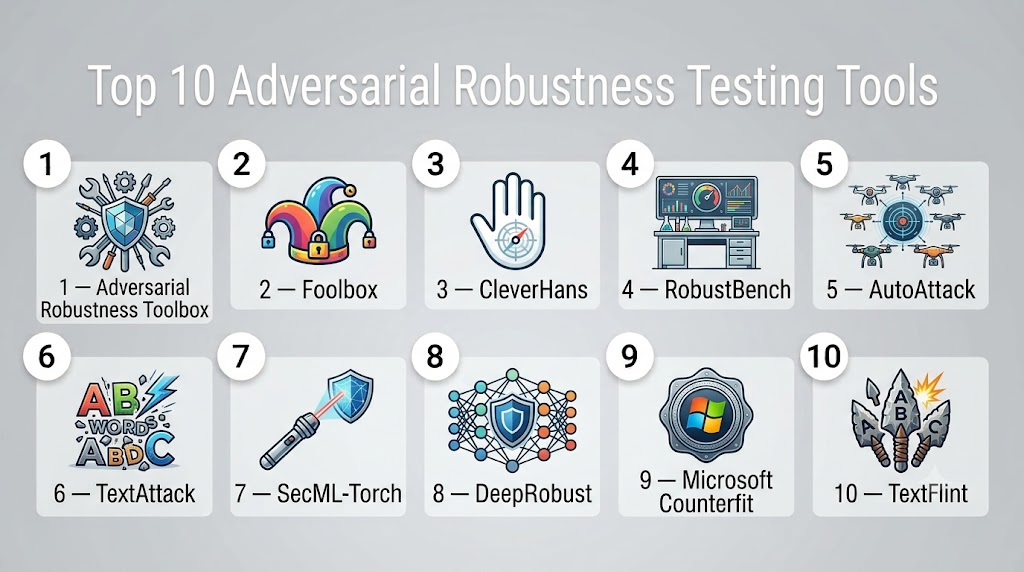
Top 10 Adversarial Robustness Testing Tools
1 — Adversarial Robustness Toolbox
One-line verdict: Best for comprehensive adversarial testing across multiple model frameworks, data types, attacks, and defenses.
Short description:
Adversarial Robustness Toolbox is an open-source Python library for evaluating and improving machine learning security. It covers evasion, poisoning, model extraction, and inference attacks across a broad range of model types and machine learning frameworks. (IBM Research)
Standout Capabilities
- Extensive collection of adversarial attack implementations
- Coverage for evasion, poisoning, extraction, and inference
- Support for image, text, audio, tabular, and other data types
- Attack and defense evaluation within one framework
- Compatibility with several popular ML frameworks
- Adversarial training and preprocessing defenses
- Robustness metrics and certification methods
- Custom estimator and attack extensibility
AI-Specific Depth
- Model support: PyTorch, TensorFlow, Keras, Scikit-learn, XGBoost, LightGBM, custom models, and other supported estimators
- RAG / knowledge integration: N/A for traditional adversarial ML workflows
- Evaluation: Attack success, robust accuracy, privacy leakage, model extraction, and defense effectiveness
- Guardrails: Focuses on model defenses, preprocessing, detection, and adversarial training rather than LLM policy guardrails
- Observability: Experiment outputs, attack metrics, model predictions, perturbation measurements, and custom logging
Pros
- One of the broadest adversarial ML toolkits available
- Suitable for research and practical security testing
- Supports both offensive testing and defensive evaluation
Cons
- Large API surface can be difficult for beginners
- Advanced attacks require mathematical and ML security expertise
- Production reporting and governance require additional tooling
Security & Compliance
The library runs within user-controlled infrastructure, so access control, encryption, retention, audit logging, and environment security depend on the organization’s implementation.
Certifications: N/A for the open-source library.
Deployment & Platforms
- Python library
- Windows, macOS, and Linux
- Local, self-hosted, private-cloud, and user-managed cloud environments
- Notebook, script, container, and pipeline-based execution
Integrations & Ecosystem
The toolbox provides estimator abstractions that connect attacks and defenses to supported machine learning frameworks.
- PyTorch
- TensorFlow
- Keras
- Scikit-learn
- XGBoost
- LightGBM
- Custom Python estimators
Pricing Model
Open-source. Infrastructure, GPU usage, engineering, model access, and enterprise support costs vary.
Best-Fit Scenarios
- Building a comprehensive internal ML security laboratory
- Testing models against multiple adversarial threat categories
- Evaluating attack mitigation and adversarial training techniques
2 — Foolbox
One-line verdict: Best for researchers benchmarking image-model robustness with efficient attacks and framework-neutral interfaces.
Short description:
Foolbox is an open-source Python library designed to create adversarial examples and benchmark the robustness of machine learning models. It is particularly well suited to computer vision research and works with major deep-learning frameworks.
Standout Capabilities
- Wide selection of gradient-based and decision-based attacks
- Strong focus on image-classification robustness
- Unified interface across supported frameworks
- Batch-oriented attack execution
- Distance-based perturbation measurement
- White-box and black-box attack options
- Support for targeted and untargeted attacks
- Integration with EagerPy for framework abstraction
AI-Specific Depth
- Model support: PyTorch, TensorFlow, JAX, and compatible differentiable models
- RAG / knowledge integration: N/A
- Evaluation: Adversarial example generation, attack success, perturbation distance, and robust accuracy
- Guardrails: N/A for policy guardrails; focuses on model-level robustness
- Observability: Attack outputs, model predictions, distances, success indicators, and user-defined reporting
Pros
- Clean interface for comparing attacks across frameworks
- Strong collection of established adversarial attacks
- Effective for computer-vision robustness research
Cons
- Primarily focused on differentiable vision models
- Limited governance and production security workflows
- Requires users to design experiment tracking and reporting
Security & Compliance
Security and compliance depend on the environment in which Foolbox is deployed.
Certifications: N/A for the open-source project.
Deployment & Platforms
- Python library
- Windows, macOS, and Linux
- Local and self-hosted deployment
- User-managed cloud and GPU environments
Integrations & Ecosystem
Foolbox is commonly used in research notebooks, model-development projects, and reproducible robustness experiments.
- PyTorch
- TensorFlow
- JAX
- EagerPy
- NumPy-based workflows
- Jupyter notebooks
- Custom evaluation pipelines
Pricing Model
Open-source. Compute, storage, engineering, and model-training costs vary.
Best-Fit Scenarios
- Comparing attacks against image classifiers
- Measuring robustness across multiple deep-learning frameworks
- Conducting academic adversarial-example research
3 — CleverHans
One-line verdict: Best for researchers needing established adversarial attack implementations and reproducible deep-learning security experiments.
Short description:
CleverHans is an open-source adversarial machine learning library created to support research on attacks and defenses. It contains well-known techniques for generating adversarial examples and evaluating model vulnerability.
Standout Capabilities
- Implementations of established evasion attacks
- Research-friendly Python APIs
- Targeted and untargeted attack support
- Gradient-based adversarial example generation
- Compatibility with modern deep-learning workflows
- Useful reference implementations
- Suitable for educational experimentation
- Community-recognized adversarial ML project
AI-Specific Depth
- Model support: Primarily differentiable deep-learning models using supported framework integrations
- RAG / knowledge integration: N/A
- Evaluation: Adversarial accuracy, attack success, perturbation constraints, and custom metrics
- Guardrails: N/A for generative policy controls
- Observability: User-defined experiment logs, predictions, attack outputs, and perturbation measurements
Pros
- Established position in adversarial ML research
- Useful for learning core attack concepts
- Supports custom research experiments
Cons
- Narrower overall coverage than Adversarial Robustness Toolbox
- Enterprise administration and dashboards are not included
- Some workflows require adaptation for newer model architectures
Security & Compliance
Deployment, authentication, data protection, and experiment security are managed by the user.
Certifications: N/A for the open-source library.
Deployment & Platforms
- Python library
- Windows, macOS, and Linux
- Local, self-hosted, and user-managed cloud environments
Integrations & Ecosystem
CleverHans fits into Python-based deep-learning research and experimentation.
- TensorFlow-compatible workflows
- PyTorch-compatible components where supported
- JAX-compatible components where supported
- NumPy
- Jupyter notebooks
- Custom training loops
- Research pipelines
Pricing Model
Open-source. Infrastructure and implementation expenses vary.
Best-Fit Scenarios
- Teaching adversarial machine learning concepts
- Reproducing established attack research
- Testing differentiable classifiers against evasion attacks
4 — RobustBench
One-line verdict: Best for standardized comparison of image-classification defenses using established robustness benchmarks and model repositories.
Short description:
RobustBench is an open-source benchmarking initiative designed to provide consistent adversarial robustness evaluation. It includes standardized threat models, benchmark results, pretrained robust models, and evaluation workflows intended to reduce misleading robustness claims. (arXiv)
Standout Capabilities
- Standardized adversarial robustness benchmarks
- Curated leaderboard of robust models
- Pretrained model repository
- Evaluation using established threat models
- AutoAttack-based assessment
- Common-corruption benchmarking
- Reproducible model comparisons
- Research transparency and community evaluation
AI-Specific Depth
- Model support: Primarily supported image classifiers and pretrained robustness models
- RAG / knowledge integration: N/A
- Evaluation: Robust accuracy, clean accuracy, common corruption performance, and standardized attacks
- Guardrails: N/A
- Observability: Benchmark results, model metadata, attack outcomes, and comparative leaderboards
Pros
- Reduces inconsistency in robustness claims
- Makes model comparison easier
- Provides access to pretrained robust models
Cons
- Primarily focused on image classification
- Standard benchmarks may not represent every real-world threat
- Does not replace application-specific adaptive testing
Security & Compliance
The open-source library does not provide enterprise access control, audit management, or compliance administration.
Certifications: N/A.
Deployment & Platforms
- Python library and benchmark website
- Linux is commonly used for GPU experiments
- macOS and Windows support may depend on machine learning dependencies
- Local and self-hosted execution
Integrations & Ecosystem
RobustBench connects standardized evaluation with model loading and AutoAttack-based testing.
- PyTorch
- AutoAttack
- Supported image datasets
- Pretrained robust models
- Research notebooks
- Benchmark pipelines
- Custom analysis workflows
Pricing Model
Open-source. GPU, storage, model inference, and research costs vary.
Best-Fit Scenarios
- Comparing image-model defenses
- Validating published robustness claims
- Selecting pretrained robust models for research
5 — AutoAttack
One-line verdict: Best for dependable baseline robustness evaluation using an ensemble of complementary adversarial attacks.
Short description:
AutoAttack is an adversarial evaluation method that combines multiple parameter-light attacks into a standardized ensemble. It is frequently used to evaluate image classifiers and identify cases where individual attacks may overestimate model robustness.
Standout Capabilities
- Ensemble of complementary attacks
- Parameter-light evaluation process
- White-box and black-box components
- Strong baseline for robust accuracy
- Targeted and untargeted evaluation
- Integration with robustness benchmarks
- Designed to reduce attack configuration bias
- Suitable for evaluating adversarial defenses
AI-Specific Depth
- Model support: Differentiable image classifiers and supported PyTorch-compatible models
- RAG / knowledge integration: N/A
- Evaluation: Robust accuracy under an ensemble of attacks
- Guardrails: N/A
- Observability: Per-attack success, robust accuracy, perturbation constraints, and evaluation logs
Pros
- Strong standardized evaluation baseline
- Harder to misconfigure than many single attacks
- Widely recognized in adversarial robustness research
Cons
- Primarily designed for image-classification settings
- Can be computationally expensive
- Does not cover poisoning, extraction, or inference attacks
Security & Compliance
Security is determined by the user-managed execution environment.
Certifications: N/A.
Deployment & Platforms
- Python and PyTorch-based workflows
- Linux, macOS, and Windows where dependencies are supported
- Local, self-hosted, and cloud GPU environments
Integrations & Ecosystem
AutoAttack is often used with robustness benchmarks and custom PyTorch evaluation scripts.
- PyTorch
- RobustBench
- Image-classification models
- Research pipelines
- Custom datasets
- GPU environments
- Notebook workflows
Pricing Model
Open-source. Compute and engineering costs vary.
Best-Fit Scenarios
- Establishing a baseline robust-accuracy score
- Evaluating adversarially trained image models
- Checking whether a defense survives multiple attack types
6 — TextAttack
One-line verdict: Best for NLP teams testing text classifiers through adversarial transformations, augmentation, and attack recipes.
Short description:
TextAttack is an open-source Python framework for adversarial attacks, data augmentation, and model training in natural language processing. It provides attack recipes, transformation constraints, datasets, model wrappers, and evaluation components for testing text-model robustness. (GitHub)
Standout Capabilities
- Large collection of NLP attack recipes
- Word, character, and sentence-level transformations
- Semantic and grammatical constraints
- Support for adversarial data augmentation
- Model training with transformed examples
- Standard datasets and model wrappers
- Command-line and Python interfaces
- Custom attack recipe development
AI-Specific Depth
- Model support: NLP classifiers, transformer models, custom model wrappers, and supported hosted interfaces
- RAG / knowledge integration: Limited; custom implementations may test retrieval-dependent components
- Evaluation: Attack success, accuracy under attack, query counts, semantic similarity, and perturbation rates
- Guardrails: Tests model robustness to manipulated text rather than complete LLM policy guardrails
- Observability: Attack logs, changed words, model outputs, query usage, and aggregate success metrics
Pros
- Strong specialization in adversarial NLP
- Flexible attack-component architecture
- Useful for testing and adversarial data augmentation
Cons
- Many workflows focus on classification rather than complete generative applications
- Language-quality constraints require careful calibration
- Large transformer attacks can be computationally expensive
Security & Compliance
Local deployment allows organizations to control datasets and model endpoints. Broader security controls depend on the implementation.
Certifications: N/A.
Deployment & Platforms
- Python library and command-line interface
- Windows, macOS, and Linux
- Local, self-hosted, and cloud execution
Integrations & Ecosystem
TextAttack supports common NLP models, datasets, and transformer-based workflows.
- Hugging Face models
- PyTorch
- TensorFlow-compatible model wrappers
- Standard NLP datasets
- Custom model wrappers
- Python applications
- Command-line automation
Pricing Model
Open-source. Compute, model access, storage, and implementation costs vary.
Best-Fit Scenarios
- Testing sentiment and intent classifiers
- Generating adversarial NLP training data
- Comparing text-model resilience across attack recipes
7 — SecML-Torch
One-line verdict: Best for PyTorch practitioners seeking modular robustness evaluation and scalable attack execution.
Short description:
SecML-Torch is an open-source library focused on robustness evaluation for deep-learning models. It provides tools for adversarial testing, attack development, model wrapping, and scalable PyTorch-based experimentation. (GitHub)
Standout Capabilities
- PyTorch-native robustness evaluation
- Modular attack implementations
- White-box and black-box testing support
- Batch-oriented evaluation
- Flexible model wrappers
- Custom loss and constraint support
- GPU-accelerated experimentation
- Research-focused extensibility
AI-Specific Depth
- Model support: PyTorch models and custom compatible model wrappers
- RAG / knowledge integration: N/A
- Evaluation: Attack success, robust accuracy, perturbation norms, and custom robustness metrics
- Guardrails: N/A for policy-based generative AI controls
- Observability: Attack outputs, model decisions, perturbation measures, and experiment-defined logs
Pros
- Natural fit for PyTorch projects
- Suitable for custom attack research
- Modular architecture supports experimentation
Cons
- Smaller ecosystem than broader adversarial toolkits
- Primarily focused on model-level robustness
- Enterprise reporting must be built separately
Security & Compliance
Security, retention, identity controls, and auditability depend on the organization’s deployment environment.
Certifications: N/A.
Deployment & Platforms
- Python and PyTorch
- Linux, macOS, and Windows depending on dependencies
- Local, self-hosted, and cloud environments
Integrations & Ecosystem
SecML-Torch is designed for PyTorch research and custom robustness pipelines.
- PyTorch
- Torchvision models
- Custom neural networks
- Jupyter notebooks
- GPU environments
- Python testing pipelines
- Research datasets
Pricing Model
Open-source. Infrastructure and development costs vary.
Best-Fit Scenarios
- Testing custom PyTorch classifiers
- Developing new adversarial attacks
- Building GPU-based robustness experiments
8 — DeepRobust
One-line verdict: Best for researchers evaluating adversarial robustness across images, graphs, and deep-learning architectures.
Short description:
DeepRobust is an open-source PyTorch adversarial learning library. It includes attack and defense implementations for image models and graph neural networks, making it useful for research beyond standard image-classification testing.
Standout Capabilities
- Image adversarial attacks and defenses
- Graph neural network robustness testing
- Targeted and untargeted attack support
- Adversarial training techniques
- Graph structure and feature attacks
- Research implementations of published methods
- PyTorch-based workflows
- Extensible experimental architecture
AI-Specific Depth
- Model support: PyTorch image models, graph neural networks, and custom compatible models
- RAG / knowledge integration: N/A
- Evaluation: Classification accuracy under attack, graph perturbation impact, attack success, and defense performance
- Guardrails: N/A
- Observability: Attack outputs, graph changes, model predictions, metrics, and user-defined logs
Pros
- Covers both image and graph adversarial learning
- Useful for graph-security research
- Provides attacks and defenses in one project
Cons
- Documentation and maintenance depth may vary by module
- Not a turnkey enterprise testing platform
- Some implementations may require older dependency versions
Security & Compliance
All security and compliance controls are managed through the user’s infrastructure.
Certifications: N/A.
Deployment & Platforms
- Python and PyTorch
- Linux, macOS, and Windows where dependencies permit
- Local, self-hosted, and cloud research environments
Integrations & Ecosystem
DeepRobust works with PyTorch models, graph datasets, and research pipelines.
- PyTorch
- Graph neural networks
- Citation-network datasets
- Image-classification datasets
- Jupyter notebooks
- Custom attack code
- Custom defense methods
Pricing Model
Open-source. Compute and implementation expenses vary.
Best-Fit Scenarios
- Evaluating graph neural network security
- Comparing image-model attack defenses
- Reproducing adversarial-learning research
9 — Microsoft Counterfit
One-line verdict: Best for security teams applying penetration-testing workflows to machine learning model endpoints.
Short description:
Counterfit is an open-source command-line framework for assessing the security of machine learning systems. It provides a generic automation layer that helps security professionals organize targets, attacks, scans, and results using familiar security-testing concepts. (GitHub)
Standout Capabilities
- Security-testing workflow for ML targets
- Command-line-driven attack automation
- Target abstraction for different model interfaces
- Scan and attack-session management
- Integration with existing adversarial libraries
- Repeatable security assessment workflows
- Suitable for black-box model testing
- Familiar structure for penetration testers
AI-Specific Depth
- Model support: Custom model targets, local models, APIs, and supported adapters
- RAG / knowledge integration: N/A for core traditional ML workflows
- Evaluation: Attack execution, target responses, scan outcomes, and attack success
- Guardrails: N/A for complete generative AI policy testing
- Observability: Session output, target configuration, attack results, and command-line logs
Pros
- Makes adversarial testing more approachable for security teams
- Supports reusable target and attack configurations
- Bridges machine learning and penetration-testing workflows
Cons
- Project activity and compatibility should be verified before adoption
- Smaller attack library than dedicated research frameworks
- Requires additional reporting for governance and executives
Security & Compliance
Counterfit is deployed in user-controlled environments. Identity, audit, encryption, retention, and isolation depend on the surrounding infrastructure.
Certifications: N/A.
Deployment & Platforms
- Command-line interface
- Windows, Linux, and compatible Python environments
- Local and self-hosted deployment
- User-managed cloud systems
Integrations & Ecosystem
Counterfit can connect model targets to attack frameworks through adapters and automation components.
- Python
- Custom model APIs
- Local machine learning models
- Adversarial attack libraries
- Security testing workflows
- Scripted automation
- Custom target adapters
Pricing Model
Open-source. Engineering, infrastructure, and model-query costs vary.
Best-Fit Scenarios
- Introducing ML testing to a security team
- Assessing black-box prediction APIs
- Building repeatable adversarial penetration tests
10 — TextFlint
One-line verdict: Best for multilingual NLP robustness testing through transformations, adversarial attacks, and structured evaluation reports.
Short description:
TextFlint is an open-source multilingual robustness evaluation toolkit for natural language processing. It provides data transformations, adversarial attack integrations, task-specific testing, and analysis capabilities for evaluating NLP model reliability. (GitHub)
Standout Capabilities
- Multilingual NLP robustness evaluation
- Task-specific data transformations
- Adversarial attack integrations
- Dataset generation and transformation
- Model evaluation and analysis
- Support for multiple NLP tasks
- Configurable test workflows
- Structured result reporting
AI-Specific Depth
- Model support: NLP models using supported wrappers and custom interfaces
- RAG / knowledge integration: N/A for native workflows
- Evaluation: Accuracy changes, transformation sensitivity, adversarial success, and task-specific metrics
- Guardrails: Focuses on NLP robustness rather than LLM safety policies
- Observability: Transformation records, model outputs, aggregate metrics, and analysis reports
Pros
- Useful for multilingual and task-oriented NLP testing
- Combines transformations with adversarial evaluation
- Helps uncover sensitivity to linguistic variation
Cons
- Smaller ecosystem than TextAttack
- Generative AI and agent testing are limited
- Compatibility with newer models may require custom work
Security & Compliance
Security and compliance are controlled by the user’s deployment and data-handling processes.
Certifications: N/A.
Deployment & Platforms
- Python toolkit
- Windows, macOS, and Linux depending on dependencies
- Local, self-hosted, and cloud execution
Integrations & Ecosystem
TextFlint fits into NLP model-development and dataset-evaluation pipelines.
- Python
- PyTorch-based NLP models
- Transformer models
- TextAttack integrations
- Standard NLP datasets
- Custom model adapters
- Multilingual test data
Pricing Model
Open-source. Compute, development, model access, and maintenance costs vary.
Best-Fit Scenarios
- Testing multilingual NLP models
- Evaluating sensitivity to linguistic transformations
- Creating robustness reports for text classifiers
Comparison Table
| Tool Name | Best For | Deployment | Model Flexibility | Strength | Watch-Out | Public Rating |
|---|---|---|---|---|---|---|
| Adversarial Robustness Toolbox | Comprehensive ML security | Self-hosted and user-managed cloud | Multi-framework and custom | Broad threat coverage | Learning curve | N/A |
| Foolbox | Image-model research | Self-hosted | PyTorch, TensorFlow, JAX | Efficient attack benchmarking | Vision-focused | N/A |
| CleverHans | Adversarial research | Self-hosted | Deep-learning models | Established attack methods | Narrower scope | N/A |
| RobustBench | Standardized benchmarking | Self-hosted | Supported robust models | Reproducible comparison | Image classification focus | N/A |
| AutoAttack | Robust-accuracy evaluation | Self-hosted | PyTorch-compatible models | Reliable attack ensemble | Compute requirements | N/A |
| TextAttack | NLP robustness | Self-hosted | Transformers and custom NLP | Text attack recipes | Limited application testing | N/A |
| SecML-Torch | PyTorch robustness research | Self-hosted | PyTorch and custom models | Modular evaluation | Smaller ecosystem | N/A |
| DeepRobust | Image and graph testing | Self-hosted | PyTorch models | Graph robustness | Dependency variability | N/A |
| Microsoft Counterfit | Security-led ML testing | Self-hosted | APIs and custom targets | Penetration-testing workflow | Maintenance should be checked | N/A |
| TextFlint | Multilingual NLP testing | Self-hosted | NLP model adapters | Linguistic transformations | Limited generative coverage | N/A |
Scoring and Evaluation
The following scores provide a comparative view rather than an absolute technical certification. Scores consider attack coverage, evaluation quality, framework compatibility, usability, computational control, extensibility, security administration, documentation, and community support.
Open-source research tools commonly score highly for flexibility but lower for built-in governance and enterprise administration. A lower ease-of-use score does not mean a tool is ineffective; it may indicate that users need stronger machine learning, mathematics, or security expertise.
Performance and cost scores consider local execution, GPU efficiency, query management, and the ability to control infrastructure expenses. Every organization should validate shortlisted tools using its own models, datasets, threat assumptions, hardware, and operational requirements.
| Tool | Core | Reliability and Evaluation | Guardrails | Integrations | Ease | Performance and Cost | Security and Admin | Support | Weighted Total |
|---|---|---|---|---|---|---|---|---|---|
| Adversarial Robustness Toolbox | 10 | 9 | 8 | 9 | 7 | 8 | 6 | 9 | 8.40 |
| Foolbox | 9 | 9 | 7 | 8 | 8 | 9 | 5 | 8 | 8.05 |
| CleverHans | 8 | 8 | 7 | 7 | 7 | 8 | 5 | 8 | 7.30 |
| RobustBench | 8 | 10 | 6 | 7 | 8 | 7 | 5 | 8 | 7.55 |
| AutoAttack | 8 | 10 | 6 | 7 | 8 | 7 | 5 | 8 | 7.55 |
| TextAttack | 9 | 9 | 7 | 9 | 8 | 7 | 5 | 9 | 7.95 |
| SecML-Torch | 8 | 8 | 7 | 7 | 7 | 8 | 5 | 7 | 7.15 |
| DeepRobust | 8 | 8 | 7 | 7 | 6 | 8 | 5 | 7 | 7.05 |
| Microsoft Counterfit | 7 | 7 | 7 | 8 | 7 | 8 | 6 | 6 | 7.15 |
| TextFlint | 7 | 8 | 6 | 7 | 7 | 8 | 5 | 6 | 6.80 |
Which Adversarial Robustness Testing Tool Is Right for You?
Solo / Freelancer
Independent developers should select a tool based on the model type rather than choosing the largest framework.
Use Foolbox or AutoAttack for image classifiers, TextAttack for NLP models, and SecML-Torch for custom PyTorch experimentation. Adversarial Robustness Toolbox is the strongest general option, but its breadth can make initial setup more complex.
Start with a defined threat model and one or two strong attacks. Running every available attack without understanding the model’s operating environment can waste compute and produce results that are difficult to interpret.
SMB
Small and medium-sized organizations should prioritize tools that work with their existing frameworks and can be automated without a dedicated adversarial research team.
Adversarial Robustness Toolbox provides broad coverage, while TextAttack and Foolbox offer more focused paths for text and image models. Counterfit may help security practitioners apply structured testing to exposed model endpoints.
SMBs should create a small regression suite covering business-critical scenarios. Every confirmed weakness should become a repeatable test before the model is updated or redeployed.
Mid-Market
Mid-market organizations usually need consistency across several data-science teams. They should standardize threat models, perturbation limits, success metrics, reporting formats, and release thresholds.
A practical stack may combine Adversarial Robustness Toolbox for broad testing, RobustBench and AutoAttack for standardized vision benchmarks, and TextAttack for NLP workloads.
The organization should also integrate results with experiment tracking, model registries, issue management, and approval workflows.
Enterprise
Large enterprises should avoid treating an open-source attack library as a complete AI security program. Tools must be surrounded by identity controls, isolated testing infrastructure, model inventory, dataset governance, incident management, and formal risk acceptance.
Adversarial Robustness Toolbox is a strong technical foundation. Enterprises can supplement it with specialized frameworks such as TextAttack, RobustBench, AutoAttack, and internal attack modules.
Testing must include business-specific misuse, supplier models, black-box APIs, compromised data pipelines, model extraction, privacy leakage, and operational failure scenarios.
Regulated Industries
Financial services, healthcare, government, insurance, transportation, and critical infrastructure teams need reproducible evidence and clearly defined threat assumptions.
They should document:
- Model and dataset versions
- Attack configurations
- Perturbation limits
- Model access level
- Test success criteria
- False-positive review
- Business impact
- Remediation ownership
- Residual risk
- Approval decisions
A high benchmark score alone does not demonstrate regulatory compliance or operational safety. Robustness evidence must be connected to the actual application and its risk controls.
Budget vs Premium
Most tools in this category are open-source, but open-source does not mean zero cost. Organizations must account for:
- GPU and cloud infrastructure
- Model-query expenses
- Security engineering
- Data preparation
- Experiment tracking
- Maintenance
- Dependency management
- Reporting
- Remediation
A lightweight tool may be less expensive for a narrow model type. A broader framework may reduce duplication when the organization operates many different models.
Build vs Buy
Build an internal robustness-testing system when the organization has specialized models, proprietary attack scenarios, strong ML security expertise, and strict deployment requirements.
Use established open-source tools when they already cover the required attacks and frameworks. Avoid reimplementing standard attacks unless the existing implementation cannot support the threat model.
Commercial services may be preferable when the organization needs managed testing, executive reporting, formal support, governance workflows, and continuous threat updates.
A hybrid model is often practical: use open-source frameworks for technical testing and a commercial security platform for organization-wide inventory, governance, and monitoring.
Implementation Playbook
First 30 Days: Pilot and Success Metrics
- Select one high-impact model.
- Document the model’s purpose, users, inputs, outputs, and business consequences.
- Identify attacker knowledge and access.
- Define white-box, grey-box, or black-box assumptions.
- Select representative clean test data.
- Establish baseline accuracy and latency.
- Choose attacks relevant to the application.
- Define allowed perturbation limits.
- Measure attack success rate and robust accuracy.
- Record model, dataset, dependency, and configuration versions.
- Manually inspect successful adversarial examples.
- Set remediation and pilot success criteria.
First 60 Days: Harden Testing and Defenses
- Add stronger and adaptive attacks.
- Test adversarial training and preprocessing defenses.
- Measure clean-accuracy trade-offs.
- Evaluate model confidence and calibration.
- Introduce privacy and model-extraction tests.
- Test corrupted and poisoned data scenarios.
- Add robustness tests to CI/CD.
- Store reusable attack configurations.
- Connect failures to issue tracking.
- Define severity and remediation timelines.
- Secure testing data and model artifacts.
- Create reports for engineering and risk teams.
First 90 Days: Scale and Govern
- Expand testing across the model inventory.
- Create reusable threat-model templates.
- Establish minimum robustness requirements by use case.
- Automate scheduled regression tests.
- Add GPU and query-budget controls.
- Compare multiple frameworks to reduce evaluation bias.
- Track vulnerabilities across model versions.
- Monitor attack success trends.
- Conduct human-led adaptive assessments.
- Validate third-party and pretrained models.
- Review data-pipeline poisoning risks.
- Create exception and risk-acceptance workflows.
- Integrate evidence with model governance.
- Repeat testing after every material model or data change.
Common Mistakes and How to Avoid Them
- Using only one attack: Combine attacks with different optimization methods and access assumptions.
- Testing unrealistic perturbations: Define limits that reflect real attacker capabilities and application constraints.
- Ignoring clean accuracy: A defense that blocks attacks but severely reduces normal performance may not be practical.
- Assuming attack failure proves robustness: The attack may be misconfigured, too weak, or incompatible with the model.
- Relying only on gradient-based attacks: Include black-box, decision-based, transfer, and adaptive methods.
- Ignoring obfuscated gradients: Some defenses appear robust because they make gradients unreliable rather than stopping attacks.
- Testing only image classifiers: Include text, audio, tabular, graph, detection, and multimodal workloads where relevant.
- Skipping poisoning tests: Evaluate training data, labeling, ingestion, and pretrained model risks.
- Ignoring privacy attacks: Test membership inference, model inversion, and sensitive-data leakage.
- Failing to version experiments: Record model weights, datasets, seeds, libraries, attacks, and configurations.
- No business-impact review: Translate technical attack success into operational consequences.
- Treating benchmark scores as universal: Standardized benchmarks may not represent real deployment conditions.
- Ignoring computational cost: Establish query limits, GPU budgets, batching, and stopping criteria.
- Skipping adaptive testing: Test whether an attacker can modify an attack after learning how the defense works.
FAQs
1. What is adversarial robustness testing?
Adversarial robustness testing measures how a machine learning model behaves when inputs or training data are intentionally manipulated. It helps identify weaknesses that may not appear during normal accuracy testing.
2. What is an adversarial example?
An adversarial example is an input modified to cause an incorrect or unsafe model response. The modification may be visually subtle, linguistically natural, or specifically optimized against the model.
3. What is the difference between evasion and poisoning?
Evasion attacks modify inputs during inference to influence predictions. Poisoning attacks manipulate training data, labels, or the training process so the resulting model learns harmful or attacker-controlled behavior.
4. What is a white-box adversarial attack?
A white-box attacker has detailed access to the model, including its architecture, parameters, gradients, or training process. This access enables highly optimized attacks.
5. What is a black-box adversarial attack?
A black-box attacker can usually send inputs and observe outputs without accessing internal model details. Attacks may rely on repeated queries, transferability, decision boundaries, or score information.
6. Which tool offers the broadest attack coverage?
Adversarial Robustness Toolbox is one of the broadest open-source options because it covers evasion, poisoning, extraction, inference, multiple data types, and several machine learning frameworks.
7. Which tool is best for computer vision?
Foolbox, AutoAttack, RobustBench, CleverHans, and Adversarial Robustness Toolbox are strong options. The best choice depends on whether the goal is research, standardized benchmarking, or broad security testing.
8. Which tool is best for NLP models?
TextAttack is a leading option for adversarial NLP testing. TextFlint can also help evaluate multilingual transformations and task-specific robustness.
9. Can these tools test generative AI applications?
Traditional robustness libraries may test underlying models or text transformations, but they do not always cover prompt injection, RAG poisoning, unsafe tool use, or multi-turn jailbreaks. Dedicated generative AI red-team tools may be needed.
10. Do robustness tools improve the model automatically?
Some frameworks include adversarial training and defense techniques, but they do not guarantee improvement. Every defense must be retested against adaptive attacks and checked for normal-performance degradation.
11. What is robust accuracy?
Robust accuracy is the percentage of test examples a model classifies correctly after a defined adversarial attack. The score is meaningful only when the threat model, perturbation limit, and attack strength are clearly stated.
12. Can an open-source robustness tool be used in an enterprise?
Yes, but the organization must add access control, infrastructure security, experiment tracking, reporting, governance, maintenance, and support processes around the tool.
13. How often should adversarial tests run?
Critical regression tests should run whenever the model, dataset, preprocessing, dependencies, or defenses change. Deeper assessments should occur before production releases and periodically during operation.
14. Does passing AutoAttack prove that a model is secure?
No. AutoAttack provides a strong standardized baseline for specific threat models, but it cannot represent every attacker, data type, business workflow, or adaptive strategy.
15. Can adversarial robustness testing be expensive?
Yes. Strong attacks may require many model queries, optimization steps, or GPU resources. Costs can be controlled through sampling, batching, query budgets, caching, and prioritized threat scenarios.
16. What information should be included in a robustness report?
A useful report should include the model version, dataset, threat model, attacks, access assumptions, perturbation limits, metrics, successful examples, business impact, remediation, and residual risk.
Conclusion
Adversarial robustness testing tools help organizations move beyond normal model accuracy and understand how their systems behave under manipulation, corruption, extraction, privacy attacks, and hostile inputs. This is essential for models that influence security, financial decisions, healthcare, identity, transportation, fraud detection, or other high-impact workflows.
