Introduction
Model watermarking and provenance tools help organizations prove where an AI model came from, how it was trained, what data influenced it, and whether its outputs are authentic or tampered with. As generative AI systems become widely deployed in business, media, finance, healthcare, and government workflows, trust in model origin and output authenticity has become just as important as model accuracy.
Model watermarking focuses on embedding invisible or detectable signals inside AI-generated outputs or model behavior so ownership or origin can be verified later. This is commonly used to detect AI-generated text, images, or audio and to protect intellectual property.
Model provenance focuses on tracking the full lifecycle of AI systems: datasets, training pipelines, feature engineering, model versions, hyperparameters, deployments, and runtime behavior. Provenance systems help answer critical questions such as “Which data trained this model?”, “Which version produced this prediction?”, and “Can we reproduce this result exactly?”
Together, watermarking and provenance create a foundation for AI accountability, auditability, compliance, and misuse detection.
Common use cases include AI-generated content detection, copyright protection, dataset lineage tracking, regulatory compliance, model audit trails, deepfake detection, enterprise ML governance, and reproducibility in machine learning pipelines.
Buyers should evaluate traceability depth, watermark robustness, attack resistance, integration with ML pipelines, storage and retention controls, multimodal support, scalability, interoperability, governance features, and support for audit workflows.
Best for: AI governance teams, MLOps engineers, compliance officers, data platform teams, research organizations, media integrity teams, and enterprises deploying generative AI at scale.
Not ideal for: early-stage prototypes, isolated experiments without production use, or simple single-model applications where traceability and compliance requirements are minimal.
What’s Changed in Model Watermarking & Provenance Systems
- Shift from optional to mandatory governance: Enterprises now treat provenance as a requirement rather than an enhancement.
- Generative AI content verification is critical: Watermarking is increasingly used to identify AI-generated text, images, and synthetic media.
- Multimodal provenance is expanding: Systems now track images, video, audio, and structured data alongside text models.
- Regulatory pressure is increasing: Organizations must maintain audit trails for AI decisions in regulated environments.
- AI supply chain visibility is required: Teams must track datasets, pretrained models, fine-tunes, adapters, and external APIs.
- Tamper resistance is a key requirement: Watermarks must survive paraphrasing, compression, cropping, translation, or model re-generation.
- Decentralized model usage is growing: Models are deployed across cloud, edge, and embedded systems, increasing traceability complexity.
- Data lineage is merging with model lineage: Organizations want unified tracking of both data pipelines and ML pipelines.
- Open standards are gaining traction: Content authenticity standards are emerging to unify provenance across platforms.
- Reproducibility is harder with LLM pipelines: Non-deterministic inference and dynamic retrieval systems complicate audit trails.
- Internal AI marketplaces require metadata tracking: Enterprises are building model registries with strict version control.
- Security and provenance are converging: Watermarks are now used to detect model theft, unauthorized reuse, and synthetic data misuse.
Quick Buyer Checklist
- Determine whether you need model watermarking, dataset lineage, or full ML pipeline provenance.
- Check if the system supports multimodal outputs (text, image, audio, video).
- Evaluate resistance to transformation attacks such as paraphrasing, compression, or re-generation.
- Confirm integration with ML pipelines (training, deployment, inference).
- Verify compatibility with your existing MLOps stack.
- Assess versioning depth for datasets, models, features, and experiments.
- Check audit log completeness and immutability.
- Evaluate scalability across large data lakes and distributed systems.
- Confirm support for reproducibility of training and inference.
- Review governance features like RBAC, approvals, and audit exports.
- Assess interoperability with data engineering tools and CI/CD systems.
- Understand storage overhead and performance impact.
- Evaluate long-term maintainability and ecosystem maturity.
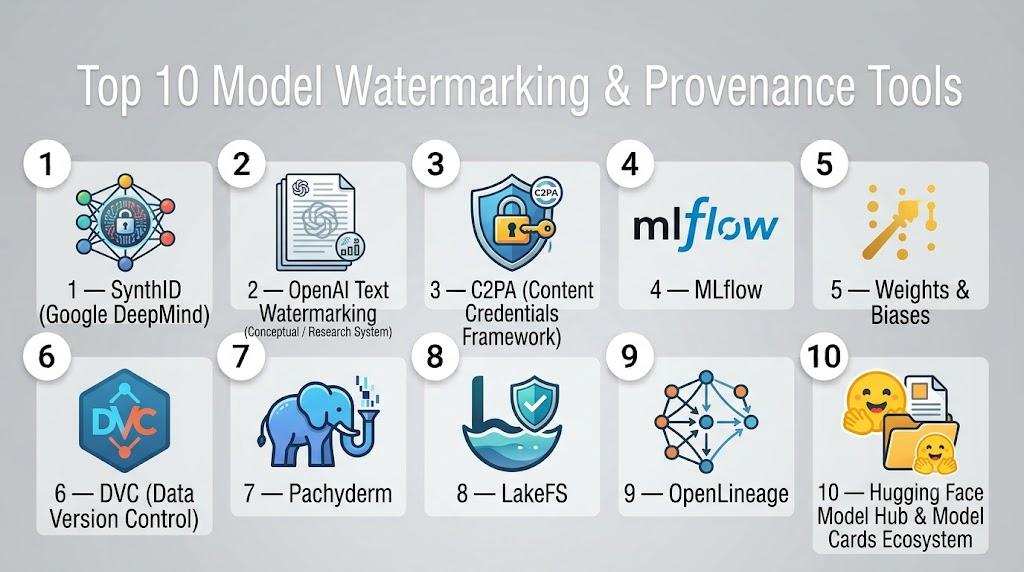
Top 10 Model Watermarking & Provenance Tools
1 — SynthID (Google DeepMind)
One-line verdict: Best for embedding robust, invisible watermarks into AI-generated content across modalities.
Short description:
SynthID is a watermarking system developed for embedding imperceptible signals into AI-generated content such as text and images. It is designed to help identify AI-generated outputs even after transformation or editing.
Standout Capabilities
- Invisible watermarking embedded during generation
- Designed for multimodal outputs (text, image, and more)
- Resistant to common transformations like cropping or paraphrasing
- Works at generation time without affecting usability
- Detection pipeline for watermark verification
- Integration with generative model pipelines
- Low perceptual impact on output quality
- Designed for large-scale deployment scenarios
AI-Specific Depth
- Model support: Typically integrated into generative models (text and image generation systems)
- RAG / knowledge integration: N/A
- Evaluation: Watermark detectability, robustness under transformation, false positive rate, and retention strength
- Guardrails: Not a guardrail system; focuses on provenance marking
- Observability: Watermark detection logs, generation metadata, verification results
Pros
- Strong focus on production-grade watermarking
- Designed for multimodal AI systems
- Robust against many post-processing transformations
Cons
- Not publicly available as a general-purpose toolkit
- Limited transparency into full implementation details
- Integration depends on model ecosystem access
Security & Compliance
Details about certifications, compliance, or audit controls are not publicly stated.
Deployment & Platforms
- Integrated within proprietary generative systems
- Not generally available as standalone software
- Cloud-based model integration
Integrations & Ecosystem
- Generative AI pipelines
- Image and text generation systems
- Internal model serving infrastructure
- Detection and verification services
Pricing Model
Not publicly stated.
Best-Fit Scenarios
- Large-scale generative AI platforms
- AI-generated content authentication systems
- Enterprise content provenance requirements
2 — OpenAI Text Watermarking (Conceptual / Research System)
One-line verdict: Best for conceptual AI text provenance through embedding statistical watermark signals in generated text.
Short description:
OpenAI has explored watermarking approaches for AI-generated text using statistical patterns that can be detected later. These systems aim to distinguish AI-generated text from human-written content.
Standout Capabilities
- Statistical watermark embedding in generated text
- Detection mechanisms based on token pattern analysis
- Designed for large-scale language models
- Low-impact integration into generation pipelines
- Detection without requiring model access
- Research-oriented approach to text provenance
- Potential resistance to minor edits and paraphrasing
- Lightweight implementation concept
AI-Specific Depth
- Model support: Large language models (conceptual integration)
- RAG / knowledge integration: N/A
- Evaluation: Detection accuracy, robustness to paraphrasing, false positive rate
- Guardrails: Not a safety guardrail system
- Observability: Watermark detection signals and statistical markers
Pros
- Lightweight approach to AI text identification
- Does not require heavy infrastructure changes
- Suitable for large-scale deployment concepts
Cons
- Public production availability is limited or not standardized
- Vulnerable to aggressive paraphrasing or re-generation
- Implementation details vary across research iterations
Security & Compliance
Not publicly stated.
Deployment & Platforms
- Research or model-integrated environments
- Not a standalone product
- Cloud-based inference systems
Integrations & Ecosystem
- Language model generation pipelines
- Content moderation systems
- AI detection frameworks
Pricing Model
Not publicly stated.
Best-Fit Scenarios
- AI-generated text detection research
- Content authenticity validation systems
- Experimental provenance tracking
3 — C2PA (Content Credentials Framework)
One-line verdict: Best for standardized content provenance across images, video, and digital media ecosystems.
Short description:
C2PA is an open standard for content authenticity that enables tracking the origin and editing history of digital media. It is widely used in media provenance systems to ensure content integrity.
Standout Capabilities
- Standardized content authenticity metadata
- Tracks origin and editing history of media
- Supports images, video, audio, and documents
- Cryptographic verification of content history
- Interoperability across platforms
- Tamper-evident provenance records
- Supports signed metadata attachments
- Industry-wide adoption efforts
AI-Specific Depth
- Model support: N/A (content-level provenance system)
- RAG / knowledge integration: N/A
- Evaluation: Integrity validation, authenticity verification, tamper detection
- Guardrails: N/A
- Observability: Content history logs, metadata chains, verification states
Pros
- Strong industry standard for media authenticity
- Works across multiple content types
- Supports cryptographic verification
Cons
- Requires ecosystem adoption for full effectiveness
- Not specific to model internals
- Does not prevent content generation misuse
Security & Compliance
Supports cryptographic signing and verification; enterprise compliance depends on implementation.
Deployment & Platforms
- Media pipelines
- Content publishing systems
- Cloud and on-device workflows
- Digital asset management systems
Integrations & Ecosystem
- Adobe Content systems
- Media publishing platforms
- Digital asset management tools
- Content verification systems
Pricing Model
Standard is open; implementation costs vary.
Best-Fit Scenarios
- Media authenticity verification
- Journalism and publishing integrity systems
- Digital content tracking pipelines
4 — MLflow
One-line verdict: Best for end-to-end ML lifecycle tracking, experiment logging, and reproducibility.
Short description:
MLflow is an open-source platform for managing the machine learning lifecycle, including experiment tracking, model versioning, reproducibility, and deployment management.
Standout Capabilities
- Experiment tracking and logging
- Model versioning and registry
- Reproducible ML workflows
- Deployment lifecycle tracking
- Artifact storage management
- Metrics and parameter logging
- Pipeline integration
- Multi-framework support
AI-Specific Depth
- Model support: PyTorch, TensorFlow, Scikit-learn, and custom models
- RAG / knowledge integration: Supports tracking pipelines that include retrieval components
- Evaluation: Metrics logging, model comparison, experiment reproducibility
- Guardrails: N/A
- Observability: Full experiment tracking and model lineage logs
Pros
- Strong MLOps foundation
- Widely adopted in ML engineering teams
- Excellent reproducibility support
Cons
- Requires infrastructure setup for full features
- Not specialized for watermarking
- Governance features depend on configuration
Security & Compliance
Security controls depend on deployment configuration.
Certifications: Not publicly stated.
Deployment & Platforms
- Self-hosted and cloud
- Windows, Linux, macOS
- Kubernetes and container environments
Integrations & Ecosystem
- Databricks ecosystem
- CI/CD pipelines
- Cloud storage systems
- ML frameworks
- Model registries
Pricing Model
Open-source core; enterprise features vary.
Best-Fit Scenarios
- ML experiment tracking
- Model lifecycle governance
- Reproducible AI pipelines
5 — Weights & Biases
One-line verdict: Best for experiment tracking, model observability, and ML lifecycle analytics.
Short description:
Weights & Biases is a machine learning platform for experiment tracking, visualization, model management, and collaboration across ML teams.
Standout Capabilities
- Experiment tracking dashboards
- Model performance visualization
- Dataset and model version tracking
- Hyperparameter optimization tracking
- Collaboration tools for ML teams
- Training monitoring and logging
- Artifact management
- Pipeline observability
AI-Specific Depth
- Model support: Multiple ML frameworks and custom training systems
- RAG / knowledge integration: Can track RAG pipelines indirectly via logs and artifacts
- Evaluation: Model metrics tracking, comparative analysis, performance visualization
- Guardrails: N/A
- Observability: Extensive experiment logs and visual dashboards
Pros
- Strong visualization and tracking
- Easy team collaboration
- Deep integration with ML workflows
Cons
- Not a dedicated provenance standard
- Requires discipline to structure metadata
- Enterprise features vary
Security & Compliance
Not publicly stated for all compliance certifications.
Deployment & Platforms
- Cloud and enterprise deployment
- Python SDK
- CI/CD integration
Integrations & Ecosystem
- PyTorch
- TensorFlow
- Hugging Face
- Kubernetes workflows
- Data pipelines
Pricing Model
Tiered model; exact pricing varies.
Best-Fit Scenarios
- ML experiment tracking
- Model performance monitoring
- Team-based ML development
6 — DVC (Data Version Control)
One-line verdict: Best for dataset versioning and reproducible machine learning pipelines.
Short description:
DVC is an open-source tool that extends Git-based workflows to machine learning datasets and pipelines, enabling version control for data and models.
Standout Capabilities
- Dataset versioning and tracking
- Pipeline reproducibility
- Git-based workflow integration
- Remote storage support
- Experiment tracking extensions
- Large dataset handling
- Model versioning support
- Collaboration-friendly workflows
AI-Specific Depth
- Model support: Any ML model pipeline
- RAG / knowledge integration: Supports versioning retrieval datasets
- Evaluation: Pipeline reproducibility metrics
- Guardrails: N/A
- Observability: Dataset lineage and pipeline history
Pros
- Strong data versioning system
- Works with Git workflows
- Lightweight and flexible
Cons
- Requires setup discipline
- Limited UI compared to commercial tools
- Governance features are minimal
Security & Compliance
Depends on storage and infrastructure configuration.
Certifications: Not publicly stated.
Deployment & Platforms
- Local and cloud storage
- Linux, macOS, Windows
- CI/CD integration
Integrations & Ecosystem
- Git
- Cloud storage providers
- ML frameworks
- CI pipelines
Pricing Model
Open-source.
Best-Fit Scenarios
- Dataset versioning
- ML reproducibility
- Pipeline tracking
7 — Pachyderm
One-line verdict: Best for container-based data lineage and reproducible data pipelines.
Short description:
Pachyderm is a data science platform focused on data versioning, lineage tracking, and reproducible pipelines using containerized workflows.
Standout Capabilities
- Containerized data pipelines
- Automatic data lineage tracking
- Versioned datasets
- Scalable distributed processing
- Pipeline reproducibility
- Kubernetes-native architecture
- Incremental processing
- Audit-ready workflows
AI-Specific Depth
- Model support: Any model integrated into pipelines
- RAG / knowledge integration: Supports versioned data pipelines for retrieval systems
- Evaluation: Pipeline execution history and reproducibility metrics
- Guardrails: N/A
- Observability: Data lineage graphs and pipeline logs
Pros
- Strong enterprise data pipeline control
- Kubernetes-native scalability
- Excellent reproducibility
Cons
- Infrastructure complexity
- Requires DevOps maturity
- Overhead for small teams
Security & Compliance
Enterprise-grade deployment options; certifications not publicly stated.
Deployment & Platforms
- Kubernetes-based deployments
- Cloud and hybrid environments
- Container-native workflows
Integrations & Ecosystem
- Kubernetes
- Cloud storage systems
- ML pipelines
- Data engineering tools
Pricing Model
Enterprise pricing not publicly stated.
Best-Fit Scenarios
- Large-scale ML data pipelines
- Reproducible data engineering systems
- Enterprise AI infrastructure
8 — LakeFS
One-line verdict: Best for Git-like versioning of data lakes and large-scale datasets.
Short description:
LakeFS is a data versioning system that enables Git-style branching, committing, and merging for data lakes.
Standout Capabilities
- Git-like data lake versioning
- Branching and merging datasets
- Atomic dataset commits
- Large-scale data handling
- Reproducible data snapshots
- Integration with data lake storage
- Collaboration-friendly data workflows
- Audit-friendly dataset history
AI-Specific Depth
- Model support: Any model consuming versioned datasets
- RAG / knowledge integration: Strong support for versioned retrieval datasets
- Evaluation: Dataset reproducibility and change tracking
- Guardrails: N/A
- Observability: Dataset lineage and commit history
Pros
- Excellent for data lake versioning
- Strong reproducibility support
- Simple Git-like mental model
Cons
- Requires infrastructure setup
- Not a full ML platform
- Governance features depend on integration
Security & Compliance
Depends on storage and deployment configuration.
Certifications: Not publicly stated.
Deployment & Platforms
- Cloud and self-hosted
- Kubernetes support
- Data lake environments
Integrations & Ecosystem
- S3-compatible storage
- Data lake platforms
- ML pipelines
- ETL systems
Pricing Model
Open-source with enterprise options.
Best-Fit Scenarios
- Data lake versioning
- ML dataset reproducibility
- Large-scale analytics pipelines
9 — OpenLineage
One-line verdict: Best for standardized data lineage tracking across modern data engineering ecosystems.
Short description:
OpenLineage is an open standard for data lineage collection and observability across data pipelines and analytics systems.
Standout Capabilities
- Standardized lineage metadata model
- Cross-tool pipeline tracking
- Event-based lineage capture
- Integration with orchestration tools
- Data dependency tracking
- Dataset transformation visibility
- Open ecosystem design
- Real-time lineage updates
AI-Specific Depth
- Model support: N/A directly (data pipeline focus)
- RAG / knowledge integration: Strong relevance for tracking retrieval data pipelines
- Evaluation: Pipeline lineage validation
- Guardrails: N/A
- Observability: Data flow and transformation tracking
Pros
- Open standard improves interoperability
- Works across multiple tools
- Strong for enterprise data governance
Cons
- Requires ecosystem adoption
- Not a standalone UI product
- Needs integration with orchestration systems
Security & Compliance
Depends on implementation and connected systems.
Certifications: Not publicly stated.
Deployment & Platforms
- Integrated with orchestration systems
- Cloud and on-prem data platforms
- Event-driven architectures
Integrations & Ecosystem
- Airflow
- Spark
- Data warehouses
- ETL tools
- Data catalogs
Pricing Model
Open standard.
Best-Fit Scenarios
- Enterprise data lineage
- Cross-system observability
- Data governance frameworks
10 — Hugging Face Model Hub & Model Cards Ecosystem
One-line verdict: Best for model metadata, lineage documentation, and community-driven model provenance tracking.
Short description:
The Hugging Face ecosystem provides model hosting, versioning, and model cards that document datasets, training processes, and intended use cases.
Standout Capabilities
- Model versioning and hosting
- Standardized model cards
- Dataset documentation
- Community-driven model sharing
- Metadata tracking for models
- Reproducibility information
- Integration with ML frameworks
- Version control for models and datasets
AI-Specific Depth
- Model support: Transformer models, vision models, audio models, and multimodal systems
- RAG / knowledge integration: Supports dataset and embedding model tracking
- Evaluation: Model metadata and performance reporting (varies by contributor)
- Guardrails: N/A
- Observability: Model version history and metadata tracking
Pros
- Large ecosystem and community adoption
- Strong model documentation standards
- Easy model sharing and reuse
Cons
- Metadata quality varies by contributors
- Not a strict governance system
- Requires external tools for full lineage control
Security & Compliance
Not publicly standardized across all hosted models.
Deployment & Platforms
- Cloud-based model hub
- API and SDK access
- Local model download support
Integrations & Ecosystem
- Transformers library
- PyTorch
- TensorFlow
- ML pipelines
- Dataset repositories
Pricing Model
Mixed open and commercial offerings.
Best-Fit Scenarios
- Model sharing and reuse
- Metadata-driven governance
- Open ML collaboration
Comparison Table
| Tool Name | Best For | Deployment | Model Flexibility | Strength | Watch-Out | Public Rating |
|---|---|---|---|---|---|---|
| SynthID | AI watermarking | Proprietary integration | Generative models | Robust watermarking | Not publicly available | N/A |
| OpenAI Watermarking | Text provenance | Research / API concept | LLMs | Lightweight detection | Limited public access | N/A |
| C2PA | Content authenticity | Cross-platform | Media systems | Industry standard | Ecosystem dependence | N/A |
| MLflow | ML lifecycle tracking | Self-hosted/cloud | Multi-framework | Reproducibility | Setup complexity | N/A |
| Weights & Biases | Experiment tracking | Cloud/self-hosted | Multi-framework | Visualization | Not full provenance standard | N/A |
| DVC | Data versioning | Local/cloud | ML pipelines | Dataset control | Requires discipline | N/A |
| Pachyderm | Data pipelines | Kubernetes | Pipeline-based ML | Scalable lineage | Infrastructure heavy | N/A |
| LakeFS | Data lake versioning | Cloud/self-hosted | Data lakes | Git-style datasets | Setup overhead | N/A |
| OpenLineage | Data lineage standard | Integration-based | Data systems | Interoperability | Not standalone | N/A |
| Hugging Face Hub | Model registry | Cloud | ML models | Ecosystem scale | Inconsistent metadata | N/A |
Scoring & Evaluation
This scoring reflects comparative usefulness for watermarking robustness, provenance completeness, ML lifecycle coverage, integration depth, and governance readiness. Scores are relative and depend on how tools are implemented within an organization.
No tool alone fully solves AI provenance or watermarking; strong implementations typically combine multiple tools across model, data, and pipeline layers.
| Tool | Core | Reliability | Governance | Integrations | Ease | Performance | Security/Admin | Support | Weighted Total |
|---|---|---|---|---|---|---|---|---|---|
| SynthID | 9 | 9 | 8 | 7 | 8 | 9 | 7 | 8 | 8.30 |
| OpenAI Watermarking | 7 | 7 | 7 | 7 | 9 | 9 | 6 | 8 | 7.50 |
| C2PA | 9 | 9 | 9 | 9 | 8 | 8 | 9 | 9 | 8.80 |
| MLflow | 9 | 9 | 9 | 9 | 8 | 8 | 8 | 9 | 8.60 |
| Weights & Biases | 9 | 9 | 8 | 9 | 9 | 8 | 8 | 9 | 8.50 |
| DVC | 8 | 9 | 9 | 8 | 8 | 9 | 7 | 8 | 8.20 |
| Pachyderm | 8 | 9 | 9 | 8 | 6 | 8 | 8 | 8 | 7.90 |
| LakeFS | 8 | 9 | 9 | 8 | 7 | 9 | 8 | 8 | 8.10 |
| OpenLineage | 8 | 8 | 9 | 9 | 7 | 8 | 8 | 8 | 8.00 |
| Hugging Face Hub | 8 | 8 | 7 | 9 | 9 | 8 | 7 | 9 | 8.10 |
Which Model Watermarking & Provenance Tool Is Right for You?
Solo / Freelancer
Independent developers should focus on simplicity and reproducibility. MLflow and DVC provide strong foundations for tracking experiments and datasets without heavy infrastructure overhead. Hugging Face Hub is useful for model sharing and version control.
Watermarking tools are usually unnecessary at this stage unless publishing AI-generated content at scale.
SMB
Small and medium businesses should combine experiment tracking with dataset versioning. A practical stack often includes Weights & Biases for monitoring and DVC for reproducibility.
This combination ensures models can be audited, improved, and reproduced without building complex infrastructure.
Mid-Market
Mid-market organizations should begin combining provenance and governance layers. MLflow or Weights & Biases can handle experiments, while LakeFS or Pachyderm manages dataset lineage.
At this stage, teams should ensure that every production model has traceable inputs, outputs, and training history.
Enterprise
Enterprises require full-stack provenance:
- C2PA for content authenticity
- MLflow for lifecycle tracking
- OpenLineage for pipeline observability
- Pachyderm or LakeFS for data lineage
- Watermarking systems like SynthID for output verification
No single tool is sufficient. A layered architecture is required.
Regulated Industries
Highly regulated sectors must prioritize auditability, reproducibility, and cryptographic verification. C2PA and OpenLineage become critical, along with strict MLflow-based experiment tracking.
Watermarking systems help validate content authenticity in legal, financial, and public communication contexts.
Budget vs Premium
Open-source provenance tools (MLflow, DVC, LakeFS) reduce licensing costs but require engineering investment. Enterprise-grade watermarking or provenance systems provide stronger guarantees but often require integration into vendor ecosystems.
A hybrid approach is most common.
Build vs Buy
Build systems when workflows are highly customized or experimental. Buy or adopt standards when auditability, compliance, and interoperability are required.
Watermarking should rarely be built from scratch due to complexity and robustness requirements.
Implementation Playbook
First 30 Days: Foundation Setup
- Identify all models, datasets, and pipelines
- Choose one tracking system (MLflow or W&B)
- Begin dataset versioning (DVC or LakeFS)
- Define model version naming conventions
- Enable experiment logging for all training runs
- Capture hyperparameters, datasets, and outputs
- Establish reproducibility baseline
- Document model lifecycle stages
First 60 Days: Provenance Expansion
- Add data lineage tracking (OpenLineage or Pachyderm)
- Integrate model registry workflows
- Start tracking deployment metadata
- Implement dataset version audits
- Add experiment comparison dashboards
- Define governance policies for model updates
- Begin tagging production vs experimental models
- Introduce reproducibility validation checks
First 90 Days: Governance & Watermarking
- Integrate content authenticity where applicable (C2PA or watermarking systems)
- Implement audit logging for model inference
- Establish provenance dashboards for stakeholders
- Enable traceability from output → model → dataset
- Automate compliance reporting
- Conduct lineage audits
- Introduce anomaly detection for dataset changes
- Validate full ML lifecycle reproducibility
Common Mistakes and How to Avoid Them
- Only tracking models but ignoring datasets
- Treating experiment logs as full provenance systems
- Not versioning preprocessing pipelines
- Ignoring multimodal content provenance
- Over-relying on watermarking without pipeline tracking
- Missing dataset lineage in RAG systems
- Not logging inference metadata
- Poor version naming conventions
- Lack of reproducibility validation
- No audit trail for model promotion
- Ignoring external pretrained model provenance
- Assuming watermarking cannot be removed or altered
- Not integrating provenance into CI/CD
- Treating governance as optional instead of foundational
FAQs
1. What is model watermarking?
Model watermarking embeds hidden or detectable signals into AI-generated content so that its origin can be verified later.
2. What is model provenance?
Model provenance tracks the full lifecycle of an AI system, including datasets, training steps, parameters, and deployment history.
3. Why is provenance important in AI?
It ensures reproducibility, accountability, compliance, and transparency in AI decision-making systems.
4. Can watermarking detect all AI-generated content?
No. Watermarking improves detection but can be weakened by transformation, re-generation, or paraphrasing.
5. What is the difference between watermarking and provenance?
Watermarking focuses on outputs, while provenance tracks the full lifecycle of data and models.
6. Do I need both watermarking and provenance?
Yes, in most enterprise systems both are required for full traceability and authenticity.
7. Is MLflow a watermarking tool?
No. MLflow is a provenance and experiment tracking tool.
8. Can provenance systems track RAG pipelines?
Yes, but they must be integrated with dataset and retrieval tracking systems.
9. Are watermarking systems reversible?
No. Proper watermarking is designed to be detectable but not easily removable.
10. Do open-source provenance tools scale?
Yes, but scaling requires proper infrastructure and governance design.
11. Can provenance prove model ownership?
It helps establish evidence, but legal ownership depends on contracts and jurisdiction.
12. Is watermarking used in all AI systems?
No. Adoption depends on regulatory needs and risk profile.
13. Can provenance help with debugging models?
Yes. It helps trace issues back to specific data, code, or training versions.
14. Are these tools required for compliance?
Some industries require provenance-like auditability, but requirements vary.
15. What is the biggest challenge in provenance?
Integrating data, model, and pipeline tracking into a unified system.
Conclusion
Model watermarking and provenance tools are becoming foundational for trustworthy AI systems. As organizations deploy generative models at scale, the ability to verify content authenticity and trace model lineage is no longer optional.
Watermarking helps validate whether content is AI-generated and supports content integrity in media and communication systems. Provenance tools ensure every step of the AI lifecycle is traceable, reproducible, and auditable.
