Introduction
AI Policy Drafting Assistants use artificial intelligence, natural language processing, machine learning, and document automation technologies to help organizations create, review, update, and manage policies more efficiently.
Organizations rely on policies to define operational standards, compliance requirements, security practices, employee responsibilities, governance rules, and business procedures. However, creating effective policies requires significant research, legal understanding, stakeholder collaboration, and continuous updates.
Traditional policy drafting often involves manually reviewing regulations, internal requirements, previous documents, and industry standards. This process can be time-consuming and challenging, especially for organizations managing large policy libraries across multiple departments.
AI-powered policy drafting assistants help automate policy creation by generating drafts, suggesting improvements, identifying missing sections, comparing requirements, and helping teams maintain consistent documentation.
These tools help organizations:
- Create policy drafts faster
- Standardize policy language
- Improve document quality
- Align policies with compliance requirements
- Update outdated policies
- Reduce administrative workload
- Improve governance processes
AI policy drafting solutions are used by:
- Compliance teams
- Legal departments
- Human resources teams
- Security organizations
- Risk management teams
- Enterprise businesses
- Government organizations
Modern AI policy drafting platforms combine generative AI, document intelligence, compliance knowledge bases, workflow automation, templates, and review collaboration tools.
The goal of these solutions is to help organizations create clearer, more consistent, and manageable policies while keeping human review involved.
How AI Policy Drafting Assistants Work
Requirement Analysis
AI analyzes:
- Business requirements
- Regulatory expectations
- Existing policies
- Industry standards
- Organizational guidelines
Policy Generation
AI helps create:
- Policy structures
- Draft content
- Sections and clauses
- Standard language
Document Improvement
AI suggests:
- Missing information
- Language improvements
- Consistency updates
- Formatting changes
Compliance Alignment
AI compares policies against:
- Regulations
- Internal controls
- Governance frameworks
Review Collaboration
Teams can:
- Review drafts
- Add comments
- Approve changes
- Maintain policy versions
Common Use Cases
- Information security policies
- Privacy policies
- Employee policies
- Compliance documentation
- Governance policies
- Risk management documents
- Operational procedures
- Regulatory documentation
- Internal guidelines
- Corporate standards
Why AI Policy Drafting Assistants Matter
Faster Policy Creation
AI reduces the time required to prepare initial policy drafts.
Better Consistency
Organizations can maintain standardized language across documents.
Improved Compliance Support
AI helps teams align policies with requirements and standards.
Easier Policy Updates
Organizations can identify sections that need revision.
Better Knowledge Management
AI helps organize and maintain policy libraries.
Evaluation Criteria for Buyers
Drafting Quality
The platform should generate clear and structured policy documents.
Compliance Awareness
Strong tools should support regulatory and governance requirements.
Customization
Organizations should be able to adapt templates and language.
Document Management
Important features include version control, collaboration, and approval workflows.
Security and Privacy
Policy information may contain sensitive organizational details.
Integration Capability
Useful integrations include document systems, GRC platforms, and collaboration tools.
User Experience
The platform should be accessible for legal, compliance, and business teams.
Key Trends
Generative AI Policy Creation
Organizations are increasingly using AI to accelerate document creation.
Automated Governance Workflows
Policy drafting is becoming connected with approval and compliance processes.
AI-Assisted Compliance Documentation
Organizations are using AI to maintain regulatory documentation.
Policy Lifecycle Management
AI tools are helping teams create, update, and retire policies efficiently.
Enterprise Knowledge Automation
Organizations are using AI to organize internal knowledge resources.
Responsible AI Governance
Companies are focusing on human review, accuracy, and accountability.
Methodology
The following platforms were evaluated using:
- Policy drafting capabilities
- AI document generation
- Compliance support
- Ease of use
- Integrations and ecosystem
- Security and privacy
- Performance and reliability
- Support and community
- Price and value
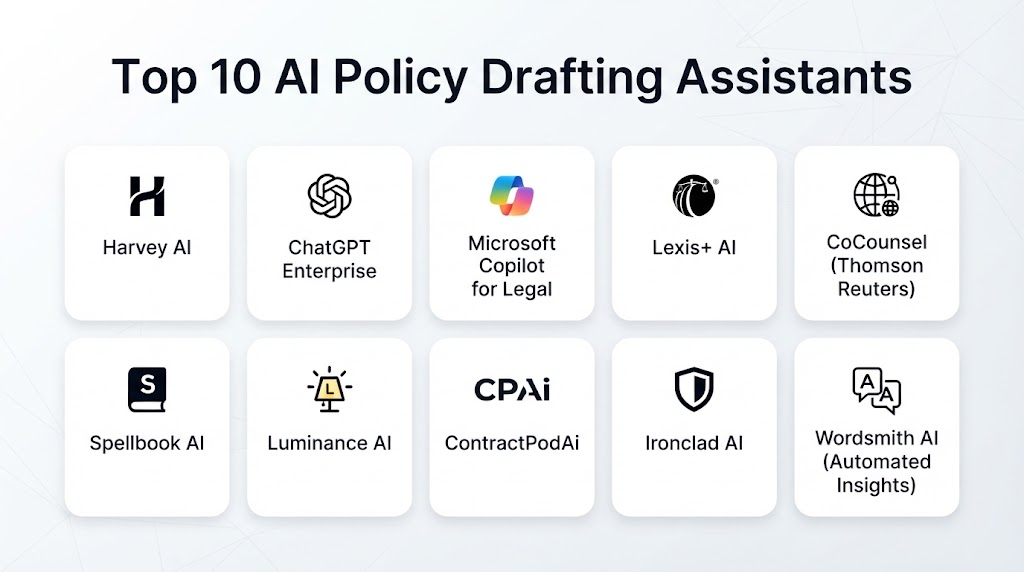
Top 10 AI Policy Drafting Assistants
1. Microsoft Copilot for Microsoft 365
Microsoft Copilot provides AI assistance for creating, editing, summarizing, and managing business documents.
Key Features
- AI document drafting
- Policy templates
- Content summarization
- Document editing
- Information retrieval
- Collaboration support
- Writing assistance
- Knowledge discovery
- Workflow integration
- Enterprise productivity features
Pros
- Strong enterprise integration
- Works with business documents
- Familiar productivity environment
- Supports collaboration
- Enterprise security options
Cons
- Requires Microsoft ecosystem
- Output requires review
- Advanced governance may need configuration
Platforms
Web, desktop, and Microsoft productivity applications.
Deployment or Support
Cloud-based enterprise AI solution.
Security & Compliance
Enterprise security controls vary.
Integrations & Ecosystem
Microsoft applications, collaboration tools, and enterprise workflows.
Support & Community
Enterprise support resources.
2. ChatGPT Enterprise
ChatGPT Enterprise provides AI-powered assistance for drafting, reviewing, summarizing, and improving business documents.
Key Features
- Policy drafting assistance
- Document generation
- Content refinement
- Summarization
- Knowledge assistance
- Writing improvement
- Workflow support
- Data analysis capabilities
- Collaboration support
- Enterprise controls
Pros
- Flexible drafting capabilities
- Strong language understanding
- Supports multiple business workflows
- Easy content iteration
- Broad AI assistance
Cons
- Requires governance policies
- Human review needed
- Custom compliance workflows may require setup
Platforms
Web and enterprise applications.
Deployment or Support
Cloud-based AI platform.
Security & Compliance
Enterprise controls vary.
Integrations & Ecosystem
Business workflows, productivity tools, and enterprise systems.
Support & Community
Enterprise support.
3. Writer
Writer provides enterprise AI writing assistance for creating consistent business content and documentation.
Key Features
- AI policy drafting
- Writing assistance
- Style guidelines
- Content templates
- Document editing
- Knowledge management
- Brand consistency
- Workflow support
- Collaboration
- Enterprise controls
Pros
- Strong enterprise writing focus
- Good consistency controls
- Useful templates
- Supports teams
- Business-friendly workflows
Cons
- Requires setup
- Best suited for enterprise users
- Compliance features vary
Platforms
Web-based platform.
Deployment or Support
Cloud-based AI writing platform.
Security & Compliance
Enterprise controls vary.
Integrations & Ecosystem
Business applications and content workflows.
Support & Community
Customer support.
4. Jasper
Jasper provides AI writing capabilities for generating and improving business content.
Key Features
- AI writing assistance
- Document drafting
- Content templates
- Editing support
- Brand voice controls
- Collaboration
- Content workflows
- Knowledge features
- Writing improvement
- Productivity tools
Pros
- Easy content creation
- Strong writing workflows
- Useful templates
- Good user experience
- Supports teams
Cons
- General writing focus
- Requires policy review
- Compliance capabilities vary
Platforms
Web-based platform.
Deployment or Support
Cloud-based AI writing platform.
Security & Compliance
Security controls vary.
Integrations & Ecosystem
Content tools and business applications.
Support & Community
Customer support.
5. Grammarly Business
Grammarly Business provides AI-powered writing assistance for improving clarity, tone, and consistency.
Key Features
- Writing improvement
- Grammar checking
- Tone suggestions
- Document editing
- Style guidance
- Collaboration support
- Writing analytics
- Productivity features
- Content refinement
- Enterprise management
Pros
- Improves writing quality
- Easy adoption
- Strong editing capabilities
- Useful business workflows
- Good usability
Cons
- Not policy-specific
- Requires human drafting
- Advanced governance varies
Platforms
Web, desktop, and browser applications.
Deployment or Support
Cloud-based writing platform.
Security & Compliance
Enterprise controls vary.
Integrations & Ecosystem
Productivity tools and business applications.
Support & Community
Customer support.
6. Notion AI
Notion AI provides AI assistance for creating, organizing, summarizing, and managing internal documents.
Key Features
- Policy drafting
- Document organization
- Summarization
- Knowledge management
- Writing assistance
- Collaboration
- Search capabilities
- Workspace integration
- Templates
- Documentation support
Pros
- Strong knowledge management
- Easy collaboration
- Flexible documentation
- User-friendly interface
- Good organization features
Cons
- Not compliance-specific
- Requires governance processes
- Enterprise configuration may be needed
Platforms
Web, desktop, and mobile applications.
Deployment or Support
Cloud-based productivity platform.
Security & Compliance
Security controls vary.
Integrations & Ecosystem
Productivity tools and collaboration workflows.
Support & Community
Community and customer support.
7. Document360 AI
Document360 provides AI-powered knowledge base and documentation management capabilities.
Key Features
- AI documentation support
- Policy documentation
- Knowledge management
- Search improvement
- Content organization
- Document creation
- Version management
- Collaboration
- Analytics
- Publishing workflows
Pros
- Strong documentation focus
- Useful knowledge management
- Good organization
- Supports policy libraries
- Structured documentation
Cons
- More documentation-focused
- Requires setup
- AI drafting depth varies
Platforms
Web-based platform.
Deployment or Support
Cloud-based documentation platform.
Security & Compliance
Security controls vary.
Integrations & Ecosystem
Knowledge systems and business workflows.
Support & Community
Customer support.
8. Scribe
Scribe provides AI-powered documentation creation tools for creating process documents and internal guides.
Key Features
- AI documentation
- Process creation
- Step-by-step guides
- Workflow documentation
- Knowledge sharing
- Editing tools
- Templates
- Collaboration
- Documentation automation
- Publishing support
Pros
- Fast documentation creation
- Easy workflow capture
- Good usability
- Helpful for procedures
- Supports internal documentation
Cons
- Focused on process documentation
- Requires policy review
- Limited legal compliance features
Platforms
Web and browser applications.
Deployment or Support
Cloud-based documentation platform.
Security & Compliance
Security controls vary.
Integrations & Ecosystem
Business workflows and productivity systems.
Support & Community
Customer support.
9. Glean
Glean provides enterprise AI search and knowledge management capabilities.
Key Features
- AI knowledge search
- Document discovery
- Enterprise information retrieval
- Knowledge organization
- Content understanding
- Workplace search
- Collaboration support
- Information access
- AI assistance
- Enterprise integrations
Pros
- Strong enterprise search
- Helps discover internal knowledge
- Supports large organizations
- Useful information retrieval
- Broad integrations
Cons
- Not specifically policy drafting focused
- Requires data integration
- Enterprise deployment needed
Platforms
Web-based platform.
Deployment or Support
Cloud-based enterprise AI platform.
Security & Compliance
Enterprise security controls.
Integrations & Ecosystem
Enterprise applications and knowledge systems.
Support & Community
Enterprise support.
10. HyperWrite
HyperWrite provides AI writing assistance for drafting, editing, and improving written content.
Key Features
- AI writing assistance
- Document drafting
- Text improvement
- Summarization
- Content generation
- Writing workflows
- Editing support
- Productivity tools
- Research assistance
- Templates
Pros
- Easy writing assistance
- Fast drafting
- Useful editing features
- Flexible workflows
- Accessible interface
Cons
- General-purpose AI writing tool
- Requires review
- Limited policy management features
Platforms
Web-based platform.
Deployment or Support
Cloud-based AI writing platform.
Security & Compliance
Security controls vary.
Integrations & Ecosystem
Writing workflows and productivity tools.
Support & Community
Customer support.
Comparison Table
| Tool Name | Best For | Platform(s) Supported | Deployment | Standout Feature | Public Rating |
|---|---|---|---|---|---|
| Microsoft Copilot for Microsoft 365 | Enterprise policy drafting | Web/Desktop | Cloud | Enterprise integration | N/A |
| ChatGPT Enterprise | Flexible AI drafting | Web | Cloud | Language generation | N/A |
| Writer | Business content standards | Web | Cloud | Style controls | N/A |
| Jasper | AI content creation | Web | Cloud | Templates | N/A |
| Grammarly Business | Writing improvement | Web/Desktop | Cloud | Editing assistance | N/A |
| Notion AI | Knowledge documentation | Web/Mobile | Cloud | Workspace AI | N/A |
| Document360 AI | Policy documentation | Web | Cloud | Knowledge management | N/A |
| Scribe | Process documentation | Web | Cloud | Workflow guides | N/A |
| Glean | Enterprise knowledge search | Web | Cloud | Information discovery | N/A |
| HyperWrite | AI writing support | Web | Cloud | Draft generation | N/A |
Weighted Evaluation
| Tool Name | Core Features 25% | Ease of Use 15% | Integrations & Ecosystem 15% | Security & Compliance 10% | Performance & Reliability 10% | Support & Community 10% | Price/Value 15% | Total |
|---|---|---|---|---|---|---|---|---|
| Microsoft Copilot | 24 | 14 | 15 | 10 | 10 | 10 | 11 | 94 |
| ChatGPT Enterprise | 25 | 14 | 14 | 10 | 10 | 10 | 11 | 94 |
| Writer | 23 | 14 | 14 | 10 | 10 | 10 | 11 | 92 |
| Jasper | 22 | 14 | 13 | 9 | 10 | 10 | 12 | 90 |
| Grammarly Business | 21 | 15 | 13 | 9 | 10 | 10 | 12 | 90 |
| Notion AI | 22 | 15 | 13 | 9 | 10 | 10 | 12 | 91 |
| Document360 AI | 22 | 13 | 13 | 9 | 10 | 10 | 11 | 88 |
| Scribe | 21 | 15 | 12 | 9 | 10 | 9 | 12 | 88 |
| Glean | 23 | 13 | 15 | 10 | 10 | 10 | 10 | 91 |
| HyperWrite | 21 | 14 | 12 | 8 | 9 | 9 | 12 | 85 |
Which AI Policy Drafting Assistant Is Right for You?
Choose Microsoft Copilot for Microsoft 365 when organizations need AI drafting integrated with enterprise productivity tools.
Choose ChatGPT Enterprise when flexible AI policy creation and document assistance are priorities.
Choose Writer when maintaining consistent business writing standards is important.
Choose Jasper when teams need AI-powered content generation.
Choose Grammarly Business when improving document quality and clarity is the goal.
Choose Notion AI when organizations need policy documentation with knowledge management.
Choose Document360 AI when structured documentation management is required.
Choose Scribe when creating process-based documentation is important.
Choose Glean when enterprise knowledge discovery supports policy creation.
Choose HyperWrite when simple AI drafting assistance is needed.
Implementation Playbook
Phase 1: Define Policy Requirements
- Identify policy categories
- Understand compliance needs
- Define approval workflows
- Select stakeholders
- Establish governance rules
Phase 2: Prepare Knowledge Sources
- Collect existing policies
- Organize templates
- Review standards
- Configure access controls
- Prepare reference materials
Phase 3: Deploy AI Drafting Workflows
- Generate policy drafts
- Review AI suggestions
- Add organizational requirements
- Validate content
- Approve documents
Phase 4: Measure Effectiveness
- Track drafting speed
- Review policy quality
- Collect user feedback
- Improve templates
- Optimize workflows
Phase 5: Maintain Policy Governance
- Update policies regularly
- Review regulatory changes
- Maintain version control
- Monitor usage
- Ensure human oversight
Common Mistakes
- Publishing AI-generated policies without review
- Ignoring regulatory requirements
- Using outdated templates
- Failing to define approval processes
- Not protecting sensitive information
- Treating AI as a legal authority
- Ignoring organizational context
- Not maintaining policy versions
FAQs
1. What are AI Policy Drafting Assistants?
AI Policy Drafting Assistants use artificial intelligence to help organizations create, edit, improve, and manage policy documents.
2. Can AI create complete policies automatically?
AI can generate drafts, but organizations should review and customize policies before approval.
3. Can AI help maintain compliance policies?
Yes. AI can assist with reviewing requirements and updating documentation.
4. Can AI replace compliance or legal teams?
No. AI supports professionals while experts remain responsible for policy decisions.
5. What types of policies can AI help create?
AI can assist with security policies, employee policies, governance documents, operational procedures, and compliance documentation.
6. How accurate are AI-generated policies?
Accuracy depends on instructions, available information, and human review.
7. Are AI policy drafting tools secure?
Organizations should evaluate security controls, access management, and data handling practices.
8. Can AI improve existing policies?
Yes. AI can help identify unclear language, missing sections, and improvement opportunities.
9. Can AI tools integrate with document management systems?
Many platforms integrate with productivity tools, knowledge systems, and enterprise applications.
10. What should organizations consider before choosing an AI policy drafting tool?
Organizations should evaluate AI quality, security, customization, integrations, workflow features, and cost.
Conclusion
AI Policy Drafting Assistants are helping organizations create and maintain policies more efficiently by combining artificial intelligence, document automation, and knowledge management capabilities. These tools reduce repetitive drafting work while improving consistency and documentation quality.Microsoft Copilot, ChatGPT Enterprise, and Writer provide powerful AI drafting capabilities, while Notion AI, Document360 AI, and Glean support knowledge-driven policy management. Other platforms help improve writing quality, documentation workflows, and enterprise collaboration.The most effective policy creation approach combines AI assistance with expert review, governance processes, and organizational requirements. AI should accelerate policy development while maintaining accuracy, accountability, and compliance.
