Introduction
Listings management tools (Local SEO) are software platforms that help businesses ensure their location information — such as address, phone number, hours, website, and categories — is accurate and consistent across numerous online directories, search engines, maps, and social platforms. In plain English, these tools automate the tedious work of updating business listings everywhere customers look, preventing outdated or incorrect information from undermining local visibility and customer trust.
In the hyper‑competitive local search landscape of 2026 and beyond, accurate and optimized listings directly impact search engine rankings, map visibility, customer conversions, and reputation. Modern listings management platforms go beyond simple distribution: they monitor listing accuracy, correct inconsistent data, track local rankings, manage reviews, and sync changes to hundreds of local directories in real time.
Real‑World Use Cases:
- Multi‑location businesses: Sync location details across hundreds of directories with one update.
- Franchises & retail chains: Maintain consistent branding and accurate local listings at scale.
- Local SEO optimization: Ensure accurate NAP (name, address, phone) data to boost search rankings.
- Review & reputation integration: Track reviews tied to local listings and respond from a central dashboard.
- Audit & compliance: Detect and fix duplicate, missing, or inconsistent listings that harm visibility.
What Buyers Should Evaluate:
- Breadth of listing coverage (search engines, maps, directories)
- Real‑time sync and correction automation
- Duplicate detection and suppression
- Local ranking tracking
- Review monitoring and integration
- Analytics and reporting dashboards
- Single dashboard for multi‑location management
- Ease of setup and onboarding
- API and data export capabilities
- Security, compliance, and access controls
Best for: Multi‑location businesses, franchises, local marketers, digital agencies, SEO professionals, and any business with physical locations that depend on local search visibility.
Not ideal for: Businesses without physical locations or those relying solely on global/inbound search strategies.
Key Trends in Listings Management Tools (Local SEO)
- AI‑powered data correction: Tools automatically infer and correct inaccurate or inconsistent listings across networks.
- Real‑time publisher sync: Instant propagation of changes to listings across hundreds of directory partners.
- Voice search readiness: Aligning listings with voice assistants and conversational search patterns.
- Review & local sentiment integration: Linking listings health with review insights for comprehensive local presence monitoring.
- Predictive listing impact scoring: Forecasting how listing changes affect local search ranking and conversions.
- API‑centric integrations: Seamless connectivity with CRM, analytics, point‑of‑sale, and marketing automation systems.
- Geo‑performance analytics: Visualizations of local search performance by region or store footprint.
- Automated duplicate detection & suppression: Identifying and cleaning harmful duplicates automatically.
- Mobile‑first visibility insights: Monitoring mobile SERP and map pack performance relevant to local queries.
- Distributed data governance: Role‑based access and workflow controls for brand teams and agencies.
How We Selected These Tools (Methodology)
- Evaluated listing coverage breadth, including search engines, maps, directories, voice platforms, and niche local publishers.
- Assessed real‑time sync and accuracy automation, including duplicate detection and correction workflows.
- Reviewed local SEO insights and analytics, including rankings, visibility, and audit dashboards.
- Examined integration ecosystems with CRM, analytics, reputation, and marketing platforms.
- Tested ease of use and onboarding, including dashboard usability and setup steps.
- Considered multi‑location and enterprise scalability, including role access controls and workflow automation.
- Analyzed reporting depth, including audits, competitive benchmarking, and trend analytics.
- Prioritized 2026 relevance, including AI enhancements, API support, and local search innovation.
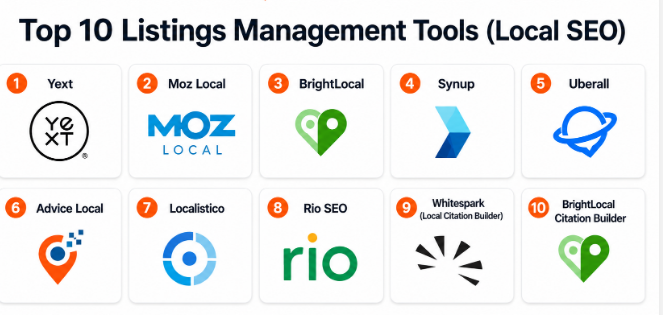
Top 10 Listings Management Tools (Local SEO)
#1 — Yext
Short description: Yext is a widely used listings management platform that helps businesses sync location data across hundreds of directories, search engines, maps, and voice assistants. Its strength lies in real‑time updates, extensive publisher network, and integration with search and map platforms.
Key Features
- Real‑time listing sync to major directories
- Duplicate detection and correction
- Local search analytics and visibility tracking
- Review monitoring and response workflows
- Knowledge Graph for structured data management
- API access for custom integrations
Pros
- Broad publisher coverage including maps and voice platforms
- Strong real‑time updating and duplicate detection
Cons
- Premium pricing for comprehensive features
- Advanced capabilities may require training
Platforms / Deployment
- Web / Mobile
- Cloud
Security & Compliance
- Role‑based access, encryption
- Not publicly stated for certifications
Integrations & Ecosystem
Integrates with CRM, analytics, reporting, and marketing platforms.
Support & Community
Documentation, onboarding support, and training resources.
#2 — Moz Local
Short description: Moz Local focuses on improving local search visibility by ensuring consistent business listings across essential directories and search engines, with auditing, correction, and reporting tools built for SMBs and agencies.
Key Features
- Listing distribution to key local directories
- Automated data correction
- Duplicate suppression
- Local visibility analytics
- Review monitoring
- Local ranking signals
Pros
- User‑friendly and approachable for SMBs
- Strong analytics for local search visibility
Cons
- Coverage smaller than enterprise networks
- Less suited for very large multi‑location needs
Platforms / Deployment
- Web
- Cloud
Security & Compliance
- Standard encryption and access controls
- Not publicly stated
Integrations & Ecosystem
CRM, analytics, and SEO tools.
Support & Community
Documentation, knowledge base, and customer support.
#3 — BrightLocal
Short description: BrightLocal specializes in local SEO, offering listings management, reputation tracking, local ranking reports, and auditing tools ideal for agencies and small businesses.
Key Features
- Local listing sync and audit tools
- Reputation & review monitoring
- Local search rank tracking
- Citation cleanup
- Reporting templates
Pros
- Local SEO focus with integrated reporting
- Designed for agencies and SMBs
Cons
- Listing coverage narrower than large enterprise tools
- Some features require manual configuration
Platforms / Deployment
- Web
- Cloud
Security & Compliance
- Encryption and permissions
- Not publicly stated
Integrations & Ecosystem
Integration with SEO, CRM, and analytics workflows.
Support & Community
Documentation, tutorials, and support resources.
#4 — Synup
Short description: Synup provides listings management, ratings & reviews tracking, and local analytics that help businesses improve local presence and customer engagement across channels.
Key Features
- Real‑time listings sync
- Review monitoring and reporting
- Duplicate detection
- Local search performance analytics
- API access
Pros
- Strong mix of listings and review insights
- Suitable for multi‑location brands
Cons
- Reporting requires configuration
- UI complexity for new users
Platforms / Deployment
- Web / Mobile
- Cloud
Security & Compliance
- Data encryption and access control
- Not publicly stated
Integrations & Ecosystem
CRM, analytics, and reputation tools.
Support & Community
Support, documentation, and onboarding guides.
#5 — Uberall
Short description: Uberall helps businesses manage local listings, interactions, and online presence across maps, directories, and search platforms, with a focus on user engagement and local visibility.
Key Features
- Listing sync and optimization
- Local search analytics
- Review & sentiment monitoring
- Competitive benchmarking
- API and custom integrations
Pros
- Strong analytics and engagement focus
- Local search and review integration
Cons
- Enterprise pricing landscape
- Advanced features require training
Platforms / Deployment
- Web / Mobile
- Cloud
Security & Compliance
- Role permissions and encryption
- Not publicly stated
Integrations & Ecosystem
Integrates with search, CRM, and analytics systems.
Support & Community
Documentation, onboarding support, and customer service.
#6 — Advice Local
Short description: Advice Local provides listings distribution and management, including syndication to niche directories, citation building, and local search optimization tailored for SMBs and agencies.
Key Features
- Listings distribution & syndication
- Citation building & clean‑up
- Local search reporting
- Review tracking
- Exportable analytics
Pros
- Affordable and citation‑focused
- Useful for agency workflows
Cons
- Less real‑time sync than enterprise players
- Smaller network than broader platforms
Platforms / Deployment
- Web
- Cloud
Security & Compliance
- Encryption and role-based access
- Not publicly stated
Integrations & Ecosystem
CRM and reporting systems.
Support & Community
Support documentation and onboarding.
#7 — Localistico
Short description: Localistico aims to unify listings, insights, and local engagement analytics, with dashboards designed for multi‑location businesses to understand local performance and reputation signals.
Key Features
- Listings distribution
- Local visibility analytics
- Review & sentiment monitoring
- Dashboard reporting
- Competitive insights
Pros
- Unified local insights dashboards
- Designed for enterprise multi‑location
Cons
- Less well known than major enterprise platforms
- Feature set evolving
Platforms / Deployment
- Web / Cloud
Security & Compliance
- Encryption and data controls
- Not publicly stated
Integrations & Ecosystem
CRM, analytics, and reporting.
Support & Community
Documentation and support.
#8 — Rio SEO
Short description: Rio SEO provides enterprise-level local search optimization and listings management, coupled with analytics and workflows for large multi‑location brands.
Key Features
- Listings sync at scale
- Local ranking analytics
- Citation clean‑up automation
- Review monitoring
- API and BI integration
Pros
- Enterprise‑grade scalability
- Deep analytics and workflows
Cons
- Complex setup
- Pricing tailored to enterprise budgets
Platforms / Deployment
- Web / Cloud
Security & Compliance
- Enterprise access controls and encryption
- Not publicly stated
Integrations & Ecosystem
CRM, analytics, BI integrations.
Support & Community
Enterprise support and documentation.
#9 — Whitespark (Local Citation Builder)
Short description: Whitespark focuses on local citation building and audit services, helping businesses identify and correct citation gaps, duplicates, and inconsistencies that harm local visibility.
Key Features
- Citation audit and tracking
- Local listing suggestions
- Duplicate detection
- Local SEO insights
Pros
- Excellent citation audit and recommendations
- Useful for local SEO campaigns
Cons
- Does not offer real‑time sync like others
- Manual workflows required
Platforms / Deployment
- Web
- Cloud
Security & Compliance
- Standard encryption and access control
- Not publicly stated
Integrations & Ecosystem
CRM and reporting tools.
Support & Community
Documentation and support resources.
#10 — BrightLocal Citation Builder
Short description: While part of the broader BrightLocal suite, the Citation Builder focuses specifically on identifying, creating, and managing local citations to improve local search presence.
Key Features
- Citation building and submission
- Local SEO auditing
- Duplicate detection
- Progress tracking
Pros
- Ideal for local SEO specialists
- Integrates with broader SEO workflows
Cons
- Citation focus only
- Not a full real‑time listings sync solution
Platforms / Deployment
- Web
- Cloud
Security & Compliance
- Encryption and access controls
- Not publicly stated
Integrations & Ecosystem
CRM and analytics export.
Support & Community
Documentation and support.
Comparison Table (Top 10)
| Tool Name | Best For | Platforms Supported | Deployment | Standout Feature | Public Rating |
|---|---|---|---|---|---|
| Yext | Enterprise listings | Web, Mobile | Cloud | Real‑time sync & broad network | N/A |
| Moz Local | SMB & agencies | Web | Cloud | User‑friendly local SEO | N/A |
| BrightLocal | Local SEO specialists | Web | Cloud | Integrated local SEO analytics | N/A |
| Synup | Multi‑location brands | Web, Mobile | Cloud | Listings + review insights | N/A |
| Uberall | Enterprise & mid‑market | Web, Mobile | Cloud | Local engagement analytics | N/A |
| Advice Local | Agencies & SMBs | Web | Cloud | Citation syndication | N/A |
| Localistico | Multi‑location insights | Web | Cloud | Unified local dashboards | N/A |
| Rio SEO | Enterprise local SEO | Web | Cloud | BI & analytic integrations | N/A |
| Whitespark | Citation audit | Web | Cloud | Citation recommendations | N/A |
| BrightLocal Citation Builder | Citation specialist | Web | Cloud | Citation building tools | N/A |
Evaluation & Scoring of Listings Management Tools
| Tool Name | Core Features | Ease | Integrations | Security | Performance | Support | Value | Weighted Total |
|---|---|---|---|---|---|---|---|---|
| Yext | 9 | 7 | 8 | 8 | 9 | 8 | 7 | 8.2 |
| Moz Local | 8 | 9 | 7 | 8 | 8 | 8 | 8 | 8.1 |
| BrightLocal | 8 | 8 | 8 | 7 | 8 | 8 | 8 | 8.0 |
| Synup | 8 | 7 | 8 | 8 | 8 | 7 | 8 | 7.9 |
| Uberall | 8 | 8 | 8 | 7 | 8 | 7 | 7 | 7.8 |
| Advice Local | 7 | 8 | 7 | 8 | 7 | 7 | 8 | 7.6 |
| Localistico | 7 | 8 | 7 | 7 | 7 | 7 | 8 | 7.5 |
| Rio SEO | 9 | 6 | 9 | 8 | 9 | 7 | 7 | 7.9 |
| Whitespark | 7 | 8 | 7 | 7 | 7 | 7 | 8 | 7.5 |
| BrightLocal CB | 6 | 8 | 7 | 7 | 7 | 7 | 8 | 7.4 |
Which Listings Management Tool Is Right for You?
Solo / Freelancer
- Moz Local and BrightLocal provide accessible platforms with strong local SEO insights and simple dashboards.
SMB
- Synup, Advice Local, and BrightLocal balance affordability with essential listings features and local SEO insights.
Mid‑Market
- Uberall, Synup, and Yext offer multi‑location capabilities and integrated analytics.
Enterprise
- Yext and Rio SEO provide scalability, real‑time sync, BI integration, and robust workflows for large global presences.
Budget vs Premium
- Budget: Advice Local, BrightLocal Citation Builder, Whitespark
- Premium: Yext, Uberall, Rio SEO
Feature Depth vs Ease of Use
- Depth: Yext, Rio SEO
- Ease: Moz Local, BrightLocal
Integrations & Scalability
- Enterprise teams should prioritize tools with APIs and CRM/analytics integration support.
Security & Compliance Needs
- Role‑based access, encryption, and workflow approvals are essential for distributed teams and regulated industries.
Frequently Asked Questions (FAQs)
1— What are listings management tools?
Listings management tools ensure accurate business information across directories, maps, search engines, and listings networks to boost local search visibility and consumer trust.
2— Why is NAP consistency important?
Consistent business name, address, and phone number (NAP) signals help search engines trust your local listings, boosting visibility and preventing customer confusion.
3— Do these tools fix duplicate listings?
Yes — many platforms detect and help merge or suppress duplicate entries that harm local SEO performance.
4— Can I manage multiple locations?
Tools like Yext, Synup, and Uberall are designed for multi‑location enterprises with centralized dashboards.
5— Do these tools track local search rankings?
Yes — platforms often include ranking performance for local SERP and map pack visibility.
6— Are reviews integrated into listings management?
Several platforms integrate review monitoring and sentiment tracking to provide a comprehensive local reputation picture.
7— How often do listings update?
Enterprise tools sync changes in real time, while others update within scheduled cycles.
8— Do they integrate with CRM systems?
Yes — many enterprise and mid‑market tools offer API or native integrations with CRM and analytics platforms.
9— Are voice assistants covered?
Some platforms include directory and structured data support for voice search platforms to improve voice query visibility.
10— How do these tools improve local SEO?
By ensuring accurate, consistent, and optimized listings across directories, maps, and search engines — which improves visibility in local search results and increases conversions.
Conclusion
Listings management tools are essential for businesses seeking visibility in local search and map results. Whether you’re a solo marketer or managing global multi‑location presences, accurate and consistent listings improve local SEO performance, customer trust, and overall reputation.Small businesses and agencies will benefit from tools like Moz Local, BrightLocal, and Advice Local, while mid‑market companies can leverage Synup and Uberall for multi‑location insights. Enterprise brands should consider Yext and Rio SEO for real‑time sync, BI integration, and scalable workflows.
