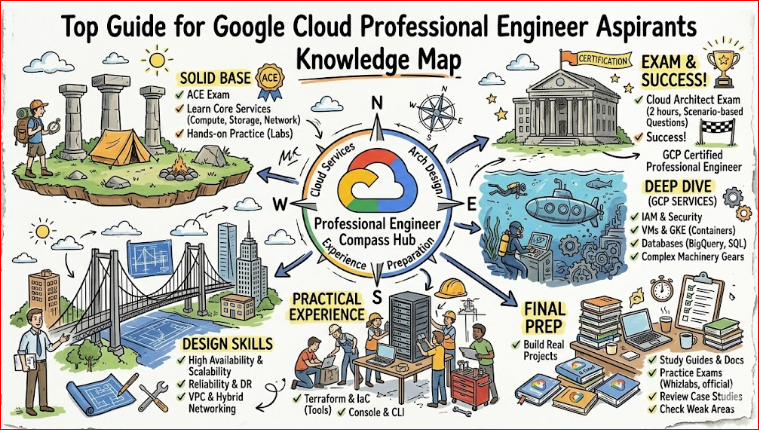
Introduction
Cloud computing is now a core part of modern software delivery, business operations, and digital transformation. Companies across India and globally are looking for engineers who can design, build, run, and improve cloud systems in a secure and scalable way. That is why the Google Cloud Professional Engineer certification has become an important career milestone for working professionals. This guide is designed for engineers, software professionals, and managers who want practical clarity about the certification path. It explains what the certification is, who should take it, the skills you can gain, how to prepare, common mistakes to avoid, and what certifications to take next. The goal is simple: help you make a smart, career-focused decision.
Why This Certification Matters
Today, cloud roles are not limited to provisioning virtual machines or managing storage. Organizations need professionals who understand architecture, automation, security, deployment pipelines, observability, and production reliability. This certification helps validate that you can think and work like a real cloud engineer in modern environments. For working engineers, this certification can improve technical confidence and strengthen interview performance. For managers, it builds better understanding of cloud delivery decisions, team expectations, and project risks. In many cases, it also helps professionals move from support or admin roles into higher-value engineering and platform roles. It is especially useful if you want to take ownership of cloud systems end-to-end. Instead of only focusing on one tool, you begin to understand how services connect across networking, identity, deployment, monitoring, and operations. That broader view is what makes this certification valuable in real organizations.
What It Is
Google Cloud Professional Engineer is a professional-level cloud certification path that focuses on designing, deploying, operating, and improving solutions on Google Cloud. It is meant for professionals who want to handle real engineering responsibilities in production environments. The certification supports practical understanding of cloud architecture, deployment workflows, security, reliability, and operations. In simple terms, it helps you learn how to build cloud systems that are not only functional, but also scalable, secure, and maintainable.
Who Should Take It
This certification is a strong fit for professionals who already work with infrastructure, cloud platforms, or software delivery and want to grow into broader engineering responsibility. It is especially useful for people who are moving from execution-only tasks into architecture, automation, and system ownership roles.
It is also a good option for software engineers who want to become cloud-native engineers and understand deployment in real environments. Engineering managers can also benefit because this certification helps them understand technical trade-offs, cloud operations realities, and team-level decision-making.
If you are switching from another cloud ecosystem, this certification can help you build Google Cloud capability without starting from zero. Your existing knowledge in Linux, networking, security, and automation can be reused and strengthened through a structured Google Cloud learning path.
Ideal candidates include:
- Cloud Engineers
- DevOps Engineers
- SREs
- Platform Engineers
- Software Engineers moving to cloud roles
- Engineering Managers
- Consultants / Architects guiding cloud transformation
Skills You’ll Gain
A serious preparation journey for this certification helps you build more than exam knowledge. It builds practical engineering thinking around how cloud services are selected, connected, secured, monitored, and maintained in production. This is the type of knowledge that improves both performance at work and credibility in interviews.
You will also learn how cloud decisions affect system reliability, scalability, and operational effort. For example, the choice of identity model, network design, or deployment pattern can directly affect security, troubleshooting effort, and delivery speed. This certification pushes you to think in those practical terms.
Another important benefit is that you begin to connect infrastructure and application delivery as one system. Instead of studying tools separately, you learn how compute, storage, networking, IAM, monitoring, and deployment come together in real cloud projects.
Key skills you’ll gain:
- Google Cloud core services and architecture planning
- Compute, storage, networking, and IAM design basics
- Deployment and production operations on cloud
- CI/CD workflow thinking for cloud delivery
- Monitoring, logging, and troubleshooting practices
- Reliability, scaling, and resilience planning
- Security and compliance-aware cloud implementation
- Cost-aware cloud engineering decisions
Real-World Projects You Should Be Able to Do After It
A good certification should help you perform real work, not just answer theoretical questions. After preparing properly for Google Cloud Professional Engineer, you should be able to understand and execute common cloud engineering tasks across design, deployment, security, and operations. This makes the certification much more useful in real job roles.
You should also be able to explain your decisions clearly, which is a key requirement in interviews and team discussions. Many professionals know how to click and configure services, but fewer can explain why a design is reliable, secure, or scalable. This certification path helps develop that practical reasoning.
The project outcomes below are realistic examples of what learners should aim for after completing a serious preparation plan. They are useful as portfolio ideas, interview talking points, and internal project responsibilities.
Projects you should be able to handle:
- Design and deploy a production-ready application on Google Cloud
- Set up IAM roles and secure access for users and services
- Configure monitoring, logs, and alerts for cloud workloads
- Build a simple CI/CD deployment flow for cloud applications
- Create scalable deployment patterns using load balancing/autoscaling
- Plan a cloud migration for a small or medium application
- Troubleshoot deployment, access, and performance issues
- Define backup and recovery approach for critical services
- Document architecture and runbooks for team operations
Prerequisites (Practical, Not Formal)
This certification can be started without a strict formal prerequisite, but some basic technical foundation makes preparation much easier. If you already understand Linux, networking, and basic cloud concepts, you will learn faster and connect concepts better. If you do not, you can still succeed with a slower and more structured plan.
Many learners struggle not because the topics are impossible, but because they try to study advanced cloud scenarios without fundamentals. For example, IAM and networking become confusing when basic identity and network flow concepts are weak. A little preparation in fundamentals can save a lot of time later.
Think of these prerequisites as “success accelerators,” not barriers. Even if you are a beginner, you can build them step by step while preparing.
Helpful prerequisites:
- Basic Linux command line usage
- Networking basics (IP, DNS, ports, subnets, routing)
- Cloud fundamentals (compute, storage, IAM basics)
- Scripting basics (Shell or Python)
- Basic understanding of app deployment workflows
- Familiarity with containers/CI-CD (helpful, not mandatory)
Preparation Plan (7–14 Days / 30 Days / 60 Days)
A good preparation plan should match your current experience and available time. Many professionals fail because they copy someone else’s plan instead of choosing a path that fits their background. The right plan should balance theory, hands-on practice, revision, and mock-based assessment.
You should also avoid studying every topic with the same depth. Some areas like IAM, networking, architecture, and operations usually need more attention because they appear in practical scenarios often. A structured plan helps you spend time where it matters most.
Below are three practical preparation paths that work well for different learner types.
7–14 Day Plan (Fast Track for Experienced Engineers)
This plan is best for professionals who already work in cloud, DevOps, or infrastructure roles and need a focused revision strategy. It assumes you understand core concepts but need structured coverage of Google Cloud services and exam-style scenario thinking. The main goal here is consolidation, not beginner learning.
You should spend most of your time on weak areas, real use cases, and practice scenarios rather than passive reading. Fast-track learners often know the basics but lose marks on architecture trade-offs and troubleshooting logic. Daily revision notes and timed mock practice are important in this plan.
Suggested breakdown:
- Days 1–2: Review certification scope + core service categories
- Days 3–5: Compute, storage, IAM, and networking focus
- Days 6–8: Deployment, operations, logging, monitoring, troubleshooting
- Days 9–10: Security, reliability, resilience, cost basics
- Days 11–12: Mock questions + architecture scenarios
- Days 13–14: Final revision + weak topic reinforcement
30 Day Plan (Balanced Plan for Working Professionals)
This is the most practical plan for working engineers who have some cloud exposure but limited depth in Google Cloud. It gives enough time to study consistently without feeling overloaded, especially if you are balancing office work and personal commitments. It also supports both understanding and retention.
The biggest advantage of this plan is that you can combine learning with hands-on practice after each topic. This improves memory and confidence because you are not only reading about cloud services, but also applying them in simple scenarios. Mock practice in the last week helps you identify gaps before the final attempt.
Suggested breakdown:
- Week 1: Cloud fundamentals + core GCP services
- Week 2: IAM, networking, security, and architecture basics
- Week 3: Deployment, automation, monitoring, and troubleshooting
- Week 4: Scenarios, mock practice, revision, and readiness checks
Daily routine recommendation:
- 60–90 minutes on weekdays
- 2–3 hours on weekends
- Hands-on practice after each major topic
60 Day Plan (Beginner-to-Confident Plan)
This plan is ideal for beginners, software engineers switching to cloud, and managers who want technical understanding without rushing. It gives enough time to build a strong base before moving into certification-level topics. This slower approach is often better for long-term career growth because it improves practical retention.
A 60-day plan also reduces stress and allows you to revisit difficult topics like IAM, networking, and operations multiple times. Beginners often need repeated exposure to connect cloud services into one system view. That repetition is a strength, not a weakness.
Suggested breakdown:
- Weeks 1–2: Linux/networking review + cloud fundamentals
- Weeks 3–4: Google Cloud core services and basic use cases
- Weeks 5–6: Security, reliability, observability, and automation basics
- Week 7: Mini projects + architecture scenarios + troubleshooting
- Week 8: Mock tests + revision + exam confidence improvement
Common Mistakes
Many professionals work hard but still feel confused during preparation because their study approach is not aligned with real cloud engineering. They focus too much on memorization and too little on understanding how services work together in production systems. This creates weak confidence during scenario-based questions and interviews.
Another common issue is inconsistency. Learners collect too many videos, notes, and websites, but do not follow one structured path from fundamentals to practice to revision. A clear plan is more powerful than many random resources.
Avoiding the mistakes below can improve both exam preparation and real job readiness.
Common mistakes to avoid:
- Studying only theory and skipping hands-on practice
- Memorizing service names without understanding use cases
- Ignoring IAM and networking because they feel difficult
- Learning isolated tools instead of end-to-end architecture
- Not practicing troubleshooting and failure scenarios
- Skipping monitoring/logging topics thinking they are “easy”
- Delaying mock tests until the last moment
- Not tracking weak areas in notes
- Following too many unstructured resources
- Focusing on exam shortcuts over long-term engineering skill
Best Next Certification After This
After completing Google Cloud Professional Engineer, the next certification should depend on your actual role and career direction. Many learners make the mistake of collecting unrelated certifications, which increases study time but gives limited career value. The better approach is to choose the next step that deepens your real work capability.
If your current role is cloud delivery and operations, a same-track certification that strengthens DevOps or platform engineering skills can be ideal. If your goal is broader ownership, cross-track options like DevSecOps, SRE, DataOps, or FinOps can make your profile stronger in modern teams. If you are moving toward leadership, architecture and management-focused certifications are better.
The next certification should answer this question: “What kind of work do I want to do more of in the next 12 months?” That answer should guide your path.
Best next options:
- Same-track: Deeper cloud/DevOps/platform operations certification
- Cross-track: DevSecOps, SRE, DataOps, AIOps/MLOps, or FinOps
- Leadership-track: Cloud architecture or engineering leadership path
Choose Your Path (6 Learning Paths)
Not every learner should follow the same sequence after a cloud certification. Your role, project type, team responsibilities, and career goal should decide what comes next. This section helps readers choose a practical path instead of studying everything at once.
These six paths are useful because they map cloud engineering into real-world specialization tracks. In modern organizations, cloud work is closely connected with DevOps, security, reliability, AI/ML platforms, data pipelines, and cost governance. Choosing a path early helps you learn with direction.
1) DevOps Path
This path is ideal for professionals who want to build deployment automation, CI/CD pipelines, infrastructure workflows, and reliable cloud operations. It is a strong fit for engineers who work closely with development and release teams. The focus here is speed, consistency, and operational quality in cloud delivery.
A DevOps path after Google Cloud Professional Engineer helps you move from “cloud user” to “cloud delivery engineer.” It strengthens practical skills that are directly useful in software release pipelines and production operations.
Suggested order:
- Cloud Fundamentals
- Google Cloud Professional Engineer
- CI/CD and Automation Certification
- Kubernetes / Container Operations
- Advanced DevOps Engineering
2) DevSecOps Path
This path is best for professionals who want to combine cloud delivery with security, compliance, and secure engineering practices. It is highly relevant because many organizations now want security integrated into pipelines rather than handled as a final review step. Cloud engineers with DevSecOps understanding become much more valuable.
After Google Cloud Professional Engineer, this path helps you understand how to secure access, pipelines, workloads, and operational processes. It also builds stronger collaboration with security teams and improves risk-aware engineering decisions.
Suggested order:
- Cloud Fundamentals
- Google Cloud Professional Engineer
- Cloud Security Basics
- DevSecOps Practitioner / Professional
- Secure CI/CD and Compliance Automation
3) SRE Path
This path is for engineers focused on uptime, service health, incident response, and reliability engineering. It is a natural extension for cloud professionals because many cloud roles eventually involve monitoring, alerting, scaling, and operational resilience. SRE is especially useful in production-heavy environments.
A Google Cloud Professional Engineer foundation makes SRE learning easier because you already understand cloud services and deployment patterns. The SRE path then adds structure around reliability targets, observability, and operational excellence.
Suggested order:
- Cloud Fundamentals
- Google Cloud Professional Engineer
- Monitoring and Observability Fundamentals
- SRE Foundation / Professional
- Incident Response and Reliability Engineering
4) AIOps / MLOps Path
This path is useful for professionals working with data science teams, ML platforms, or intelligent operations use cases. Modern cloud environments often require automation around model deployment, monitoring, and operational decision-making. This path connects cloud engineering with AI/ML lifecycle operations.
After Google Cloud Professional Engineer, this path helps learners understand how cloud infrastructure supports model training, deployment, monitoring, and automated operations. It is a strong option for future-focused roles where engineering and AI platforms overlap.
Suggested order:
- Cloud Fundamentals
- Google Cloud Professional Engineer
- Containers/Kubernetes Basics
- MLOps / AIOps Foundation
- ML Pipeline Operations and Monitoring
5) DataOps Path
This path is best for data engineers and platform teams managing pipelines, transformations, quality checks, and reliable data delivery in cloud environments. Data systems need not only processing knowledge but also strong cloud infrastructure understanding. This is where Google Cloud Professional Engineer becomes a strong base.
With a DataOps path, you move from just building data pipelines to managing them as production systems. That includes automation, reliability, governance, and team collaboration across data and platform functions.
Suggested order:
- Cloud Fundamentals
- Google Cloud Professional Engineer
- Data Engineering Fundamentals
- DataOps Practices and Pipeline Automation
- Data Platform Reliability and Governance
6) FinOps Path
This path is ideal for professionals involved in cloud cost control, optimization, governance, and budgeting. Many organizations now need engineers who understand not just performance and reliability, but also cost impact. FinOps skills are especially useful for platform teams, cloud operations, and engineering managers.
After learning cloud engineering through Google Cloud Professional Engineer, this path helps you make better design decisions with cost awareness. It teaches how usage patterns, architecture choices, and governance affect cloud spending in real environments.
Suggested order:
- Cloud Fundamentals
- Google Cloud Professional Engineer
- Cloud Cost Management Basics
- FinOps Foundation / Practitioner
- Cloud Optimization and Governance
Role → Recommended Certifications
| Role | Recommended Starting Point | Next Recommended Certification | Why It Helps |
|---|---|---|---|
| DevOps Engineer | Google Cloud Professional Engineer | DevOps / CI-CD / Kubernetes track | Improves deployment automation and production operations |
| SRE | Google Cloud Professional Engineer | SRE / Observability certification | Builds reliability, alerts, incident response skills |
| Platform Engineer | Google Cloud Professional Engineer | Kubernetes / Platform Engineering track | Helps standardize internal platforms and reusable services |
| Cloud Engineer | Google Cloud Professional Engineer | Cloud Security or DevOps track | Expands from provisioning to secure operations |
| Security Engineer | Google Cloud Professional Engineer | DevSecOps / Cloud Security track | Adds cloud implementation depth to security decisions |
| Data Engineer | Google Cloud Professional Engineer | DataOps / Data Engineering track | Strengthens infrastructure + pipeline operations |
| FinOps Practitioner | Google Cloud Professional Engineer | FinOps certification | Connects cloud architecture decisions with cost outcomes |
| Engineering Manager | Google Cloud Professional Engineer | Cloud Architecture / Leadership track | Improves planning, review, hiring, and technical governance |
Certification Table
| Certification | Track | Level | Who it’s for | Prerequisites | Skills covered | Recommended order |
|---|---|---|---|---|---|---|
| Google Cloud Professional Engineer | Cloud / DevOps | Professional | Cloud, DevOps, SRE, Platform engineers | Cloud basics, Linux, networking | GCP architecture, deployment, operations, reliability | 2 |
| Cloud Fundamentals | Cross-track | Foundation | Beginners, managers, software engineers | Basic IT knowledge | Cloud concepts, service models, basics | 1 |
| DevOps Foundation | DevOps | Foundation | DevOps beginners | Linux + basic SDLC | CI/CD basics, automation, collaboration | 3 |
| DevOps Professional | DevOps | Professional | Working DevOps engineers | Foundation + project exposure | Pipelines, IaC, automation, operations | 4 |
| Kubernetes Fundamentals | DevOps / Platform | Foundation | Platform/cloud engineers | Containers basics | Pods, services, deployment basics | 3 |
| Kubernetes Operations / Admin | DevOps / Platform | Intermediate | DevOps, SRE, platform teams | K8s fundamentals | Cluster operations, scaling, troubleshooting | 4 |
| DevSecOps Foundation | DevSecOps | Foundation | DevOps + Security teams | DevOps basics | Security in CI/CD, shift-left principles | 3 |
| DevSecOps Professional | DevSecOps | Professional | Security engineers, DevOps engineers | Foundation + cloud basics | Secure pipelines, automation, compliance | 4 |
| Cloud Security Fundamentals | DevSecOps | Foundation | Security and cloud teams | Basic cloud knowledge | IAM, network security, access controls | 3 |
| SRE Foundation | SRE | Foundation | Ops, platform, reliability teams | Linux, monitoring basics | SLI/SLO/SLA, incidents, reliability basics | 3 |
| SRE Professional | SRE | Professional | Working SREs and senior ops engineers | SRE foundation + production exposure | Reliability engineering, capacity, incident response | 4 |
| Observability / Monitoring Certification | SRE | Intermediate | SRE, Ops, support engineers | Infra/application basics | Logs, metrics, traces, alerts | 4 |
| AIOps Foundation | AIOps | Foundation | Ops teams exploring automation | Monitoring basics | Event correlation, automation concepts | 4 |
| MLOps Foundation | AIOps / MLOps | Foundation | ML engineers, platform teams | Python + ML basics (helpful) | ML lifecycle operations, deployment basics | 4 |
| DataOps Foundation | DataOps | Foundation | Data engineers, analytics teams | Data pipeline basics | Pipeline automation, governance, data quality | 4 |
| Data Engineering Professional | DataOps | Professional | Data engineers | SQL, ETL basics, cloud basics | Data architecture, pipelines, scaling | 5 |
| FinOps Foundation | FinOps | Foundation | Cloud owners, finance, ops teams | Cloud basics | Cost visibility, tagging, budgeting | 4 |
| FinOps Practitioner | FinOps | Intermediate | Cloud cost and platform teams | FinOps foundation | Optimization, governance, showback/chargeback | 5 |
Next Certifications to Take (3 Options)
After Google Cloud Professional Engineer, the smartest next step depends on whether you want deeper cloud execution, broader specialization, or leadership growth. Many professionals rush into another exam immediately, but it is better to choose the next certification based on role responsibilities and the kind of projects you want to handle.
The three options below give a practical framework that works for most professionals. They also help readers avoid confusion and build a certification strategy with long-term career value.
1) Same Track (Deepen Cloud + Delivery)
This option is best for professionals who want stronger implementation capability in cloud operations, DevOps workflows, and platform engineering. It helps you become more effective in delivery, automation, and production support roles. Choose this path if your day-to-day work is already cloud-heavy and you want deeper hands-on strength.
2) Cross-Track (Expand Into DevSecOps / SRE / DataOps / FinOps)
This path is ideal if you want to increase your career scope and become more valuable across teams. Cloud roles now overlap with security, reliability, cost management, and data operations, so cross-track skills create stronger real-world relevance. It is a good option for professionals who want future-proof growth.
3) Leadership Track (Architecture / Engineering Management)
This option is suited for senior engineers, tech leads, and engineering managers who want stronger design and decision-making capability. Leadership-track certifications help in architecture reviews, risk planning, team direction, and business-aligned technical choices. It is less about configuration depth and more about system-level thinking.
List of Top Institutions for Training cum Certifications in Google Cloud Professional Engineer
DevOpsSchool
DevOpsSchool is a well-known training provider for cloud, DevOps, SRE, and related certification programs. It is popular among working professionals because it focuses on practical learning, structured guidance, and career-oriented preparation. For Google Cloud Professional Engineer aspirants, it can help with roadmap-based learning, real-world concepts, and certification support.
Cotocus
Cotocus is known for enterprise-focused technology training and consulting-oriented learning support. It can be helpful for learners who want to understand cloud implementation from both technical and business perspectives. This makes it useful for professionals preparing for certifications while also improving real project understanding.
Scmgalaxy
Scmgalaxy has strong visibility in the DevOps and automation learning space and is often considered by technical learners. It supports foundational to advanced learning in cloud and DevOps-related areas. For Google Cloud Professional Engineer preparation, it can be a useful option for structured concept building and guided learning.
BestDevOps
BestDevOps is recognized for training programs in DevOps, cloud, and modern IT engineering domains. It is often chosen by learners looking for certification-aligned preparation with practical examples and role-based skills. This makes it useful for professionals who want both exam support and real-world knowledge.
devsecopsschool.com
devsecopsschool.com is a strong option for professionals who want to combine cloud engineering knowledge with security-focused practices. It helps learners understand the connection between cloud platforms, security controls, and secure delivery pipelines. This is especially useful for those planning a DevSecOps path after cloud certification.
sreschool.com
sreschool.com is helpful for professionals focusing on reliability engineering, observability, and incident response. It complements Google Cloud Professional Engineer preparation by strengthening operational excellence and production reliability skills. This is a good choice for learners targeting SRE or platform reliability roles.
aiopsschool.com
aiopsschool.com supports learners who want to explore AIOps, operational intelligence, and automation-driven monitoring practices. It can help cloud engineers expand toward modern operations and intelligent system management use cases. This is useful for professionals planning to combine cloud engineering with AIOps/MLOps growth.
dataopsschool.com
dataopsschool.com is useful for professionals working with data pipelines, analytics platforms, and cloud-based data operations. It helps learners understand how cloud engineering and data workflow reliability work together in real environments. This can be valuable for Data Engineers and DataOps practitioners after building cloud foundations.
finopsschool.com
finopsschool.com is a good option for professionals interested in cloud cost optimization, governance, and financial accountability. It helps connect technical cloud usage decisions with cost efficiency and business impact. This is especially useful for Cloud Engineers, managers, and FinOps practitioners managing cloud spend.
FAQs – Certification Program Focused
1) Is Google Cloud Professional Engineer difficult?
It can feel difficult if you prepare only through theory and memorization. However, when you study with hands-on practice and real scenarios, the difficulty becomes much more manageable. The certification rewards practical understanding more than surface-level knowledge.
2) How much time do I need to prepare?
Preparation time depends on your current experience in cloud and infrastructure. Experienced engineers may prepare in a shorter timeframe, while beginners may need a structured 30–60 day plan. The key is consistency, not speed.
3) Do I need coding experience?
You do not need advanced software development skills to start. But basic scripting knowledge is very helpful for automation, troubleshooting, and understanding operational workflows. Even simple Shell or Python skills can improve your learning speed.
4) Do I need prior Google Cloud experience?
Prior experience helps, but it is not mandatory if you follow a structured path. Many learners successfully prepare by first learning cloud fundamentals and then moving into Google Cloud service-level topics. Hands-on practice during preparation is very important.
5) Is this certification useful for DevOps roles?
Yes, it is very useful because DevOps work often includes cloud deployment, IAM, monitoring, automation, and operational troubleshooting. This certification strengthens the cloud side of DevOps capability. It also helps in real delivery and platform-focused responsibilities.
6) Is this certification useful for SRE roles?
Yes, especially for SREs working on reliability, observability, and service operations in cloud environments. A strong cloud engineering base makes it easier to handle scaling, incident response, and resilience planning. It also supports better architecture understanding.
7) Can managers also take this certification?
Yes, engineering managers and technical leads can benefit a lot from this certification path. It helps them understand cloud decisions, team challenges, and architecture trade-offs more clearly. This improves planning, hiring, review quality, and delivery governance.
8) What should I study first: cloud basics or certification topics?
Start with cloud basics if you are new or only partially familiar with cloud systems. A strong foundation makes professional-level topics easier to understand and remember. Jumping directly into advanced topics often causes confusion.
9) Should I focus more on services or architecture scenarios?
Both are important, but architecture and scenario-based understanding usually has more practical value. Knowing a service name is not enough if you cannot choose the right service for a real use case. Scenario thinking improves both exam and job performance.
10) Is this certification valuable for career growth?
Yes, it can significantly improve your profile for cloud engineering, DevOps, SRE, and platform roles. It also signals that you can think beyond basic provisioning and work with production-level systems. The value becomes stronger when supported by real projects.
11) What is the best sequence after this certification?
There is no one sequence for everyone. The best next step depends on your job role and target path such as DevOps, SRE, DevSecOps, DataOps, AIOps/MLOps, or FinOps. Role-based learning creates better outcomes than random certification collection.
12) Can I get a better job only with certification?
Certification helps improve credibility and visibility, but it is rarely enough by itself. Employers also look for hands-on project experience, troubleshooting ability, and communication skills. The best strategy is certification plus practical work examples.
FAQs on Google Cloud Professional Engineer
1) Who is the ideal candidate for Google Cloud Professional Engineer?
The ideal candidate is a working professional involved in cloud operations, DevOps, SRE, platform engineering, or application deployment. It is also a good fit for software engineers moving into cloud-native roles. Managers can use it to improve technical decision-making clarity.
2) Is this certification only for Google Cloud specialists?
No, it is not only for people already working deeply on Google Cloud. Professionals from AWS or Azure backgrounds can also benefit by building multi-cloud capability. It helps expand job opportunities and strengthens cloud architecture understanding.
3) What kind of questions should I expect while preparing?
Preparation usually includes scenario-based thinking around architecture, deployment, security, reliability, and operations. You should focus on use cases and decision-making, not only definitions. Practical troubleshooting understanding is also very valuable.
4) How important are networking and IAM for this certification?
They are extremely important because many cloud failures and access issues come from weak network design or incorrect permissions. A strong understanding of IAM and networking improves both exam readiness and real-world operations. These topics should never be skipped.
5) Can this certification help in freelance or consulting work?
Yes, it can improve trust and credibility when speaking with clients about cloud implementation or modernization projects. However, clients also expect practical capability, so project examples are important. Certification plus real execution experience is the strongest combination.
6) Should I build projects while studying?
Yes, building small but real projects is one of the best ways to prepare. Projects help you apply what you learn in deployment, IAM, monitoring, and troubleshooting. They also become useful examples in interviews and professional discussions.
7) What is the biggest mistake people make before the exam?
A common mistake is delaying mock practice and focusing too much on memorization. Many learners know service names but struggle with architecture choices and troubleshooting logic. Starting scenario practice earlier gives much better results.
8) What should I do after finishing the certification?
After finishing, choose a specialization path based on your role and future target. You can go deeper into DevOps, SRE, DevSecOps, DataOps, AIOps/MLOps, or FinOps. It is also a good time to build 1–2 portfolio projects that show practical cloud engineering capability.
Testimonials
Testimonial 1 — Rahul
“I was working in a support-focused role and wanted to move into cloud engineering, but I was confused about where to begin. This certification path gave me a clear structure and helped me think in terms of real production systems. The biggest change was my confidence in explaining cloud decisions during interviews.”
Testimonial 2 — Sneha
“I already had some cloud exposure, but I was missing depth in architecture and troubleshooting. Preparing for this certification helped me connect services, security, and operations more clearly. It improved both my technical discussions at work and my readiness for role upgrades.”
Testimonial 3 — Arjun
“As an engineering manager, I wanted stronger technical clarity to support my team better. This certification path helped me understand cloud trade-offs, reliability concerns, and operational planning in a practical way. It made my reviews and project decisions much more informed.”
Conclusion
Google Cloud Professional Engineer is a strong and practical certification choice for professionals who want to move beyond basic cloud usage and build real engineering capability. It helps you understand how to design, deploy, secure, monitor, and improve cloud systems in a way that supports real business and production needs. The biggest benefit is not just the certification itself, but the engineering thinking you develop during preparation. If you combine a structured study plan with hands-on practice, role-based learning paths, and the right next certification, this certification can become a major step forward in your career. Whether you are a DevOps Engineer, SRE, Platform Engineer, Cloud Engineer, Security Engineer, Data Engineer, FinOps Practitioner, or Engineering Manager, this path can help you grow with confidence and direction.

I really liked how the article highlights both technical skills and practical knowledge required for this certification. It gives a balanced understanding of the role.