Last updated: 29 November 2026
You should learn machine learning and AI if you want to use, question or build the systems that increasingly shape ordinary work. The payoff can be a new career, but more often it is being better at the job you already have: knowing what to automate, what to check and when a confident answer is wrong.
That does not mean everyone needs to train neural networks. The useful question is how deep you need to go. This guide covers the reasons, the evidence, the limits and a practical way to start.
What AI and machine learning actually are
Artificial intelligence (AI) is the broad field of building software that performs tasks we associate with human judgment, such as recognising images, understanding language or planning actions.
Machine learning (ML) is a part of AI in which a system learns patterns from data instead of following only hand-written rules. Deep learning is a part of ML that uses neural networks with many layers. Today’s generative AI tools, which produce text, images and code, are built on deep learning.
How a model learns
Consider a hypothetical spam filter. You collect emails that people have already marked as spam or not spam. A training algorithm adjusts the model until its predictions match those labels reasonably well.
You then test it on emails it has never seen. If it performs well enough, you put it to use and keep watching, because spammers change their tactics.
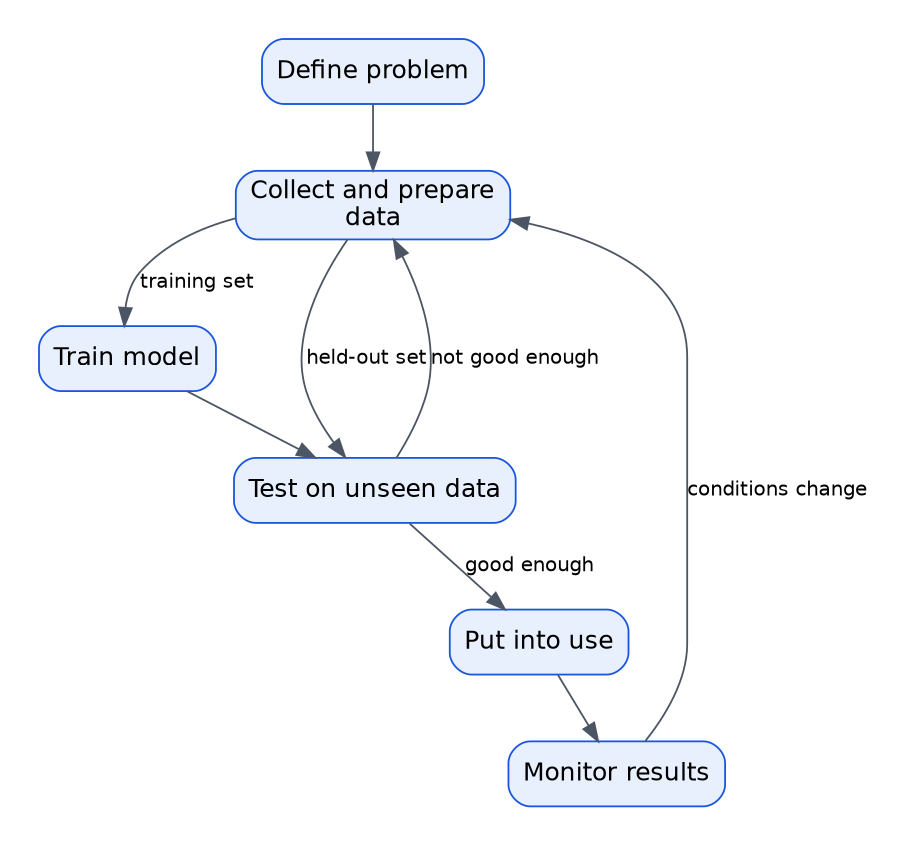
Most ML projects follow some version of this loop. Understanding it helps you ask better questions about almost any AI product.
Why learn machine learning and artificial intelligence?
1. AI is already part of everyday work and study
Stanford’s 2026 AI Index reports that generative AI reached 53% adoption among the population within three years, faster than the personal computer or the internet. It also reports that four in five US high school and college students use AI for schoolwork.
Using a tool is not the same as understanding it. Learning the basics shows why a model can write fluently and still be factually wrong, and why its output needs checking.
2. Employers expect skills to shift
The World Economic Forum’s Future of Jobs Report 2025 drew on more than 1,000 employers. It ranked AI and big data as the fastest-growing skill area, and listed AI and machine learning specialists among the fastest-growing roles in percentage terms.
The same employers expected 39% of workers’ core skills to change by 2030. These are expectations from a survey published in January 2025, not guaranteed outcomes.
3. Data careers have a strong official outlook
The US Bureau of Labor Statistics projects employment of data scientists to grow 35% from 2025 to 2035, much faster than the average for all occupations. It estimates about 24,800 openings a year and reports a median annual wage of $120,230 for 2025. The typical entry-level education it lists is a bachelor’s degree.
Read these figures carefully. They cover one occupation in one country, not every job with “AI” in its title. A short course alone should not be expected to produce that salary.
4. Your domain knowledge becomes more valuable
A nurse, accountant or logistics planner knows which errors matter and which data is misleading. Add ML literacy and that person can frame a problem, spot an unrealistic claim and judge whether a prediction is useful. The following examples are hypothetical:
- Marketing: testing whether a churn model really finds customers who are likely to leave.
- Operations: comparing a demand forecast with the simple method the team already uses.
- Human resources: asking whether a screening tool treats groups of applicants differently.
- Software testing: designing checks for features whose output varies between runs.
5. It sharpens your reasoning about evidence
ML teaches habits that transfer well: set a baseline, test on unseen data, look at the errors and separate correlation from cause. These help you evaluate reports, vendor demos and news stories, even if you never deploy a model.
6. Informed people can challenge automated decisions
Models can inherit gaps and bias from their data. Knowing this lets you ask who was missing from the data, how mistakes are caught and whether a person can appeal a decision.
The honest limits: what learning AI will not guarantee
AI skills are not job insurance. The 2026 AI Index reports that employment among US software developers aged 22 to 25 has fallen nearly 20% since 2024, while headcount for older developers grew. It notes similar declines in customer service.
For newcomers, this suggests that listing a course certificate may not be enough. Aim to show judgment: a finished project, a clear explanation of its weaknesses and knowledge of a real problem area.
Capability is also uneven. The same report says leading models match or exceed people on some advanced science and competition mathematics tasks, yet still struggle with things such as telling the time and multistep planning. Learning where systems fail is part of the skill.
How deep should you go?
| Level | Suits | What to learn | Evidence of skill |
|---|---|---|---|
| AI literacy | Almost anyone | Core concepts, prompting, fact-checking, privacy, bias | You can explain when not to trust an output |
| Applied user | Analysts, managers, domain experts | Data handling, metrics, experiment design, workflow automation | A measured improvement over the old process |
| AI application builder | Software developers | Python or another language, model APIs, retrieval, evaluation, security | A working app with repeatable tests |
| ML practitioner | Data scientists, ML engineers | Statistics, model training, feature work, deployment, monitoring | An end-to-end model with honest error analysis |
| Researcher | People creating new methods | Advanced mathematics, deep learning theory, reading and reproducing papers | Reproduced or original results |
Pick the lowest level that serves your goal, then go further if the work interests you.
What you need before you start
AI literacy needs no programming. Building models does need some. Google’s Machine Learning Crash Course assumes no earlier ML knowledge, but it recommends comfort with variables, linear equations, function graphs, histograms and means.
It also expects you to be a capable programmer, ideally in Python. Calculus is optional and mainly helps with advanced topics. If you are new to programming, learn basic Python first.
A sensible learning order
- Python and data: functions, loops, lists, dictionaries, then NumPy and pandas.
- Basic statistics: averages, spread, outliers and probability.
- Classic ML: regression, classification, train and test splits, overfitting.
- Evaluation: accuracy, precision, recall and the cost of each error type.
- Deep learning and generative AI: neural networks, language models and retrieval.
- Production and responsibility: deployment, monitoring, privacy and fairness.
Hands-on exercise: beat a baseline
This short exercise uses the small handwritten digits dataset included with scikit-learn. It compares a model that learns nothing useful with one that learns from the pixels. The code has not been tested here.
python -m venv .venv
source .venv/bin/activate      # Windows: .venv\Scripts\activate
pip install scikit-learn
Save this as digits.py and run it with python digits.py.
from sklearn.datasets import load_digits
from sklearn.dummy import DummyClassifier
from sklearn.linear_model import LogisticRegression
from sklearn.metrics import classification_report
from sklearn.model_selection import train_test_split

X, y = load_digits(return_X_y=True)

X_train, X_test, y_train, y_test = train_test_split(
    X, y, test_size=0.25, random_state=42, stratify=y
)

baseline = DummyClassifier(strategy="most_frequent")
baseline.fit(X_train, y_train)
print("Baseline accuracy:", baseline.score(X_test, y_test))

model = LogisticRegression(max_iter=5000)
model.fit(X_train, y_train)
print("Model accuracy:", model.score(X_test, y_test))

print(classification_report(y_test, model.predict(X_test)))
Now answer these questions:
- How far above the baseline is the model? With ten digit classes, why is the baseline so weak?
- Which digit has the lowest recall, and why might it be confused with others?
- What happens if you train on only 100 examples? Try
X_train[:100]andy_train[:100]. - Would this model work on photos of your own handwriting? What differs from the training data?
The last question matters most. A good test score describes performance on similar data, not on every input the real world may send.
Best practices for learning
- Start with a question you care about. Motivation lasts longer when the result is useful to you.
- Build small, complete projects. Define the problem, prepare data, set a baseline, evaluate and write up the limits.
- Use AI assistants as tutors, then verify. Ask for explanations, but write and debug some code yourself.
- Protect data. Do not paste confidential or personal information into tools unless you are authorised to.
- Keep a project log. Record what you changed, why and what happened.
Common mistakes and how to fix them
| Mistake | Why it hurts | Better approach |
|---|---|---|
| Collecting courses without building | Recognition feels like skill | Finish a project after each major topic |
| Starting with the most complex model | Hard to debug or justify | Begin with a simple baseline |
| Tuning against the test set | Scores become too optimistic | Use validation data or cross-validation; keep the test set for the end |
| Letting future or answer data leak into training | The model fails after release | Check that each input is available at prediction time |
| Reporting accuracy alone | Rare but costly errors stay hidden | Review precision, recall and actual failures |
| Waiting to master all the mathematics | Progress stalls | Learn the mathematics alongside the methods that use it |
Frequently asked questions
Is machine learning still worth learning when AI tools can write code?
Yes, if you want to judge the results. Generated code can run and still use leaked data, the wrong metric or a poor test. Understanding ML helps you catch those problems.
Should I learn AI or machine learning first?
Start with general AI concepts, then learn core ML. If your goal is building models, ML fundamentals make later work in deep learning and generative AI much easier to follow.
Do I need a degree?
Not to learn the subject or use it at work. Many specialist roles do ask for formal education, and the BLS lists a bachelor’s degree as typical for entry into data science.
How long does it take?
There is no reliable single figure. It depends on your programming and mathematics background, weekly study time and target level. Set milestones based on things you can build or explain.
Am I too late to start?
No fixed deadline exists. Tools change quickly, but data quality, evaluation and clear problem definition remain useful foundations.
Your next step
Choose one level from the table and one problem from your work or studies. Write down how you would measure success before choosing any tool. Then run the exercise above, or, if you do not code, test an AI assistant on ten questions whose answers you already know and note where it fails.