Introduction
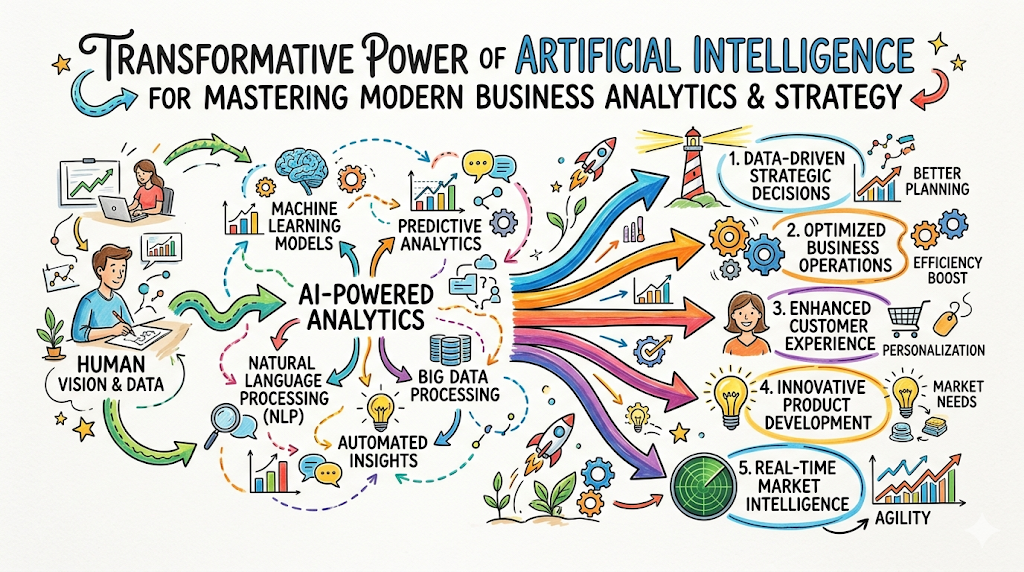
The modern business landscape is defined by the sheer volume of data generated every second, making manual analysis an increasingly obsolete practice. Artificial Intelligence has fundamentally changed how companies approach business analytics by enabling them to move beyond historical reporting toward a more proactive, intelligent understanding of their operations. By utilizing advanced algorithms and machine learning, organizations can now identify subtle patterns, forecast future trends with greater precision, and automate the decision-making process. This transition from basic data processing to intelligent foresight is what separates market leaders from their competitors in an data-driven economy. For those looking to deepen their expertise and master these sophisticated technologies, AIUniverse.xyz provides comprehensive resources and structured learning paths. This guide explores the core principles, strategic benefits, and operational frameworks that make AI a necessity for contemporary business analytics.
Understanding AI in Business Analytics
What is Business Analytics?
Business analytics is the process of collecting, processing, and analyzing data to gain insights that inform decision-making. It covers everything from basic descriptive statistics to complex predictive modeling, helping managers understand their operational performance.
What is Artificial Intelligence in Analytics?
Artificial Intelligence in analytics involves using advanced algorithms and machine learning to automate the analysis of large, complex datasets. It takes standard data processing a step further by identifying patterns that are too subtle or complex for human analysts to spot on their own.
Evolution of Data-Driven Decision Making
Initially, business decisions were made based on intuition and manual ledger tracking. This evolved into the era of basic spreadsheets and static reporting. Now, we are in the era of “Decision Intelligence,” where AI provides the context and speed necessary for real-time, informed choices.
Why Businesses Are Adopting AI Analytics
The primary driver for adoption is scale. With the explosion of digital data, manual analysis is no longer viable. Companies adopt AI to reduce the risk of human error, save time, and uncover hidden opportunities that would otherwise remain buried in “data silos.”
Core Ways AI Is Used in Business Analytics
Data Collection and Processing
AI tools automatically aggregate data from multiple sources—like social media, sales software, and website logs—and clean it up, ensuring that analysts work with accurate, high-quality information.
Customer Behavior Analysis
By tracking clicks, purchases, and preferences, AI creates detailed profiles for individual customers. This allows businesses to offer personalized recommendations that feel helpful rather than intrusive.
Predictive Analytics and Forecasting
Predictive analytics uses historical data to estimate future outcomes. For example, a restaurant chain can use AI to predict how many ingredients they will need next week based on weather, holidays, and past traffic patterns.
Real-Time Data Insights
Modern business moves fast. AI processes incoming data streams in real-time, sending alerts the moment a key performance metric drops below expected levels, allowing for immediate corrective action.
Automated Reporting Systems
Gone are the days of spending hours building slide decks. AI platforms generate dynamic reports that update themselves as new data arrives, giving stakeholders a “live” view of business health.
Anomaly Detection in Business Data
AI monitors operations to find outliers. If a business suddenly sees a massive, unexpected spike in subscription cancellations, the AI flags it immediately so the team can investigate the cause.
Key AI Techniques Used in Business Analytics
Machine Learning Models
These are the engines of AI. They learn from historical data to make classifications or predictions. For instance, a credit card company uses these models to learn the difference between a normal purchase and a suspicious transaction.
Natural Language Processing (NLP)
NLP allows computers to understand human language. Businesses use it to analyze customer sentiment in feedback forms, emails, and social media mentions, turning unstructured text into structured sentiment scores.
Data Mining Techniques
Data mining is the process of digging through massive databases to find useful patterns. AI automates this, uncovering hidden relationships between products, pricing, and timing.
Neural Networks and Deep Learning
Inspired by the human brain, these techniques handle highly complex, unstructured data, such as images or video. They are increasingly used in retail to track store traffic and product placement efficiency.
Automation and Intelligent Dashboards
These tools do more than display data; they offer suggestions. If a dashboard shows a drop in sales, the AI might add a note saying, “Check marketing spend in the Northeast region; it is lower than expected.”
Real-World Applications of AI in Business Analytics
AI in Retail and E-Commerce
Retailers use AI to manage inventory dynamically. If a viral social media trend starts, the system automatically suggests increasing stock levels for the relevant products.
AI in Banking and Finance
Banks utilize AI to detect fraud. When a customer makes a purchase far from home that doesn’t match their spending habits, the AI blocks the transaction and sends a verification prompt.
AI in Healthcare Analytics
Healthcare providers use AI to analyze patient outcomes and operational data to optimize hospital staffing levels, ensuring that doctors and nurses are available when the demand is highest.
AI in Marketing and Advertising
Marketers use AI to test dozens of ad variations simultaneously. The system learns in real-time which image or headline resonates with specific demographics and shifts the budget accordingly.
AI in Supply Chain Optimization
AI predicts logistics bottlenecks. For example, a manufacturer can use AI to see that a port strike is likely to happen, allowing them to reroute shipping before the actual disruption occurs.
AI in SaaS and Digital Platforms
SaaS companies use AI to track “churn.” By monitoring usage metrics, the AI identifies when a user is likely to stop paying and triggers an automated engagement email to re-engage them.
Benefits of Using AI in Business Analytics
- Faster Decision Making: You no longer need to wait for weekly reports to understand current performance.
- Improved Accuracy in Forecasting: Mathematical models reduce the “guesswork” associated with long-term planning.
- Better Customer Experience: Personalized services lead to higher customer satisfaction and loyalty.
- Reduced Operational Costs: By automating data cleaning and reporting, teams save countless hours of manual effort.
- Enhanced Business Efficiency: Processes become leaner as AI identifies waste and redundancy.
- Competitive Advantage: Companies that leverage AI data gain insights faster than those relying on traditional, slower methods.
Challenges of AI in Business Analytics
Poor Data Quality
If your underlying data is messy or incomplete, the AI’s output will be unreliable. Data hygiene remains the most critical hurdle for many businesses.
Data Privacy Concerns
Handling customer data comes with significant responsibility. Businesses must ensure that their AI tools comply with strict data protection regulations.
Integration with Legacy Systems
Many companies still rely on older, rigid software that does not “talk” well with modern AI platforms, making integration a technical challenge.
Skill Gaps in Teams
There is a shortage of professionals who understand both the business context and the technical requirements of AI-driven analytics.
Model Bias and Errors
If an AI model is trained on biased historical data, it may produce biased recommendations, which can hurt the business and its reputation.
Best Practices for Implementing AI in Analytics
- Start with Clean Data: Before deploying complex models, ensure your data pipeline is robust and trustworthy.
- Focus on High-Impact Use Cases: Don’t try to automate everything. Pick one problem—like inventory management—and master it first.
- Use Explainable AI Models: You should be able to understand why the AI made a certain recommendation.
- Integrate AI with Existing Tools: Choose solutions that plug into the systems your team already knows how to use.
- Continuously Monitor Performance: AI models can drift or become less accurate over time as business environments change; keep them updated.
AI in Business Analytics vs Traditional Analytics
| Feature | Traditional Analytics | AI-Augmented Analytics |
| Data Usage | Historical/Static | Real-time/Dynamic |
| Output | Manual reports | Automated insights |
| Approach | Reactive | Proactive/Predictive |
| Complexity | Human-constrained | Scaleable/Algorithmic |
Essential Technologies Behind AI Analytics
Machine Learning Platforms
These provide the foundation for building, testing, and deploying custom predictive models.
Big Data Systems
Tools that manage massive, distributed datasets that are too large for standard databases to handle.
Cloud Computing
Cloud providers offer the massive processing power required to run AI models without needing expensive local hardware.
Data Visualization Tools
Software that turns complex AI output into easy-to-read charts, heatmaps, and interactive dashboards.
AI Automation Frameworks
Pre-built tools that handle repetitive tasks like data ingestion and model retraining.
Career Opportunities in AI Business Analytics
Skills Required for Professionals
You need a mix of technical skills, such as SQL and Python, alongside strong business acumen to interpret the AI’s output into actionable strategy.
Popular Job Roles
Roles like Data Analyst, AI Business Consultant, and Analytics Architect are in high demand across almost every industry.
Certifications and Learning Paths
Professional development is essential as the field evolves. Structured learning through platforms like AIUniverse.xyz provides the necessary foundation to navigate this career path.
Learning Resources from AIUniverse.xyz
We provide curated content, case studies, and tutorials designed to help you bridge the gap between business management and AI implementation.
Future of AI in Business Analytics
Autonomous Analytics Systems
We are moving toward systems that not only report but also take action on behalf of the business without human oversight.
AI-Powered Decision Intelligence
Analytics will increasingly become “invisible,” with AI embedded in every tool, constantly suggesting improvements in the background.
Real-Time Predictive Business Models
Future models will adapt instantly to global events, such as changes in interest rates or supply chain shocks.
Generative AI in Analytics
Generative AI will allow managers to ask questions in plain English and receive detailed, narrative-based reports that explain the “why” behind the data.
Intelligent Business Automation
As AI becomes more reliable, routine strategic decisions will move from human consensus to AI-assisted, automated workflows.
FAQ Section
1. Is AI in business analytics only for large corporations?
No, modern cloud-based AI tools have made advanced analytics accessible to small and medium-sized businesses as well.
2. Can AI replace the need for human analysts?
No, AI replaces the tedious parts of the job, allowing human analysts to focus on higher-level strategy and creative problem-solving.
3. Does AI require deep knowledge of mathematics?
While a basic understanding helps, many modern platforms abstract the math, allowing business users to get insights without being data scientists.
4. How do I choose the right AI analytics tool?
Start by identifying your specific business goal and looking for tools that integrate easily with your current data sources.
5. Is data security a major concern?
Yes, data security is paramount, and businesses should prioritize platforms with strong encryption and compliance certifications.
6. How do I handle “black box” AI models?
Prioritize “explainable AI” (XAI) tools that provide a clear rationale for every decision or prediction they generate.
7. Can AI predict sudden market crashes?
AI can spot the patterns leading up to one, but it cannot predict unpredictable “black swan” events with perfect certainty.
8. What is the first step to becoming AI-ready?
Focus on centralizing your data and cleaning it, as good analytics are impossible without high-quality inputs.
9. Will AI make my current tools obsolete?
Not necessarily; many AI tools are designed to work alongside your existing software stack to add intelligence to it.
10. Where can I find more resources on this topic?
Platforms like AIUniverse.xyz offer dedicated learning paths to help professionals master AI-driven analytics.
Conclusion
Integrating Artificial Intelligence into business analytics is transforming the corporate landscape by turning massive datasets into clear, actionable paths for growth and efficiency. By adopting these technologies, organizations can move from reactive reporting to proactive decision intelligence, securing a significant competitive advantage in their respective markets. As these tools continue to evolve, staying updated and skilled in AI-driven strategy will remain a core requirement for leaders across every sector. The shift toward automated, data-centric operations is not just a technological upgrade but a fundamental requirement for long-term sustainability and success. To continue building expertise and stay ahead in this dynamic field, professionals should prioritize ongoing education and the consistent application of intelligent analytical frameworks.
