Introduction
Developer Portal Software helps organizations create centralized platforms where developers can access APIs, documentation, SDKs, onboarding guides, workflows, internal tools, and collaboration resources. These platforms improve developer productivity by simplifying discovery, integration, governance, and self-service access across engineering ecosystems.
Modern Developer Portal Software has become increasingly important as organizations adopt microservices, platform engineering, internal developer platforms, and API-first architectures. Enterprises now require centralized portals that reduce developer friction, standardize workflows, improve governance, and accelerate software delivery across distributed engineering teams.
Real World Use Cases
- Internal developer platforms for engineering teams
- API discovery and documentation management
- Self-service infrastructure provisioning
- Platform engineering and DevOps workflows
- Developer onboarding and service catalogs
Evaluation Criteria for Buyers
- Ease of developer onboarding
- API and service catalog capabilities
- Documentation management
- Integration ecosystem
- Automation and workflow support
- Security and access controls
- Scalability across engineering teams
- Platform extensibility
- Search and discovery experience
- Governance and compliance support
Best for: enterprises, SaaS companies, platform engineering teams, DevOps organizations, API-driven businesses, and developer-focused technology companies.
Not ideal for: organizations with very small engineering teams or businesses without complex development workflows requiring centralized developer enablement.
Key Trends in Developer Portal Software
- Internal developer platforms are becoming mainstream in enterprises.
- AI-powered documentation and onboarding assistants are expanding rapidly.
- Service catalogs are evolving into operational governance hubs.
- Platform engineering adoption continues accelerating globally.
- API-first architectures are driving stronger portal investments.
- Self-service infrastructure workflows are becoming standard.
- Kubernetes and cloud-native integrations are expanding.
- Developer experience metrics are becoming business priorities.
- Security governance and policy enforcement are increasingly centralized.
- Workflow automation and golden path templates are improving developer productivity.
How We Selected These Tools
The tools in this list were selected using practical engineering and platform operations evaluation criteria.
- Market adoption and platform engineering relevance
- API documentation and service catalog capabilities
- Developer onboarding experience
- Integration ecosystem maturity
- Security and governance capabilities
- Workflow automation support
- Scalability across enterprise engineering environments
- Community adoption and extensibility
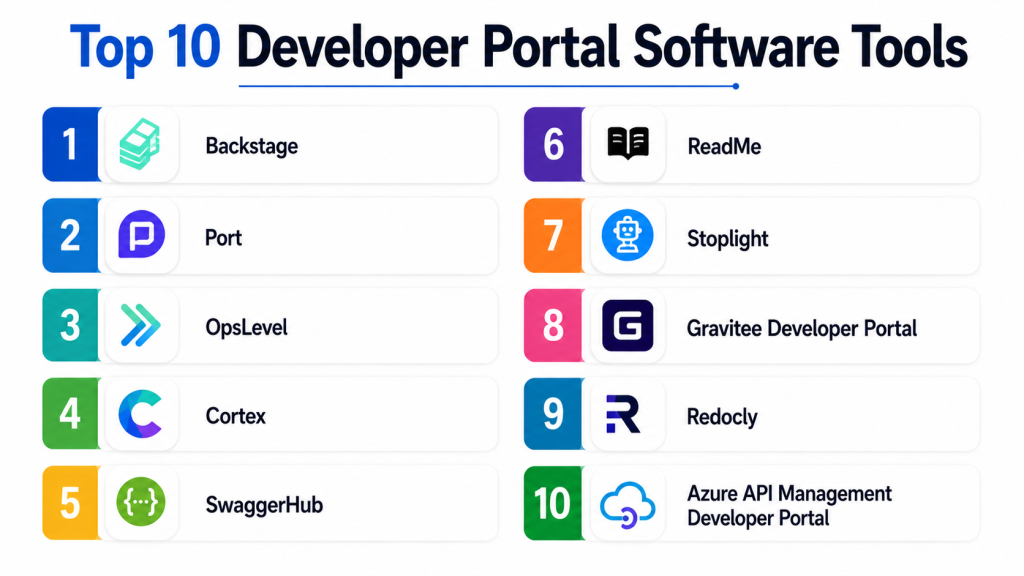
Top 10 Developer Portal Software Tools
1- Backstage
Short description:
Backstage is one of the most widely adopted open-source developer portal platforms. Originally created by Spotify, it helps organizations build internal developer portals with service catalogs, documentation, software templates, and operational tooling. Backstage has become a leading platform engineering solution for enterprises adopting cloud-native architectures and internal developer platforms.
Key Features
- Centralized software catalog
- Plugin-based architecture
- Kubernetes integrations
- Developer templates
- Technical documentation management
- Search and discovery tools
- CI/CD integrations
Pros
- Highly customizable open-source platform
- Strong platform engineering ecosystem
- Large community adoption
Cons
- Requires engineering effort for deployment
- Initial setup complexity can be high
- Enterprise governance may require additional tooling
Platforms / Deployment
- Web
- Cloud / Self-hosted / Hybrid
Security & Compliance
- RBAC
- SSO/SAML support
- Audit capabilities depend on deployment
- Security posture varies by implementation
Integrations & Ecosystem
Backstage supports one of the largest integration ecosystems in platform engineering.
- Kubernetes
- GitHub
- GitLab
- Jenkins
- ArgoCD
- PagerDuty
Support & Community
Very strong open-source community with growing enterprise support ecosystems.
2- Port
Short description:
Port is a modern internal developer portal platform designed to improve developer self-service and operational visibility. The platform enables organizations to create centralized engineering hubs with service catalogs, workflows, scorecards, and governance controls. Port focuses heavily on developer productivity and operational standardization.
Key Features
- Internal developer portal
- Service catalog management
- Self-service workflows
- Scorecards and governance
- CI/CD visibility
- Cloud infrastructure integrations
- Developer onboarding tools
Pros
- Strong developer experience focus
- Excellent workflow automation
- Good governance capabilities
Cons
- Premium pricing may impact smaller teams
- Requires process standardization
- Smaller ecosystem than Backstage
Platforms / Deployment
- Web
- Cloud / Hybrid
Security & Compliance
- RBAC
- SSO/SAML
- Audit logging
- Administrative controls
Integrations & Ecosystem
Port integrates with modern DevOps and cloud-native tooling.
- GitHub
- GitLab
- Kubernetes
- Datadog
- PagerDuty
- Jira
Support & Community
Strong enterprise onboarding and responsive commercial support.
3- OpsLevel
Short description:
OpsLevel is a developer portal and service ownership platform focused on operational maturity and reliability management. It helps engineering organizations manage service catalogs, standards, ownership, and governance while improving platform visibility. OpsLevel is especially useful for teams managing large-scale microservices environments.
Key Features
- Service catalog management
- Ownership tracking
- Reliability scorecards
- Governance automation
- Operational maturity reporting
- Incident management integrations
- API visibility
Pros
- Excellent governance capabilities
- Strong service ownership visibility
- Good operational maturity tooling
Cons
- Less flexible than open-source alternatives
- Can require operational process maturity
- Smaller ecosystem compared to Backstage
Platforms / Deployment
- Web
- Cloud
Security & Compliance
- SSO/SAML
- RBAC
- Audit logging
- Administrative controls
Integrations & Ecosystem
OpsLevel integrates with engineering and operational tooling.
- GitHub
- Datadog
- PagerDuty
- Jira
- Kubernetes
- Terraform
Support & Community
Strong customer onboarding and enterprise-focused support.
4- Cortex
Short description:
Cortex is an internal developer portal platform focused on engineering operations, service ownership, and reliability workflows. It enables teams to centralize service metadata, automate governance, and improve developer visibility across distributed systems. Cortex is commonly adopted by large engineering organizations managing complex software ecosystems.
Key Features
- Service catalog
- Operational scorecards
- Ownership management
- Workflow automation
- Reliability governance
- Incident visibility
- Developer self-service
Pros
- Strong operational governance
- Excellent service visibility
- Good enterprise scalability
Cons
- Premium enterprise pricing
- Requires operational maturity
- Smaller community ecosystem
Platforms / Deployment
- Web
- Cloud
Security & Compliance
- RBAC
- SSO/SAML
- Audit logging
- Administrative controls
Integrations & Ecosystem
Cortex integrates with operational and cloud-native tooling.
- Kubernetes
- GitHub
- Datadog
- PagerDuty
- Slack
- Jira
Support & Community
Enterprise-focused support with strong onboarding assistance.
5- SwaggerHub
Short description:
SwaggerHub is a collaborative API design and documentation platform widely used for API lifecycle management. It enables teams to design, document, standardize, and publish APIs within centralized developer portals. SwaggerHub is especially popular among API-first organizations and development teams building external developer ecosystems.
Key Features
- API documentation management
- OpenAPI support
- API design collaboration
- Version control
- Developer portal publishing
- API governance
- SDK generation support
Pros
- Excellent API documentation workflows
- Strong OpenAPI ecosystem support
- Easy collaboration for API teams
Cons
- Focused mainly on APIs rather than full platform engineering
- Advanced governance may require premium plans
- Limited internal service catalog depth
Platforms / Deployment
- Web
- Cloud / Hybrid
Security & Compliance
- SSO/SAML
- RBAC
- Administrative controls
- Audit capabilities
Integrations & Ecosystem
SwaggerHub integrates with API and CI/CD ecosystems.
- GitHub
- GitLab
- Postman
- Jenkins
- Azure DevOps
Support & Community
Strong API developer community and extensive documentation resources.
6- ReadMe
Short description:
ReadMe is a developer experience platform focused on API documentation, onboarding, and developer engagement. The platform helps organizations create polished developer portals with interactive API references, guides, changelogs, and analytics. ReadMe is commonly used by SaaS companies and API-driven businesses.
Key Features
- Interactive API documentation
- Developer onboarding workflows
- Changelog management
- API analytics
- Search capabilities
- Custom branding
- API playground support
Pros
- Excellent developer experience design
- Strong documentation usability
- Good onboarding workflows
Cons
- Primarily API-focused
- Limited internal platform engineering capabilities
- Advanced customization may require technical expertise
Platforms / Deployment
- Web
- Cloud
Security & Compliance
- SSO/SAML
- Access controls
- Administrative governance
- GDPR considerations
Integrations & Ecosystem
ReadMe supports integrations with API and developer tooling.
- OpenAPI
- GitHub
- Postman
- Zapier
- Slack
Support & Community
Strong onboarding resources and active API developer customer base.
7- Stoplight
Short description:
Stoplight is an API design and developer portal platform built around API governance, collaboration, and standards management. The platform enables organizations to centralize API workflows while improving consistency and developer experience across engineering teams.
Key Features
- API design governance
- Developer portal publishing
- API mocking
- Documentation management
- OpenAPI tooling
- Collaboration workflows
- Style guide enforcement
Pros
- Strong API governance capabilities
- Excellent standards enforcement
- Good developer collaboration tools
Cons
- More API-centric than platform-centric
- Smaller ecosystem than SwaggerHub
- Advanced enterprise features may require premium plans
Platforms / Deployment
- Web
- Cloud
Security & Compliance
- SSO/SAML
- RBAC
- Administrative controls
- Audit capabilities
Integrations & Ecosystem
Stoplight integrates with API lifecycle tooling.
- GitHub
- GitLab
- Postman
- OpenAPI tools
- CI/CD platforms
Support & Community
Growing API developer ecosystem with strong documentation support.
8- Gravitee Developer Portal
Short description:
Gravitee Developer Portal is part of the Gravitee API management ecosystem. It helps organizations create centralized API portals for internal and external developers while supporting governance, security, and API discovery workflows. The platform is commonly adopted in API-heavy enterprise environments.
Key Features
- API portal publishing
- API subscription management
- Developer onboarding
- Access control management
- API analytics
- Workflow automation
- API governance
Pros
- Strong API management integration
- Good governance capabilities
- Suitable for enterprise API ecosystems
Cons
- Less focused on internal platform engineering
- Advanced customization may require technical expertise
- Smaller community compared to leading open-source platforms
Platforms / Deployment
- Web
- Cloud / Self-hosted / Hybrid
Security & Compliance
- RBAC
- SSO/SAML
- Access management
- Audit capabilities
Integrations & Ecosystem
Gravitee integrates with enterprise API management workflows.
- Kubernetes
- OAuth providers
- API gateways
- CI/CD pipelines
- Identity platforms
Support & Community
Commercial enterprise support and growing API-focused community.
9- Redocly
Short description:
Redocly is an API documentation and developer portal platform focused on producing high-quality developer experiences. It enables organizations to build API reference portals, governance workflows, and collaborative documentation environments. Redocly is especially popular among developer-first SaaS companies.
Key Features
- API documentation portals
- OpenAPI support
- API governance workflows
- Search and discovery
- Branding customization
- Documentation versioning
- Collaboration tools
Pros
- Excellent documentation quality
- Strong developer experience focus
- Good OpenAPI support
Cons
- Limited internal platform engineering capabilities
- API-centric workflow focus
- Advanced customization can require expertise
Platforms / Deployment
- Web
- Cloud / Self-hosted
Security & Compliance
- RBAC
- SSO/SAML
- Administrative controls
- Audit capabilities
Integrations & Ecosystem
Redocly integrates with API and documentation ecosystems.
- GitHub
- GitLab
- OpenAPI tooling
- CI/CD pipelines
- Markdown workflows
Support & Community
Strong documentation resources and active API developer audience.
10- Azure API Management Developer Portal
Short description:
Azure API Management Developer Portal is Microsoft’s developer-facing portal solution for API discovery, onboarding, and consumption. It enables enterprises to publish APIs securely while integrating tightly with Azure cloud services and governance controls. The platform is commonly used by enterprises already invested in Azure ecosystems.
Key Features
- API publishing and discovery
- Developer onboarding
- Access and subscription management
- API documentation
- Azure ecosystem integration
- Branding customization
- API analytics
Pros
- Strong enterprise governance
- Excellent Azure integration
- Scalable cloud-native architecture
Cons
- Best suited mainly for Azure environments
- Complex enterprise configuration
- Premium pricing for advanced capabilities
Platforms / Deployment
- Web
- Cloud
Security & Compliance
- RBAC
- SSO/SAML
- Azure security controls
- Audit logging
- Administrative governance
Integrations & Ecosystem
Azure API Management integrates deeply with Microsoft cloud services.
- Azure DevOps
- Active Directory
- Kubernetes
- GitHub
- Logic Apps
- Microsoft Defender
Support & Community
Strong enterprise support backed by Microsoft ecosystem resources.
Comparison Table
| Tool Name | Best For | Platform Supported | Deployment | Standout Feature | Public Rating |
|---|---|---|---|---|---|
| Backstage | Internal developer platforms | Web | Cloud / Self-hosted / Hybrid | Open-source extensibility | N/A |
| Port | Developer self-service | Web | Cloud / Hybrid | Workflow automation | N/A |
| OpsLevel | Service ownership | Web | Cloud | Operational governance | N/A |
| Cortex | Engineering operations | Web | Cloud | Reliability scorecards | N/A |
| SwaggerHub | API documentation | Web | Cloud / Hybrid | OpenAPI collaboration | N/A |
| ReadMe | Developer onboarding | Web | Cloud | Interactive documentation | N/A |
| Stoplight | API governance | Web | Cloud | API standards enforcement | N/A |
| Gravitee Developer Portal | API ecosystems | Web | Cloud / Self-hosted / Hybrid | API subscription workflows | N/A |
| Redocly | API documentation quality | Web | Cloud / Self-hosted | Developer-focused documentation | N/A |
| Azure API Management Developer Portal | Enterprise Azure APIs | Web | Cloud | Azure-native integration | N/A |
Evaluation & Scoring of Developer Portal Software
| Tool Name | Core 25% | Ease 15% | Integrations 15% | Security 10% | Performance 10% | Support 10% | Value 15% | Weighted Total |
| Backstage | 10 | 7 | 10 | 8 | 9 | 9 | 9 | 8.9 |
| Port | 9 | 8 | 9 | 8 | 8 | 8 | 7 | 8.3 |
| OpsLevel | 8 | 8 | 8 | 8 | 8 | 8 | 7 | 7.9 |
| Cortex | 9 | 7 | 8 | 8 | 8 | 8 | 7 | 8.0 |
| SwaggerHub | 8 | 8 | 8 | 8 | 8 | 8 | 8 | 8.0 |
| ReadMe | 8 | 9 | 7 | 7 | 8 | 8 | 8 | 8.0 |
| Stoplight | 8 | 8 | 8 | 7 | 8 | 7 | 8 | 7.8 |
| Gravitee Developer Portal | 8 | 7 | 8 | 8 | 8 | 7 | 7 | 7.7 |
| Redocly | 8 | 8 | 7 | 7 | 8 | 8 | 8 | 7.9 |
| Azure API Management Developer Portal | 9 | 7 | 9 | 9 | 9 | 9 | 7 | 8.5 |
These scores are comparative and intended to help engineering organizations evaluate strengths across platform engineering and API management use cases. Enterprises may prioritize governance and scalability, while startups may focus more on developer experience and deployment flexibility.
Which Developer Portal Software Tool Is Right for You?
Solo / Freelancer
Individual developers and small API providers often benefit from lightweight documentation-focused platforms like ReadMe or Redocly for publishing APIs and onboarding developers.
SMB
SMBs typically require strong documentation, onboarding, and automation capabilities without excessive operational overhead. SwaggerHub, ReadMe, and Port are strong options.
Mid-Market
Mid-market organizations often need stronger governance, service catalogs, and workflow standardization. OpsLevel, Cortex, and Backstage are strong candidates.
Enterprise
Large enterprises usually require scalable internal developer platforms, governance controls, and operational visibility. Backstage, Port, and Azure API Management Developer Portal are leading enterprise choices.
Budget vs Premium
Open-source platforms like Backstage provide strong flexibility for organizations with engineering resources, while commercial platforms simplify onboarding and operational management.
Feature Depth vs Ease of Use
Backstage offers exceptional extensibility but requires engineering effort. ReadMe and SwaggerHub prioritize usability and faster onboarding experiences.
Integrations & Scalability
Backstage and Azure API Management offer some of the strongest ecosystem integrations for enterprise-scale environments.
Security & Compliance Needs
Organizations operating in regulated industries should prioritize platforms with strong RBAC, audit logging, SSO/SAML, and governance capabilities.
Frequently Asked Questions
1. What is Developer Portal Software?
Developer Portal Software provides centralized environments where developers can access APIs, documentation, onboarding guides, workflows, service catalogs, and operational tooling.
2. Why are developer portals becoming important?
Developer portals improve developer productivity, reduce onboarding friction, standardize workflows, and simplify service discovery in complex engineering environments.
3. What is the difference between API portals and developer portals?
API portals primarily focus on API documentation and onboarding, while developer portals provide broader platform engineering capabilities including service catalogs and self-service workflows.
4. Which platform is best for internal developer platforms?
Backstage is currently one of the most widely adopted internal developer platform solutions because of its extensibility and large ecosystem.
5. Are open-source developer portals suitable for enterprises?
Yes. Many enterprises use Backstage and other open-source platforms successfully, although deployment and operational complexity may require dedicated engineering resources.
6. What integrations are most important for developer portals?
Organizations should evaluate integrations with CI/CD systems, Kubernetes, Git providers, observability platforms, identity providers, and incident management tools.
7. How important is platform engineering for developer portals?
Platform engineering is becoming a major driver of developer portal adoption because organizations want standardized workflows and improved developer self-service.
8. What security features should buyers prioritize?
RBAC, SSO/SAML, audit logging, API governance, access controls, and compliance visibility are important for enterprise deployments.
9. Can developer portals improve onboarding speed?
Yes. Centralized documentation, templates, service catalogs, and self-service workflows significantly reduce onboarding time for engineering teams.
10. What common mistakes should organizations avoid?
Organizations often underestimate governance requirements, integration complexity, and the operational effort required to maintain developer portals at scale.
Conclusion
Developer Portal Software has become a critical component of modern platform engineering and API-driven development strategies. These platforms help organizations improve developer productivity, standardize engineering workflows, centralize documentation, and enable scalable self-service operations. Backstage continues leading the internal developer platform movement, while tools like Port, OpsLevel, SwaggerHub, and ReadMe address different aspects of developer enablement and governance. The best platform depends on organizational maturity, engineering scale, API strategy, and operational complexity. Teams should evaluate integration compatibility, governance needs, workflow automation capabilities, and long-term scalability before selecting a developer portal solution.
