Introduction
Passkey and FIDO2 Authentication Platforms are modern identity security solutions designed to replace traditional passwords with phishing-resistant authentication methods. These platforms use cryptographic credentials stored on trusted devices such as smartphones, security keys, or biometrics-enabled hardware to securely authenticate users without relying on passwords alone.
As cyberattacks continue to evolve in and beyond, organizations are increasingly moving toward passwordless authentication to reduce phishing risks, credential theft, account takeover attacks, and authentication fatigue. Regulatory pressure, hybrid work environments, and Zero Trust security initiatives are also accelerating adoption across industries.
Real-World Use Cases
- Passwordless employee login for enterprise applications
- Secure customer authentication for banking and e-commerce
- Phishing-resistant MFA for remote workers
- Identity verification for privileged administrators
- Passwordless authentication for healthcare and government systems
Evaluation Criteria for Buyers
Organizations evaluating Passkey and FIDO2 platforms should consider:
- FIDO2 and WebAuthn support
- Passwordless authentication maturity
- Ease of deployment and onboarding
- Cross-platform compatibility
- Identity provider integrations
- Scalability for workforce and customer IAM
- Compliance and audit capabilities
- Device management and recovery workflows
- API and developer ecosystem
- Total cost of ownership
Best for: Enterprises, SMBs, financial services, healthcare organizations, SaaS companies, government agencies, remote-first businesses, and organizations adopting Zero Trust security models.
Not ideal for: Very small environments with limited authentication complexity or legacy-only systems that cannot support modern identity standards without significant modernization.
Key Trends in Passkey & FIDO2 Authentication Platforms
- Rapid enterprise adoption of passwordless authentication strategies
- Passkeys becoming default authentication across consumer applications
- AI-powered risk analysis integrated into authentication workflows
- Increasing regulatory pressure for phishing-resistant MFA
- Expansion of device-bound cryptographic authentication
- Stronger integration with Zero Trust and SASE platforms
- Growth of decentralized identity and identity wallet technologies
- Improved cross-device passkey synchronization
- Wider adoption of hardware security keys for privileged access
- Consolidation of IAM, MFA, and passwordless platforms into unified identity ecosystems
How We Selected These Tools
The platforms included in this list were evaluated using the following methodology:
- Enterprise adoption and industry recognition
- FIDO2 and WebAuthn feature completeness
- Passwordless authentication capabilities
- Identity federation and SSO integration quality
- Security architecture maturity
- Platform scalability and performance
- Developer APIs and extensibility
- Customer support, onboarding, and ecosystem strength
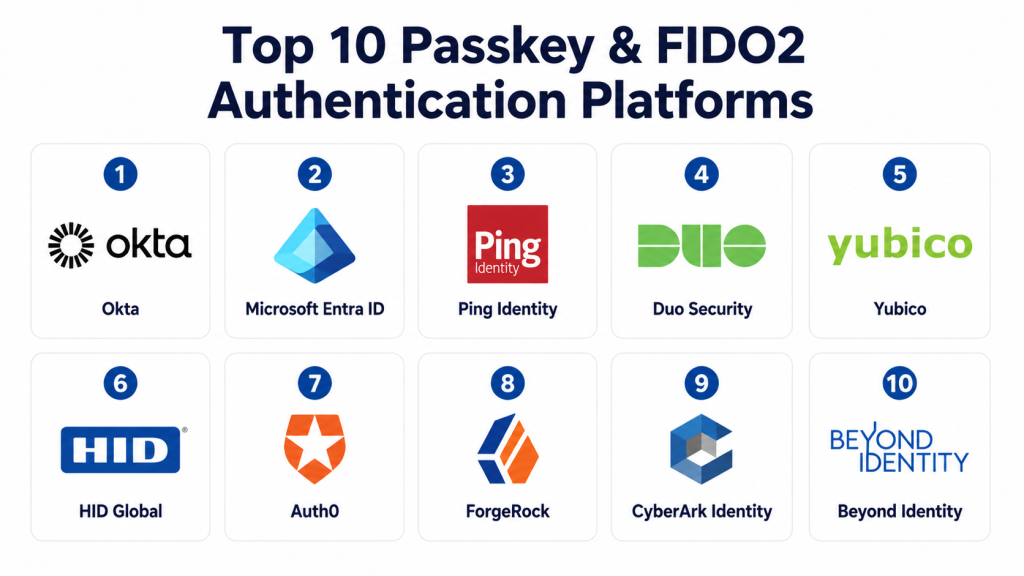
Top 10 Passkey & FIDO2 Authentication Platforms
1- Okta
Short description: Okta is one of the most recognized identity and access management platforms supporting passkeys, FIDO2 authentication, and passwordless login experiences. It provides centralized identity controls for workforce and customer identity scenarios. Organizations use Okta to simplify authentication across cloud applications while improving security posture. The platform supports modern authentication standards and integrates with thousands of enterprise applications. Okta is commonly adopted by enterprises seeking scalable identity infrastructure and strong ecosystem compatibility.
Key Features
- FIDO2 and WebAuthn support
- Passwordless authentication workflows
- Adaptive MFA
- Universal Directory
- Single Sign-On capabilities
- Lifecycle management
- Extensive application integrations
Pros
- Strong enterprise ecosystem
- Excellent cloud application integrations
- Mature identity management capabilities
Cons
- Pricing may increase with advanced modules
- Initial configuration can be complex
Platforms / Deployment
- Web
- Cloud
Security & Compliance
- SSO/SAML
- MFA
- RBAC
- Audit logs
- Encryption
- SOC 2
- ISO 27001
Integrations & Ecosystem
Okta offers one of the largest identity integration ecosystems in the market with broad SaaS and enterprise compatibility.
- Microsoft 365
- Google Workspace
- AWS
- Salesforce
- Slack
- ServiceNow
Support & Community
Strong enterprise documentation, training resources, partner ecosystem, and active administrator community.
2- Microsoft Entra ID
Short description: Microsoft Entra ID, formerly Azure Active Directory, provides identity management and passwordless authentication capabilities deeply integrated with Microsoft environments. It supports FIDO2 security keys, passkeys, and passwordless sign-in methods for enterprise users. Organizations adopting Microsoft cloud infrastructure frequently rely on Entra ID for centralized authentication and Zero Trust access management. The platform continues expanding passwordless support across workforce and customer access scenarios.
Key Features
- Passkey authentication
- FIDO2 security key support
- Conditional access policies
- Passwordless sign-in
- Identity governance
- Risk-based authentication
- Deep Microsoft ecosystem integration
Pros
- Excellent Microsoft integration
- Strong enterprise scalability
- Mature security controls
Cons
- Best value inside Microsoft ecosystem
- Advanced identity governance may require premium licensing
Platforms / Deployment
- Web
- Cloud
Security & Compliance
- MFA
- SSO/SAML
- RBAC
- Audit logging
- Encryption
- Conditional access
Integrations & Ecosystem
Strong integration with Microsoft and enterprise ecosystems.
- Microsoft 365
- Teams
- Intune
- Defender
- ServiceNow
- Third-party SaaS apps
Support & Community
Large enterprise support ecosystem and extensive documentation.
3- Ping Identity
Short description: Ping Identity delivers enterprise-grade identity management with strong support for FIDO2 and passwordless authentication. It is widely used by large enterprises requiring flexible identity orchestration, federation, and adaptive access controls. The platform supports workforce and customer identity scenarios while integrating with complex enterprise infrastructures.
Key Features
- Passwordless authentication
- Adaptive MFA
- Identity federation
- FIDO2 support
- Risk-based authentication
- API security
- Identity orchestration
Pros
- Strong enterprise flexibility
- Mature federation capabilities
- Extensive customization options
Cons
- Higher complexity for smaller teams
- Enterprise pricing model
Platforms / Deployment
- Cloud
- Hybrid
Security & Compliance
- MFA
- SAML
- Encryption
- Audit logs
- RBAC
Integrations & Ecosystem
- Active Directory
- Salesforce
- AWS
- Google Workspace
- Okta integrations
- API-based extensibility
Support & Community
Strong enterprise support with experienced implementation partners.
4- Duo Security
Short description: Duo Security focuses on secure authentication and Zero Trust access with strong support for passwordless and FIDO2-based login experiences. The platform is widely adopted due to its ease of deployment and user-friendly authentication workflows. Duo is commonly used by organizations seeking to modernize MFA while improving user experience.
Key Features
- Passwordless authentication
- FIDO2 security keys
- Adaptive access policies
- Device trust
- MFA protection
- Endpoint visibility
- User authentication insights
Pros
- Easy deployment
- Excellent user experience
- Strong MFA capabilities
Cons
- Some advanced features require broader Cisco ecosystem
- Less identity governance depth compared to larger IAM suites
Platforms / Deployment
- Web
- Cloud
Security & Compliance
- MFA
- Encryption
- Audit logging
- Device verification
Integrations & Ecosystem
- Cisco Secure products
- Microsoft applications
- VPN integrations
- Cloud services
- Identity providers
Support & Community
Strong onboarding experience and accessible documentation.
5- Yubico
Short description: Yubico is a leader in hardware-based authentication and FIDO2 security keys. Its YubiKey ecosystem is widely deployed across enterprises and government agencies seeking phishing-resistant authentication. Yubico supports passwordless login, smart card authentication, and multi-protocol authentication methods.
Key Features
- FIDO2 security keys
- Passwordless login
- Smart card support
- Hardware-backed authentication
- Multi-protocol support
- Phishing-resistant MFA
- Device portability
Pros
- Extremely strong security posture
- Hardware-backed authentication
- Broad protocol support
Cons
- Requires physical device management
- Additional hardware costs
Platforms / Deployment
- Windows
- macOS
- Linux
- iOS
- Android
Security & Compliance
- FIDO2
- MFA
- Encryption
- Hardware authentication
Integrations & Ecosystem
- Microsoft Entra ID
- Okta
- Google Workspace
- AWS
- Enterprise VPNs
- Password managers
Support & Community
Large security community and mature enterprise support options.
6- HID Global
Short description: HID Global provides enterprise identity and authentication solutions including FIDO2 security keys and passwordless authentication technologies. The company is recognized for physical and digital identity integration, especially in regulated industries and enterprise security environments.
Key Features
- FIDO2 authentication
- Security tokens
- Smart card integration
- Passwordless access
- PKI support
- Enterprise identity management
- Multi-factor authentication
Pros
- Strong enterprise security heritage
- Broad authentication methods
- Good regulated-industry support
Cons
- Complex deployments for smaller organizations
- Higher enterprise focus
Platforms / Deployment
- Hybrid
- Cloud
Security & Compliance
- MFA
- Encryption
- PKI
- Audit controls
Integrations & Ecosystem
- Enterprise IAM systems
- Smart card infrastructure
- Physical access systems
- Identity providers
Support & Community
Enterprise-grade support with implementation expertise.
7- Auth0
Short description: Auth0 provides developer-focused identity and authentication capabilities including passkey and FIDO2 support. It is widely adopted by SaaS companies and application developers building modern authentication experiences for customers and employees.
Key Features
- Passkey support
- Passwordless authentication
- Developer APIs
- Social login support
- MFA
- Identity federation
- Customer IAM
Pros
- Developer-friendly platform
- Fast integration workflows
- Strong customer identity support
Cons
- Costs can scale quickly
- Complex customization for advanced enterprise scenarios
Platforms / Deployment
- Cloud
- Web
Security & Compliance
- MFA
- SSO/SAML
- Encryption
- RBAC
- Audit logging
Integrations & Ecosystem
- OAuth providers
- SaaS applications
- API frameworks
- Mobile applications
- Identity providers
Support & Community
Strong developer community and extensive documentation.
8- ForgeRock
Short description: ForgeRock delivers enterprise identity platforms supporting passwordless authentication, FIDO2 standards, and customer identity management. The platform is commonly used by large enterprises managing millions of identities across workforce and customer environments.
Key Features
- Passwordless authentication
- Identity orchestration
- FIDO2 support
- Customer IAM
- Workforce identity
- Risk-based authentication
- API identity security
Pros
- Enterprise-scale identity management
- Flexible deployment models
- Strong customer identity capabilities
Cons
- Enterprise implementation complexity
- Significant administrative requirements
Platforms / Deployment
- Cloud
- Hybrid
Security & Compliance
- MFA
- Encryption
- RBAC
- Audit logging
Integrations & Ecosystem
- Enterprise IAM systems
- APIs
- Cloud services
- Mobile platforms
- Identity providers
Support & Community
Strong enterprise support and consulting ecosystem.
9- CyberArk Identity
Short description: CyberArk Identity combines privileged access management with passwordless authentication and identity security controls. It is especially valuable for organizations focused on protecting high-risk accounts and privileged users against phishing and credential theft.
Key Features
- Passwordless authentication
- Privileged access controls
- Adaptive MFA
- Risk-based policies
- Identity lifecycle management
- Secure SSO
- Endpoint identity protection
Pros
- Excellent privileged account security
- Strong Zero Trust alignment
- Mature enterprise controls
Cons
- Enterprise-focused pricing
- More advanced administration requirements
Platforms / Deployment
- Cloud
- Hybrid
Security & Compliance
- MFA
- RBAC
- Audit logs
- Encryption
Integrations & Ecosystem
- PAM systems
- Active Directory
- Cloud applications
- SIEM tools
- Identity providers
Support & Community
Comprehensive enterprise support and onboarding services.
10- Beyond Identity
Short description: Beyond Identity focuses on passwordless authentication using device-bound cryptographic credentials and identity-based access controls. The platform emphasizes phishing-resistant authentication and Zero Trust security while simplifying passwordless deployment.
Key Features
- Passwordless authentication
- Device-bound credentials
- FIDO2 support
- Zero Trust access
- Risk analytics
- Device posture assessment
- Cloud-native deployment
Pros
- Strong phishing resistance
- Modern Zero Trust architecture
- Simplified user experience
Cons
- Smaller ecosystem compared to larger IAM vendors
- Limited legacy system compatibility
Platforms / Deployment
- Cloud
- Web
Security & Compliance
- MFA
- Encryption
- Device trust
- Audit logging
Integrations & Ecosystem
- Okta
- Microsoft Entra ID
- Cloud applications
- Device management platforms
- Security tools
Support & Community
Growing enterprise adoption and responsive support model.
Comparison Table
| Tool Name | Best For | Platforms Supported | Deployment | Standout Feature | Public Rating |
|---|---|---|---|---|---|
| Okta | Enterprise IAM | Web | Cloud | Large integration ecosystem | N/A |
| Microsoft Entra ID | Microsoft environments | Web | Cloud | Deep Microsoft integration | N/A |
| Ping Identity | Enterprise federation | Web | Hybrid | Identity orchestration | N/A |
| Duo Security | Easy passwordless MFA | Web | Cloud | User-friendly authentication | N/A |
| Yubico | Hardware-backed security | Multi-platform | Hybrid | YubiKey ecosystem | N/A |
| HID Global | Regulated industries | Multi-platform | Hybrid | Smart card integration | N/A |
| Auth0 | Developer-first identity | Web | Cloud | Developer APIs | N/A |
| ForgeRock | Large-scale CIAM | Multi-platform | Hybrid | Enterprise identity scale | N/A |
| CyberArk Identity | Privileged access security | Multi-platform | Hybrid | PAM integration | N/A |
| Beyond Identity | Zero Trust passwordless | Web | Cloud | Device-bound authentication | N/A |
Evaluation & Scoring of Passkey & FIDO2 Authentication Platforms
| Tool Name | Core | Ease | Integrations | Security | Performance | Support | Value | Weighted Total |
| Okta | 10 | 9 | 10 | 9 | 9 | 9 | 8 | 9.2 |
| Microsoft Entra ID | 10 | 8 | 10 | 10 | 9 | 9 | 8 | 9.2 |
| Ping Identity | 9 | 7 | 9 | 9 | 9 | 8 | 7 | 8.4 |
| Duo Security | 9 | 10 | 8 | 9 | 8 | 9 | 8 | 8.8 |
| Yubico | 9 | 8 | 8 | 10 | 9 | 8 | 7 | 8.5 |
| HID Global | 8 | 7 | 8 | 9 | 8 | 8 | 7 | 7.9 |
| Auth0 | 9 | 9 | 9 | 8 | 8 | 8 | 8 | 8.6 |
| ForgeRock | 9 | 6 | 9 | 9 | 9 | 8 | 7 | 8.2 |
| CyberArk Identity | 9 | 7 | 8 | 10 | 9 | 8 | 7 | 8.3 |
| Beyond Identity | 8 | 9 | 7 | 9 | 8 | 8 | 8 | 8.1 |
These scores are comparative evaluations designed to help organizations identify strengths and trade-offs among platforms. Enterprises prioritizing compliance and advanced identity governance may weigh security and integrations more heavily, while SMBs may prioritize ease of use and deployment speed. The best platform depends on infrastructure, security maturity, and authentication strategy goals.
Which Passkey & FIDO2 Authentication Platform Is Right for You?
Solo / Freelancer
Duo Security and Auth0 are strong options for smaller environments due to simpler onboarding, lower complexity, and accessible passwordless authentication workflows.
SMB
Okta, Duo Security, and Beyond Identity offer a strong balance of usability, integrations, and modern authentication capabilities for growing organizations.
Mid-Market
Ping Identity, Auth0, and CyberArk Identity provide scalable identity management with stronger governance and authentication controls.
Enterprise
Microsoft Entra ID, Okta, ForgeRock, and CyberArk Identity are excellent for organizations requiring enterprise-scale identity orchestration, compliance, and Zero Trust alignment.
Budget vs Premium
Duo Security and Auth0 may provide faster deployment for smaller budgets, while ForgeRock and CyberArk typically align with premium enterprise security investments.
Feature Depth vs Ease of Use
Okta and Duo emphasize usability, while Ping Identity and ForgeRock deliver deeper enterprise customization and orchestration capabilities.
Integrations & Scalability
Organizations with large SaaS ecosystems or hybrid infrastructures should prioritize Okta, Microsoft Entra ID, or Ping Identity for integration flexibility.
Security & Compliance Needs
Highly regulated industries should strongly evaluate CyberArk Identity, Yubico, Microsoft Entra ID, and HID Global due to strong phishing-resistant authentication capabilities.
Frequently Asked Questions
1- What is a passkey authentication platform?
A passkey authentication platform enables passwordless login using cryptographic credentials tied to trusted devices or hardware security keys. These platforms reduce phishing risks and improve authentication security.
2- What is FIDO2 authentication?
FIDO2 is an authentication standard that combines WebAuthn and CTAP protocols to support secure passwordless authentication using biometrics, hardware keys, or trusted devices.
3- Why are organizations moving away from passwords?
Passwords are vulnerable to phishing, credential stuffing, and reuse attacks. Passkeys and FIDO2 authentication significantly reduce these risks by using device-based cryptographic authentication.
4- Are passkeys more secure than traditional MFA?
In many cases, yes. Passkeys are phishing-resistant and remove reliance on shared secrets such as passwords, making account compromise substantially more difficult.
5- Can passkey platforms integrate with existing IAM systems?
Most leading platforms integrate with Active Directory, Microsoft Entra ID, Okta, Google Workspace, VPNs, cloud applications, and enterprise identity providers.
6- What industries benefit most from FIDO2 authentication?
Financial services, healthcare, government, SaaS, technology, and remote-first enterprises often benefit most because of higher compliance and security requirements.
7- Do users need special hardware for passkeys?
Not always. Many passkeys can be stored on smartphones, laptops, or biometric devices. Hardware security keys are often used for privileged or high-security environments.
8- What are common deployment challenges?
Common challenges include legacy application compatibility, user onboarding, recovery workflows, and integrating passwordless authentication into existing IAM infrastructure.
9- How expensive are passwordless authentication platforms?
Pricing varies depending on deployment size, authentication methods, integrations, and enterprise requirements. Some vendors charge per user, while others offer modular pricing.
10- Can passkeys completely replace passwords?
Many organizations are moving toward fully passwordless environments, but some legacy systems may still require passwords during transitional phases.
Conclusion
Passkey and FIDO2 authentication platforms are rapidly becoming foundational components of modern identity security strategies. As organizations continue facing phishing attacks, credential theft, and growing compliance expectations, passwordless authentication offers a more secure and user-friendly alternative to traditional passwords. Enterprise organizations often prioritize platforms such as Microsoft Entra ID, Okta, Ping Identity, and CyberArk Identity for advanced governance and scalability, while Duo Security, Auth0, and Beyond Identity provide excellent flexibility for organizations focused on usability and faster deployment. Hardware-focused solutions like Yubico and HID Global remain highly valuable for privileged access and regulated environments requiring strong phishing resistance. The best platform ultimately depends on organizational size, existing infrastructure, compliance requirements, and long-term Zero Trust goals. Shortlist two or three vendors, conduct a pilot deployment, validate integration compatibility, and evaluate user adoption before committing to a broader rollout.
