Introduction
eBPF Observability and Runtime Security Tools help engineering, DevOps, SRE, platform, and security teams monitor what is happening inside Linux systems, Kubernetes clusters, containers, workloads, and network flows without requiring heavy application instrumentation. eBPF works close to the kernel, which allows tools to capture signals such as system calls, network activity, process behavior, file access, service communication, latency, profiling data, and suspicious runtime events.
These tools matter because modern cloud-native environments are distributed, fast-moving, and difficult to observe using only logs and traditional agents. Containers start and stop quickly, microservices create complex traffic patterns, and attackers increasingly exploit runtime behavior after deployment. eBPF-based tools give teams deeper visibility into live workloads while supporting performance monitoring, troubleshooting, threat detection, policy enforcement, and compliance investigation.
Real World Use Cases
- Monitoring Kubernetes network flows and service-to-service communication
- Detecting suspicious process execution inside containers
- Investigating runtime threats across cloud workloads
- Profiling CPU and application performance with low overhead
- Tracking system calls, file access, and privilege escalation attempts
- Observing application dependencies without changing application code
- Enforcing runtime security policies in Kubernetes clusters
- Troubleshooting latency, packet drops, DNS issues, and service failures
Evaluation Criteria for Buyers
- Kubernetes and container visibility
- Runtime threat detection depth
- Network observability capabilities
- Performance overhead and scalability
- Policy enforcement and response actions
- Ease of deployment and operations
- Integration with SIEM, SOAR, observability, and DevOps tools
- Cloud, hybrid, and on-premises support
- Alert quality and investigation workflows
- Enterprise support and governance controls
Best for: DevOps teams, SRE teams, platform engineering teams, cloud security teams, Kubernetes operators, SOC analysts, incident response teams, and enterprises running containerized or cloud-native workloads.
Not ideal for: very small teams running simple applications without Kubernetes, containers, or deep runtime visibility needs. Traditional monitoring, basic logging, or managed cloud-native monitoring may be enough when workloads are small and operational risk is low.
Key Trends in eBPF Observability and Runtime Security Tools
- eBPF is becoming a core foundation for Kubernetes observability because it can capture workload behavior without requiring heavy application code changes.
- Runtime security is shifting from static scanning alone to live workload behavior monitoring.
- Cloud-native teams are using eBPF to connect network, process, container, and identity context into one investigation view.
- Continuous profiling is gaining adoption as teams need always-on performance insights with lower overhead.
- Kubernetes-aware security tools are moving closer to policy enforcement, not only alerting.
- eBPF is increasingly used for service maps, dependency discovery, DNS visibility, and packet-level troubleshooting.
- Security teams are integrating eBPF alerts with SIEM, SOAR, ticketing, and incident response workflows.
- Platform teams are evaluating eBPF tools alongside service meshes, CNI platforms, and observability stacks.
- Open-source eBPF projects remain important, but enterprises often need managed dashboards, support, and governance.
- Buyers are paying more attention to kernel compatibility, operational overhead, and safe rollout practices.
How We Selected These Tools
The tools in this list were selected using a practical cloud-native observability and runtime security evaluation framework.
- Relevance to eBPF-based observability or runtime security
- Adoption across Kubernetes, container, and Linux environments
- Depth of visibility into processes, network flows, system calls, and workloads
- Runtime threat detection and policy enforcement capabilities
- Integration with cloud-native, DevOps, SIEM, and observability ecosystems
- Fit for SMB, mid-market, enterprise, and open-source use cases
- Deployment flexibility across cloud, hybrid, and self-managed environments
- Documentation quality, community strength, and operational maturity
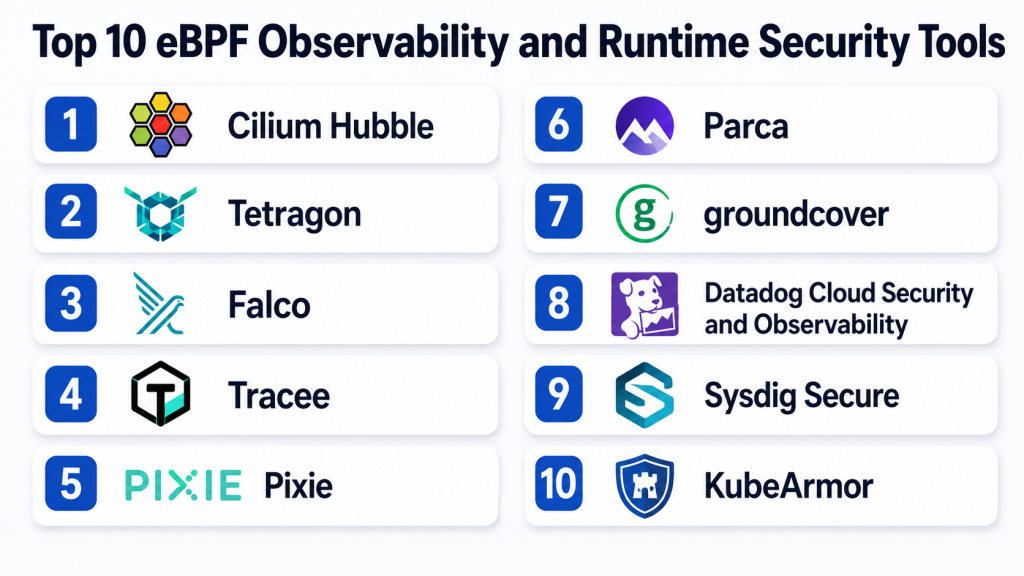
Top 10 eBPF Observability and Runtime Security Tools
1- Cilium Hubble
Short description:
Cilium Hubble is an observability layer built for Cilium-powered Kubernetes networking environments. It gives teams visibility into service communication, network flows, DNS activity, HTTP traffic, and security policies across Kubernetes clusters. Hubble is especially valuable for platform engineering and SRE teams that need to understand how microservices communicate in real time. It helps teams troubleshoot network failures, policy drops, latency issues, and workload dependencies. For organizations already using Cilium as their CNI, Hubble provides a natural extension for deep network observability.
Key Features
- Kubernetes network flow visibility
- Service dependency mapping
- DNS and HTTP observability
- Network policy troubleshooting
- Real-time flow inspection
- Multi-cluster visibility support
- Integration with Cilium security policies
Pros
- Excellent fit for Cilium-based Kubernetes environments
- Strong network and service visibility
- Useful for troubleshooting and security investigations
Cons
- Best value requires Cilium adoption
- Focuses more on network observability than broad host security
- Advanced operations may require Kubernetes networking expertise
Platforms / Deployment
- Kubernetes / Linux
- Cloud / Self-hosted / Hybrid
Security & Compliance
- Network policy visibility
- Identity-aware traffic observability
- Policy troubleshooting support
- Broader compliance depends on deployment and governance
Integrations & Ecosystem
Cilium Hubble integrates naturally with Kubernetes and cloud-native observability workflows.
- Cilium
- Kubernetes
- Prometheus
- Grafana
- Service maps
- Network policy workflows
Support & Community
Cilium and Hubble have a strong open-source community and broad cloud-native adoption. Enterprise support is available through related commercial ecosystems.
2- Tetragon
Short description:
Tetragon is an eBPF-based security observability and runtime enforcement tool designed for Kubernetes and Linux environments. It monitors runtime events such as process execution, network activity, file access, and security-sensitive behavior. Tetragon is useful for security teams that want deep workload visibility combined with policy-driven response actions. It can help detect suspicious runtime behavior, trace attacker activity, and enforce controls closer to the kernel. It is especially strong for Kubernetes-aware runtime security use cases.
Key Features
- eBPF-based runtime security monitoring
- Kubernetes-aware event visibility
- Process and network activity tracking
- File access monitoring
- Runtime policy enforcement
- Real-time event filtering
- Security investigation context
Pros
- Strong runtime security visibility
- Kubernetes-aware enforcement capabilities
- Useful for threat detection and investigation
Cons
- Requires policy design maturity
- Kubernetes-focused workflows may need onboarding
- Advanced tuning can require eBPF and security expertise
Platforms / Deployment
- Kubernetes / Linux
- Cloud / Self-hosted / Hybrid
Security & Compliance
- Runtime policy enforcement
- Security event monitoring
- Kubernetes-aware visibility
- Compliance depends on policy configuration and deployment
Integrations & Ecosystem
Tetragon fits into cloud-native runtime security and platform engineering workflows.
- Kubernetes
- Cilium ecosystem
- SIEM tools
- Prometheus
- Grafana
- Incident response workflows
Support & Community
Tetragon has strong open-source community support and is increasingly relevant for Kubernetes runtime security teams.
3- Falco
Short description:
Falco is a runtime security tool focused on detecting suspicious behavior in containers, Kubernetes, hosts, and cloud-native environments. It uses rules to identify abnormal activity such as shell execution inside containers, unexpected file access, privilege escalation, and suspicious system calls. Falco is popular among security and DevOps teams because it provides practical runtime detection with a strong open-source ecosystem. It is often used as a detection layer alongside vulnerability scanning, Kubernetes security controls, and SIEM workflows.
Key Features
- Runtime threat detection
- System call monitoring
- Kubernetes and container context
- Custom rule engine
- Alerting for suspicious behavior
- Integration with security workflows
- Open-source detection rules
Pros
- Strong runtime detection ecosystem
- Mature open-source community
- Flexible rule customization
Cons
- Alert tuning may be required
- Detection quality depends on rules
- Enforcement capabilities may need additional tooling
Platforms / Deployment
- Linux / Kubernetes / Containers
- Cloud / Self-hosted / Hybrid
Security & Compliance
- Runtime threat detection
- Custom security rules
- Kubernetes-aware alerts
- Compliance depends on alerting and governance implementation
Integrations & Ecosystem
Falco integrates well with cloud-native security and incident response systems.
- Kubernetes
- Helm
- SIEM platforms
- Slack
- Prometheus
- Cloud-native alerting systems
Support & Community
Falco has a strong CNCF ecosystem, active community, and broad adoption among container security teams.
4- Tracee
Short description:
Tracee is an eBPF-based runtime security and observability tool focused on tracing system events and detecting suspicious behavior. It is useful for security teams investigating process activity, file events, network behavior, and container-level runtime signals. Tracee can support threat hunting, incident investigation, and detection engineering workflows. It is especially valuable for teams that want flexible runtime visibility with security-focused event collection. Tracee works well in Kubernetes and Linux environments where deep system-level context is required.
Key Features
- eBPF-based event tracing
- Runtime threat detection
- Container and Kubernetes visibility
- File and process event monitoring
- Security rule support
- Incident investigation context
- Flexible event output options
Pros
- Strong runtime event visibility
- Useful for threat hunting and investigations
- Good fit for security engineering teams
Cons
- Requires tuning for high-signal alerts
- May need operational expertise for large environments
- Commercial support depends on chosen deployment model
Platforms / Deployment
- Linux / Kubernetes / Containers
- Cloud / Self-hosted / Hybrid
Security & Compliance
- Runtime event monitoring
- Detection rule support
- Container-aware visibility
- Compliance depends on deployment and retention policies
Integrations & Ecosystem
Tracee fits into runtime security and investigation workflows.
- Kubernetes
- SIEM tools
- JSON event pipelines
- Security analytics platforms
- Incident response workflows
- DevSecOps pipelines
Support & Community
Tracee has an active open-source community and is commonly used by teams focused on runtime security research and detection.
5- Pixie
Short description:
Pixie is an observability platform for Kubernetes that uses eBPF to collect telemetry automatically without requiring manual instrumentation in many common workflows. It is designed to help developers, SREs, and platform teams troubleshoot service performance, latency, errors, network behavior, and application dependencies. Pixie is especially useful for teams that want rapid Kubernetes visibility without adding tracing libraries to every application. It provides rich context for service maps, protocol visibility, and live debugging.
Key Features
- Automatic Kubernetes observability
- eBPF-based telemetry collection
- Service maps and dependency visibility
- Live debugging workflows
- Network and application performance insights
- Query-based investigation
- Low-friction deployment model
Pros
- Fast visibility for Kubernetes workloads
- Reduces need for manual instrumentation
- Strong developer and SRE troubleshooting experience
Cons
- Kubernetes-focused use case
- May not replace full observability stacks
- Advanced analysis requires learning query workflows
Platforms / Deployment
- Kubernetes / Linux
- Cloud / Self-hosted / Hybrid
Security & Compliance
- Observability-focused telemetry
- Access controls depend on deployment
- Compliance depends on data handling and retention configuration
Integrations & Ecosystem
Pixie fits into Kubernetes troubleshooting and platform observability workflows.
- Kubernetes
- Prometheus-style workflows
- Service maps
- Developer debugging
- Observability dashboards
- Cloud-native operations
Support & Community
Pixie has a strong open-source foundation and remains useful for teams seeking Kubernetes-first observability.
6- Parca
Short description:
Parca is a continuous profiling tool that helps teams understand CPU and performance behavior across services and infrastructure. It can use eBPF to capture profiling data with minimal application changes, making it useful for performance optimization, cost reduction, and engineering efficiency. Parca helps developers identify hot paths, inefficient code, resource-heavy services, and long-running performance regressions. It is especially valuable for teams that need always-on profiling rather than occasional manual profiling sessions.
Key Features
- Continuous profiling
- eBPF-based profiling support
- CPU performance analysis
- Flame graph visualization
- Long-term profiling storage
- Low-overhead profiling workflows
- Developer performance debugging
Pros
- Strong performance optimization focus
- Useful for cost and efficiency improvements
- Good fit for engineering teams running many services
Cons
- Focused on profiling rather than broad security
- Requires profiling knowledge for best results
- May need integration with other observability tools
Platforms / Deployment
- Linux / Kubernetes
- Cloud / Self-hosted / Hybrid
Security & Compliance
- Observability-focused profiling
- Access controls depend on deployment
- Compliance depends on storage and data governance configuration
Integrations & Ecosystem
Parca fits performance engineering and observability workflows.
- Kubernetes
- Prometheus ecosystem
- Grafana workflows
- CI performance testing
- Engineering optimization processes
- Cloud-native infrastructure
Support & Community
Parca has an active open-source community and is useful for teams adopting continuous profiling practices.
7- groundcover
Short description:
groundcover is an observability platform that uses eBPF to provide visibility into applications, infrastructure, Kubernetes, logs, metrics, traces, and service behavior. It is designed for teams that want rich telemetry without sending all data to an external SaaS by default. groundcover is especially relevant for organizations that want cost control, privacy, and broad observability coverage. It helps DevOps and SRE teams understand service behavior, troubleshoot incidents, and reduce observability blind spots in cloud and hybrid environments.
Key Features
- eBPF-based observability
- Metrics, logs, traces, and service visibility
- Kubernetes monitoring
- Private data control options
- Application behavior insights
- Cost-aware observability model
- Cloud and on-premises coverage
Pros
- Strong observability coverage
- Useful for privacy-conscious teams
- Helps reduce manual instrumentation effort
Cons
- Commercial platform evaluation may be needed
- Security depth may differ from dedicated runtime security tools
- Deployment design depends on environment size
Platforms / Deployment
- Kubernetes / Linux / Cloud environments
- Cloud / Hybrid / Customer-controlled deployment
Security & Compliance
- Data control options
- Access controls vary by deployment
- Compliance details should be validated during procurement
Integrations & Ecosystem
groundcover integrates with modern observability and DevOps workflows.
- Kubernetes
- Cloud infrastructure
- Metrics pipelines
- Log workflows
- Tracing workflows
- Alerting systems
Support & Community
Commercial support is available, with resources oriented toward DevOps and SRE teams managing production observability.
8- Datadog Cloud Security and Observability
Short description:
Datadog uses eBPF across observability and security use cases to provide visibility into infrastructure, applications, workloads, containers, and runtime behavior. It is suitable for organizations that want a managed observability and security platform rather than assembling separate open-source components. Datadog is especially useful for teams that need metrics, traces, logs, profiling, cloud security, workload protection, and incident workflows in one ecosystem. It is commonly adopted by mid-market and enterprise teams that prioritize operational visibility and integrated dashboards.
Key Features
- Infrastructure and application monitoring
- Runtime workload security capabilities
- eBPF-based visibility in supported areas
- Container and Kubernetes monitoring
- Continuous profiling support
- Security alerting and investigation workflows
- Broad dashboard and analytics ecosystem
Pros
- Strong all-in-one observability experience
- Good enterprise dashboard and alerting capabilities
- Broad integration ecosystem
Cons
- Pricing can become complex at scale
- Less customizable than self-built open-source stacks
- Requires careful data volume and cost management
Platforms / Deployment
- Linux / Kubernetes / Cloud / Containers
- Cloud / Hybrid
Security & Compliance
- MFA
- RBAC
- Audit logs
- Encryption
- Compliance details vary by product and plan
Integrations & Ecosystem
Datadog integrates with a broad set of cloud, DevOps, and security tools.
- Kubernetes
- AWS
- Azure
- Google Cloud
- CI/CD platforms
- SIEM and incident workflows
Support & Community
Strong enterprise documentation, onboarding resources, and commercial support options.
9- Sysdig Secure
Short description:
Sysdig Secure is a cloud and container security platform that uses runtime insights to detect, prioritize, and respond to security threats in cloud-native environments. It is strongly associated with container security, Kubernetes security, runtime detection, and the Falco ecosystem. Sysdig Secure is useful for organizations that want enterprise-grade runtime security workflows with dashboards, investigation context, posture visibility, and response capabilities. It is especially relevant for regulated or security-mature teams running production Kubernetes workloads.
Key Features
- Runtime threat detection
- Kubernetes and container security
- Cloud security context
- Falco-based detection ecosystem
- Vulnerability and posture workflows
- Incident investigation support
- Policy and compliance visibility
Pros
- Strong runtime security capabilities
- Good fit for Kubernetes and cloud security teams
- Enterprise-grade investigation workflows
Cons
- Commercial pricing may be high for smaller teams
- Requires tuning and security process maturity
- Broader platform may be more than simple observability needs
Platforms / Deployment
- Kubernetes / Linux / Cloud / Containers
- Cloud / Hybrid
Security & Compliance
- Runtime threat detection
- RBAC
- Audit support
- Compliance reporting capabilities vary by plan
Integrations & Ecosystem
Sysdig Secure integrates with cloud-native security and operations workflows.
- Kubernetes
- Falco
- Cloud providers
- CI/CD systems
- SIEM platforms
- Incident response tools
Support & Community
Strong enterprise support and a large cloud-native security ecosystem, including strong connection to Falco community practices.
10- KubeArmor
Short description:
KubeArmor is a runtime security enforcement tool for Kubernetes and containerized workloads. It uses Linux security mechanisms and can integrate with eBPF-based visibility patterns to enforce workload behavior policies. KubeArmor is useful for teams that want to restrict file access, process execution, network behavior, and runtime actions based on policy. It is especially valuable for Kubernetes security teams that need workload hardening beyond detection and alerting.
Key Features
- Runtime policy enforcement
- Kubernetes workload protection
- File, process, and network policy controls
- Container behavior restrictions
- Policy-as-code workflows
- Host and workload security visibility
- Cloud-native deployment model
Pros
- Strong runtime enforcement focus
- Useful for workload hardening
- Good fit for Kubernetes security programs
Cons
- Requires careful policy design
- Enforcement can disrupt workloads if misconfigured
- May need additional tools for full observability
Platforms / Deployment
- Kubernetes / Linux / Containers
- Cloud / Self-hosted / Hybrid
Security & Compliance
- Runtime enforcement policies
- Workload behavior restrictions
- Kubernetes security controls
- Compliance depends on policies, auditability, and governance
Integrations & Ecosystem
KubeArmor fits runtime hardening and Kubernetes security workflows.
- Kubernetes
- Policy-as-code workflows
- SIEM tools
- DevSecOps pipelines
- Container security platforms
- Runtime investigation workflows
Support & Community
KubeArmor has an active open-source community and enterprise ecosystem support through related security platforms.
Comparison Table
| Tool Name | Best For | Platform Supported | Deployment | Standout Feature | Public Rating |
|---|---|---|---|---|---|
| Cilium Hubble | Kubernetes network observability | Kubernetes, Linux | Cloud / Self-hosted / Hybrid | Service and network flow visibility | N/A |
| Tetragon | Runtime security enforcement | Kubernetes, Linux | Cloud / Self-hosted / Hybrid | eBPF security observability and enforcement | N/A |
| Falco | Runtime threat detection | Linux, Kubernetes, Containers | Cloud / Self-hosted / Hybrid | Rule-based suspicious behavior detection | N/A |
| Tracee | Runtime tracing and threat hunting | Linux, Kubernetes, Containers | Cloud / Self-hosted / Hybrid | eBPF event tracing for investigations | N/A |
| Pixie | Kubernetes application observability | Kubernetes, Linux | Cloud / Self-hosted / Hybrid | Automatic telemetry without heavy instrumentation | N/A |
| Parca | Continuous profiling | Linux, Kubernetes | Cloud / Self-hosted / Hybrid | Always-on profiling and flame graphs | N/A |
| groundcover | Full-stack eBPF observability | Kubernetes, Linux, Cloud | Cloud / Hybrid | Private and cost-aware observability | N/A |
| Datadog Cloud Security and Observability | Managed observability and security | Linux, Kubernetes, Cloud, Containers | Cloud / Hybrid | Unified dashboards and broad integrations | N/A |
| Sysdig Secure | Enterprise runtime security | Kubernetes, Linux, Cloud, Containers | Cloud / Hybrid | Runtime cloud-native threat detection | N/A |
| KubeArmor | Runtime policy enforcement | Kubernetes, Linux, Containers | Cloud / Self-hosted / Hybrid | Workload behavior restriction policies | N/A |
Evaluation and Scoring of eBPF Observability and Runtime Security Tools
| Tool Name | Core 25% | Ease 15% | Integrations 15% | Security 10% | Performance 10% | Support 10% | Value 15% | Weighted Total |
| Cilium Hubble | 9 | 8 | 9 | 8 | 9 | 8 | 9 | 8.6 |
| Tetragon | 9 | 7 | 8 | 10 | 9 | 8 | 9 | 8.6 |
| Falco | 9 | 7 | 8 | 9 | 8 | 9 | 10 | 8.6 |
| Tracee | 8 | 7 | 8 | 9 | 8 | 8 | 9 | 8.1 |
| Pixie | 9 | 8 | 8 | 7 | 8 | 8 | 9 | 8.3 |
| Parca | 8 | 8 | 8 | 7 | 9 | 8 | 9 | 8.2 |
| groundcover | 9 | 8 | 8 | 8 | 8 | 8 | 8 | 8.2 |
| Datadog Cloud Security and Observability | 9 | 9 | 10 | 9 | 9 | 9 | 7 | 8.9 |
| Sysdig Secure | 9 | 8 | 9 | 10 | 9 | 9 | 7 | 8.7 |
| KubeArmor | 8 | 7 | 8 | 9 | 8 | 8 | 9 | 8.1 |
These scores are comparative and should be interpreted based on your operating model. Observability-first teams may prioritize Cilium Hubble, Pixie, Parca, groundcover, or Datadog. Runtime-security teams may prioritize Tetragon, Falco, Tracee, Sysdig Secure, or KubeArmor. Kubernetes-heavy organizations should evaluate deployment complexity, kernel compatibility, policy design, alert noise, and integration with existing monitoring and incident response workflows.
Which eBPF Observability and Runtime Security Tool Is Right for You?
Solo / Freelancer
Solo developers and independent consultants should start with open-source tools that are easy to test in labs or small clusters. Falco, Tracee, Pixie, Parca, and Cilium Hubble are good starting points depending on the need. If the goal is runtime detection, Falco or Tracee may be more useful. If the goal is Kubernetes troubleshooting, Pixie or Hubble can provide practical visibility. For performance optimization, Parca is a strong choice.
SMB
Small and growing teams should avoid deploying too many overlapping tools at once. A practical approach is to choose one observability-focused tool and one runtime security-focused tool. For example, a Cilium-based team may pair Hubble with Tetragon. A team needing runtime alerts may start with Falco. If the team wants managed dashboards and lower operational overhead, groundcover or Datadog may be easier than operating multiple open-source components.
Mid-Market
Mid-market organizations usually need stronger workflows for alert routing, ownership, dashboards, and incident investigation. Datadog, Sysdig Secure, groundcover, Cilium Hubble, Tetragon, and Falco are strong candidates. Teams should evaluate how each tool integrates with SIEM, ticketing, Kubernetes labels, cloud accounts, and on-call workflows. Mid-market teams should also define alert severity, investigation playbooks, and retention policies before rollout.
Enterprise
Enterprises should treat eBPF tooling as part of a broader cloud-native operations and security architecture. Datadog and Sysdig Secure are strong commercial options for enterprise visibility and security operations. Cilium Hubble and Tetragon are strong for organizations standardizing around Cilium. Falco and Tracee are strong for open-source runtime detection programs. KubeArmor is useful when runtime enforcement and workload hardening are priorities.
Budget vs Premium
Open-source tools such as Falco, Tracee, Parca, Pixie, Hubble, Tetragon, and KubeArmor can provide strong value, but they require operational ownership. Premium platforms such as Datadog, Sysdig Secure, and groundcover reduce setup effort and provide managed dashboards, support, and enterprise workflows. Budget decisions should include not only licensing, but also deployment effort, alert tuning, storage, retention, training, and incident response process design.
Feature Depth vs Ease of Use
Datadog and Sysdig Secure offer broad platform depth with managed experiences. Falco, Tracee, Tetragon, and KubeArmor provide deep runtime security capabilities but require more tuning and policy design. Pixie and Hubble are strong for Kubernetes visibility, while Parca is more specialized for profiling. The right choice depends on whether your priority is troubleshooting, detection, enforcement, profiling, or unified operations.
Integrations & Scalability
At scale, integrations become critical. Buyers should validate support for Kubernetes labels, cloud metadata, SIEM pipelines, Prometheus, Grafana, Slack, PagerDuty, ticketing tools, and data export workflows. Large environments should also test performance overhead, event volume, storage requirements, and policy rollout controls. eBPF can provide deep visibility, but poor rollout planning can create noisy alerts or operational complexity.
Security & Compliance Needs
Security-sensitive teams should focus on runtime detection, policy enforcement, auditability, access controls, alert retention, and evidence collection. Tetragon, Falco, Tracee, Sysdig Secure, and KubeArmor are especially relevant for runtime security. Observability tools should be combined with vulnerability scanning, image signing, admission controls, identity management, SIEM correlation, and incident response workflows for stronger defense.
Frequently Asked Questions
1. What are eBPF Observability and Runtime Security Tools?
eBPF Observability and Runtime Security Tools use Linux kernel-level visibility to monitor systems, containers, network flows, processes, and runtime behavior. They help teams troubleshoot performance issues, detect threats, and enforce policies in modern cloud-native environments.
2. Why is eBPF important for Kubernetes observability?
Kubernetes environments are dynamic, and traditional monitoring often misses short-lived containers and low-level network behavior. eBPF helps capture service communication, process activity, and network events with rich context and less manual instrumentation.
3. Are eBPF tools only for security teams?
No. eBPF tools are useful for SREs, DevOps teams, platform engineers, performance engineers, and security teams. Observability teams use them for troubleshooting, while security teams use them for runtime detection and enforcement.
4. What is the difference between observability and runtime security?
Observability focuses on understanding system health, performance, latency, dependencies, and behavior. Runtime security focuses on detecting or stopping suspicious actions such as unexpected process execution, file access, privilege escalation, or malicious network activity.
5. Which eBPF tool is best for Kubernetes networking visibility?
Cilium Hubble is a strong choice for Kubernetes networking visibility, especially when Cilium is already used as the CNI. It provides service maps, network flows, DNS visibility, and policy troubleshooting.
6. Which eBPF tool is best for runtime threat detection?
Falco, Tetragon, Tracee, and Sysdig Secure are strong options for runtime threat detection. The best choice depends on whether the team wants open-source rules, Kubernetes-aware enforcement, investigation depth, or enterprise-managed workflows.
7. Do eBPF tools replace logs and metrics?
No. eBPF tools complement logs, metrics, traces, and profiling. They provide deep kernel and workload-level visibility, but teams still need application logs, business metrics, dashboards, alerts, and incident workflows.
8. What are the risks of deploying eBPF tools?
Risks include kernel compatibility issues, event volume growth, noisy alerts, performance overhead, policy misconfiguration, and operational complexity. Teams should test tools in staging before broad production rollout.
9. Are eBPF tools suitable for regulated industries?
Yes, but regulated organizations must validate access controls, data retention, audit logs, encryption, evidence collection, and compliance reporting. Tool selection should align with internal security policies and regulatory expectations.
10. What common mistakes should buyers avoid?
Buyers should avoid choosing tools only by feature count, deploying without kernel compatibility testing, ignoring alert tuning, skipping ownership planning, and failing to integrate findings into SIEM, incident response, and DevOps workflows.
Conclusion
eBPF Observability and Runtime Security Tools are becoming essential for modern Kubernetes, container, and cloud-native operations. They provide deep visibility into network flows, process execution, system calls, service dependencies, performance bottlenecks, and suspicious runtime behavior without relying only on traditional instrumentation. Cilium Hubble is excellent for Kubernetes network observability, Tetragon and KubeArmor are strong for runtime enforcement, Falco and Tracee are valuable for threat detection, Pixie and Parca support troubleshooting and profiling, while Datadog, Sysdig Secure, and groundcover provide broader managed platform experiences. The best tool depends on whether your main goal is visibility, troubleshooting, profiling, threat detection, or enforcement. A practical next step is to shortlist two or three tools, test them in a production-like Kubernetes environment, measure overhead and alert quality, validate integrations with your existing monitoring and security stack, and then roll out policies gradually across teams.
