Introduction
Artifact and container signing verification tools help software teams prove that images, packages, binaries, SBOMs, and build attestations are authentic, untampered, and traceable to a trusted source. These tools are now central to software supply chain security because modern applications depend on containers, open-source packages, CI/CD systems, cloud registries, and automated deployments.
For engineering and security teams, artifact signing is not just about adding a signature. It is about verifying identity, checking provenance, validating policies, enforcing trusted deployment rules, and reducing the risk of malicious or compromised software reaching production. Sigstore has become a major ecosystem in this space because it supports keyless signing, transparency logs, identity-based verification, and Kubernetes enforcement patterns.
Real World Use Cases
- Signing container images before pushing them to registries
- Verifying images before Kubernetes deployment
- Attaching SBOMs and provenance attestations to software artifacts
- Enforcing admission control policies in production clusters
- Validating CI/CD build identity and source repository trust
- Preventing unsigned or tampered artifacts from being deployed
- Supporting SLSA-style software supply chain maturity
- Creating audit-ready software delivery pipelines
Evaluation Criteria for Buyers
- Signing and verification workflow maturity
- Support for containers, artifacts, SBOMs, and attestations
- Keyless signing and identity-based trust
- Integration with CI/CD platforms
- Kubernetes admission control support
- Registry and OCI artifact compatibility
- Policy enforcement capabilities
- Provenance and SLSA support
- Developer experience and automation readiness
- Enterprise governance and auditability
Best for: DevOps teams, platform engineering teams, security teams, cloud-native organizations, regulated enterprises, open-source maintainers, Kubernetes operators, and software vendors that need trusted artifact delivery.
Not ideal for: very small teams with no CI/CD automation, no container usage, or no requirement to verify software integrity before deployment. In those cases, basic registry controls and dependency scanning may be enough at the early stage.
Key Trends in Artifact and Container Signing Verification Tools
- Keyless signing is becoming more practical because teams want to reduce long-lived private key management.
- Transparency logs are gaining importance for public accountability and auditability.
- Kubernetes admission control is becoming a major enforcement layer for signed containers.
- SBOM signing and attestation verification are becoming part of secure release workflows.
- SLSA provenance verification is moving from theory into practical CI/CD adoption.
- OCI registries are increasingly used to store signatures, attestations, SBOMs, and related metadata.
- Policy-as-code tools are being combined with signing tools for stronger deployment governance.
- Developer experience is improving through CLI-based signing, GitHub workflow integrations, and automated verification.
- Enterprises are treating artifact signing as a required control for software supply chain compliance.
- Signing tools are being evaluated alongside vulnerability scanners, SBOM generators, CI/CD security platforms, and runtime admission controllers.
How We Selected These Tools
The tools in this list were selected using a practical software supply chain security evaluation framework.
- Relevance to artifact signing, verification, provenance, or admission control
- Adoption across cloud-native and DevOps ecosystems
- Compatibility with containers, OCI registries, and CI/CD workflows
- Support for Sigstore, SLSA, in-toto, or related supply chain standards
- Ability to support automated policy enforcement
- Fit for enterprise, SMB, platform engineering, and open-source use cases
- Security posture, transparency, and trust model maturity
- Developer usability, documentation quality, and ecosystem strength
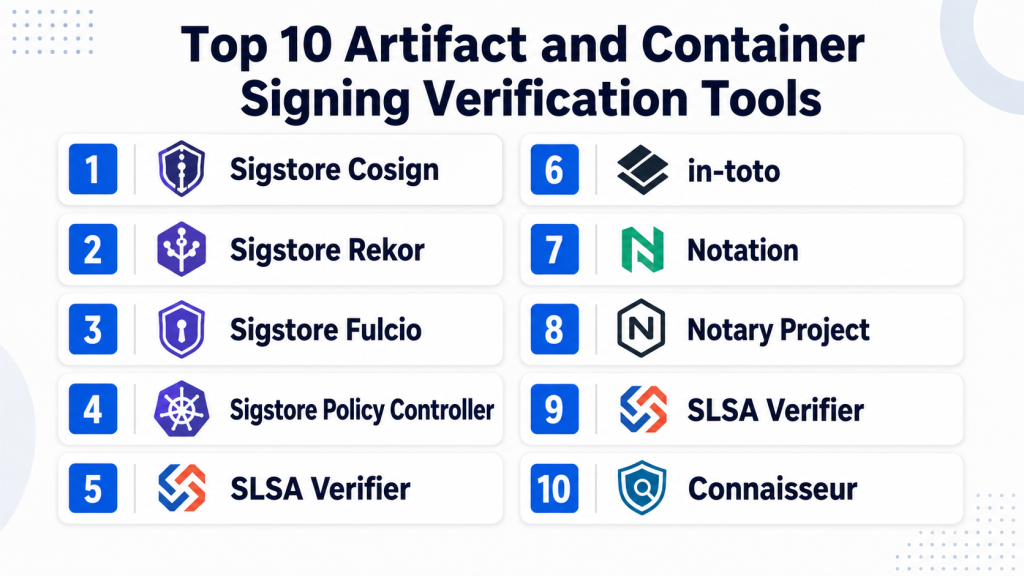
Top 10 Artifact and Container Signing Verification Tools
1- Sigstore Cosign
Short description:
Sigstore Cosign is one of the most important tools for signing and verifying container images and software artifacts. It is widely used for keyless signing, OCI artifact signing, SBOM signing, and attestation workflows. Cosign is especially useful for DevOps and platform teams that want to integrate signing directly into CI/CD pipelines without managing complex long-lived signing keys. It works well with container registries and is commonly used as the practical signing interface for the broader Sigstore ecosystem.
Key Features
- Container image signing and verification
- Keyless signing support
- OCI registry signature storage
- SBOM and attestation signing
- Integration with Rekor transparency log
- Support for private key, KMS, and keyless workflows
- CLI-friendly automation for CI/CD pipelines
Pros
- Strong fit for modern container security workflows
- Practical for both open-source and enterprise teams
- Works well with automated release pipelines
Cons
- Requires teams to understand signing policies and identity rules
- Verification workflows need careful CI/CD and cluster integration
- Enterprise governance depends on implementation design
Platforms / Deployment
- Linux / Windows / macOS
- Cloud / Self-hosted / Hybrid
Security & Compliance
- Keyless signing support
- Transparency log integration
- KMS signing support
- Identity-based verification
- Compliance depends on deployment and governance model
Integrations & Ecosystem
Cosign integrates naturally with cloud-native delivery pipelines and container registries.
- Kubernetes
- OCI registries
- GitHub Actions
- GitLab CI
- Tekton
- Rekor
- Fulcio
- SLSA workflows
Support & Community
Cosign has strong open-source community adoption and is backed by the broader Sigstore ecosystem. Documentation and examples are widely available, but production rollout still requires internal security design.
2- Sigstore Rekor
Short description:
Sigstore Rekor is a transparency log used to record signing metadata and support verifiable software supply chain trust. It helps teams prove that a signature or attestation was logged and can be independently checked later. Rekor is especially useful for organizations that want auditable signing records, public transparency, and stronger accountability around artifact releases. It is often used together with Cosign and Fulcio as part of a keyless signing workflow.
Key Features
- Transparency log for signing metadata
- Verifiable record of artifact signatures
- Integration with Cosign workflows
- Support for supply chain auditability
- Append-only transparency model
- Public good infrastructure support
- Useful for keyless signing verification
Pros
- Improves auditability and trust
- Works well with Sigstore signing workflows
- Supports transparent software release practices
Cons
- Not a standalone signing tool
- Requires understanding of transparency log verification
- Enterprise private deployment may require extra planning
Platforms / Deployment
- Web / Linux
- Cloud / Self-hosted / Hybrid
Security & Compliance
- Transparency log verification
- Tamper-evident record model
- Compliance depends on how logs are governed and retained
- Not publicly stated for broad enterprise certifications
Integrations & Ecosystem
Rekor is mainly used inside the Sigstore ecosystem and related verification workflows.
- Cosign
- Fulcio
- CI/CD systems
- Artifact verification pipelines
- Supply chain audit workflows
Support & Community
Rekor benefits from the Sigstore community and open-source development model. Teams adopting Rekor should define clear verification and audit practices.
3- Sigstore Fulcio
Short description:
Sigstore Fulcio is a certificate authority component used in Sigstore keyless signing workflows. It issues short-lived signing certificates based on identity, often through OIDC-based authentication. Fulcio helps reduce the burden of managing long-lived private signing keys, making it attractive for CI/CD pipelines and open-source projects. It is usually used behind the scenes with Cosign rather than directly by every developer.
Key Features
- Keyless signing certificate issuance
- Short-lived certificate model
- OIDC identity integration
- Works with Cosign signing workflows
- Helps reduce long-lived key risk
- Supports identity-based trust
- Important component of Sigstore architecture
Pros
- Reduces private key management burden
- Strong fit for automated CI/CD signing
- Helps connect signatures to workload identity
Cons
- Not a standalone verification product
- Requires understanding of identity providers
- Private deployments require careful trust root management
Platforms / Deployment
- Web / Linux
- Cloud / Self-hosted / Hybrid
Security & Compliance
- Short-lived certificates
- OIDC-based identity model
- Trust root management
- Compliance depends on identity provider and deployment design
Integrations & Ecosystem
Fulcio works closely with Sigstore components and identity systems.
- Cosign
- Rekor
- OIDC providers
- GitHub Actions
- Kubernetes-related workflows
- CI/CD signing pipelines
Support & Community
Fulcio is supported by the Sigstore open-source ecosystem. It is most useful for teams adopting the complete Sigstore trust model.
4- Sigstore Policy Controller
Short description:
Sigstore Policy Controller is a Kubernetes admission controller used to enforce deployment policies based on signed artifacts and verifiable supply chain metadata. It helps prevent unsigned, untrusted, or policy-violating container images from running in Kubernetes clusters. This makes it especially valuable for platform engineering teams that want to turn signing into a real deployment control rather than just a release-time activity.
Key Features
- Kubernetes admission control
- Cosign signature verification
- Policy-based image admission
- Supply chain metadata enforcement
- Tag-to-digest resolution
- Cluster-level deployment protection
- Integration with Sigstore trust workflows
Pros
- Turns signing into enforceable runtime governance
- Strong Kubernetes-native fit
- Helps prevent untrusted images from deployment
Cons
- Requires Kubernetes policy design expertise
- Still needs strong CI/CD signing discipline
- Misconfigured policies may block valid deployments
Platforms / Deployment
- Kubernetes
- Cloud / Self-hosted / Hybrid
Security & Compliance
- Admission control enforcement
- Signature verification
- Policy-based deployment governance
- RBAC depends on Kubernetes configuration
- Compliance depends on cluster governance
Integrations & Ecosystem
Policy Controller integrates with Kubernetes and Sigstore signing workflows.
- Kubernetes admission control
- Cosign
- OCI registries
- CI/CD pipelines
- Cluster policy workflows
- Supply chain metadata verification
Support & Community
The tool is part of the Sigstore ecosystem and has active open-source development. Enterprise teams should test policies carefully before production enforcement.
5- SLSA Verifier
Short description:
SLSA Verifier is a tool focused on verifying SLSA provenance generated by supported CI/CD builders. It checks whether provenance is cryptographically valid and whether important values such as builder identity, source repository, and reference match expected values. This makes it useful for teams that want to go beyond image signatures and verify how an artifact was actually built.
Key Features
- SLSA provenance verification
- Cryptographic signature validation
- Builder identity checking
- Source repository validation
- Ref and branch verification
- CI/CD provenance workflow support
- Useful for release integrity checks
Pros
- Strong fit for provenance-focused security
- Helps validate build origin and process
- Practical for SLSA adoption programs
Cons
- Focused on provenance, not general signing
- Requires supported provenance generation workflows
- Teams must define expected verification values carefully
Platforms / Deployment
- Linux / Windows / macOS
- Cloud / Self-hosted / CI/CD
Security & Compliance
- Provenance signature verification
- Builder identity validation
- Source repository verification
- Compliance depends on SLSA adoption and CI/CD governance
Integrations & Ecosystem
SLSA Verifier fits naturally into secure release and CI/CD verification pipelines.
- GitHub Actions provenance
- SLSA generators
- CI/CD release workflows
- Artifact verification pipelines
- in-toto style attestations
Support & Community
Supported by the SLSA ecosystem and useful for teams implementing stronger supply chain security controls.
6- in-toto
Short description:
in-toto is a framework for securing the software supply chain through signed metadata and attestations. It helps teams describe and verify steps in a software build or release process. Rather than only asking whether an artifact is signed, in-toto helps answer what happened during the supply chain and whether the expected process was followed. It is especially useful for organizations adopting provenance, attestations, and SLSA-style verification.
Key Features
- Supply chain layout verification
- Signed metadata support
- Attestation workflows
- Build step integrity validation
- Provenance support
- Integration with SLSA concepts
- Policy-driven verification model
Pros
- Strong conceptual foundation for supply chain integrity
- Useful for advanced provenance workflows
- Flexible across build and release processes
Cons
- Higher learning curve than simple signing tools
- Requires process modeling and metadata discipline
- Operational adoption can be complex
Platforms / Deployment
- Linux / Windows / macOS
- Cloud / Self-hosted / Hybrid
Security & Compliance
- Signed metadata
- Attestation verification
- Supply chain step validation
- Compliance depends on implementation and governance
Integrations & Ecosystem
in-toto connects with supply chain security and provenance workflows.
- SLSA provenance
- CI/CD pipelines
- Artifact metadata
- Policy engines
- Secure build systems
- Verification tooling
Support & Community
in-toto has a strong security-focused open-source community and is commonly referenced in software supply chain security discussions.
7- Notation
Short description:
Notation is a tool for signing and verifying OCI artifacts using the Notary Project ecosystem. It is designed to work with container registries and OCI-native artifact workflows. Notation is useful for organizations that want registry-compatible signing and verification using a standards-oriented model. It is commonly evaluated alongside Cosign when teams compare container image signing approaches.
Key Features
- OCI artifact signing
- Signature verification
- Registry-native workflows
- Certificate-based signing support
- Plugin extensibility
- Container image trust workflows
- CLI-based automation
Pros
- Strong OCI artifact alignment
- Practical for registry-based signing workflows
- Useful for enterprise container governance
Cons
- Ecosystem differs from Sigstore keyless model
- Requires trust policy configuration
- Adoption depends on registry and platform compatibility
Platforms / Deployment
- Linux / Windows / macOS
- Cloud / Self-hosted / Hybrid
Security & Compliance
- Signature verification
- Certificate-based trust models
- Registry-based policy workflows
- Compliance depends on deployment and trust policy design
Integrations & Ecosystem
Notation integrates with OCI registries and container delivery workflows.
- OCI registries
- Container image pipelines
- CI/CD platforms
- Notary Project components
- Kubernetes policy tools
Support & Community
Notation benefits from the Notary Project and cloud-native security community. Enterprise usage should include trust policy planning and registry compatibility testing.
8- Notary Project
Short description:
Notary Project is a broader ecosystem for signing and verifying OCI artifacts. It focuses on secure software distribution, registry-native trust, and artifact signature standards. While Notation is the CLI tool, Notary Project provides the surrounding model and specifications that help organizations build trusted artifact workflows. It is especially relevant for teams standardizing OCI artifact signing across registries and cloud platforms.
Key Features
- OCI artifact signing ecosystem
- Secure software distribution model
- Signature specification support
- Registry-native trust workflows
- Policy-driven verification concepts
- Compatibility with Notation
- Container supply chain integrity focus
Pros
- Strong standards-oriented approach
- Useful for enterprise registry trust models
- Works well with OCI artifact strategies
Cons
- More ecosystem than single product
- Requires tooling selection and implementation planning
- May overlap with Sigstore-based approaches
Platforms / Deployment
- Web / Linux / Windows / macOS
- Cloud / Self-hosted / Hybrid
Security & Compliance
- Artifact signature verification model
- Trust policy support through related tooling
- Compliance depends on platform and implementation
Integrations & Ecosystem
Notary Project supports OCI-focused signing and verification patterns.
- Notation
- OCI registries
- Container pipelines
- Kubernetes policy tools
- Cloud-native artifact workflows
Support & Community
The project is supported by a cloud-native ecosystem and is relevant for teams aligning with OCI artifact signing practices.
9- Ratify
Short description:
Ratify is a verification engine for securing Kubernetes deployments by checking artifact metadata such as signatures, SBOMs, and attestations. It is often used with policy engines and admission control workflows to verify artifacts before they are allowed into a cluster. Ratify is useful for organizations that want flexible verification across multiple artifact metadata types rather than only simple image signature checks.
Key Features
- Kubernetes artifact verification
- Signature verification support
- SBOM and attestation verification patterns
- Admission control integration
- Plugin-based verification approach
- Registry metadata validation
- Policy engine compatibility
Pros
- Strong fit for Kubernetes enforcement
- Flexible verification architecture
- Useful for signed metadata beyond images
Cons
- Requires Kubernetes policy expertise
- Deployment design can be complex
- Works best as part of a broader governance stack
Platforms / Deployment
- Kubernetes
- Cloud / Self-hosted / Hybrid
Security & Compliance
- Admission-time artifact verification
- Policy-driven trust enforcement
- RBAC depends on Kubernetes configuration
- Compliance depends on cluster policy design
Integrations & Ecosystem
Ratify fits into Kubernetes-native supply chain enforcement workflows.
- Kubernetes
- Gatekeeper
- OCI registries
- Notation
- SBOM metadata
- Attestation workflows
Support & Community
Ratify has a growing cloud-native security community. It is best suited for teams comfortable operating Kubernetes admission and policy systems.
10- Connaisseur
Short description:
Connaisseur is a Kubernetes admission controller focused on verifying container image signatures before deployment. It helps platform teams enforce that only trusted and signed images are admitted into clusters. Connaisseur is useful for organizations that want Kubernetes-native container trust enforcement and prefer admission control as the final gate before workloads run.
Key Features
- Kubernetes admission control
- Container image signature verification
- Trust policy configuration
- Registry-based verification workflows
- Deployment admission protection
- Support for signed image governance
- Cluster security enforcement
Pros
- Practical for Kubernetes image verification
- Helps enforce signed-image policies
- Useful as a deployment security gate
Cons
- Kubernetes-specific use case
- Requires careful trust configuration
- Less broad than full supply chain platforms
Platforms / Deployment
- Kubernetes
- Cloud / Self-hosted / Hybrid
Security & Compliance
- Admission control enforcement
- Signature verification
- Policy-based trust rules
- Compliance depends on Kubernetes governance
Integrations & Ecosystem
Connaisseur fits Kubernetes-native deployment security workflows.
- Kubernetes
- Container registries
- Signed image workflows
- CI/CD pipelines
- Cluster admission policies
Support & Community
Connaisseur has an open-source community and is useful for teams focused specifically on Kubernetes image signature enforcement.
Comparison Table
| Tool Name | Best For | Platform Supported | Deployment | Standout Feature | Public Rating |
|---|---|---|---|---|---|
| Sigstore Cosign | Container and artifact signing | Linux, Windows, macOS | Cloud / Self-hosted / Hybrid | Keyless signing and OCI signatures | N/A |
| Sigstore Rekor | Transparency logging | Web, Linux | Cloud / Self-hosted / Hybrid | Tamper-evident signing records | N/A |
| Sigstore Fulcio | Keyless certificate issuance | Web, Linux | Cloud / Self-hosted / Hybrid | Short-lived identity certificates | N/A |
| Sigstore Policy Controller | Kubernetes enforcement | Kubernetes | Cloud / Self-hosted / Hybrid | Admission policy based on Cosign metadata | N/A |
| SLSA Verifier | Provenance verification | Linux, Windows, macOS | Cloud / Self-hosted / CI/CD | Builder and source validation | N/A |
| in-toto | Supply chain attestations | Linux, Windows, macOS | Cloud / Self-hosted / Hybrid | Signed supply chain metadata | N/A |
| Notation | OCI artifact signing | Linux, Windows, macOS | Cloud / Self-hosted / Hybrid | Registry-native artifact signing | N/A |
| Notary Project | OCI trust ecosystem | Web, Linux, Windows, macOS | Cloud / Self-hosted / Hybrid | OCI signing specifications | N/A |
| Ratify | Kubernetes artifact verification | Kubernetes | Cloud / Self-hosted / Hybrid | Metadata verification engine | N/A |
| Connaisseur | Kubernetes image admission | Kubernetes | Cloud / Self-hosted / Hybrid | Signed image admission control | N/A |
Evaluation & Scoring of Artifact and Container Signing Verification Tools
| Tool Name | Core 25% | Ease 15% | Integrations 15% | Security 10% | Performance 10% | Support 10% | Value 15% | Weighted Total |
| Sigstore Cosign | 10 | 8 | 9 | 10 | 9 | 9 | 10 | 9.3 |
| Sigstore Rekor | 8 | 7 | 8 | 9 | 8 | 8 | 9 | 8.1 |
| Sigstore Fulcio | 8 | 7 | 8 | 9 | 8 | 8 | 9 | 8.1 |
| Sigstore Policy Controller | 9 | 7 | 8 | 9 | 8 | 8 | 9 | 8.3 |
| SLSA Verifier | 8 | 8 | 8 | 9 | 8 | 8 | 9 | 8.3 |
| in-toto | 9 | 6 | 8 | 9 | 8 | 8 | 9 | 8.1 |
| Notation | 8 | 8 | 8 | 8 | 8 | 8 | 9 | 8.1 |
| Notary Project | 8 | 7 | 8 | 8 | 8 | 8 | 9 | 8.0 |
| Ratify | 8 | 7 | 8 | 8 | 8 | 7 | 8 | 7.8 |
| Connaisseur | 7 | 7 | 7 | 8 | 8 | 7 | 8 | 7.4 |
These scores are comparative and should be interpreted based on use case. Cosign scores highest because it is a practical signing and verification interface for many artifact workflows. Rekor and Fulcio are critical Sigstore components but are usually adopted as part of a broader signing architecture rather than as standalone buyer tools. Kubernetes-heavy teams may value Policy Controller, Ratify, or Connaisseur more than standalone provenance tools. Organizations focused on SLSA maturity should prioritize SLSA Verifier and in-toto alongside signing tools.
Which Artifact and Container Signing Verification Tool Is Right for You?
Solo / Freelancer
Independent developers and maintainers should start with Sigstore Cosign because it offers practical artifact signing and verification workflows without requiring a large platform team. If the project publishes containers or release binaries, Cosign can help add trust to release artifacts. Open-source maintainers may also benefit from Rekor-backed transparency because it improves public verification and auditability. For simple projects, adding signing to the release workflow is often the most practical first step.
SMB
Small and growing engineering teams should focus on Cosign, SLSA Verifier, and basic CI/CD signing automation. Cosign helps sign container images and artifacts, while SLSA Verifier helps validate provenance when supported by the build system. Teams using Kubernetes can add Policy Controller later once signing is reliable. SMBs should avoid starting with overly complex policy enforcement until build and release signing workflows are stable.
Mid-Market
Mid-market organizations usually need stronger governance across multiple teams, registries, and clusters. Cosign, Policy Controller, SLSA Verifier, and in-toto are strong candidates for this stage. These tools help teams connect artifact signatures, provenance, and deployment policy enforcement. Ratify may also be useful for Kubernetes environments that need broader verification of signatures, SBOMs, and attestations.
Enterprise
Enterprises should treat artifact signing as a full software supply chain control. A mature architecture may combine Cosign for signing, Fulcio for identity-based certificates, Rekor for transparency, SLSA Verifier for provenance checks, and Policy Controller or Ratify for Kubernetes enforcement. Enterprises using OCI trust models may also evaluate Notation and Notary Project. The best stack depends on registry strategy, identity providers, CI/CD systems, and compliance requirements.
Budget vs Premium
Most tools in this category are open source, but the real cost comes from implementation, governance, CI/CD integration, training, and ongoing policy maintenance. Budget-conscious teams should start with Cosign and automated verification in CI/CD. Enterprises should budget for platform engineering time, security reviews, observability, developer education, and production support. A low-license-cost tool can still require serious operational investment.
Feature Depth vs Ease of Use
Cosign offers the best balance of practical usability and strong artifact signing capability. in-toto offers deeper supply chain modeling but requires more process maturity. Policy Controller, Ratify, and Connaisseur add enforcement depth for Kubernetes but require careful admission policy design. Notation provides a registry-native signing workflow, while Notary Project gives broader ecosystem direction rather than a single implementation experience.
Integrations & Scalability
Cosign and Sigstore components integrate well with CI/CD workflows, OCI registries, and Kubernetes-based deployments. SLSA Verifier fits release validation workflows where provenance is available. Policy Controller and Ratify scale best when teams already have standardized Kubernetes governance practices. Enterprises should test integrations with registries, identity providers, source control systems, and deployment platforms before organization-wide rollout.
Security & Compliance Needs
Security-sensitive teams should prioritize identity-based signing, transparency logging, provenance verification, admission control, auditability, and policy-as-code. Artifact signing should be combined with vulnerability scanning, SBOM generation, secret scanning, dependency review, and runtime controls. Signing proves integrity and identity, but it does not automatically prove that the artifact is vulnerability-free or safe by business policy.
Frequently Asked Questions
1. What are artifact and container signing tools?
Artifact and container signing tools help prove that software packages, container images, binaries, SBOMs, and attestations were created by a trusted identity and were not modified after signing. They add cryptographic trust to software delivery pipelines.
2. What is Sigstore used for?
Sigstore is used to simplify signing, verification, and software supply chain protection. Its ecosystem supports keyless signing, transparency logs, identity-based certificates, and verification workflows for containers and other software artifacts.
3. What is the difference between signing and verification?
Signing creates a cryptographic proof that an artifact came from a trusted identity. Verification checks that proof before the artifact is used, deployed, or trusted in a release or production environment.
4. Why is Cosign so popular for container signing?
Cosign is popular because it provides practical signing and verification workflows for OCI container images and related artifacts. It works well in CI/CD pipelines and supports keyless signing through the Sigstore ecosystem.
5. What is keyless signing?
Keyless signing allows teams to sign artifacts using identity-based short-lived certificates rather than managing long-lived private keys. This reduces key management risk and works well with automated CI/CD identity systems.
6. What is a transparency log in software signing?
A transparency log records signing events in a tamper-evident way. This helps users and auditors verify that signatures or attestations were logged and can be checked later for accountability.
7. Do signing tools replace vulnerability scanners?
No. Signing tools prove integrity, identity, and provenance, but they do not replace vulnerability scanning. Secure software delivery should combine signing, SBOMs, vulnerability scanning, secrets detection, policy enforcement, and runtime monitoring.
8. How does Kubernetes use signed container verification?
Kubernetes can use admission controllers or policy engines to verify image signatures before workloads are allowed to run. This helps prevent unsigned or untrusted images from entering production clusters.
9. What is SLSA provenance verification?
SLSA provenance verification checks whether an artifact was built by an expected builder, from an expected source repository, and through an expected build process. It helps teams verify the origin and integrity of build outputs.
10. What common mistakes should teams avoid?
Teams should avoid signing artifacts without enforcing verification, ignoring identity rules, skipping provenance checks, using broad trust policies, and failing to educate developers. Signing must be connected to CI/CD controls and deployment enforcement to provide real value.
Conclusion
Artifact and container signing verification tools are now a core part of software supply chain security. Tools like Sigstore Cosign, Rekor, Fulcio, Policy Controller, SLSA Verifier, in-toto, Notation, Notary Project, Ratify, and Connaisseur help teams prove artifact integrity, verify build provenance, enforce trusted deployment policies, and reduce the risk of compromised software reaching production. Cosign is often the best starting point because it provides practical signing and verification workflows for containers and related artifacts. More mature teams can add provenance verification, transparency logging, and Kubernetes admission control to build a stronger end-to-end trust model. The best approach is not to choose one universal winner, but to design a layered workflow: sign artifacts during CI/CD, attach SBOMs and attestations, verify provenance before release, and enforce trusted artifacts at deployment. As a next step, shortlist two or three tools based on your CI/CD and Kubernetes environment, run a pilot on one production-like service, validate registry and identity integrations, and then scale the policy gradually across teams.
