Introduction
AI Content Authenticity and Provenance Tools help organizations verify where digital content came from, how it was created, whether it was edited, and whether AI was involved in the creation process. These tools are becoming essential as AI-generated images, videos, audio, and text become harder to distinguish from human-created or camera-captured media. Instead of relying only on visual inspection or AI detection, provenance tools add metadata, cryptographic signatures, trust signals, watermarks, and verification workflows that help users understand content origin.
For businesses, publishers, creators, legal teams, governments, and platforms, content authenticity is now a trust and risk management requirement. Marketing teams need to disclose AI-assisted content, media organizations need to protect editorial credibility, marketplaces need to reduce fraud, and enterprises need audit trails for AI-generated assets. Buyers should evaluate whether a tool supports C2PA Content Credentials, watermarking, verification, metadata inspection, content labeling, enterprise controls, API access, and workflow integration.
Real World Use Cases
- Verifying whether an image or video contains trusted provenance metadata
- Adding Content Credentials to creative assets before publishing
- Detecting AI-generated media across moderation workflows
- Preserving attribution for creators, photographers, and brands
- Checking whether digital evidence has been edited or manipulated
- Labeling AI-generated images, audio, and video for transparency
- Supporting newsroom verification and misinformation review
- Building enterprise AI governance workflows for generated content
Evaluation Criteria for Buyers
- C2PA and Content Credentials support
- AI watermarking or detection capability
- Media type coverage across images, video, audio, and text
- Verification accuracy and transparency
- API and developer integration options
- Enterprise dashboard and workflow controls
- Privacy and data handling model
- Metadata preservation and inspection
- Ease of use for creators and reviewers
- Fit for publishing, compliance, moderation, or security teams
Best for: media organizations, publishers, creative teams, AI product teams, trust and safety teams, legal teams, government agencies, marketplaces, social platforms, and enterprises using generative AI at scale.
Not ideal for: teams that only need basic file storage or simple manual review. These tools are also not a complete replacement for editorial judgment, forensic analysis, moderation review, or broader AI governance controls.
Key Trends in AI Content Authenticity and Provenance Tools
- C2PA Content Credentials are becoming a major standard for content provenance and authenticity.
- AI watermarking is being combined with metadata-based provenance for stronger verification.
- Creative tools are adding built-in disclosure and attribution workflows.
- Search engines and browsers are beginning to support content authenticity inspection.
- Camera manufacturers and media platforms are becoming more involved in provenance adoption.
- Enterprises are treating AI content labeling as part of responsible AI governance.
- Trust and safety teams are combining AI detection, provenance metadata, and human review.
- Content authenticity workflows are expanding from images into video, audio, documents, and multimodal assets.
- APIs and SDKs are becoming important for embedding authenticity checks into products.
- Buyers are realizing that provenance tools reduce uncertainty but do not guarantee truth by themselves.
How We Selected These Tools
The tools in this list were selected using a practical buyer-focused evaluation framework.
- Relevance to AI content authenticity, provenance, watermarking, or verification
- Support for C2PA, Content Credentials, metadata inspection, or related standards
- Usefulness for enterprise, creator, media, and trust and safety workflows
- Developer integration options such as APIs, SDKs, or inspection tools
- Ability to support real-world publishing and governance workflows
- Media coverage across image, video, audio, or document formats
- Ecosystem adoption and long-term relevance
- Practical fit for reducing misinformation, fraud, attribution loss, or AI disclosure risk
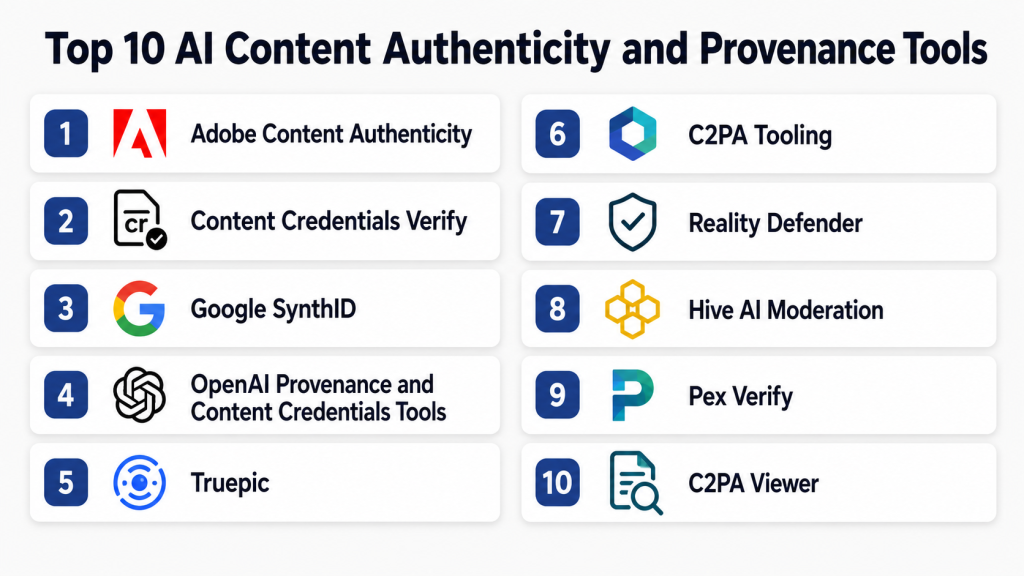
Top 10 AI Content Authenticity and Provenance Tools
1- Adobe Content Authenticity
Short description:
Adobe Content Authenticity helps creators, brands, and media teams attach Content Credentials to digital assets so viewers can understand who created or edited the content and whether AI tools were involved. It is closely aligned with the C2PA ecosystem and supports practical workflows for attribution, transparency, and AI disclosure. Adobe’s approach is especially useful for creative professionals and organizations that already rely on Adobe tools for design, photography, video, and content production. The platform helps make authenticity information more visible and easier to inspect.
Key Features
- Content Credentials support
- Creator attribution workflows
- AI disclosure metadata
- Image, video, and audio transparency workflows
- Integration with creative production environments
- Verification through compatible inspection tools
- Support for provenance-aware publishing practices
Pros
- Strong fit for creative and publishing teams
- Closely aligned with C2PA Content Credentials workflows
- Useful for attribution and AI transparency
Cons
- Best value comes when workflows already use supported creative tools
- Metadata can still be removed by platforms or file processing
- Enterprise governance may require broader workflow planning
Platforms / Deployment
- Web / Creative software ecosystem
- Cloud
Security & Compliance
- Uses provenance metadata and signing concepts
- C2PA-aligned authenticity workflows
- Broader compliance depends on customer configuration
- Not publicly stated for all enterprise certifications in this context
Integrations & Ecosystem
Adobe Content Authenticity fits naturally into creative, publishing, and content production workflows.
- Adobe creative applications
- Content Credentials inspection workflows
- C2PA ecosystem
- Publishing workflows
- Creator attribution workflows
Support & Community
Adobe has strong documentation, large creator adoption, and broad industry participation through content authenticity initiatives.
2- Content Credentials Verify
Short description:
Content Credentials Verify is a practical verification tool for inspecting media that contains Content Credentials. It helps users review provenance information, understand how an asset was created or edited, and check whether AI-related disclosures are present. This type of tool is useful for journalists, reviewers, creators, buyers, and trust teams that need a simple way to inspect authenticity metadata. It is especially valuable for lightweight verification workflows where users need quick transparency without complex forensic tools.
Key Features
- Content Credentials inspection
- Provenance metadata viewing
- Edit history visibility
- AI disclosure review
- Browser-based verification experience
- Support for C2PA-aligned credentials
- Simple review workflow for non-technical users
Pros
- Easy to use for quick checks
- Useful for journalists and content reviewers
- Helps make provenance metadata understandable
Cons
- Only useful when credentials are available or recoverable
- Not a full deepfake detection platform
- Cannot prove content truth beyond available provenance data
Platforms / Deployment
- Web
- Cloud
Security & Compliance
- Verifies available Content Credentials
- Trust depends on credential chain and issuer information
- Not publicly stated for broad enterprise certifications
Integrations & Ecosystem
Content Credentials Verify works as part of the broader provenance inspection ecosystem.
- C2PA Content Credentials
- Creator verification workflows
- Editorial review workflows
- Media inspection processes
- AI transparency workflows
Support & Community
Supported by the content authenticity ecosystem and useful for broad public-facing verification needs.
3- Google SynthID
Short description:
Google SynthID is a watermarking and identification technology designed to help identify AI-generated content. It is especially relevant for organizations using Google’s generative AI ecosystem or evaluating AI transparency workflows. SynthID focuses on adding signals that can help detect AI-generated content even when visible metadata is missing or modified. It is best understood as part of a broader authenticity strategy that may also include C2PA credentials, labels, moderation workflows, and policy enforcement.
Key Features
- AI watermarking support
- AI-generated content identification
- Support for synthetic media transparency
- Integration with Google AI ecosystem
- Potential resilience beyond basic metadata
- Useful for platform-level verification workflows
- Supports responsible AI disclosure patterns
Pros
- Strong relevance for AI-generated media transparency
- Useful complement to provenance metadata
- Backed by major AI platform ecosystem
Cons
- Best suited to supported generation workflows
- Not a universal detector for all AI content
- Verification scope depends on implementation and media type
Platforms / Deployment
- Web / AI platform ecosystem
- Cloud
Security & Compliance
- Watermark-based authenticity signal
- Verification depends on supported content and workflow
- Not publicly stated for broad enterprise compliance certifications
Integrations & Ecosystem
SynthID fits into AI generation, content labeling, and verification workflows.
- Google AI products
- Image generation workflows
- Content authenticity checks
- Platform-level transparency systems
- AI governance workflows
Support & Community
Supported by Google’s AI ecosystem and increasingly relevant for AI transparency discussions.
4- OpenAI Provenance and Content Credentials Tools
Short description:
OpenAI Provenance and Content Credentials workflows help users understand whether supported media was generated or modified through OpenAI systems. The approach combines content provenance metadata, AI transparency signals, and verification tooling for supported outputs. This is useful for users, publishers, and platforms that need clearer disclosure around AI-generated content. It is especially important as organizations increasingly publish AI-assisted images and other generated media in customer-facing environments.
Key Features
- Content Credentials support for supported outputs
- AI-generated content transparency
- Verification workflows for supported media
- Integration with AI image generation pipelines
- Metadata-based provenance information
- Support for broader authenticity ecosystem
- Useful for responsible AI disclosure
Pros
- Strong fit for OpenAI-generated media transparency
- Helps users inspect supported AI content
- Aligns with broader industry provenance standards
Cons
- Verification scope depends on supported content types
- Metadata can be removed during file handling
- Not a universal detector for all AI-generated content
Platforms / Deployment
- Web / API ecosystem
- Cloud
Security & Compliance
- C2PA-aligned provenance support for supported content
- AI transparency metadata
- Compliance depends on organizational usage and policy controls
Integrations & Ecosystem
OpenAI provenance workflows fit into AI generation, publishing, and governance pipelines.
- ChatGPT image workflows
- API-generated media workflows
- C2PA ecosystem
- Content verification workflows
- AI governance processes
Support & Community
Supported through OpenAI product documentation and broader ecosystem adoption around provenance and AI transparency.
5- Truepic
Short description:
Truepic provides image and video authenticity solutions focused on trusted capture, verification, and content provenance. It is often relevant for organizations that need high-confidence media verification in insurance, field operations, inspections, journalism, compliance, and trust-sensitive workflows. Truepic’s approach is especially valuable when authenticity needs to begin at the point of capture rather than after content has already circulated online. It supports use cases where organizations must prove that visual evidence is real, timely, and traceable.
Key Features
- Trusted image and video capture
- Media authenticity verification
- Provenance and integrity workflows
- Enterprise verification use cases
- Field documentation support
- Anti-fraud media validation
- Content authenticity ecosystem participation
Pros
- Strong fit for evidence and field verification
- Useful for fraud reduction and trust workflows
- Supports enterprise-grade authenticity use cases
Cons
- More specialized than general creator tools
- May be excessive for simple content labeling
- Pricing and deployment details vary by use case
Platforms / Deployment
- Web / Mobile / API
- Cloud
Security & Compliance
- Media integrity verification
- Provenance workflows
- Enterprise controls vary by plan and implementation
- Not publicly stated for all certifications in this context
Integrations & Ecosystem
Truepic can support business workflows where verified media is operationally important.
- Insurance workflows
- Field inspection systems
- Claims review systems
- Compliance workflows
- API-based verification workflows
Support & Community
Enterprise-focused support and strong relevance for authenticity-sensitive industries.
6- C2PA Tooling
Short description:
C2PA Tooling refers to the open technical tools, SDKs, and libraries used by developers to create, read, inspect, and validate C2PA Content Credentials. These tools are important for engineering teams that want to build provenance support directly into products, publishing systems, camera workflows, or AI generation pipelines. Rather than being a single end-user product, C2PA tooling gives developers the building blocks to implement authenticity and provenance standards in their own software.
Key Features
- C2PA manifest creation and inspection
- Content Credentials validation
- SDK and library support
- Provenance metadata workflows
- Cryptographic signing concepts
- Developer integration options
- Support for standards-aligned implementation
Pros
- Strong fit for developers and platform teams
- Enables custom provenance workflows
- Aligned with open technical standards
Cons
- Requires engineering expertise
- Not a complete end-user product by itself
- Production trust model requires careful implementation
Platforms / Deployment
- Linux / Windows / macOS / Web
- Cloud / Self-hosted / Hybrid
Security & Compliance
- Cryptographically bound provenance metadata
- Trust list concepts
- Signature validation support
- Compliance depends on implementation and governance
Integrations & Ecosystem
C2PA tooling fits into custom product, publishing, and AI platform workflows.
- Media pipelines
- AI generation platforms
- CMS systems
- Verification tools
- Creative applications
- Developer SDK workflows
Support & Community
Strong standards-driven ecosystem with growing developer participation and documentation.
7- Reality Defender
Short description:
Reality Defender is an AI detection and content verification platform focused on identifying manipulated and synthetic media. It is commonly considered by trust and safety teams, enterprises, financial institutions, media teams, and security teams that need to detect deepfakes or suspicious media at scale. Reality Defender is especially useful when organizations need API-based analysis, dashboard workflows, and detection coverage across multiple content types. It works best as part of a broader verification stack that includes provenance checks, human review, and policy controls.
Key Features
- AI-generated media detection
- Deepfake detection workflows
- Enterprise dashboard
- API-based analysis
- Multi-format content review
- Risk scoring and review support
- Trust and safety workflow fit
Pros
- Strong fit for enterprise detection workflows
- Useful for security and fraud review teams
- API support enables workflow integration
Cons
- Detection is probabilistic and not always definitive
- May need human review for high-stakes decisions
- Does not replace provenance metadata workflows
Platforms / Deployment
- Web / API
- Cloud
Security & Compliance
- Enterprise security controls vary by deployment
- Access controls and audit needs should be validated during procurement
- Not publicly stated for all certifications in this context
Integrations & Ecosystem
Reality Defender fits into enterprise detection and moderation pipelines.
- Trust and safety workflows
- Fraud review systems
- Media verification pipelines
- API integrations
- Security operations workflows
Support & Community
Enterprise-focused support model with relevance for organizations handling synthetic media risk.
8- Hive AI Moderation
Short description:
Hive AI Moderation provides AI-powered content moderation and media analysis capabilities, including tools that can help identify synthetic or manipulated media in broader trust and safety workflows. It is useful for platforms, marketplaces, communities, and media applications that need scalable content review. Hive is not only a provenance tool, but it can support authenticity-adjacent workflows where teams need to detect, label, or review AI-generated and risky media at volume.
Key Features
- AI-powered content moderation
- Synthetic media detection support
- Image and video analysis
- API-driven workflow integration
- Platform trust and safety support
- Scalable review workflows
- Automated content classification
Pros
- Strong fit for high-volume platforms
- Useful for moderation and policy enforcement
- API workflows support scalable deployment
Cons
- Broader moderation platform rather than pure provenance tool
- Detection results require policy interpretation
- Human review may still be required for sensitive cases
Platforms / Deployment
- Web / API
- Cloud
Security & Compliance
- Enterprise controls vary by plan and implementation
- Data handling and compliance terms should be verified during procurement
- Not publicly stated for all certifications in this context
Integrations & Ecosystem
Hive fits into content safety, moderation, and platform review pipelines.
- Marketplace moderation
- Social platform workflows
- Media review systems
- API-based content screening
- Trust and safety dashboards
Support & Community
Commercial support is available for enterprise and platform customers with high-volume moderation needs.
9- Pex Verify
Short description:
Pex Verify is focused on content identification, attribution, and rights-related media intelligence. While it is not only an AI provenance tool, it is relevant for organizations that need to track content usage, ownership signals, and media authenticity across digital platforms. Pex-style verification workflows are useful for rights holders, media companies, creators, and platforms that need to understand where content appears and whether it aligns with ownership or authorization rules.
Key Features
- Content identification
- Rights and ownership workflows
- Media matching and verification
- Platform-scale monitoring
- Attribution support
- Usage tracking
- Brand and rights protection workflows
Pros
- Strong fit for rights holders and media companies
- Useful for attribution and ownership workflows
- Supports platform-scale media intelligence
Cons
- Not primarily a C2PA provenance tool
- Best suited to rights and identification use cases
- May not replace AI watermark or credential verification
Platforms / Deployment
- Web / API
- Cloud
Security & Compliance
- Enterprise access controls vary by deployment
- Rights and verification workflows depend on customer configuration
- Not publicly stated for all certifications in this context
Integrations & Ecosystem
Pex Verify can support media rights, platform monitoring, and attribution workflows.
- Rights management systems
- Media platforms
- Creator economy workflows
- API-based content identification
- Brand protection processes
Support & Community
Commercial support is typically oriented toward media organizations, rights holders, and platforms.
10- C2PA Viewer
Short description:
C2PA Viewer is a lightweight tool for inspecting C2PA manifests and Content Credentials in supported media files. It is useful for creators, reviewers, journalists, researchers, and developers who need a quick way to examine provenance metadata. The tool helps users understand available credential data, including creation details, editing history, software information, and signature status where present. It is especially useful for education, lightweight validation, and workflow testing.
Key Features
- C2PA manifest inspection
- Content Credentials viewing
- Raw metadata visibility
- Browser-based verification
- Creator and editor information review
- AI content disclosure inspection
- Simple provenance education workflow
Pros
- Easy for lightweight verification
- Useful for learning and testing C2PA workflows
- Helpful for quick metadata inspection
Cons
- Limited to available provenance metadata
- Not a full enterprise governance platform
- Cannot detect all AI-generated content without credentials
Platforms / Deployment
- Web
- Cloud / Browser-based
Security & Compliance
- Inspect-and-view verification model
- Security depends on browser and workflow handling
- Not publicly stated for enterprise certifications
Integrations & Ecosystem
C2PA Viewer fits into lightweight review and education workflows.
- C2PA Content Credentials
- Editorial verification workflows
- Creator review processes
- Developer testing
- Media literacy workflows
Support & Community
Useful community-facing tool for public education, developer testing, and simple verification workflows.
Comparison Table
| Tool Name | Best For | Platform Supported | Deployment | Standout Feature | Public Rating |
|---|---|---|---|---|---|
| Adobe Content Authenticity | Creative attribution and AI disclosure | Web, creative ecosystem | Cloud | Content Credentials for creators | N/A |
| Content Credentials Verify | Lightweight provenance inspection | Web | Cloud | Simple credential verification | N/A |
| Google SynthID | AI watermarking and identification | Web, AI platform ecosystem | Cloud | Watermark-based AI transparency | N/A |
| OpenAI Provenance and Content Credentials Tools | OpenAI-generated content transparency | Web, API ecosystem | Cloud | C2PA and AI provenance workflows | N/A |
| Truepic | Trusted capture and media verification | Web, Mobile, API | Cloud | Capture-based authenticity verification | N/A |
| C2PA Tooling | Developer implementation of provenance standards | Linux, Windows, macOS, Web | Cloud / Self-hosted / Hybrid | SDK and standards-based implementation | N/A |
| Reality Defender | Deepfake and synthetic media detection | Web, API | Cloud | Enterprise AI media detection | N/A |
| Hive AI Moderation | High-volume platform moderation | Web, API | Cloud | Scalable content analysis | N/A |
| Pex Verify | Rights and content identification | Web, API | Cloud | Media attribution and ownership tracking | N/A |
| C2PA Viewer | Simple C2PA metadata inspection | Web | Cloud / Browser-based | Raw manifest inspection | N/A |
Evaluation and Scoring of AI Content Authenticity and Provenance Tools
| Tool Name | Core 25% | Ease 15% | Integrations 15% | Security 10% | Performance 10% | Support 10% | Value 15% | Weighted Total |
| Adobe Content Authenticity | 9 | 9 | 8 | 8 | 8 | 9 | 8 | 8.5 |
| Content Credentials Verify | 8 | 9 | 7 | 8 | 8 | 8 | 9 | 8.2 |
| Google SynthID | 8 | 8 | 8 | 8 | 8 | 9 | 8 | 8.1 |
| OpenAI Provenance and Content Credentials Tools | 8 | 8 | 8 | 8 | 8 | 8 | 8 | 8.0 |
| Truepic | 9 | 8 | 8 | 9 | 8 | 8 | 7 | 8.2 |
| C2PA Tooling | 9 | 6 | 9 | 9 | 8 | 8 | 9 | 8.3 |
| Reality Defender | 8 | 8 | 8 | 8 | 8 | 8 | 7 | 7.9 |
| Hive AI Moderation | 8 | 8 | 8 | 7 | 8 | 8 | 8 | 7.9 |
| Pex Verify | 7 | 8 | 8 | 7 | 8 | 8 | 7 | 7.5 |
| C2PA Viewer | 7 | 9 | 6 | 7 | 8 | 7 | 9 | 7.5 |
These scores are comparative and should be interpreted based on buyer needs. Creative teams may prioritize ease of use and attribution workflows, while enterprises may prioritize APIs, security, governance, and platform integration. Detection-focused tools should not be treated as perfect truth engines because AI detection is probabilistic. Provenance tools are strongest when combined with content policy, trusted capture, human review, and responsible AI governance.
Which AI Content Authenticity and Provenance Tool Is Right for You?
Solo / Freelancer
Solo creators, photographers, designers, and independent publishers should prioritize tools that are easy to use and help preserve attribution. Adobe Content Authenticity, Content Credentials Verify, and C2PA Viewer are strong choices for creators who want to add or inspect provenance signals without building custom systems. These tools can help show whether content was created, edited, or AI-assisted, while also improving transparency for audiences and clients.
SMB
Small and mid-sized businesses should focus on practical workflows that support marketing, publishing, brand trust, and customer-facing transparency. Adobe Content Authenticity is useful for creative teams, while Content Credentials Verify and C2PA Viewer can help content reviewers inspect provenance. SMBs using AI-generated assets should also evaluate whether their generation platforms support provenance metadata or watermarking so that disclosure does not depend only on manual labeling.
Mid-Market
Mid-market organizations usually need a mix of creator workflows, review workflows, and API-driven checks. Adobe Content Authenticity, Truepic, Reality Defender, and C2PA Tooling can be useful depending on the business model. Media companies and agencies may prioritize Content Credentials workflows, while marketplaces and trust teams may need detection platforms that help identify suspicious or manipulated media at scale.
Enterprise
Enterprises should approach content authenticity as part of AI governance, brand protection, legal risk management, and trust and safety operations. A mature stack may include C2PA-based provenance, AI watermarking, deepfake detection, trusted capture, moderation tooling, and human review. C2PA Tooling is useful for organizations building authenticity into internal systems, while Truepic, Reality Defender, Hive AI Moderation, and Pex Verify may support specialized verification and monitoring needs.
Budget vs Premium
Free or lightweight tools such as C2PA Viewer and Content Credentials Verify are useful for basic inspection and education. Premium platforms are more appropriate when teams need API access, dashboards, enterprise support, high-volume analysis, trusted capture, or workflow integration. Budget planning should include not only software cost but also training, review processes, metadata preservation, content policy updates, and integration work.
Feature Depth vs Ease of Use
Content Credentials Verify and C2PA Viewer are easy to use but limited to inspection workflows. Adobe Content Authenticity offers stronger creator-facing workflows. C2PA Tooling provides deeper implementation flexibility but requires engineering resources. Reality Defender, Hive AI Moderation, and Truepic provide more specialized enterprise capabilities but may require procurement review, policy design, and workflow integration.
Integrations & Scalability
Organizations that need scalability should prioritize API access, workflow automation, bulk processing, and integration with CMS, DAM, moderation, publishing, and AI generation systems. C2PA Tooling is useful for product teams building native provenance support. Detection and moderation platforms are better for high-volume review. Creative teams should validate whether authenticity metadata is preserved through editing, export, upload, CDN, and social publishing workflows.
Security & Compliance Needs
Security-sensitive organizations should evaluate how each tool handles uploaded content, metadata, logs, access controls, retention, and auditability. Provenance can support compliance and governance, but it does not replace legal review, data protection policies, or responsible AI controls. Buyers should also validate whether authenticity information remains intact across file conversions, compression, publishing platforms, and downstream sharing.
Frequently Asked Questions
1. What are AI Content Authenticity and Provenance Tools?
AI Content Authenticity and Provenance Tools help verify where digital content came from, how it was created, and whether AI was involved. They may use metadata, cryptographic signatures, watermarks, detection models, or trusted capture workflows.
2. What is C2PA?
C2PA is an open technical standard for recording and verifying content origin and edit history. It enables Content Credentials and similar provenance workflows that help users understand how media was created or modified.
3. What are Content Credentials?
Content Credentials are provenance records attached to digital assets. They can show creator details, editing history, AI involvement, software used, and other transparency information when supported by the creation and viewing tools.
4. Can provenance tools prove that content is true?
No. Provenance tools can show origin, edit history, and authenticity signals, but they do not automatically prove that the content itself is factually true. Editorial review and contextual verification are still required.
5. Are AI detection tools always accurate?
No. AI detection tools are probabilistic and can produce false positives or false negatives. They should be used as part of a broader review workflow that includes provenance checks and human judgment.
6. What is the difference between watermarking and provenance metadata?
Watermarking adds hidden or detectable signals to content, while provenance metadata records information about origin and edits. The strongest strategies often combine both approaches.
7. Can Content Credentials be removed?
Yes. Metadata may be stripped during file conversion, compression, screenshots, uploads, or platform processing. That is why many organizations combine provenance metadata with watermarking, trusted capture, and platform-level verification.
8. Which tool is best for creative teams?
Adobe Content Authenticity is a strong choice for creative teams that want attribution and AI disclosure workflows. Content Credentials Verify and C2PA Viewer are useful for inspecting authenticity metadata.
9. Which tool is best for enterprise trust and safety teams?
Reality Defender, Hive AI Moderation, Truepic, and C2PA Tooling are strong candidates depending on whether the team needs detection, trusted capture, custom provenance implementation, or high-volume moderation workflows.
10. What mistakes should buyers avoid?
Buyers should avoid treating AI detection as perfect, ignoring metadata preservation, skipping policy design, failing to train reviewers, and assuming one tool can solve all authenticity risks. A layered workflow is usually more reliable.
Conclusion
AI Content Authenticity and Provenance Tools are becoming essential as organizations publish, review, and govern large volumes of AI-assisted and digital media. C2PA Content Credentials, watermarking systems, trusted capture platforms, deepfake detection tools, and moderation APIs all solve different parts of the authenticity challenge. Adobe Content Authenticity, Content Credentials Verify, Google SynthID, OpenAI provenance workflows, Truepic, C2PA Tooling, Reality Defender, Hive AI Moderation, Pex Verify, and C2PA Viewer each fit different buyer needs. Creative teams should start with attribution and disclosure workflows, while enterprises should build layered systems that combine provenance, detection, policy, and human review. The best next step is to shortlist two or three tools based on your media type, publishing workflow, and risk level, then run a pilot that tests metadata preservation, verification accuracy, integrations, and reviewer usability before scaling across teams.
