Introduction
SSL/TLS Certificate Authorities (CAs) and their associated tooling form the backbone of secure internet communication. At a fundamental level, these platforms issue digital certificates that encrypt web traffic, authenticate server identity, and enable trust between users and services. SSL/TLS certificates are not just about “closing the lock icon.” They are essential for securing websites, APIs, email servers, IoT devices, internal services, and any digital endpoint that must avoid eavesdropping, tampering, or impersonation.
In and beyond, businesses increasingly rely on automated issuance, renewal, rotation, compliance monitoring, and integrated lifecycle tooling. Managing certificate lifecycles manually or with spreadsheets has become impractical — certificate outages can lead to outages, blocked APIs, failed integrations, broken user sessions, and compliance violations. Modern CA tooling helps teams eliminate expired certificates, unify multi‑cloud issuance, enforce authentication policies, and scale securely.
Real‑world use cases include:
- Securing public websites and multi‑domain services with DV/OV/EV certificates.
- Protecting APIs and microservices with automated certificate issuance and rotation.
- Managing internal PKI for employee devices, services, and internal apps.
- Automating certificate lifecycle (issuance, renewal, revocation) at large scale.
- Ensuring compliance with industry standards (PCI DSS, HIPAA, SOC 2, ISO 27001).
- Monitoring expiration, key strength, cipher health, revocation status, and trust chains.
What buyers should evaluate:
- Certificate types supported (DV, OV, EV, wildcard, SAN, multi‑domain).
- Automation capabilities (ACME support, APIs, CLI tools, orchestration).
- Lifecycle tooling (renewal alerts, rotation orchestration, certificate discovery).
- Integration ecosystem (cloud providers, CDNs, load balancers, DevOps pipelines).
- Security posture (key protection, audit logs, RBAC, MFA).
- Scalability & performance (throughput, issuance speed, global availability).
- Compliance readiness (auditing, reporting, retention, PKI governance).
- Developer friendliness (APIs, SDKs, automation hooks).
- Global trust (browser/root store acceptance, legacy client compatibility).
- Support & community (enterprise support, troubleshooting resources, user base).
Best for: Security teams, DevOps engineers, cloud architects, SaaS companies, enterprises, infrastructure teams, and product teams that automate secure connectivity at scale.
Not ideal for: Individuals or small sites requiring only a basic free certificate; standalone hobby projects without scalability or automation needs can often get by with simpler CA options or embedded tooling without full CA platforms.
Key Trends in SSL/TLS Certificate Authorities Tooling
- Automation Is Default: Manual renewal is obsolete — automation through ACME, APIs, and orchestration tools is standard.
- Certificate Lifecycle Management (CLM): Tooling now includes discovery, rotation, revocation, and compliance reporting across estates.
- DevOps Integration: CI/CD pipelines, infrastructure‑as‑code tooling, and service mesh integrations make certificate operations part of developer workflows.
- Cloud Vendor Built‑Ins: Major cloud providers include native certificate services tied to load balancers, functions, and cloud resources.
- Internal PKI Growth: Enterprises increasingly run internal PKI with automation, separating internal from public trust environments.
- Short‑Lived Certificates: Many CA tools default to short‑lived certificates (e.g., 90 days) to reduce key risk exposure.
- Zero Trust Architecture: Certificate issuance is key to mutual TLS, identity‑based access, and service mesh security models.
- Observability Convergence: Certificate health and expiry feed into observability stacks for proactive alerts.
- Enterprise Compliance Tooling: Enhanced reporting for audit, retention, compromise detection, and regulatory alignment.
- Root Store Diversity: Tooling increasingly helps manage certificate chains, intermediate rotation, and cross‑store compliance.
How We Selected These Tools (Methodology)
- Market adoption: Adoption among enterprises, DevOps teams, cloud providers, SaaS, and infrastructure users.
- Feature depth: Automation, monitoring, lifecycle tooling, and management capabilities.
- Security posture: Support for strong key protection, audit, RBAC, MFA, and compliance readiness.
- Integration breadth: Ability to integrate with cloud platforms, CDNs, orchestration tooling, and DevOps pipelines.
- Scalability: Suitability for large certificate estates, automated renewal, and enterprise workflows.
- Developer experience: APIs, ACME support, SDKs, CLI tooling, and automation hooks.
- Deployment flexibility: Cloud, on‑premises, hybrid, and internal PKI support.
- Support & documentation: Enterprise support options, community adoption, and learning resources.
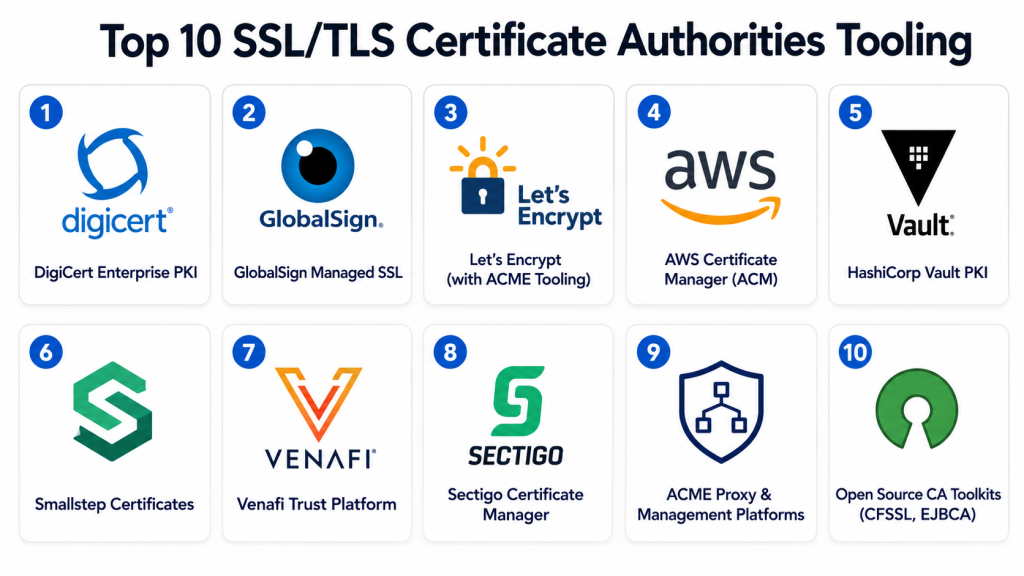
Top 10 SSL/TLS Certificate Authorities Tooling
1 — DigiCert Enterprise PKI
Short description:
DigiCert Enterprise PKI is a high‑trust certificate authority and management platform tailored for global enterprises and regulated industries. It provides automated issuance, lifecycle orchestration, compliance reporting, multi‑environment integration, and strong governance controls. DigiCert is frequently chosen by organizations requiring robust automation, auditability, and integration with cloud and DevOps stacks.
Key Features
- Comprehensive certificate lifecycle management
- DV, OV, EV, wildcard, SAN certificate support
- API automation and orchestration support
- Compliance reporting and audit trails
- Managed PKI and trust chain governance
- Certificate discovery and inventory
- Integration with cloud/CDN/DevOps tooling
Pros
- Enterprise‑ready automation and compliance support.
- Broad certificate type and governance toolset.
- Strong support and documentation for regulated environments.
Cons
- Premium cost structure.
- Can be complex to configure for smaller teams.
- Advanced tooling may require training.
Platforms / Deployment
Cloud / Managed Enterprise / Hybrid options
Security & Compliance
Supports MFA, RBAC, audit logs, key protection, SOC 2, ISO 27001, PCI DSS, and regulatory reporting (varies by plan).
Integrations & Ecosystem
Integrates with cloud providers, orchestration tooling, CDNs, load balancers, DevOps pipelines, and internal PKI environments.
- Cloud platform integrations
- CDNs and global load balancers
- CI/CD tooling and automation
- API gateways and service meshes
- Enterprise SIEM/SOAR
- Directory services
Support & Community
Enterprise support tiers, professional services, and comprehensive documentation. Mature community among security and infrastructure teams.
2 — GlobalSign Managed SSL
Short description:
GlobalSign offers managed SSL/TLS services and PKI tooling designed for enterprises, service providers, and large organizations. With strong automation, compliance focus, and global trust services, GlobalSign helps teams issue, renew, and rotate certificates reliably at scale.
Key Features
- Multi‑type certificates (DV/OV/EV/SAN)
- Cloud‑based certificate management console
- Automation via APIs and ACME
- Compliance alerts and reporting
- Certificate inventory and discovery
- Managed trust services
- API access and integration hooks
Pros
- High reliability and global trust footprint.
- Strong compliance and enterprise visibility.
- Automation support for lifecycle workflows.
Cons
- Interface may feel complex for small teams.
- Cost scales with certificate volume and features.
- Some advanced features require enterprise licensing.
Platforms / Deployment
Cloud / Managed
Security & Compliance
Enterprise‑grade controls including RBAC, MFA, audit logs, and compliance reporting. Certifications vary by configuration.
Integrations & Ecosystem
Integration with cloud platforms, enterprise tooling, automation frameworks, and CI/CD workflows.
- Cloud load balancers
- API orchestration
- DevOps pipelines
- Enterprise security feeds
- Internal key stores
Support & Community
Dedicated support tiers, professional services, and documentation tailored to enterprise use cases.
3 — Let’s Encrypt (with ACME Tooling)
Short description:
Let’s Encrypt is a free, automated certificate authority that issues domain‑validated (DV) certificates using the ACME protocol. While it does not offer enterprise management dashboards by itself, its ACME ecosystem enables automated issuance and renewal through various clients and tooling, making it widely used for secure HTTPS deployment at scale without licensing cost.
Key Features
- Free DV certificates
- ACME‑based automation
- Wildcard and standard certificate support
- Broad ecosystem of client tooling
- Widely trusted by browsers and systems
Pros
- Fully free and automated certificate issuance.
- ACME tooling encourages DevOps automation.
- Broad adoption in cloud and open‑source landscapes.
Cons
- Only DV certificates — no OV/EV guarantees.
- Lacks enterprise reporting or built‑in management UI.
- Manual tooling assembly required for lifecycle orchestration.
Platforms / Deployment
Web / Cloud / Open‑source
Security & Compliance
Standard TLS cryptography and automated renewal improve security, but enterprise compliance tooling depends on external systems.
Integrations & Ecosystem
Works with ACME clients and automation systems across web servers, orchestration tooling, and cloud services.
- ACME client frameworks
- DevOps workflows (CI/CD)
- Server configuration tooling
- Containers and orchestrators
- Reverse proxies and gateways
Support & Community
Community‑driven support, strong open‑source ecosystem, and learning resources.
4 — AWS Certificate Manager (ACM)
Short description:
AWS Certificate Manager is a cloud certificate service integrated with AWS infrastructure. It issues, renews, and manages SSL/TLS certificates for AWS resources such as load balancers, API gateways, and custom domains, with automated provisioning and renewal within the AWS ecosystem.
Key Features
- Automated provisioning for AWS services
- Integration with load balancers, APIs, and edge services
- Renewal automation
- Private CA support (via ACM Private CA)
- Centralized certificate inventory
- API and IaC (Infrastructure as Code) integration
Pros
- Deep integration with AWS infrastructure.
- Automated lifecycle management.
- Private CA option for internal use.
Cons
- Best value realized within AWS environments.
- Not a standalone enterprise CA outside AWS.
- Management may require AWS IAM and policies.
Platforms / Deployment
Cloud (AWS) / Managed
Security & Compliance
Uses AWS security models, IAM, audit logs, and encryption standards — SOC 2 and other compliance profiles via AWS account configuration.
Integrations & Ecosystem
Works with AWS tools, orchestration frameworks, monitoring, and infrastructure services.
- Load balancers and CDN edge
- API gateways
- Cloud automation tools
- Logging and monitoring infrastructure
- IAM and security tooling
Support & Community
AWS support tiers, documentation, and community resources.
5 — HashiCorp Vault PKI
Short description:
HashiCorp Vault provides secret management and an internal PKI engine for issuing dynamic certificates and keys. While not a public CA, Vault’s PKI tooling allows internal certificate issuance, rotation, and automation for services, devices, and internal infrastructure in hybrid or on‑premises environments.
Key Features
- Dynamic certificate issuance
- Stateful PKI engine
- Role‑based issuance policies
- Short‑lived certificates support
- API automation and CLI hooks
- Secrets management integration
- Hybrid deployment options
Pros
- Strong internal PKI and automation tooling.
- Ideal for zero‑trust and service‑to‑service security.
- Integrates with secret infrastructure.
Cons
- Requires internal PKI design and policies.
- Not a public CA — certificates are trust‑limited.
- Operational overhead for large estates unless automated thoroughly.
Platforms / Deployment
Cloud / Self‑hosted / Hybrid
Security & Compliance
Supports RBAC, audit logging, MFA possibilities via integration, and strong key protection. Compliance depends on deployment context.
Integrations & Ecosystem
Integrates with CI/CD, orchestration, cloud provisioning, and secret workflows.
- DevOps automation tools
- Container orchestration
- On‑premises services
- Secrets workflows
- Service meshes
Support & Community
Strong open‑source community and enterprise support options.
(Tools #6–#10 continued below)
6 — Smallstep Certificates
Short description:
Smallstep Certificates is a modern certificate automation platform designed for internal PKI, service‑to‑service authentication, and DevOps workflows. It focuses on zero‑downtime issuance, automated renewal, and machine‑friendly APIs for internal and external certificate needs.
Key Features
- Certificate automation APIs
- Zero‑downtime rotation workflows
- ACME and PKI support
- Integration with orchestrators and service meshes
- Short‑lived certificate focus
- Private trust chains and internal CA support
Pros
- Strong automation and DevOps orientation.
- Developer‑friendly APIs.
- Ideal for service mesh and zero‑trust use cases.
Cons
- Not a public CA (internal trust by design).
- Requires integration planning for large enterprises.
- Best fit for technical teams.
Platforms / Deployment
Cloud / Self‑hosted / Hybrid
Security & Compliance
Internal key protection and RBAC policies supported; compliance depends on deployment.
Integrations & Ecosystem
Built for automation stacks, orchestrators, and internal services.
- Service mesh tooling
- CI/CD systems
- DevOps workflows
- Orchestration automation
- Permission and secret systems
Support & Community
Growing community and enterprise support offerings.
7 — Venafi Trust Platform
Short description:
Venafi Trust Platform is an enterprise focused certificate lifecycle automation and governance system. It centralizes discovery, orchestration, policy enforcement, and compliance reporting across certificate estates, supporting both public CA and internal PKI.
Key Features
- Certificate discovery and inventory
- Policy and governance controls
- Hosting integration and automation
- Compliance reporting and audit trails
- Multi‑environment orchestration
- Risk and expiration alerts
- Integration with enterprise tooling
Pros
- Strong governance and compliance tooling.
- Enterprise scalability for large estates.
- Multi‑CA support.
Cons
- Premium cost.
- Requires planning and governance policies.
- Complexity for smaller sites.
Platforms / Deployment
Cloud / Hybrid / Managed Enterprise
Security & Compliance
Enterprise‑grade RBAC, audit logs, compliance dashboards, and retention policies support regulatory programs.
Integrations & Ecosystem
Integrates widely with CAs, cloud platforms, automation tooling, and orchestration systems.
8 — Sectigo Certificate Manager
Short description:
Sectigo Certificate Manager is a platform for centralized issuance, monitoring, automation, and reporting across public and private certificate use cases. It supports integration with web servers, email servers, internal PKI, and enterprise environments.
Key Features
- Centralized certificate management
- Public and private certificate issuance
- Automation via APIs
- Inventory and reporting
- Compliance alerts
- Multi‑domain support
Pros
- Comprehensive certificate visibility and automation.
- Supports internal and external certificates.
- Useful for mixed environments.
Cons
- User interface complexity reported by some users.
- Feature availability may vary by plan.
- Premium feature set can be costly.
Platforms / Deployment
Cloud / Managed / Hybrid
Security & Compliance
Supports RBAC, audit logs, encryption controls, and enterprise reporting options.
9 — ACME Proxy & Management Platforms
Short description:
ACME Proxy & Management Platforms provide a centralized ACME client, certificate caching, policy enforcement, and dashboard control over automated issuance. These platforms build on the ACME protocol to unify certificate operations for teams managing many domains or edge environments.
Key Features
- Centralized ACME orchestration
- Multi‑domain policy control
- Certificate caching and distribution
- Renewal automation
- Access controls and audit logs
Pros
- Good for large distributed estates.
- Strong automation from a single control plane.
- Developer and infrastructure‑friendly.
Cons
- Not a CA by itself — requires upstream CA.
- Deployment and configuration overhead.
- Requires integration with existing toolchains.
Platforms / Deployment
Cloud / Self‑hosted / Hybrid
Security & Compliance
Supports enterprise policies, audit trails, and encryption configuration controls.
10 — Open Source CA Toolkits (CFSSL, EJBCA)
Short description:
Open Source CA toolkits like CFSSL and EJBCA offer flexible certificate generation, internal CA management, and automation tooling. These platforms are useful for self‑hosted internal PKI, external CA integration, and custom workflows where teams need direct control over trust chains and issuance processes.
Key Features
- Self‑hosted CA and PKI engines
- Certificate generation and signing
- API and CLI tooling
- Automation support
- Custom trust chain configuration
- Flexible deployment
Pros
- Full control and customization.
- No licensing costs for core tooling.
- Useful for internal and specialized workflows.
Cons
- Requires PKI knowledge and operational expertise.
- No global public CA trust by default.
- Support and maintenance depend on in‑house teams.
Platforms / Deployment
Self‑hosted / Hybrid
Security & Compliance
Configurable key protection, RBAC, audit logging; compliance depends on deployment practice.
Comparison Table (Top 10)
| Tool Name | Best For | Platform(s) Supported | Deployment | Standout Feature | Public Rating |
|---|---|---|---|---|---|
| DigiCert Enterprise PKI | Enterprise automation & compliance | Web / Cloud | Managed / Hybrid | PKI + lifecycle orchestration | N/A |
| GlobalSign Managed SSL | Enterprise & regulated industries | Web / Cloud | Managed | Compliance & automation | N/A |
| Let’s Encrypt + ACME | Automation & cost‑free issuance | Web / Cloud | Open source | Free automated DV issuance | N/A |
| AWS Certificate Manager | AWS‑centric infrastructures | Cloud (AWS) | Managed | AWS integration & automation | N/A |
| HashiCorp Vault PKI | Internal PKI for services | Cloud / Hybrid | Self‑hosted | Dynamic internal certificates | N/A |
| Smallstep Certificates | Developer PKI & automation | Cloud / Hybrid | Hybrid | Zero downtime renewal | N/A |
| Venafi Trust Platform | Governance & discovery | Web / Cloud | Managed | Enterprise governance | N/A |
| Sectigo Certificate Manager | Mixed public/private certificates | Web / Cloud | Managed / Hybrid | Centralized management | N/A |
| ACME Proxy & Management | Certificate automation at scale | Web / Cloud | Hybrid | Centralized ACME control | N/A |
| Open Source CA Toolkits | Custom CA workflows | Self‑hosted | Self‑hosted | Full operational control | N/A |
Evaluation & Scoring of SSL/TLS Certificate Authorities Tooling
| Tool Name | Core 25% | Ease 15% | Integrations 15% | Security 10% | Performance & Reliability 10% | Support & Community 10% | Value 15% | Weighted Total |
|---|---|---|---|---|---|---|---|---|
| DigiCert Enterprise PKI | 9.5 | 8.0 | 9.0 | 9.0 | 9.0 | 9.0 | 8.5 | 8.90 |
| GlobalSign Managed SSL | 9.0 | 7.5 | 8.5 | 8.5 | 8.5 | 8.0 | 8.0 | 8.40 |
| Let’s Encrypt + ACME | 7.5 | 9.0 | 8.0 | 7.5 | 8.0 | 8.5 | 9.5 | 8.35 |
| AWS Certificate Manager | 8.5 | 8.5 | 8.5 | 8.0 | 8.5 | 8.0 | 8.0 | 8.35 |
| HashiCorp Vault PKI | 8.0 | 7.0 | 8.0 | 8.5 | 8.0 | 8.0 | 7.5 | 7.75 |
| Smallstep Certificates | 8.0 | 8.0 | 8.0 | 8.0 | 8.0 | 7.5 | 7.5 | 7.80 |
| Venafi Trust Platform | 9.0 | 7.0 | 8.5 | 8.5 | 8.5 | 8.5 | 7.0 | 8.15 |
| Sectigo Certificate Manager | 8.5 | 7.5 | 8.0 | 8.0 | 8.0 | 7.5 | 7.5 | 7.70 |
| ACME Proxy & Management | 8.0 | 7.0 | 8.0 | 8.0 | 8.0 | 7.0 | 7.5 | 7.55 |
| Open Source CA Toolkits | 7.5 | 6.5 | 7.5 | 8.0 | 8.0 | 6.5 | 8.5 | 7.50 |
How to interpret the scores:
- 8.5+: Enterprise flexible options with strong automation, compliance, and governance.
- 8.0–8.4: Powerful choices for cloud or automation‑centric workflows with fewer governance overheads.
- 7.5–7.9: Good tools with specific use‑case strengths (internal PKI, developer automation, ACME management).
- Below 7.5: Best suited for internal or technical audiences with narrower focus.
Which SSL/TLS Certificate Authority Tool Is Right for You?
Solo / Freelancer
If your needs are simple and you just want reliable HTTPS certificates without cost, Let’s Encrypt with ACME tooling is the most practical choice. Use ACME clients or automation scripts to reduce manual effort.
SMB (Small to Mid‑Size Business)
Businesses with a mix of public‑facing and internal services should consider AWS Certificate Manager for cloud‑centric workloads or Sectigo Certificate Manager if you need centralized control across external and internal certificates.
Mid‑Market
Teams that manage certificates across multiple environments and need stronger automation and inventory visibility should consider GlobalSign Managed SSL or DigiCert Enterprise PKI.
Enterprise
Large organizations and regulated industries benefit from DigiCert Enterprise PKI or Venafi Trust Platform for governance, compliance reporting, automated lifecycle workflows, and large estate visibility.
Budget vs Premium
For zero‑cost issuance and basic automation, Let’s Encrypt with ACME tooling is unbeatable. For premium features like governance, audit reporting, policy enforcement, and managed enterprise support, DigiCert and GlobalSign are often preferred.
Feature Depth vs Ease of Use
If ease of use and cloud integration matter more than deep governance, AWS Certificate Manager or Let’s Encrypt are practical. For deep governance, compliance, and enterprise reporting, Venafi and DigiCert are stronger.
Integrations & Scalability
For cloud‑native environments, choose AWS Certificate Manager or tooling with native DevOps integrations. For mixed ecosystems across cloud, on‑prem, and hybrid, GlobalSign or Sectigo Certificate Manager offer broad compatibility.
Security & Compliance Needs
Enterprises with heavy compliance obligations should prioritize tools with robust audit, RBAC, MFA, and reporting — such as DigiCert Enterprise PKI or Venafi Trust Platform.
Frequently Asked Questions (FAQs)
1. What is an SSL/TLS Certificate Authority?
A Certificate Authority (CA) issues digital certificates that validate server identity and enable encrypted communication between clients and servers. SSL/TLS certificates help ensure that data in transit is encrypted and trusted.
2. What are the main types of certificates?
Common certificate types are Domain Validation (DV), Organization Validation (OV), Extended Validation (EV), Wildcard, and SAN (Subject Alternative Name) certificates. Each type offers a different level of identity assurance and use‑case fit.
3. What is ACME and why is it important?
ACME (Automatic Certificate Management Environment) is a protocol for automating the issuance and renewal of certificates. It reduces manual operations and helps prevent expiry outages through automation.
4. What is certificate lifecycle management (CLM)?
CLM refers to processes and tooling that cover issuance, renewal, expiration tracking, revocation, rotation, inventory, and compliance reporting of certificates. Effective CLM prevents outages caused by expired or mismanaged certificates.
5. Can I use Let’s Encrypt for enterprise workloads?
Let’s Encrypt is suitable for many production environments that only need domain‑validated certificates and automated renewal. However, enterprises requiring OV/EV certificates, compliance reporting, and centralized governance may need a commercial CA platform.
6. How do I automate certificate renewal?
Automation can be achieved through ACME clients, cloud platform managed services, APIs, orchestration tooling, or dedicated certificate lifecycle platforms that handle renewal without manual intervention.
7. What is a private CA?
A private CA issues certificates trusted within an organization or controlled ecosystem (e.g., internal services, devices, IoT). Unlike public CAs, private CA certificates may not be trusted by external clients or browsers by default.
8. Why does certificate automation matter?
Manual certificate management is error‑prone, and expired certificates are a leading cause of service outages. Automation ensures certificates are issued, renewed, rotated, and monitored without human delays.
9. What role does PKI play in zero‑trust security?
Public Key Infrastructure (PKI) enables secure identity, encryption, and mutual authentication across services. In zero‑trust architectures, dynamic certificates help enforce identity‑based access and secure service communication.
10. How do I monitor certificate health?
Monitoring involves tracking expiration, revocation status, key strength, cipher compatibility, trust chain validity, and inventory across environments. Tools with dashboards, alerts, and audit logs help maintain certificate health.
Conclusion
SSL/TLS Certificate Authorities tooling spans free automated issuance to enterprise‑grade lifecycle, governance, and compliance platforms. If you need cost‑effective automation without enterprise reporting, Let’s Encrypt with ACME tooling is a strong choice. For cloud‑centric workloads, AWS Certificate Manager offers tight integration. Enterprises with complex estates and compliance needs should consider DigiCert Enterprise PKI or Venafi Trust Platform for governance and scale. Tools like GlobalSign Managed SSL, Smallstep Certificates, HashiCorp Vault PKI, and Sectigo Certificate Manager fill the middle ground between developer flexibility and enterprise automation. To choose your best fit, shortlist tools that match your deployment patterns, test automation workflows, validate compliance capabilities, and confirm integration support with your infrastructure and DevOps pipelines. Unauthorized certificates, expired keys, or manual processes can harm uptime and trust — the right tooling prevents that and supports secure digital operations at scale.
