Introduction
Transactional Email APIs help applications send automated, event-based emails such as account verification, password reset, login alerts, order confirmations, invoices, payment receipts, shipping updates, trial reminders, system notifications, and product activity alerts. Unlike newsletter tools or bulk marketing platforms, transactional email APIs are built for reliability, speed, deliverability, developer control, and real-time application workflows.
These tools matter because transactional emails often carry business-critical information. If a password reset email is delayed, a payment receipt does not arrive, or an account verification message lands in spam, the user experience suffers immediately. For SaaS companies, eCommerce brands, marketplaces, fintech apps, education platforms, healthcare portals, and developer-led products, transactional email is part of the core application infrastructure.
Real-world use cases include:
- User authentication: Send OTPs, verification links, password reset emails, and login alerts.
- eCommerce notifications: Send order confirmations, shipping updates, invoices, refunds, and delivery notices.
- SaaS product alerts: Notify users about account changes, usage limits, billing events, workflow updates, and system status.
- Marketplace communication: Send booking confirmations, seller alerts, buyer receipts, and dispute notifications.
- Developer workflow automation: Trigger emails from application code, webhooks, queues, and backend events.
- Compliance and security messaging: Send policy updates, account warnings, data export notices, and audit-related alerts.
Evaluation Criteria for Buyers:
- API reliability: Uptime, delivery speed, retry handling, and infrastructure maturity.
- Deliverability support: Domain authentication, reputation monitoring, suppression lists, bounce handling, and spam prevention.
- Developer experience: Clear APIs, SDKs, documentation, webhooks, templates, and test environments.
- Template management: Dynamic variables, localization, versioning, reusable layouts, and preview tools.
- Analytics and reporting: Opens, clicks, bounces, complaints, delivery events, logs, and message tracking.
- Security controls: API keys, permissions, encryption, audit logs, SSO, MFA, and access controls.
- Compliance readiness: GDPR, SOC 2, HIPAA, ISO 27001, or regional data handling where applicable.
- Scalability: Ability to handle low, medium, and high-volume transactional traffic.
- Integrations: Application frameworks, CRMs, commerce platforms, databases, workflow tools, and webhooks.
- Pricing and value: Free tier, pay-as-you-go, dedicated IP options, overage rules, and enterprise pricing.
Best for: Transactional Email APIs are best for developers, SaaS teams, product teams, DevOps teams, eCommerce companies, marketplaces, fintech platforms, agencies, and enterprises that need reliable automated email delivery from applications.
Not ideal for: These platforms are not ideal as standalone marketing automation systems if you need advanced campaign builders, audience segmentation, journey automation, or newsletter-first workflows. Some tools include marketing features, but transactional email APIs should be selected primarily for infrastructure reliability, delivery speed, API quality, and deliverability controls.
Key Trends in Transactional Email APIs
- Deliverability is becoming a core product requirement: Teams now treat email delivery as infrastructure, not just a communication add-on.
- Authentication standards are more important: SPF, DKIM, DMARC, custom return paths, and domain alignment are now basic requirements for serious senders.
- Developer experience is a major differentiator: Clear APIs, SDKs, sandbox testing, webhooks, and logs make implementation faster and easier.
- Template workflows are becoming more product-led: Teams want dynamic templates, localization, version control, reusable components, and approval workflows.
- Email event data is being used inside products: Delivery, bounce, open, click, and complaint events are increasingly connected to dashboards, CRMs, and customer success workflows.
- AI-assisted email optimization is growing: Some platforms are adding content checks, deliverability suggestions, anomaly detection, and smart reporting.
- Multi-channel messaging is expanding: Email APIs are increasingly bundled with SMS, WhatsApp, push notifications, and in-app messaging.
- Security and compliance expectations are rising: Enterprises need role-based access, audit logs, SSO, data handling controls, and contractual compliance support.
- Dedicated IP and domain reputation strategies are becoming more common: High-volume senders need stronger control over sending reputation and traffic separation.
- Redundancy and failover are gaining attention: Businesses are exploring backup providers or multi-provider routing to avoid dependency on one email API.
How We Selected These Tools Methodology
The tools in this list were selected based on their usefulness for application-driven transactional email, developer adoption, deliverability support, API quality, scalability, security, and fit across different business sizes. The goal is to provide a balanced list for developers, startups, SaaS teams, eCommerce companies, agencies, and enterprises.
- Market recognition: Platforms widely recognized by developers, SaaS teams, marketers, and enterprise technology teams were prioritized.
- API and developer experience: Documentation quality, SDK availability, webhooks, testing tools, and implementation simplicity were considered.
- Deliverability capabilities: Domain authentication, bounce handling, complaint tracking, suppression lists, and reputation support were evaluated.
- Feature completeness: Templates, analytics, logs, event tracking, dedicated IP options, and inbound email handling were reviewed.
- Scalability: Tools suitable for both low-volume startups and high-volume production environments were included.
- Security posture: API key controls, access management, authentication, encryption, and compliance readiness were considered.
- Integrations and ecosystem: Compatibility with frameworks, CRMs, eCommerce platforms, automation tools, and webhooks was reviewed.
- Customer fit: The list balances developer-first tools, enterprise platforms, marketing-suite tools with strong transactional APIs, and cost-effective options.
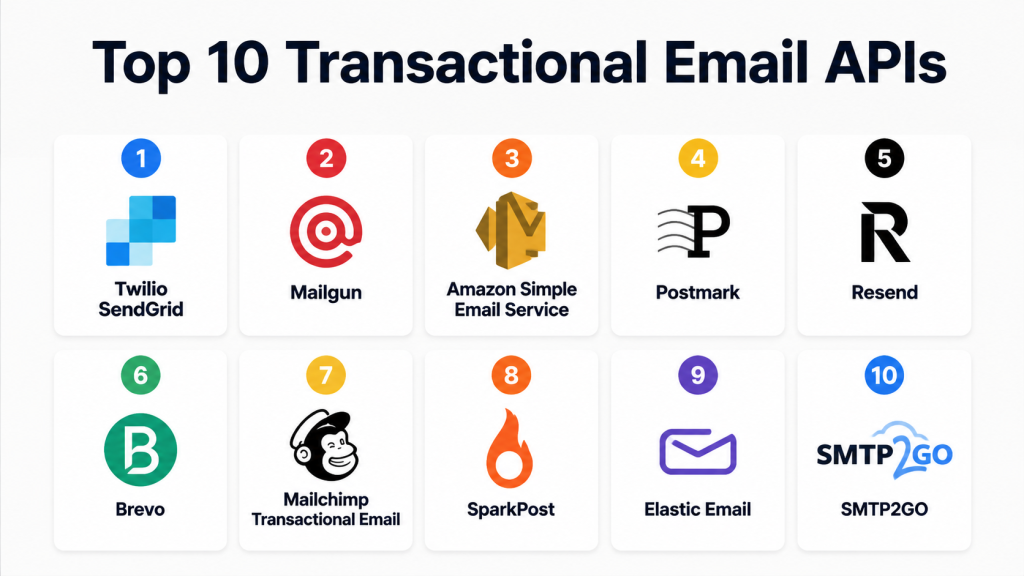
Top 10 Transactional Email APIs
1- Twilio SendGrid
Short description:
Twilio SendGrid is one of the most widely used transactional email APIs for developers, SaaS companies, enterprises, and high-volume senders. It provides reliable email sending infrastructure, REST APIs, SMTP relay, dynamic templates, analytics, webhooks, and deliverability tools. SendGrid is commonly used for account notifications, password resets, order confirmations, billing emails, product alerts, and large-scale transactional workflows. It also supports marketing email use cases, but its developer-friendly transactional email API is a major strength. For teams that need scale, ecosystem maturity, and strong API support, SendGrid is a practical choice.
Key Features
- REST API and SMTP relay
- Dynamic email templates
- Event webhooks for delivery, bounce, open, click, and complaint tracking
- Dedicated IP options
- Suppression management
- Email analytics and logs
- Domain authentication and deliverability tools
Pros
- Strong developer ecosystem and API maturity.
- Suitable for high-volume transactional email.
- Good combination of templates, analytics, and deliverability controls.
Cons
- Deliverability performance depends on proper setup and sender behavior.
- Advanced deliverability features may require higher plans.
- Dashboard and settings can feel complex for beginners.
Platforms / Deployment
Web / Cloud-based API / SMTP relay
Security & Compliance
Supports API key controls, account security features, domain authentication, suppression handling, and access management. Specific compliance details should be validated based on plan and business requirements.
Integrations & Ecosystem
SendGrid has a broad ecosystem because it is used across applications, marketing systems, eCommerce workflows, and developer stacks.
- REST APIs
- SMTP integrations
- Webhooks
- SaaS applications
- eCommerce platforms
- CRM and automation workflows
- Cloud and serverless environments
Support & Community
SendGrid provides documentation, API references, support resources, developer guides, and plan-based support options. It has strong community awareness among developers and SaaS teams.
2- Mailgun
Short description:
Mailgun is a transactional email API platform designed for developers and product teams that need programmable email sending, validation, routing, and deliverability support. It is commonly used by SaaS products, marketplaces, fintech platforms, and applications that rely on automated emails. Mailgun provides APIs, SMTP relay, webhooks, logs, email validation, inbound routing, and deliverability optimization features. It is especially useful for technical teams that want control over email infrastructure and event data. Mailgun is a strong choice for teams that need both outbound transactional sending and developer-focused email tooling.
Key Features
- Transactional email API
- SMTP relay
- Email validation tools
- Inbound email routing
- Webhooks and event tracking
- Logs and analytics
- Deliverability optimization options
Pros
- Strong fit for developer-led teams.
- Useful inbound and outbound email capabilities.
- Good visibility through logs and event tracking.
Cons
- Best results require proper domain authentication and reputation management.
- Some deliverability tools may require additional plans or products.
- Non-technical users may need developer support.
Platforms / Deployment
Web / Cloud-based API / SMTP relay
Security & Compliance
Supports API keys, domain authentication, account controls, and secure sending workflows. Specific compliance details should be validated based on plan and customer requirements.
Integrations & Ecosystem
Mailgun integrates well with backend systems, SaaS applications, developer workflows, and email validation processes.
- REST APIs
- SMTP relay
- Webhooks
- Inbound routing
- Email validation
- Backend frameworks
- Monitoring workflows
Support & Community
Mailgun provides developer documentation, API guides, support resources, and technical onboarding content. It is well known among developers and product engineering teams.
3- Amazon Simple Email Service
Short description:
Amazon Simple Email Service, commonly known as Amazon SES, is a cloud-based email sending service used for transactional, notification, and marketing email workloads. It is especially useful for businesses already operating inside AWS because it integrates with AWS identity, monitoring, applications, and automation workflows. Amazon SES provides APIs, SMTP, domain authentication, configuration sets, bounce and complaint handling, and scalable email sending. It is often selected by technical teams that want cost-efficient email infrastructure with cloud-native control. SES is powerful, but it usually requires more setup and operational understanding than beginner-focused tools.
Key Features
- Email sending through API and SMTP
- Domain authentication support
- Bounce and complaint handling
- Configuration sets and event publishing
- Dedicated IP options
- Integration with AWS services
- High scalability for application-driven email
Pros
- Strong fit for AWS-based applications.
- Cost-efficient for high-volume senders.
- Powerful event and infrastructure integration options.
Cons
- Requires more technical setup than simpler platforms.
- Template and dashboard experience may be less marketer-friendly.
- Deliverability management requires careful configuration.
Platforms / Deployment
Cloud / AWS-based email API / SMTP relay
Security & Compliance
Uses AWS identity, permissions, logging, encryption options, and account security controls. Specific compliance alignment depends on AWS configuration and customer requirements.
Integrations & Ecosystem
Amazon SES integrates deeply with AWS infrastructure and application workflows.
- AWS Lambda
- Amazon SNS
- Amazon CloudWatch
- Amazon S3
- IAM permissions
- Backend applications
- Infrastructure-as-code tools
Support & Community
Amazon SES has official documentation, AWS support options, developer guides, and large community usage among cloud engineering teams.
4- Postmark
Short description:
Postmark is a transactional email service designed for fast, reliable delivery of important application emails. It focuses strongly on transactional use cases rather than broad marketing automation. Postmark is popular with SaaS companies, product teams, developers, and businesses that care about speed, simplicity, and clear message tracking. It provides APIs, SMTP, templates, message streams, webhooks, bounce handling, and detailed delivery logs. Postmark is especially useful for user-facing product emails such as password resets, confirmations, notifications, and billing updates. Its clean interface and transactional-first approach make it easy for teams to manage critical email flows.
Key Features
- Transactional email API and SMTP
- Message streams for separating email types
- Email templates
- Webhooks and event tracking
- Bounce and suppression management
- Detailed message activity logs
- Inbound email processing
Pros
- Strong focus on transactional email reliability.
- Clean dashboard and developer-friendly workflow.
- Useful logs for troubleshooting delivery issues.
Cons
- Not as marketing-suite focused as some competitors.
- Pricing may be less attractive for some very high-volume use cases.
- Advanced enterprise governance may require plan review.
Platforms / Deployment
Web / Cloud-based API / SMTP relay
Security & Compliance
Supports account security features, API keys, domain authentication, and secure sending workflows. Specific compliance details should be validated based on business needs.
Integrations & Ecosystem
Postmark integrates with application stacks, SaaS workflows, and developer tools where reliable transactional email is needed.
- REST APIs
- SMTP relay
- Webhooks
- Application frameworks
- Inbound email workflows
- Product notification systems
- Monitoring workflows
Support & Community
Postmark provides clear documentation, support resources, developer guides, and strong reputation among SaaS and product-led teams.
5- Resend
Short description:
Resend is a developer-focused transactional email API designed for modern application teams. It is especially popular among developers building SaaS products, startups, and modern web applications that need a clean API, good developer experience, and easy integration. Resend focuses on simple implementation, React-based email workflows, domain setup, API-based sending, and clear logs. It is a strong choice for modern JavaScript and TypeScript teams that want fast setup and clean email development workflows. While it may not have the long enterprise history of older platforms, it is appealing for teams that value modern developer experience.
Key Features
- Developer-friendly email API
- Modern SDK support
- React email workflow support
- Domain authentication
- Email logs and delivery tracking
- Simple dashboard
- Webhook support
Pros
- Excellent developer experience for modern app teams.
- Easy to integrate into SaaS and web applications.
- Strong fit for JavaScript and TypeScript workflows.
Cons
- Enterprise feature depth may be less mature than older providers.
- Buyers should validate volume, compliance, and support needs.
- Advanced deliverability requirements may need additional review.
Platforms / Deployment
Web / Cloud-based API
Security & Compliance
Supports API keys, domain authentication, and secure email sending workflows. Specific compliance details should be validated based on plan and customer requirements.
Integrations & Ecosystem
Resend integrates well with modern web development stacks and developer workflows.
- JavaScript and TypeScript applications
- Modern web frameworks
- Serverless applications
- Backend APIs
- Webhooks
- React email workflows
- Cloud deployment platforms
Support & Community
Resend provides documentation, developer resources, API guides, and growing community adoption among modern web developers.
6- Brevo
Short description:
Brevo provides transactional email APIs along with broader customer communication and marketing capabilities. It is useful for SMBs, eCommerce businesses, SaaS companies, and teams that want both transactional and marketing email from one platform. Brevo supports SMTP relay, email API, templates, transactional logs, automation workflows, SMS, CRM-related tools, and campaign features. It is especially useful for businesses that want a unified communication platform rather than separate tools for transactional and marketing email. Developers can use its API while marketing teams can use its campaign and automation features.
Key Features
- Transactional email API
- SMTP relay
- Email templates
- Transactional logs
- Marketing email tools
- SMS and multi-channel communication
- Automation workflows
Pros
- Good fit for businesses wanting transactional and marketing tools together.
- Useful for SMBs and eCommerce teams.
- Multi-channel communication support.
Cons
- Developer experience may not be as focused as pure API-first platforms.
- Advanced transactional customization should be reviewed.
- Larger technical teams may prefer more developer-centric APIs.
Platforms / Deployment
Web / Cloud-based API / SMTP relay
Security & Compliance
Supports account security features, domain authentication, and customer communication workflows. Specific compliance details should be validated based on plan and region.
Integrations & Ecosystem
Brevo integrates with business, marketing, eCommerce, and customer communication workflows.
- SMTP integrations
- REST APIs
- eCommerce platforms
- CRM workflows
- Marketing automation
- SMS tools
- Website and form workflows
Support & Community
Brevo provides documentation, help resources, onboarding support, and product guidance for transactional and marketing communication users.
7- Mailchimp Transactional Email
Short description:
Mailchimp Transactional Email, formerly known as Mandrill, is a transactional email service connected with the Mailchimp ecosystem. It is useful for businesses already using Mailchimp for marketing and customer communication. The platform supports API-based sending, SMTP, templates, tagging, metadata, webhooks, analytics, and transactional message tracking. It is suitable for order confirmations, password resets, account notifications, and application-generated emails. Its main strength is its connection with Mailchimp for businesses that want marketing and transactional email under a familiar ecosystem. Teams should review plan requirements and fit before choosing it as their primary transactional email API.
Key Features
- Transactional email API
- SMTP sending
- Templates and merge variables
- Webhooks and event tracking
- Tags and metadata
- Message analytics
- Mailchimp ecosystem connection
Pros
- Good fit for Mailchimp users.
- Useful templates and tracking capabilities.
- Supports both API and SMTP workflows.
Cons
- Best suited for teams already in the Mailchimp ecosystem.
- May not be the first choice for API-first developer teams.
- Pricing and access model should be reviewed carefully.
Platforms / Deployment
Web / Cloud-based API / SMTP relay
Security & Compliance
Supports account security features, API access controls, and domain authentication. Specific compliance details should be validated based on plan and customer requirements.
Integrations & Ecosystem
Mailchimp Transactional Email works best within broader Mailchimp-led marketing and customer communication workflows.
- Mailchimp ecosystem
- SMTP integrations
- REST APIs
- Webhooks
- eCommerce workflows
- Application backends
- Analytics workflows
Support & Community
Mailchimp provides documentation, support resources, and customer help options. Community knowledge is strong because of Mailchimp’s broad market presence.
8- SparkPost
Short description:
SparkPost is an email delivery platform designed for transactional and high-volume email sending. It is used by SaaS companies, digital businesses, and enterprises that need analytics, deliverability features, APIs, templates, and scalable sending infrastructure. SparkPost provides real-time event data, webhooks, suppression management, templates, analytics, and deliverability visibility. It is especially useful for businesses that need detailed performance signals from email events. SparkPost is a practical option for teams that want a balance between technical email infrastructure and deliverability intelligence.
Key Features
- Transactional email API
- SMTP relay
- Templates and substitution data
- Real-time event webhooks
- Suppression list management
- Analytics and reporting
- Deliverability monitoring features
Pros
- Strong event data and analytics.
- Useful for high-volume transactional email.
- Good fit for teams needing deliverability visibility.
Cons
- Setup may require technical expertise.
- Pricing and enterprise fit should be reviewed carefully.
- Some users may prefer simpler developer-first platforms.
Platforms / Deployment
Web / Cloud-based API / SMTP relay
Security & Compliance
Supports API key controls, domain authentication, sending controls, and secure workflows. Specific compliance details should be validated based on plan and requirements.
Integrations & Ecosystem
SparkPost integrates with application platforms, analytics workflows, and email-driven product systems.
- REST APIs
- SMTP integrations
- Webhooks
- Application backends
- Analytics systems
- Marketing systems
- Data workflows
Support & Community
SparkPost provides documentation, technical resources, support options, and guidance for email sending and deliverability workflows.
9- Elastic Email
Short description:
Elastic Email is an email delivery platform that supports transactional email, marketing campaigns, email API, SMTP relay, templates, analytics, and list management features. It is useful for startups, SMBs, agencies, and businesses that want cost-effective email sending with both transactional and campaign capabilities. Elastic Email offers developer tools for API-based sending while also supporting marketer-friendly email features. It can be a practical option for teams that want affordable email infrastructure without needing a highly complex enterprise platform. Buyers should review deliverability needs, support expectations, and sending volume before choosing.
Key Features
- Transactional email API
- SMTP relay
- Email templates
- Campaign tools
- Analytics and reporting
- Contact management
- Webhooks and integrations
Pros
- Cost-effective for many small and growing teams.
- Supports both transactional and marketing email.
- API and SMTP flexibility.
Cons
- Enterprise governance may be limited compared with larger platforms.
- Advanced deliverability needs should be evaluated.
- Support experience may vary by plan.
Platforms / Deployment
Web / Cloud-based API / SMTP relay
Security & Compliance
Supports account controls, domain authentication, and secure sending workflows. Specific compliance details are not publicly stated.
Integrations & Ecosystem
Elastic Email integrates with applications, marketing workflows, and business email systems through API and SMTP options.
- REST APIs
- SMTP relay
- Marketing workflows
- Contact management
- Webhooks
- Business applications
- Website forms
Support & Community
Elastic Email provides documentation, help resources, and support options depending on plan. It is known among SMBs and cost-conscious senders.
10- SMTP2GO
Short description:
SMTP2GO is an email delivery service focused on reliable SMTP and API-based email sending for businesses, developers, and IT teams. It is commonly used for transactional emails, application notifications, system alerts, and business email delivery. SMTP2GO provides SMTP relay, API sending, reporting, bounce tracking, blacklist monitoring, and delivery analytics. It is especially useful for teams that want a straightforward email delivery service with practical monitoring and support. It works well for businesses that need reliable outbound email without building complex infrastructure.
Key Features
- SMTP relay and email API
- Delivery reporting
- Bounce and spam complaint tracking
- Blacklist monitoring
- Domain authentication support
- Email activity logs
- Webhook and integration options
Pros
- Simple setup for SMTP and application email delivery.
- Useful monitoring and reporting features.
- Good fit for IT teams and business applications.
Cons
- May not be as developer-trendy as newer API-first tools.
- Advanced template workflows may be less deep than some competitors.
- High-scale enterprise needs should be validated.
Platforms / Deployment
Web / Cloud-based API / SMTP relay
Security & Compliance
Supports account security features, domain authentication, API controls, and sending monitoring. Specific compliance details should be validated based on plan and business needs.
Integrations & Ecosystem
SMTP2GO integrates with applications, servers, business systems, websites, and SMTP-compatible tools.
- SMTP-compatible applications
- Web applications
- Business software
- API workflows
- Monitoring systems
- Website forms
- Server notifications
Support & Community
SMTP2GO provides documentation, setup guides, support resources, and customer assistance for SMTP and API email delivery workflows.
Comparison Table Top 10
| Tool Name | Best For | Platform Supported | Deployment | Standout Feature | Public Rating |
|---|---|---|---|---|---|
| Twilio SendGrid | High-volume transactional email | Web / API / SMTP | Cloud | Mature API and scalable sending | N/A |
| Mailgun | Developer-led email workflows | Web / API / SMTP | Cloud | API, validation, and inbound routing | N/A |
| Amazon SES | AWS-based applications | Cloud / API / SMTP | Cloud | Cost-efficient AWS-native sending | N/A |
| Postmark | SaaS and product emails | Web / API / SMTP | Cloud | Transactional-first reliability | N/A |
| Resend | Modern web developers | Web / API | Cloud | Developer-friendly modern API | N/A |
| Brevo | SMB communication workflows | Web / API / SMTP | Cloud | Transactional plus marketing tools | N/A |
| Mailchimp Transactional Email | Mailchimp users | Web / API / SMTP | Cloud | Mailchimp ecosystem connection | N/A |
| SparkPost | High-volume analytics-driven sending | Web / API / SMTP | Cloud | Real-time event data | N/A |
| Elastic Email | Cost-conscious SMBs | Web / API / SMTP | Cloud | Affordable transactional and campaign sending | N/A |
| SMTP2GO | SMTP and business app delivery | Web / API / SMTP | Cloud | Simple SMTP relay and monitoring | N/A |
Evaluation & Scoring of Transactional Email APIs
The scoring below is comparative and based on common buyer needs such as API reliability, ease of use, integrations, security, performance, support, and price value. A higher score does not mean a universal winner. Developer teams may prefer Mailgun, Postmark, Resend, or Amazon SES, while SMBs may prefer Brevo, Elastic Email, or SMTP2GO. Enterprises and high-volume senders should also test deliverability, support, compliance, and dedicated IP options before making a decision.
| Tool Name | Core 25% | Ease 15% | Integrations 15% | Security 10% | Performance 10% | Support 10% | Value 15% | Weighted Total 0–10 |
| Twilio SendGrid | 9.0 | 8.0 | 9.0 | 8.5 | 9.0 | 8.5 | 8.0 | 8.60 |
| Mailgun | 9.0 | 8.0 | 8.5 | 8.0 | 8.5 | 8.0 | 8.0 | 8.40 |
| Amazon SES | 8.5 | 7.0 | 9.0 | 8.5 | 9.0 | 8.0 | 9.0 | 8.45 |
| Postmark | 8.5 | 9.0 | 8.0 | 8.0 | 9.0 | 8.5 | 8.0 | 8.45 |
| Resend | 8.0 | 9.0 | 8.0 | 7.5 | 8.0 | 8.0 | 8.5 | 8.20 |
| Brevo | 8.0 | 8.5 | 8.0 | 8.0 | 8.0 | 8.0 | 8.5 | 8.15 |
| Mailchimp Transactional Email | 8.0 | 8.0 | 8.0 | 8.0 | 8.0 | 8.0 | 7.5 | 7.95 |
| SparkPost | 8.5 | 7.5 | 8.5 | 8.0 | 8.5 | 8.0 | 7.5 | 8.10 |
| Elastic Email | 7.5 | 8.0 | 7.5 | 7.5 | 7.5 | 7.5 | 8.5 | 7.75 |
| SMTP2GO | 8.0 | 8.5 | 7.5 | 8.0 | 8.0 | 8.5 | 8.0 | 8.10 |
How to interpret the scores:
- 8.5 and above: Strong platforms for broad transactional email use cases.
- 8.0 to 8.4: Good platforms with clear strengths for specific buyer segments.
- 7.5 to 7.9: Practical choices when cost, simplicity, or specific workflow fit matters.
- Below 7.5: May still work for niche use cases, but should be tested carefully.
- Always validate deliverability, logs, templates, webhooks, support, and pricing with a real pilot.
Which Transactional Email API Is Right for You?
Solo / Freelancer
Solo developers and freelancers usually need fast setup, simple API keys, easy domain authentication, and basic logs. Resend, Postmark, Elastic Email, and SMTP2GO are practical options. If you already use AWS and are comfortable with cloud configuration, Amazon SES can also be cost-effective.
SMB
Small and mid-sized businesses need reliability, templates, simple dashboards, support, and reasonable pricing. Postmark, Brevo, SendGrid, SMTP2GO, and Elastic Email can be strong options depending on the team’s technical level. SMBs that need both marketing and transactional email may prefer Brevo or Elastic Email.
Mid-Market
Mid-market teams often need better analytics, multiple domains, dedicated IP options, suppression management, and webhook-based event tracking. SendGrid, Mailgun, Postmark, SparkPost, and Amazon SES are strong options. Teams should test deliverability and bounce handling before moving all production traffic.
Enterprise
Enterprises should focus on scale, account governance, security, support, dedicated IP strategy, compliance, event data, and integration depth. SendGrid, Mailgun, Amazon SES, and SparkPost are practical enterprise-capable options. Businesses already using Mailchimp may consider Mailchimp Transactional Email, while AWS-heavy teams may prefer Amazon SES.
Budget vs Premium
Budget-focused teams often look at Amazon SES, Elastic Email, Brevo, or SMTP2GO. Premium buyers may prefer SendGrid, Mailgun, Postmark, or SparkPost for stronger logs, support, templates, deliverability controls, and API ecosystems. The best choice should consider total value, not just price per email.
Feature Depth vs Ease of Use
If feature depth matters most, SendGrid, Mailgun, Amazon SES, and SparkPost offer strong APIs and infrastructure features. If ease of use matters more, Postmark, Resend, Brevo, and SMTP2GO are easier for many teams to adopt. Developers who want modern simplicity may prefer Resend, while product teams may prefer Postmark.
Integrations & Scalability
For AWS-native applications, Amazon SES is a natural fit. For developer-led SaaS platforms, Mailgun, SendGrid, Postmark, and Resend are strong. For marketing plus transactional workflows, Brevo and Mailchimp Transactional Email may fit better. For SMTP-heavy business applications, SMTP2GO is practical.
Security & Compliance Needs
Security-focused buyers should review API key controls, domain authentication, SSO, MFA, audit logs, data residency, encryption, and compliance documentation. Enterprises should also validate dedicated IP support, suppression controls, data retention, user permissions, and incident response processes before choosing.
Frequently Asked Questions FAQs
1. What is a transactional email API?
A transactional email API lets applications send automated emails triggered by user actions or system events. Common examples include password resets, account verification, receipts, invoices, alerts, and product notifications.
2. How is transactional email different from marketing email?
Transactional email is triggered by a specific action or event and usually contains important account or service information. Marketing email is usually promotional and sent to lists or segments for campaigns, newsletters, or offers.
3. Why should I use an email API instead of my own mail server?
Running your own mail server requires deliverability management, IP reputation, bounce handling, authentication, monitoring, and maintenance. Email APIs reduce operational work and provide infrastructure built for reliable sending.
4. What should I check before choosing a transactional email provider?
Check API quality, SMTP support, deliverability tools, domain authentication, templates, logs, webhooks, pricing, support, security controls, and integration fit with your application stack.
5. What is domain authentication?
Domain authentication proves that your application is authorized to send email from your domain. It usually includes SPF, DKIM, DMARC, and related DNS records that improve trust and reduce spoofing risk.
6. Do transactional email APIs guarantee inbox delivery?
No platform can guarantee inbox placement because mailbox providers use many reputation and engagement signals. However, a good provider helps with authentication, bounce handling, reputation monitoring, and delivery infrastructure.
7. Which transactional email API is best for developers?
Mailgun, Postmark, Resend, SendGrid, and Amazon SES are strong developer-friendly options. The best choice depends on whether you prefer simple setup, deep APIs, cloud integration, cost efficiency, or advanced deliverability controls.
8. Which transactional email API is best for startups?
Startups often choose Postmark, Resend, SendGrid, Mailgun, Amazon SES, or Brevo depending on technical needs and budget. Startups should prioritize ease of setup, logs, templates, support, and deliverability basics.
9. What are webhooks in transactional email?
Webhooks send event data back to your application when an email is delivered, opened, clicked, bounced, deferred, or marked as spam. They help teams update user records, trigger workflows, and monitor communication health.
10. What is a dedicated IP and do I need one?
A dedicated IP gives a sender separate IP reputation rather than sharing with other customers. It is useful for high-volume senders, but smaller senders may perform better on shared infrastructure if they lack consistent volume.
Conclusion
Transactional Email APIs are essential infrastructure for modern applications because they support account security, customer communication, payments, notifications, onboarding, and product workflows. SendGrid, Mailgun, Amazon SES, and Postmark are strong choices for reliable application-driven email, while Resend is attractive for modern developer teams. Brevo, Mailchimp Transactional Email, and Elastic Email are useful when businesses want transactional email alongside marketing workflows, and SMTP2GO is practical for teams needing simple SMTP and API-based delivery. The best platform depends on your technical stack, email volume, compliance needs, deliverability expectations, and support requirements. Start by shortlisting two or three tools, authenticate your domain, test real templates, review webhooks and logs, monitor bounce handling, and choose the provider that keeps your critical emails fast, reliable, and easy to manage.
