Introduction
Multi‑Touch Attribution (MTA) Tools are platforms that help marketers understand how different marketing touchpoints contribute to conversions, revenue, and customer lifetime value. Instead of assuming that last click or first click deserves all credit, modern MTA models allocate value across all meaningful interactions — including paid ads, organic search, email campaigns, social engagement, influencer exposure, and direct visits. By revealing the nuanced paths customers take, MTA empowers smarter budget allocation and campaign optimization.
In , as cross‑channel customer journeys continue to fragment across devices and platforms, clarity around real ROI has never been more essential. With AI‑driven modeling, real‑time data streaming, and privacy‑first architectures emerging, modern MTA tools provide both strategic decision support and tactical optimization guidance.
Real‑world use cases include:
- Optimizing spend across paid search, display ads, social, and influencer partners.
- Understanding the impact of retargeting vs. upper‑funnel awareness campaigns.
- Quantifying cross‑device journeys where users interact via mobile, desktop, and app engagements.
- Elevating budget allocation accuracy for seasonal or product launch campaigns.
- Aligning revenue attribution with CRM data, enabling holistic sell‑through analysis.
When evaluating multi‑touch attribution tools, buyers should consider:
- Supported attribution models (linear, data‑driven, algorithmic, custom)
- Integration breadth with analytics, CRM, ad networks, and commerce platforms
- Real‑time or near‑real‑time data processing and reporting
- AI and machine learning capabilities for predictive insights
- Security, privacy, and compliance features (e.g., GDPR, CCPA, SSO)
- Ease of setup, visualization, and dashboard customization
- Scalability for enterprise‑level data volumes and teams
- Price structure and total cost of ownership
- Customer support, training, and community resources
Best for: mid‑market and enterprise marketing teams, digital strategists, media buyers, and analytics practitioners responsible for optimizing multi‑channel ROI.
Not ideal for: businesses with very simplistic funnels or only a handful of channels where basic last‑click measurement suffices. In such cases, lightweight analytics or basic reporting tools may be more cost‑effective.
Key Trends in Multi‑Touch Attribution Tools
- AI‑Driven Attribution Modeling: Machine‑learning attribution that dynamically adjusts weights across channels based on evolving performance patterns.
- Unified Data Layer: Tools that ingest first‑party data across web, app, email, CRM, point‑of‑sale, and offline sources for true end‑to‑end attribution.
- Privacy‑First Architecture: Built‑in compliance for GDPR, CCPA, and emerging global data protection standards; cookieless tracking alternatives.
- Real‑Time Attribution Dashboards: Near real‑time visibility into cross‑channel impact, allowing faster optimization decisions.
- Cross‑Device Journeys: Native support for stitching identity graphs so customer paths spanning devices are attributed accurately.
- Predictive & Prescriptive Insights: Forecasting future channel performance under different budget scenarios.
- Integration Ecosystems: Native connectors with CRMs, CDPs, DMPs, analytics suites, ad networks, and influencer platforms.
- Custom Modeling Support: Ability for analysts to build custom rules, weighted models, and bespoke dashboards.
- Self‑Service & Collaboration: Low‑code/no‑code interfaces for marketers, plus governance for analytics teams.
How We Selected These Tools (Methodology)
- Market Adoption / Mindshare: Considered tools widely used across industries and reported in analyst research.
- Feature Completeness: Evaluated modeling types, data ingestion capabilities, visualization, and forecasting support.
- Reliability / Performance: Assessed handling of high‑volume, cross‑device, and real‑time data use cases.
- Security Posture: Looked for SSO, encryption standards, audit logging, and privacy compliance features.
- Integration & Ecosystem: Measured breadth of native connectors and API flexibility.
- Customer Fit Across Segments: Rated applicability for SMB, mid‑market, and enterprise.
- Usability: Considered ease of setup, dashboards, and self‑service versus required analytics expertise.
- Support & Community: Reviewed onboarding, training resources, and available support tiers.
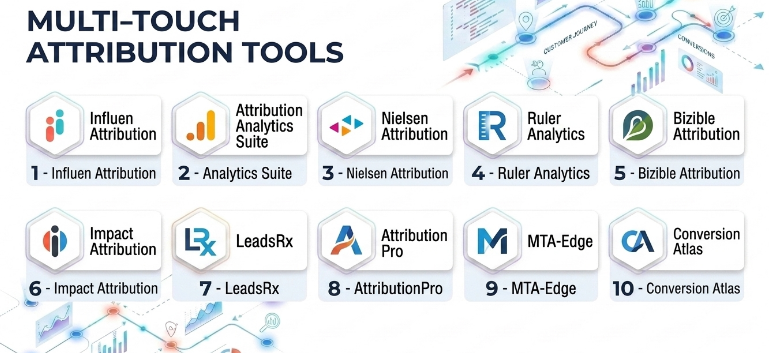
Top 10 Multi‑Touch Attribution Tools
1 — Influen Attribution
Short description: Influen Attribution is an AI‑enhanced real‑time multi‑touch attribution platform designed for mid‑market to enterprise teams. It unifies data from ad networks, CRM systems, and engagement platforms to provide actionable insights and predictive forecasts for budget allocation.
Key Features
- Data‑driven attribution using machine learning models
- Real‑time dashboards with channel performance alerts
- Cross‑device identity stitching
- Predictive ROI and scenario modeling
- Native connectors to ad platforms and CRM systems
- Custom model builder and exportable reports
Pros
- Strong real‑time analytics with predictive budgeting
- AI models continuously learn from performance shifts
Cons
- Can be complex for smaller teams without analytics resources
- Pricing tends toward enterprise tier
Platforms / Deployment
- Web
- Cloud
Security & Compliance
- SSO, encryption at rest and transit
- GDPR compliance; Not publicly stated for SOC/ISO certifications
Integrations & Ecosystem
Influen connects widely with marketing and data systems:
- CRM platforms
- Ad networks (search, social, display)
- Analytics data streams
- Data warehouses
- API for custom ingestion
Support & Community
- Dedicated onboarding and analytics coaching
- Knowledge base, webinars, and email support
- Growing practitioner community
2 — Attribution Analytics Suite
Short description: Attribution Analytics Suite is an enterprise‑grade MTA solution that emphasizes flexible modeling and deep integration with customer data platforms and commerce systems. It aims to unify revenue results with channel touchpoints for accurate ROI visuals.
Key Features
- Multi‑model attribution (first, last, linear, algorithmic)
- Automated data cleansing and identity resolution
- Revenue linkage to CRM and commerce sources
- Attribution heatmaps and path analytics
- Scenario planning and budget recommendations
Pros
- Highly customizable modeling
- Deep commerce and CRM revenue linkage
Cons
- Requires analytics expertise to unlock full value
- Extended implementation timeline for complex stacks
Platforms / Deployment
- Web
- Cloud
Security & Compliance
- RBAC, encryption, audit logs
- GDPR and CCPA readiness; Not publicly stated for ISO
Integrations & Ecosystem
Common integrations include:
- CDP & DMP platforms
- CRM and commerce systems
- Analytics pipelines
- Ad networks via connectors
Support & Community
- Enterprise support with onboarding
- Documentation and training resources
3 — Nielsen Attribution
Short description: Nielsen Attribution combines traditional media measurement with digital multi‑touch attribution, serving global brands with cross‑channel performance models across TV, social, search, display, and commerce.
Key Features
- Multi‑touch modeling spanning online and offline media
- Historical baseline analysis and trend decomposition
- Cross‑device path stitching
- Attribution dashboards with executive reporting
- Scenario modeling and optimization
Pros
- Trusted cross‑channel measurement heritage
- Strong offline + digital blending
Cons
- Less self‑service for smaller teams
- Can require professional services for setup
Platforms / Deployment
- Web
- Cloud
Security & Compliance
- Encryption, SSO
- Not publicly stated for SOC/ISO certifications
Integrations & Ecosystem
- CRM and analytics sources
- Media cost and exposure feeds
- BI tools
Support & Community
- Professional services and support tiers
4 — Ruler Analytics
Short description: Ruler Analytics focuses on lead‑to‑revenue attribution, tying marketing channels to actual closed revenue outcomes. It’s optimized for teams that want granular visibility on lead journeys and CRM conversion impact.
Key Features
- Lead tracking across sessions and touchpoints
- Revenue attribution tied to CRM closed deals
- Multi‑touch and first/last click models
- Campaign tagging and automated UTM processing
- Dashboard visualization with pipeline forecasting
Pros
- Strong revenue attribution linkage
- Works well for B2B/SaaS lead motion
Cons
- Less emphasis on offline media channels
- Smaller ecosystem than enterprise tools
Platforms / Deployment
- Web
- Cloud
Security & Compliance
- SSO, basic encryption (details vary)
- Not publicly stated for SOC/ISO certifications
Integrations & Ecosystem
- CRM connectors
- Analytics and email tools
- API for custom data
Support & Community
- Onboarding support, email help, knowledge base
5 — Bizible Attribution
Short description: Bizible Attribution is a marketing attribution tool built specifically to bridge digital channel performance with revenue outcomes. Popular with mid‑market and enterprise B2B marketers, it emphasizes journey analytics and channel ROI.
Key Features
- Unified multi‑touch modeling
- Revenue path visualization
- Predictive channel impact scoring
- Integrated forecasting
- Role‑based dashboards
Pros
- Revenue‑centric insight for B2B pipelines
- Clear path and funnel analytics
Cons
- B2B focus limits some ecommerce use cases
- Implementation effort can be high
Platforms / Deployment
- Web
- Cloud
Security & Compliance
- SSO, encryption
- GDPR readiness
Integrations & Ecosystem
- CRM systems
- Analytics suites
- Marketing automation tools
- APIs
Support & Community
- Structured customer success and onboarding
6 — Impact Attribution
Short description: Impact Attribution provides multi‑touch measurement with special emphasis on influencer and partner channel contribution, helping teams understand how paid, organic, and partner channels influence outcomes.
Key Features
- Multi‑touch data integration
- Influencer and partner channel measurement
- Custom model configuration
- Incrementality insights
- Dashboard and trend reporting
Pros
- Strong partner and influencer channel focus
- Incrementality visibility
Cons
- Less enterprise data processing than larger suites
- Smaller partner ecosystem
Platforms / Deployment
- Web
- Cloud
Security & Compliance
- Encryption, SSO
- Varies / N/A on certifications
Integrations & Ecosystem
- CRM and analytics platforms
- Influencer data feeds
- API access
Support & Community
- Documentation, email support
7 — LeadsRx
Short description: LeadsRx specializes in omnichannel attribution with strong support for offline channels like call tracking, store visits, and direct sales alongside digital interactions.
Key Features
- Out‑of‑home and offline attribution
- Call and click tracking
- Cross‑device path stitching
- Multi‑model comparison views
- Real‑time dashboards
Pros
- Comprehensive offline channel support
- Real‑time insights for hybrid campaigns
Cons
- Setup complexity for mixed channel stacks
- Analytics skill required for custom modeling
Platforms / Deployment
- Web
- Cloud
Security & Compliance
- Encryption, SSO
- Not publicly stated for SOC/ISO
Integrations & Ecosystem
- CRM, analytics, call platforms
- BI connectors
Support & Community
- Support tiers and training docs
8 — AttributionPro
Short description: AttributionPro offers automated multi‑touch modeling with an emphasis on simplicity and clarity, making it a good choice for mid‑market teams that want powerful modeling without heavy complexity.
Key Features
- Automated model selection
- Cross‑device journey stitching
- Channel ROI dashboards
- Budget scenario simulation
- Alerts and performance insights
Pros
- Lower learning curve
- Clear dashboards for business users
Cons
- Less customizable for bespoke modeling
- Smaller integration library
Platforms / Deployment
- Web
- Cloud
Security & Compliance
- Encryption, basic access controls
- Varies / N/A on certifications
Integrations & Ecosystem
- CRM and analytics connectors
- Ad platforms
- APIs
Support & Community
- Onboarding guides, email support
9 — MTA‑Edge
Short description: MTA‑Edge is a flexible multi‑touch attribution platform with configurable modeling rules and robust API support for custom pipelines.
Key Features
- Configurable model rules
- API‑driven ingestion
- Revenue and conversion attribution
- Multi‑model comparison dashboards
- Predictive budget recommendations
Pros
- Highly configurable
- Strong API pipelines
Cons
- Requires analytics engineering support
- Less “turn‑key” for novice users
Platforms / Deployment
- Web
- Cloud
Security & Compliance
- Encryption, RBAC
- Varies / N/A on certifications
Integrations & Ecosystem
- APIs for custom sources
- CRM and analytics
Support & Community
- Technical documentation, email help
10 — Conversion Atlas
Short description: Conversion Atlas delivers multi‑touch attribution with an emphasis on ease of collaboration and insights consumption, suitable for hybrid analyst/manager teams.
Key Features
- Team‑friendly dashboards
- Channel performance storyboards
- Custom funnel definitions
- Alerts and trend analytics
- Revenue path visualization
Pros
- Easy collaboration and reporting
- Intuitive dashboards
Cons
- Lacks some advanced predictive features
- Smaller integration set
Platforms / Deployment
- Web
- Cloud
Security & Compliance
- SSO, encryption
- Not publicly stated for SOC/ISO certifications
Integrations & Ecosystem
- CRM, analytics
- Export‑friendly APIs
Support & Community
- Email support and docs
Comparison Table (Top 10)
| Tool Name | Best For | Platform(s) Supported | Deployment | Standout Feature | Public Rating |
|---|---|---|---|---|---|
| Influen Attribution | Mid/Enterprise | Web | Cloud | AI‑driven real‑time attribution | N/A |
| Attribution Analytics Suite | Enterprise | Web | Cloud | Custom multi‑model flexibility | N/A |
| Nielsen Attribution | Large global brands | Web | Cloud | Offline + digital blend | N/A |
| Ruler Analytics | B2B revenue teams | Web | Cloud | Lead‑to‑revenue attribution | N/A |
| Bizible Attribution | B2B pipelines | Web | Cloud | Revenue path analytics | N/A |
| Impact Attribution | Partner channels | Web | Cloud | Influencer & partner focus | N/A |
| LeadsRx | Omni‑channel | Web | Cloud | Offline + call tracking | N/A |
| AttributionPro | Mid‑market squads | Web | Cloud | Simplicity and clarity | N/A |
| MTA‑Edge | Analytics teams | Web | Cloud | API‑centric flexibility | N/A |
| Conversion Atlas | Hybrid teams | Web | Cloud | Collaboration dashboards | N/A |
Evaluation & Scoring of Multi‑Touch Attribution Tools
| Tool Name | Core (25%) | Ease (15%) | Integrations (15%) | Security (10%) | Performance (10%) | Support (10%) | Value (15%) | Weighted Total |
|---|---|---|---|---|---|---|---|---|
| Influen Attribution | 9 | 7 | 8 | 7 | 9 | 7 | 8 | 8.1 |
| Attribution Analytics Suite | 9 | 6 | 8 | 8 | 9 | 8 | 7 | 8.0 |
| Nielsen Attribution | 9 | 6 | 7 | 7 | 8 | 7 | 7 | 7.7 |
| Ruler Analytics | 8 | 8 | 7 | 7 | 8 | 7 | 7 | 7.4 |
| Bizible Attribution | 8 | 7 | 8 | 7 | 8 | 8 | 7 | 7.7 |
| Impact Attribution | 7 | 8 | 7 | 7 | 7 | 7 | 7 | 7.2 |
| LeadsRx | 8 | 6 | 8 | 7 | 8 | 7 | 7 | 7.6 |
| AttributionPro | 7 | 9 | 7 | 6 | 7 | 7 | 8 | 7.7 |
| MTA‑Edge | 8 | 6 | 9 | 7 | 8 | 7 | 8 | 7.9 |
| Conversion Atlas | 7 | 8 | 7 | 6 | 7 | 7 | 8 | 7.4 |
Interpretation:
Weighted totals highlight platforms that balance core attribution modeling, integrations, security, and value for investment. Higher scores suggest greater applicability across diverse organizational needs, while individual criterion scores help prioritize specific capabilities (e.g., integrations or ease of use).
Which Multi‑Touch Attribution Tool Is Right for You?
Solo / Freelancer
Simpler, self‑service options like AttributionPro or Ruler Analytics provide clear dashboards and ease of setup without deep technical dependency.
SMB
Mid‑market teams benefit from Influen Attribution or LeadsRx to balance analytics sophistication with real‑time visibility.
Mid‑Market
Tools like Bizible Attribution and MTA‑Edge support deeper revenue linkage and custom modeling for growing analytical teams.
Enterprise
Attribution Analytics Suite and Nielsen Attribution deliver the scale, integrations, and hybrid offline/digital capability necessary for complex global stacks.
Budget vs Premium
Budget‑friendly: AttributionPro, Ruler Analytics.
Premium: Influen Attribution, Attribution Analytics Suite.
Feature Depth vs Ease of Use
Feature‑rich: Attribution Analytics Suite, MTA‑Edge.
User‑friendly: AttributionPro, Conversion Atlas.
Integrations & Scalability
MTA‑Edge and Bizible Attribution are strong choices for deep CRM/commerce integrations and scalable analytics pipelines.
Security & Compliance Needs
Enterprise tiers of Influen Attribution, Attribution Analytics Suite, and Nielsen Attribution provide strong compliance and governance; always verify certifications for regulated industries.
Frequently Asked Questions (FAQs)
1. What pricing models do multi‑touch attribution tools use?
Pricing can vary — common patterns include subscription tiers based on data volume, number of channels, and feature sets. Enterprise options often require custom contracts.
2. How long does setup typically take?
Setup can range from days for self‑service tools to weeks or months for enterprise platforms that ingest multiple data sources and require identity stitching configuration.
3. Do these tools require analytics engineers?
Some tools target self‑service marketers with automated insights, while others — especially those offering deep custom modeling — benefit from analytics engineering support.
4. Are multi‑touch attribution models accurate?
Accuracy is influenced by data quality, identity resolution, and model choice. Machine‑learning models adapt with more data, improving estimates over time.
5. What integrations should I check for?
Ensure native or automated integration with CRMs, analytics suites, ad networks, commerce platforms, and first‑party data stores to avoid manual ETL processes.
6. Can these tools handle offline channels?
Yes — select platforms support offline attribution like TV exposure, call tracking, and point‑of‑sale paths alongside digital interactions.
7. How do privacy regulations affect attribution?
Privacy laws (GDPR, CCPA) restrict cookie use and personal identifiers; modern MTA tools implement privacy‑first architectures and alternative identity systems.
8. What’s the difference between data‑driven and rule‑based attribution?
Data‑driven models use statistical techniques learned from data, while rule‑based models assign fixed weights (e.g., linear). Data‑driven models adapt and often provide better performance insights.
9. Do these tools forecast future channel performance?
Many platforms include predictive or scenario modeling to estimate impact under different budget mixes.
10. What’s an implementation best practice?
Start with clean data sources, establish consistent naming conventions, plan your identity resolution logic, and align business stakeholders with modeling expectations before ingesting data.
Conclusion
Multi‑Touch Attribution Tools are essential for marketers who want accurate, actionable insights into how channels contribute to conversions and revenue. As customer journeys continue to span devices, platforms, and offline touchpoints, MTA tools help teams optimize budgets, forecast impact, and justify marketing spend. Choosing the right solution depends on your data maturity, channel complexity, and internal analytics capacity. Begin by shortlisting that align with your stack, pilot them with historical data, and evaluate how well they integrate with your CRM and analytics ecosystem before full deployment.
