Introduction
Prompt Security & Guardrail Tools are specialized platforms that enforce safety, policy, and ethical constraints for AI prompts, especially in large language models and generative AI systems. In plain English, these tools prevent AI outputs from producing harmful, unsafe, or non-compliant content by implementing rules, content filtering, and monitoring AI behavior. In, as enterprises scale generative AI usage across marketing, customer support, coding, and content creation, maintaining prompt security is critical to avoid reputational, regulatory, and operational risks.
Real-world use cases include:
- Ensuring AI-generated content meets legal and compliance standards in marketing and publishing.
- Filtering sensitive or unsafe outputs in chatbots and AI assistants.
- Enforcing internal company policies for AI responses in customer-facing applications.
- Monitoring AI prompt usage to prevent data leakage or exposure of confidential information.
- Preventing unintended instructions or hallucinations in AI-generated code or content.
Evaluation Criteria for Buyers often include:
- Policy enforcement capabilities for prompts and outputs
- Real-time content monitoring and filtering
- Integration with LLMs, AI pipelines, and internal platforms
- Scalability across enterprise AI deployments
- Audit logging and reporting for compliance
- Alerting for unsafe or non-compliant prompts
- Support for multiple AI providers and frameworks
- Ease of policy configuration and management
- Security and access controls (SSO, MFA, RBAC)
- Cost-effectiveness and enterprise support
Best for: AI/ML engineers, compliance officers, data governance teams, and enterprise teams leveraging generative AI in regulated or high-risk industries.
Not ideal for: Small teams using limited AI instances or cloud services with built-in moderation, or projects where prompt security is low-risk.
Key Trends in Prompt Security & Guardrail Tools
- AI-assisted content moderation and real-time prompt monitoring.
- Integration of policy enforcement in MLOps and AI pipelines.
- Support for multi-provider and multi-model AI environments.
- Expansion of automated compliance reporting for enterprise governance.
- Implementation of role-based and attribute-based access control (RBAC/ABAC).
- Cloud-native, hybrid, and on-prem deployment options.
- AI-driven recommendations for prompt improvements and risk reduction.
- Enhanced visualization and dashboards for stakeholder reporting.
- Subscription-based and usage-based pricing for enterprise scalability.
- Interoperability with identity providers, SIEM tools, and analytics platforms.
How We Selected These Tools (Methodology)
- Reviewed market adoption and enterprise mindshare for generative AI governance.
- Assessed feature completeness including policy enforcement, prompt filtering, and reporting.
- Evaluated reliability and performance signals in high-volume AI pipelines.
- Examined security posture, including encryption, authentication, and audit logs.
- Checked integration capabilities with AI models, LLMs, and MLOps frameworks.
- Analyzed customer fit across SMB, mid-market, and enterprise deployments.
- Assessed scalability for multiple models, clouds, and enterprise usage.
- Considered support quality and community engagement for onboarding and troubleshooting.
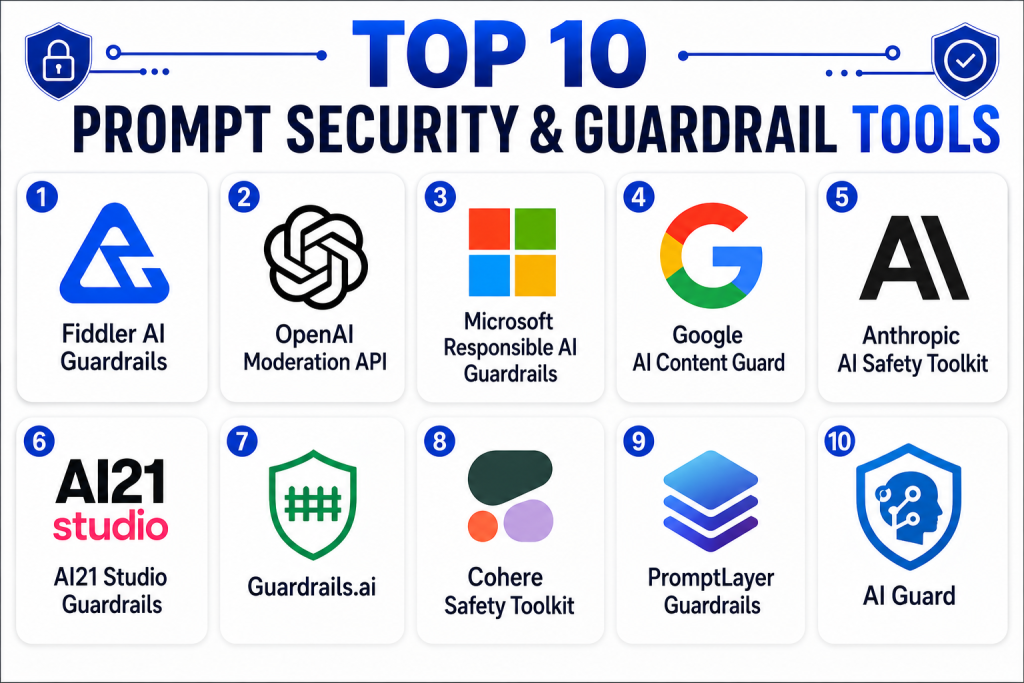
Top 10 Prompt Security & Guardrail Tools
1- Fiddler AI Guardrails
Short description: Fiddler AI Guardrails monitors AI prompt inputs and outputs, enforcing policies to prevent unsafe or non-compliant content. Suitable for enterprises scaling generative AI across multiple teams.
Key Features
- Real-time prompt monitoring and filtering
- Policy enforcement for safety and compliance
- Dashboard reporting for governance teams
- Alerts for unsafe or non-compliant outputs
- Integration with multiple LLM providers
- Audit logging for compliance
Pros
- Enterprise-ready governance dashboards
- Strong visibility into AI usage
Cons
- Requires initial configuration
- Complex for smaller teams without AI governance expertise
Platforms / Deployment
- Web / Cloud / Hybrid
Security & Compliance
- SSO, MFA, encryption, RBAC
- SOC 2, ISO 27001, GDPR
Integrations & Ecosystem
- OpenAI, Anthropic, Hugging Face
- REST APIs
- MLOps pipeline integration
Support & Community
- Enterprise support and documentation
- Active professional support community
2- OpenAI Moderation API
Short description: OpenAI Moderation API provides prompt-level content filtering and policy enforcement for developers and enterprises using OpenAI models.
Key Features
- Real-time moderation of AI-generated outputs
- Predefined policy templates for safety
- Integration with API-based LLM workflows
- Alerts for non-compliant outputs
- Logging for audit and compliance
Pros
- Cloud-native and easy to integrate
- Works directly with OpenAI models
Cons
- Limited to OpenAI ecosystem
- No visual dashboards for enterprise reporting
Platforms / Deployment
- Web / Cloud
Security & Compliance
- Encryption and API authentication
- Not publicly stated for certifications
Integrations & Ecosystem
- OpenAI API
- Python, Node.js, and REST integration
- Webhooks for alerts
Support & Community
- Documentation and developer forums
- OpenAI support channels
3- Microsoft Responsible AI Guardrails
Short description: Microsoft Responsible AI Guardrails enforces policies for AI prompts and outputs in Azure deployments, providing monitoring and compliance tools.
Key Features
- Policy enforcement for LLM usage
- Real-time monitoring and alerts
- Dashboard reporting for compliance
- Integration with Azure AD for identity control
- Multi-model support across enterprise AI
Pros
- Tight Azure ecosystem integration
- Enterprise-focused governance
Cons
- Limited use outside Azure
- Learning curve for small teams
Platforms / Deployment
- Web / Cloud
Security & Compliance
- Azure security standards
- GDPR, SOC 2
Integrations & Ecosystem
- Azure OpenAI, Azure ML
- REST APIs and PowerBI
- Identity and access management systems
Support & Community
- Enterprise support and documentation
- Active forums and community channels
4- Google AI Content Guard
Short description: Google AI Content Guard provides automated monitoring, filtering, and alerting for AI-generated content in cloud environments, suitable for enterprises scaling LLM usage.
Key Features
- Automated prompt and output filtering
- Policy enforcement and logging
- Alerts for unsafe content
- Multi-cloud support
- Dashboard visualization for teams
Pros
- Cloud-native and scalable
- Real-time enforcement of AI safety policies
Cons
- Focused on Google ecosystem
- Limited support for on-premises deployments
Platforms / Deployment
- Web / Cloud
Security & Compliance
- Google Cloud security standards
- Not publicly stated for certifications
Integrations & Ecosystem
- TensorFlow, PaLM, and other LLM APIs
- REST API and webhook integration
- Cloud identity services
Support & Community
- Documentation and developer support
- Google Cloud forums
5- Anthropic AI Safety Toolkit
Short description: Anthropic AI Safety Toolkit enforces safety and ethical guardrails for LLM prompts, preventing harmful outputs and enabling enterprise governance.
Key Features
- Safety prompt templates
- Real-time filtering and moderation
- Audit logs for compliance
- Alerts for high-risk prompt usage
- Integration with Anthropic models
Pros
- Strong AI safety focus
- Enterprise-ready for compliance
Cons
- Limited model coverage outside Anthropic
- Requires setup for enterprise dashboards
Platforms / Deployment
- Web / Cloud
Security & Compliance
- Encryption and access control
- Not publicly stated for certifications
Integrations & Ecosystem
- Anthropic Claude API
- REST integration for pipelines
- Logging and alert systems
Support & Community
- Documentation and support tiers
- Professional services
6- AI21 Studio Guardrails
Short description: AI21 Studio Guardrails provides enterprise safety, prompt control, and content monitoring for generative AI applications.
Key Features
- Policy enforcement on AI prompts
- Monitoring for unsafe outputs
- Multi-model support
- Alerts and notifications
- Dashboard reporting
Pros
- Developer-friendly
- Real-time AI safety enforcement
Cons
- Limited outside AI21 models
- Requires integration for enterprise pipelines
Platforms / Deployment
- Web / Cloud
Security & Compliance
- API authentication and encryption
- Not publicly stated
Integrations & Ecosystem
- AI21 APIs
- REST and Python SDKs
- Webhook support
Support & Community
- Enterprise documentation
- Developer community
7- Guardrails.ai
Short description: Guardrails.ai provides customizable AI prompt safety rules, monitoring, and real-time alerts for enterprises using multiple LLMs.
Key Features
- Rule-based prompt enforcement
- Real-time monitoring dashboards
- Alerting for violations
- Multi-provider support
- Audit logs for compliance
Pros
- Flexible for multi-LLM environments
- Enterprise-grade dashboards
Cons
- Initial setup complexity
- Limited open-source options
Platforms / Deployment
- Web / Cloud / Hybrid
Security & Compliance
- SSO, MFA, audit logs
- SOC 2, encryption
Integrations & Ecosystem
- OpenAI, Anthropic, AI21
- REST API integration
- MLOps pipelines
Support & Community
- Enterprise support
- Documentation and onboarding
8- Cohere Safety Toolkit
Short description: Cohere Safety Toolkit implements content guardrails, monitoring, and policy enforcement for LLM prompt safety in enterprise deployments.
Key Features
- Policy enforcement and moderation
- Real-time alerts for unsafe prompts
- Multi-model support
- Audit logging
- Dashboard reporting
Pros
- Enterprise-ready
- Easy integration with LLMs
Cons
- Limited community resources
- Restricted to Cohere API models
Platforms / Deployment
- Web / Cloud
Security & Compliance
- Encryption and access controls
- Not publicly stated
Integrations & Ecosystem
- Cohere API
- Python SDK
- Webhooks for alerts
Support & Community
- Professional support and documentation
9- PromptLayer Guardrails
Short description: PromptLayer Guardrails offers policy enforcement, prompt logging, and monitoring across multiple LLMs, focusing on enterprise governance and compliance.
Key Features
- Policy enforcement for AI prompts
- Real-time monitoring and dashboards
- Multi-LLM support
- Alerts for non-compliant prompts
- Integration with ML pipelines
Pros
- Multi-provider support
- Enterprise-ready dashboards
Cons
- Complexity in multi-LLM setups
- Requires technical integration
Platforms / Deployment
- Web / Cloud
Security & Compliance
- SSO, MFA, encryption
- Not publicly stated
Integrations & Ecosystem
- OpenAI, Anthropic, Cohere
- REST API and webhook integration
- MLOps pipelines
Support & Community
- Enterprise support
- Documentation and tutorials
10- AI Guard
Short description: AI Guard centralizes prompt safety, policy enforcement, and monitoring for enterprise AI deployments across multiple clouds and LLMs.
Key Features
- Centralized policy enforcement
- Real-time prompt monitoring
- Multi-LLM and multi-cloud support
- Alerts and audit logging
- Dashboard reporting
Pros
- Scalable for large enterprises
- Comprehensive monitoring features
Cons
- Complex initial deployment
- Limited open-source flexibility
Platforms / Deployment
- Web / Cloud / Hybrid
Security & Compliance
- SOC 2, encryption, RBAC
- Audit logging
Integrations & Ecosystem
- OpenAI, Anthropic, AI21, Cohere
- REST APIs and MLOps pipeline integration
Support & Community
- Enterprise support
- Professional documentation and onboarding
Comparison Table (Top 10)
| Tool Name | Best For | Platform(s) Supported | Deployment | Standout Feature | Public Rating |
|---|---|---|---|---|---|
| Fiddler AI Guardrails | Enterprise AI governance | Web | Cloud / Hybrid | Granular policy enforcement | N/A |
| OpenAI Moderation API | OpenAI integrations | Web | Cloud | Real-time moderation | N/A |
| Microsoft Responsible AI Guardrails | Azure AI | Web | Cloud | Policy enforcement & monitoring | N/A |
| Google AI Content Guard | Cloud-native AI | Web | Cloud | Real-time safety enforcement | N/A |
| Anthropic AI Safety Toolkit | Enterprise LLM safety | Web | Cloud | Predefined safety prompt templates | N/A |
| AI21 Studio Guardrails | Generative AI | Web | Cloud | Multi-model prompt safety | N/A |
| Guardrails.ai | Multi-LLM enterprises | Web | Cloud / Hybrid | Customizable AI rules | N/A |
| Cohere Safety Toolkit | Cohere API models | Web | Cloud | Prompt safety and monitoring | N/A |
| PromptLayer Guardrails | Multi-LLM governance | Web | Cloud | Centralized dashboards | N/A |
| AI Guard | Large-scale enterprise AI | Web | Cloud / Hybrid | Multi-cloud, multi-LLM monitoring | N/A |
Evaluation & Scoring of Prompt Security & Guardrail Tools
| Tool Name | Core (25%) | Ease (15%) | Integrations (15%) | Security (10%) | Performance (10%) | Support (10%) | Value (15%) | Weighted Total |
|---|---|---|---|---|---|---|---|---|
| Fiddler AI Guardrails | 9 | 8 | 8 | 9 | 9 | 8 | 8 | 8.7 |
| OpenAI Moderation API | 8 | 8 | 7 | 7 | 8 | 7 | 8 | 7.7 |
| Microsoft Responsible AI Guardrails | 8 | 7 | 8 | 8 | 8 | 7 | 7 | 7.7 |
| Google AI Content Guard | 8 | 8 | 7 | 7 | 8 | 7 | 8 | 7.8 |
| Anthropic AI Safety Toolkit | 8 | 7 | 7 | 8 | 8 | 7 | 7 | 7.7 |
| AI21 Studio Guardrails | 8 | 7 | 7 | 7 | 8 | 7 | 7 | 7.6 |
| Guardrails.ai | 9 | 8 | 8 | 8 | 9 | 8 | 8 | 8.3 |
| Cohere Safety Toolkit | 8 | 7 | 7 | 7 | 8 | 7 | 7 | 7.5 |
| PromptLayer Guardrails | 8 | 7 | 8 | 8 | 8 | 7 | 7 | 7.8 |
| AI Guard | 9 | 7 | 8 | 8 | 9 | 8 | 8 | 8.2 |
Interpretation: Weighted totals indicate relative strengths across policy enforcement, integrations, security, monitoring, support, and value. Higher totals suggest stronger enterprise readiness and multi-LLM governance capabilities.
Which Prompt Security & Guardrail Tool Is Right for You?
Solo / Freelancer
Open-source and cloud-native options like OpenAI Moderation API and Cohere Safety Toolkit are ideal for experimentation or small-scale deployments.
SMB
AI21 Studio Guardrails and PromptLayer Guardrails provide flexible governance for teams scaling AI usage with multiple models.
Mid-Market
Fiddler AI Guardrails and Microsoft Responsible AI Guardrails offer dashboards, alerts, and compliance reporting for medium-scale enterprise AI deployments.
Enterprise
Guardrails.ai, AI Guard, and Anthropic AI Safety Toolkit provide full-scale governance, multi-cloud support, and comprehensive monitoring for regulated AI environments.
Budget vs Premium
Open-source and API-based tools reduce cost but require technical setup. Premium platforms provide richer dashboards, reporting, and governance automation.
Feature Depth vs Ease of Use
Enterprise tools offer deep policy configuration and reporting; API-based or open-source tools prioritize flexibility and developer integration.
Integrations & Scalability
Enterprise solutions scale across multiple clouds and LLMs; open-source tools require manual integration for large deployments.
Security & Compliance Needs
High-regulation industries should prioritize Guardrails.ai, AI Guard, and Fiddler AI Guardrails. Low-risk teams may leverage cloud-native APIs with basic monitoring.
Frequently Asked Questions (FAQs)
1- What pricing models do these tools use?
Enterprise platforms generally adopt subscription or usage-based pricing. Open-source or API-based tools are often free or pay-per-use.
2- How long does onboarding take?
Cloud APIs and open-source frameworks can be integrated in days; enterprise dashboards may require weeks for configuration and training.
3- What are common mistakes using these tools?
Skipping policy definition, ignoring audit logs, and failing to configure alerts are frequent errors.
4- Are these tools secure?
Enterprise platforms provide encryption, SSO/MFA, RBAC, and audit logging. Open-source tools rely on secure deployment practices.
5- Can these tools scale for multiple LLMs?
Yes, premium solutions like Guardrails.ai and AI Guard support multi-model, multi-cloud scaling.
6- How do these tools integrate with existing AI pipelines?
Most enterprise tools integrate with LLM APIs, MLOps pipelines, and analytics dashboards. Open-source tools may require custom integration.
7- Is switching between tools difficult?
Migration depends on policy formats and LLM APIs. Standardized APIs and documentation help ease transitions.
8- Are there alternatives to dedicated prompt security tools?
Some MLOps platforms offer basic guardrails and monitoring, but dedicated tools provide granular enforcement and governance.
9- How frequently should prompts and outputs be monitored?
Continuous monitoring is recommended; periodic reviews should occur at least quarterly for enterprise deployments.
10- Do these tools support compliance frameworks?
Enterprise solutions often provide SOC 2, ISO 27001, GDPR, and HIPAA reporting. Open-source tools require manual implementation of compliance policies.
Conclusion
Prompt Security & Guardrail Tools are essential for enterprises deploying AI safely and responsibly. Selection depends on scale, budget, regulatory requirements, and AI complexity. API-based and open-source tools like OpenAI Moderation API and Cohere Safety Toolkit are ideal for experimentation and small teams, while enterprise platforms like Fiddler AI Guardrails, Guardrails.ai, and AI Guard provide comprehensive monitoring, multi-LLM support, and compliance reporting. A recommended approach is to shortlist , run pilot tests on key AI workflows, and validate integration with existing governance pipelines to ensure prompt safety and regulatory compliance across all AI systems in and beyond.
