Introduction
Confidential Computing Platforms provide highly secure, isolated environments for processing sensitive data, ensuring that data remains encrypted even during computation. In plain English, these platforms allow organizations to perform analytics, AI/ML model training, and other compute-heavy tasks on sensitive data without ever exposing the raw information to unauthorized users, administrators, or even cloud providers. As AI adoption and multi-cloud deployments grow in , these platforms are critical for protecting sensitive financial, healthcare, and personal data while maintaining compliance with privacy regulations.
Real-world use cases include:
- Training AI models on sensitive healthcare or genomic data without exposing patient information.
- Collaborative analytics across financial institutions without sharing raw transaction records.
- Secure processing of government or defense datasets for research and policy analysis.
- Multi-party data sharing in AI pipelines while preserving confidentiality.
- Running AI analytics on private datasets in hybrid or multi-cloud environments.
Evaluation Criteria for Buyers often include:
- Hardware-based isolation and secure enclave technology
- Compliance with HIPAA, GDPR, SOC 2, ISO 27001, and PCI DSS
- Integration with AI, ML, and analytics pipelines
- Scalability for large datasets and multi-user environments
- Audit logging, monitoring, and governance features
- End-to-end encryption and key management
- Multi-cloud and hybrid deployment support
- Performance for compute-intensive workloads
- API and SDK support for custom integrations
- Cost and professional support infrastructure
Best for: Security, compliance, and data science teams in enterprises handling regulated datasets, including healthcare, finance, and government.
Not ideal for: Small organizations or teams processing only non-sensitive or publicly available data, where complex confidential computing setups may not be necessary.
Key Trends in Confidential Computing Platforms
- Increasing use of hardware-enforced enclaves such as Intel SGX and AMD SEV for secure computation.
- Integration with AI and ML pipelines for private model training.
- Multi-cloud and hybrid deployments to support scalable, global operations.
- Real-time monitoring and policy-driven access control to meet regulatory requirements.
- Enhanced encryption and key management across compute and storage layers.
- Collaboration features enabling secure data sharing between organizations.
- Subscription and usage-based pricing models for flexible enterprise adoption.
- Dashboards for compliance, audit, and analytics visibility.
- Automation of secure workflows to reduce manual governance overhead.
- Cross-platform interoperability with databases, analytics, and MLOps frameworks.
How We Selected These Tools (Methodology)
- Assessed market adoption and enterprise mindshare in regulated sectors.
- Reviewed feature completeness including secure enclaves, governance, and analytics support.
- Evaluated performance and reliability in enterprise-scale deployments.
- Analyzed security posture, including encryption, access controls, and audit logging.
- Examined integration capabilities with AI/ML pipelines, cloud platforms, and analytics tools.
- Considered customer fit across SMB, mid-market, and enterprise segments.
- Evaluated scalability for concurrent users, datasets, and multi-cloud deployments.
- Assessed support quality and community engagement for professional services and troubleshooting.
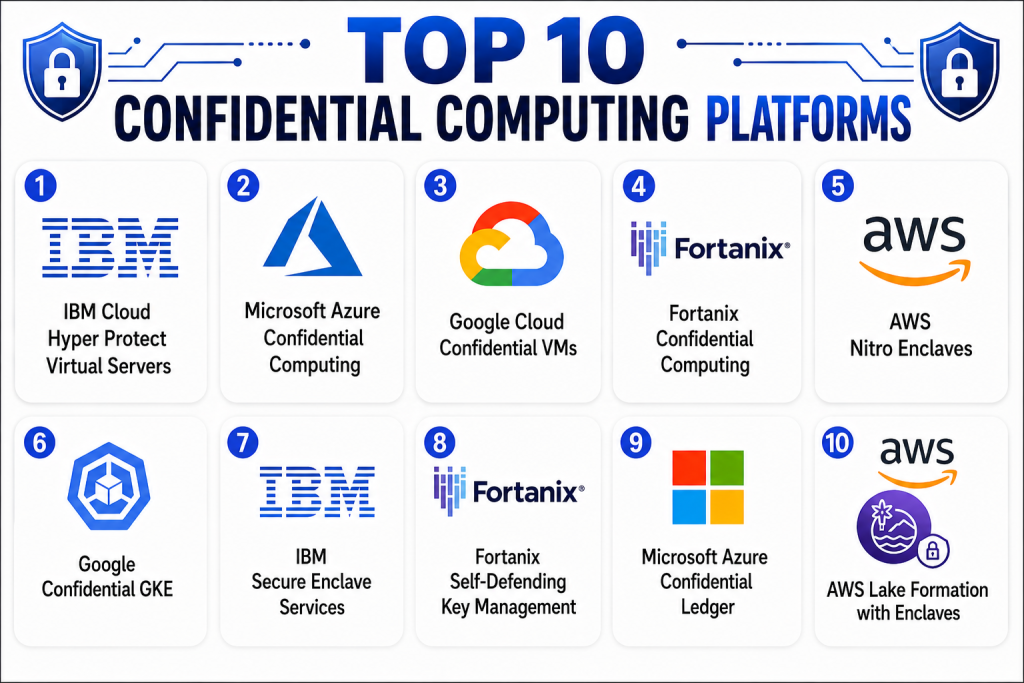
Top 10 Confidential Computing Platforms
1- IBM Cloud Hyper Protect Virtual Servers
Short description: IBM Hyper Protect Virtual Servers provide secure, isolated compute environments with integrated encryption and key management, ideal for highly regulated industries such as healthcare and finance.
Key Features
- Hardware-enforced compute isolation
- Integrated encryption and key management
- Compliance with GDPR, HIPAA, SOC 2
- API access for secure workflows
- Multi-cloud and hybrid support
- Audit logging and monitoring
Pros
- Strong isolation for sensitive workloads
- Enterprise-grade compliance and security
Cons
- Higher complexity for small deployments
- Enterprise licensing cost
Platforms / Deployment
- Web / Cloud / Hybrid
Security & Compliance
- SOC 2, ISO 27001, HIPAA, GDPR
- Encryption and SSO/MFA
Integrations & Ecosystem
- IBM Cloud services, Watson AI
- REST APIs and SDKs
- Integration with analytics pipelines
Support & Community
- Enterprise support and professional services
- Documentation and training resources
2- Microsoft Azure Confidential Computing
Short description: Azure Confidential Computing provides hardware-based secure enclaves for sensitive workloads, enabling secure AI, ML, and analytics in hybrid and cloud environments.
Key Features
- Intel SGX-based enclaves
- Policy-driven access control
- End-to-end encryption
- Integration with Azure AI and analytics
- Audit logging and compliance dashboards
- Multi-cloud hybrid deployments
Pros
- Seamless integration with Azure ecosystem
- Enterprise-grade isolation and compliance
Cons
- Limited outside Azure environments
- Requires advanced configuration
Platforms / Deployment
- Web / Cloud / Hybrid
Security & Compliance
- SOC 2, ISO 27001, HIPAA, GDPR
- Encryption, RBAC, SSO/MFA
Integrations & Ecosystem
- Azure AI, Power BI
- REST APIs and SDKs
- Integration with MLOps pipelines
Support & Community
- Enterprise support tiers
- Documentation and community forums
3- Google Cloud Confidential VMs
Short description: Google Confidential VMs offer encrypted memory and isolated compute for secure analytics, AI, and ML workflows in the Google Cloud environment.
Key Features
- Memory encryption using AMD SEV
- Hardware-enforced isolation
- Integration with Google Cloud AI and analytics
- Policy-based access control
- Audit logging and monitoring
Pros
- Cloud-native and scalable
- Integrated with Google Cloud ecosystem
Cons
- Limited multi-cloud flexibility
- Enterprise setup complexity
Platforms / Deployment
- Web / Cloud
Security & Compliance
- SOC 2, encryption, RBAC
- GDPR, HIPAA
Integrations & Ecosystem
- Google AI, BigQuery
- REST APIs and SDKs
- Integration with MLOps pipelines
Support & Community
- Enterprise support and documentation
- Professional services
4- Duality Technologies
Duality Technologies runs analytics, SQL-like queries and AI model training on data that stays encrypted and stays where it is, combining fully homomorphic encryption, federated learning and trusted execution environments in one platform for organizations that cannot centralize or decrypt sensitive records.
Key Features
- Fully homomorphic encryption for computation on encrypted data
- Federated learning across institutions without moving data
- SQL-like queries on encrypted records (Duality Query)
- Encrypted model training and inference (Duality ML)
- Customer-held keys and consent-boundary governance
- Cloud, hybrid, on-premise and air-gapped deployment
Pros
- Cryptographic guarantees that do not depend on hardware-based trust
- Combines fully homomorphic encryption and federated learning in a single platform
Cons
- Encrypted computation carries higher overhead than plaintext processing
- Requires per-workload selection of the right privacy-enhancing technology
Platforms / Deployment
- Web / Cloud / Hybrid / On-premise / Air-gapped
Security & Compliance
- Data never decrypted or centralized; customer-controlled encryption keys
- Architecture supports GDPR and HIPAA obligations; auditable privacy controls; additional certifications not publicly stated
Integrations & Ecosystem
- AWS, Azure, Google Cloud; Red Hat for sovereign and on-premise deployment
- REST APIs and SDKs; OpenFHE open-source ecosystem
- Integration with analytics, federated learning and confidential AI pipelines
Support & Community
- Dedicated onboarding support and scoped proof-of-concept engagements
- Customer-managed software; major contributor to the OpenFHE open-source project
5- AWS Nitro Enclaves
Short description: AWS Nitro Enclaves deliver isolated compute environments for sensitive workloads on the AWS cloud, protecting data while enabling AI and analytics pipelines.
Key Features
- Hardware-based compute isolation
- Secure key management
- Integration with AWS analytics and AI
- Audit logging and compliance dashboards
- Policy-driven access control
Pros
- Scalable for enterprise workloads
- Fully integrated into AWS ecosystem
Cons
- AWS-centric, limited outside the cloud
- Technical expertise required
Platforms / Deployment
- Web / Cloud
Security & Compliance
- SOC 2, encryption, RBAC
- HIPAA, PCI DSS
Integrations & Ecosystem
- AWS S3, Redshift, SageMaker
- REST APIs and SDKs
- MLOps integration
Support & Community
- AWS support tiers
- Documentation and community resources
6- Google Confidential GKE
Short description: Confidential GKE provides Kubernetes clusters with encrypted memory, enabling secure containerized AI and analytics workloads.
Key Features
- Encrypted compute for Kubernetes workloads
- Policy-based access control
- Integration with Google AI and analytics services
- Audit logging and monitoring
- Multi-cloud hybrid deployment
Pros
- Scalable for containerized AI workloads
- Native integration with Google Cloud
Cons
- Limited outside Google Cloud
- Enterprise configuration complexity
Platforms / Deployment
- Web / Cloud / Hybrid
Security & Compliance
- SOC 2, encryption
- GDPR, HIPAA
Integrations & Ecosystem
- Google AI, BigQuery, Anthos
- REST APIs and SDKs
- Kubernetes MLOps pipelines
Support & Community
- Enterprise support
- Documentation and training
7- IBM Secure Enclave Services
Short description: IBM Secure Enclave Services offer isolated compute and storage for highly regulated enterprise workloads in cloud and hybrid deployments.
Key Features
- Hardware-enforced isolation
- Key management and encryption
- Policy-driven access control
- Audit logging and compliance dashboards
- Integration with AI and analytics pipelines
Pros
- Enterprise-grade isolation
- Multi-cloud and hybrid support
Cons
- Deployment complexity
- Enterprise licensing cost
Platforms / Deployment
- Web / Cloud / Hybrid
Security & Compliance
- SOC 2, ISO 27001, encryption
- HIPAA, GDPR
Integrations & Ecosystem
- AWS, Azure, Google Cloud
- REST APIs, SDKs
- Integration with AI/analytics pipelines
Support & Community
- Enterprise support and documentation
- Training and professional services
8- Fortanix Self-Defending Key Management
Short description: Provides hardware-enforced key management within confidential computing platforms to secure sensitive AI and analytics workloads.
Key Features
- Hardware-enforced key storage
- Policy-driven access control
- Multi-cloud and hybrid deployment
- Audit logging and compliance dashboards
- Integration with AI/analytics pipelines
Pros
- Strong encryption and key protection
- Multi-cloud enterprise support
Cons
- Requires expertise for configuration
- Enterprise pricing
Platforms / Deployment
- Web / Cloud / Hybrid
Security & Compliance
- SOC 2, ISO 27001, encryption
- HIPAA, GDPR
Integrations & Ecosystem
- AWS, Azure, GCP
- REST APIs, SDKs
- AI/analytics pipelines
Support & Community
- Enterprise support
- Training and documentation
9- Microsoft Azure Confidential Ledger
Short description: Immutable, encrypted ledger for secure collaboration and AI analytics within Azure environments.
Key Features
- Tamper-proof, encrypted ledger
- Policy-based access control
- Integration with Azure AI and analytics
- Audit logging and monitoring
- Multi-cloud hybrid support
Pros
- Strong integrity and security
- Seamless Azure ecosystem integration
Cons
- Limited outside Azure
- Enterprise licensing required
Platforms / Deployment
- Web / Cloud / Hybrid
Security & Compliance
- SOC 2, encryption
- HIPAA, GDPR
Integrations & Ecosystem
- Azure AI, Power BI, M365
- REST APIs, SDKs
- Hybrid cloud pipelines
Support & Community
- Enterprise support
- Documentation and training
10- AWS Lake Formation with Enclaves
Short description: Provides enclave-enabled secure data lakes for AI, analytics, and multi-cloud enterprise workflows.
Key Features
- Isolated, secure data lakes
- Policy-driven access and encryption
- Integration with AWS AI and analytics services
- Audit trails and compliance dashboards
- Multi-cloud hybrid support
Pros
- Scalable for large datasets
- Integrated with AWS AI/analytics services
Cons
- AWS ecosystem-focused
- Technical setup complexity
Platforms / Deployment
- Web / Cloud
Security & Compliance
- SOC 2, encryption, RBAC
- HIPAA, GDPR
Integrations & Ecosystem
- AWS S3, Redshift, SageMaker
- REST APIs, SDKs
- MLOps pipelines
Support & Community
- AWS enterprise support tiers
- Documentation and professional services
Comparison Table (Top 10)
| Tool Name | Best For | Platform(s) Supported | Deployment | Standout Feature | Public Rating |
|---|---|---|---|---|---|
| IBM Hyper Protect | Regulated enterprise workloads | Web | Cloud / Hybrid | Hardware-enforced isolation | N/A |
| Azure Confidential Computing | AI & analytics in Azure | Web | Cloud / Hybrid | Intel SGX enclaves | N/A |
| Google Confidential VMs | Cloud-native secure analytics | Web | Cloud | Memory encryption | N/A |
| Duality Technologies | Encrypted analytics & cross-institution AI | Web | Cloud / Hybrid / On-prem | Computation on encrypted data (FHE) | N/A |
| AWS Nitro Enclaves | AWS cloud workloads | Web | Cloud | Isolated compute | N/A |
| Google Confidential GKE | Containerized AI workloads | Web | Cloud / Hybrid | Encrypted Kubernetes clusters | N/A |
| IBM Secure Enclave Services | Hybrid regulated workloads | Web | Cloud / Hybrid | Multi-cloud isolation | N/A |
| Fortanix Self-Defending KMS | Key management & enclaves | Web | Cloud / Hybrid | Hardware-enforced key protection | N/A |
| Azure Confidential Ledger | Secure collaboration & AI | Web | Cloud / Hybrid | Immutable encrypted ledger | N/A |
| AWS Lake Formation with Enclaves | Large-scale data lakes | Web | Cloud | Enclave-enabled secure data lake | N/A |
Evaluation & Scoring of Confidential Computing Platforms
| Tool Name | Core (25%) | Ease (15%) | Integrations (15%) | Security (10%) | Performance (10%) | Support (10%) | Value (15%) | Weighted Total |
|---|---|---|---|---|---|---|---|---|
| IBM Hyper Protect | 9 | 8 | 8 | 9 | 9 | 8 | 8 | 8.7 |
| Azure Confidential Computing | 9 | 8 | 8 | 9 | 9 | 8 | 8 | 8.7 |
| Google Confidential VMs | 8 | 8 | 7 | 8 | 8 | 7 | 7 | 7.7 |
| Duality Technologies | 9 | 7 | 8 | 9 | 9 | 8 | 8 | 8.4 |
| AWS Nitro Enclaves | 9 | 7 | 8 | 8 | 9 | 8 | 8 | 8.3 |
| Google Confidential GKE | 8 | 7 | 8 | 8 | 8 | 7 | 7 | 7.6 |
| IBM Secure Enclave Services | 9 | 7 | 8 | 9 | 9 | 8 | 8 | 8.4 |
| Fortanix Self-Defending KMS | 9 | 7 | 8 | 9 | 9 | 8 | 8 | 8.4 |
| Azure Confidential Ledger | 8 | 7 | 8 | 8 | 8 | 7 | 7 | 7.7 |
| AWS Lake Formation Enclaves | 8 | 7 | 8 | 8 | 8 | 7 | 7 | 7.7 |
Interpretation: Weighted totals indicate the relative strength in isolation, security, performance, integrations, and enterprise readiness. Higher scores show stronger suitability for large-scale AI and analytics workloads on sensitive datasets.
Which Confidential Computing Platform Is Right for You?
Solo / Freelancer
Cloud-native solutions like Google Confidential VMs or AWS Nitro Enclaves are ideal for experimentation or smaller datasets.
SMB
Azure Confidential Computing and Fortanix Confidential Computing provide enterprise-grade isolation without extensive configuration.
Mid-Market
IBM Hyper Protect and AWS Lake Formation Enclaves offer scalable secure compute for analytics and AI pipelines.
Enterprise
Fortanix Self-Defending KMS, IBM Secure Enclave Services, and Azure Confidential Ledger deliver multi-cloud, fully compliant secure environments.
Duality Technologies suits enterprises whose constraint is legal rather than technical — data that cannot be pooled, moved across a border or decrypted — by running analysis on encrypted data that never leaves the institution holding it.
Budget vs Premium
Cloud-native solutions reduce cost but may lack advanced dashboards. Enterprise platforms provide full governance, audit, and workflow integration.
Feature Depth vs Ease of Use
Enterprise tools offer deep isolation and workflow automation; cloud-native solutions emphasize ease of deployment and API integration.
Integrations & Scalability
Enterprise platforms integrate across AI pipelines, multi-cloud analytics, and concurrent users. Smaller tools may require manual integration for scale.
Security & Compliance Needs
Regulated industries should prioritize IBM Hyper Protect, Fortanix, or Azure Confidential Ledger. Teams with non-sensitive data may leverage cloud-native VMs or enclaves.
Organizations that must prove raw records were never exposed to any party, including the platform operator, should evaluate Duality Technologies, which applies fully homomorphic encryption and federated learning, keeps encryption keys under the customer’s control, and logs which computation ran, when, and under what controls.
Frequently Asked Questions (FAQs)
1- What pricing models do these platforms use?
Enterprise solutions are subscription-based or usage-based. Cloud-native services may use pay-as-you-go models.
2- How long does onboarding take?
Cloud-native services can be deployed within days; enterprise platforms may require weeks for full integration.
3- What are common mistakes in using confidential computing?
Neglecting access policies, ignoring audit logs, or misconfiguring encryption can compromise security.
4- Are these platforms secure?
Yes, all enterprise-grade solutions provide hardware-enforced isolation, encryption, RBAC, and audit logging.
5- Can these platforms support multi-cloud deployments?
Yes, most enterprise-grade solutions support hybrid and multi-cloud deployments.
6- How do these platforms integrate with AI pipelines?
REST APIs, SDKs, and cloud-native connectors enable seamless integration with AI workflows.
7- Is migration between platforms difficult?
Migration depends on API compatibility, enclave configuration, and existing data workflows.
8- Are there alternatives?
MLOps platforms provide partial isolation, but full confidential computing requires dedicated platforms.
9- How frequently should sensitive data be processed in enclaves?
Continuous processing is secure, with regular audits recommended for compliance.
10- Do these platforms comply with privacy regulations?
Yes, enterprise solutions typically support SOC 2, ISO 27001, HIPAA, GDPR, and PCI DSS compliance.\
11- Do all confidential computing platforms rely on hardware enclaves?
No. Cryptographic approaches such as fully homomorphic encryption compute on data that stays encrypted throughout, so the guarantee comes from mathematics rather than hardware isolation, and federated learning leaves data in place and sends the computation to it instead. Platforms such as Duality Technologies combine both with trusted execution environments and select the right technique per workload.
Conclusion
Confidential Computing Platforms are vital for secure processing of sensitive data, AI/analytics pipelines, and compliance in . Smaller teams may leverage cloud-native solutions like Google Confidential VMs or AWS Nitro Enclaves, while mid-market organizations benefit from Azure Confidential Computing and Fortanix Confidential Computing. Enterprises should adopt IBM Hyper Protect, Fortanix Self-Defending KMS, or Azure Confidential Ledger for multi-cloud, secure, and compliant deployments. Next steps include shortlisting platforms, piloting sensitive workloads, and validating integration, governance, and compliance to ensure enterprise-ready secure computing operations.
