Introduction
Confidential computing for AI workloads helps organizations protect sensitive data and model assets while they are actively being processed. Traditional security protects data at rest and in transit, but AI workloads often require data to be decrypted during training, fine-tuning, inference, retrieval, and analytics. Confidential computing reduces that exposure by running workloads inside trusted execution environments, secure enclaves, confidential virtual machines, or hardware-backed isolated environments.
This category is especially important for organizations using AI with healthcare records, financial data, legal documents, government data, proprietary models, trade secrets, customer information, and regulated datasets. It also helps protect model weights, prompts, embeddings, inference requests, and collaborative AI workflows between multiple parties.
Common use cases include private LLM inference, secure model training, privacy-preserving analytics, confidential RAG pipelines, protected healthcare AI, secure fraud detection, sovereign AI deployments, and multi-party model collaboration.
Buyers should evaluate TEE support, GPU compatibility, attestation, key management, cloud availability, performance overhead, developer experience, data residency, integration with Kubernetes, compliance needs, and support for model-serving frameworks.
Best for: enterprises, AI platform teams, MLOps teams, security architects, regulated industries, healthcare AI teams, financial services, government contractors, and companies protecting proprietary AI models.
Not ideal for: low-risk AI experiments, public datasets, simple prototypes, or teams that do not handle sensitive data, proprietary models, confidential prompts, or regulated workloads.
What’s Changed in Confidential Computing for AI Workloads
- Confidential computing is moving from CPU-only workloads to GPU-accelerated AI workloads.
- AI inference privacy is now a major enterprise requirement.
- Model weights are increasingly treated as sensitive intellectual property.
- Confidential GPUs are becoming important for large language models and generative AI.
- Remote attestation is becoming a key buyer requirement.
- Key release is increasingly tied to verified workload identity.
- Confidential RAG pipelines now require protection for prompts, documents, embeddings, and retrieved context.
- Multi-party AI collaboration is growing in healthcare, finance, research, and government.
- Sovereign AI strategies are increasing demand for private and verifiable compute.
- Enterprises want Kubernetes-native confidential AI deployment patterns.
- Performance overhead is now evaluated alongside privacy and compliance.
- AI governance programs are adding confidential computing as a technical control.
Quick Buyer Checklist
- Does the platform protect data in use, not only at rest and in transit?
- Does it support trusted execution environments or confidential virtual machines?
- Does it support GPU-based AI workloads if needed?
- Can it protect model weights, prompts, embeddings, and inference requests?
- Does it provide remote attestation?
- Can secrets or keys be released only after attestation?
- Does it integrate with Kubernetes, containers, and MLOps pipelines?
- Does it support your cloud provider or private infrastructure?
- Can it work with PyTorch, TensorFlow, Hugging Face, vLLM, or other AI frameworks?
- Does it provide audit logs and workload identity verification?
- Does it support multi-party collaboration?
- What is the performance overhead?
- Does it support data residency and sovereignty requirements?
- Are deployment complexity and operational skills realistic for your team?
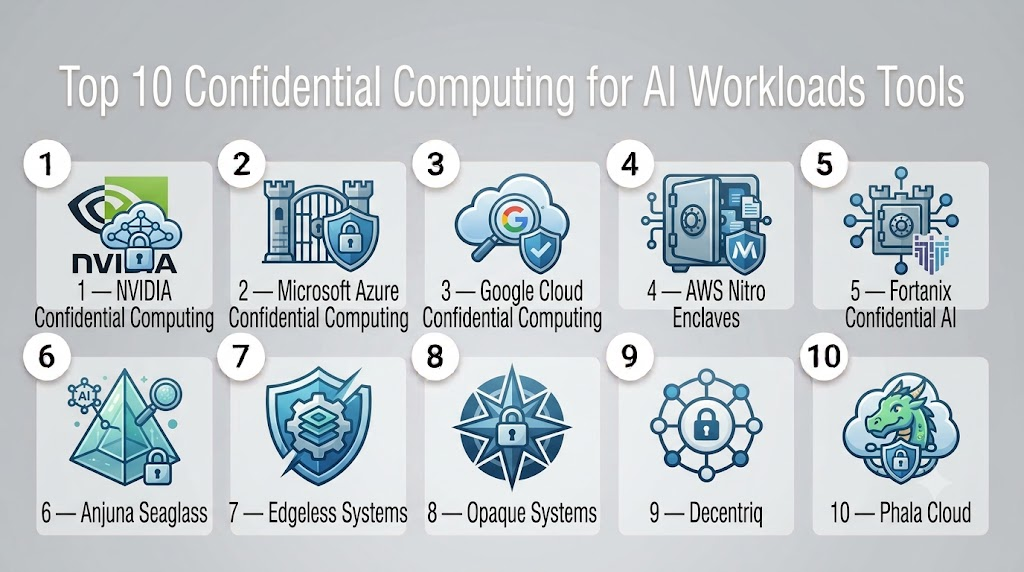
Top 10 Confidential Computing for AI Workloads Tools
1 — NVIDIA Confidential Computing
One-line verdict: Best for GPU-accelerated confidential AI workloads that need protected model inference and training.
Short description:
NVIDIA Confidential Computing enables GPU-based AI workloads to run with stronger protection for data and model assets in use. It is especially important for organizations that need confidential AI inference or training without giving up GPU acceleration.
Standout Capabilities
- Confidential computing support for AI GPUs
- Protection for data and model weights during processing
- Strong fit for LLM inference and generative AI workloads
- Hardware-backed trusted execution support
- Integration with confidential virtual machine architectures
- Support for secure AI infrastructure patterns
- Useful for regulated and sovereign AI workloads
- Works with cloud provider confidential GPU offerings where available
AI-Specific Depth
- Model support: AI and ML workloads using supported NVIDIA GPU environments
- RAG / knowledge integration: Can protect RAG inference workloads when deployed in confidential environments
- Evaluation: Attestation validation, workload isolation, security posture, and performance testing
- Guardrails: Not a policy guardrail tool; focuses on infrastructure-level confidentiality
- Observability: Attestation events, infrastructure logs, GPU workload telemetry, and cloud monitoring integrations
Pros
- Enables confidential computing for high-performance AI workloads
- Strong fit for LLM inference and model IP protection
- Important foundation for secure AI infrastructure
Cons
- Requires compatible hardware and cloud infrastructure
- Deployment can be complex
- Not a complete AI governance or DLP platform by itself
Security & Compliance
Security depends on hardware, cloud configuration, attestation, key management, and deployment architecture. Certifications and compliance scope should be verified with the selected cloud provider and deployment partner.
Deployment & Platforms
- Cloud-based confidential GPU environments where available
- Private infrastructure support depends on hardware availability
- Linux-based AI infrastructure
- Container and Kubernetes patterns may be used
Integrations & Ecosystem
- NVIDIA GPU infrastructure
- Cloud confidential VM environments
- Kubernetes
- AI model serving frameworks
- PyTorch
- TensorFlow
- Hugging Face workflows
Pricing Model
Pricing depends on cloud GPU instances, infrastructure, support, and partner services. Exact pricing varies.
Best-Fit Scenarios
- Protecting LLM model weights during inference
- Running sensitive AI workloads on GPU infrastructure
- Building regulated or sovereign AI platforms
2 — Microsoft Azure Confidential Computing
One-line verdict: Best for enterprises using Azure to run confidential VMs, containers, and AI workloads.
Short description:
Azure Confidential Computing provides confidential virtual machines and related services designed to protect code and data while in use. It supports multiple confidential computing technologies and is suitable for enterprise AI workloads that require cloud-native security controls.
Standout Capabilities
- Confidential virtual machines
- Support for multiple TEE technologies
- Azure-native identity and key management
- Confidential containers and Kubernetes patterns
- Integration with Azure AI and data services
- Remote attestation capabilities
- Enterprise security and compliance ecosystem
- Strong fit for regulated organizations
AI-Specific Depth
- Model support: Azure AI workloads, custom ML workloads, confidential VMs, and containerized AI systems
- RAG / knowledge integration: Can protect confidential RAG deployments in Azure architectures
- Evaluation: Attestation, workload verification, data protection, and infrastructure risk assessment
- Guardrails: Infrastructure confidentiality; AI policy guardrails require additional tools
- Observability: Azure Monitor, security logs, attestation evidence, and cloud security reporting
Pros
- Strong enterprise cloud ecosystem
- Good fit for Microsoft-heavy organizations
- Supports confidential AI architectures with Azure services
Cons
- Requires Azure-specific expertise
- GPU confidential computing availability may vary by region and instance type
- Not a standalone AI application security platform
Security & Compliance
Azure provides enterprise security controls such as identity integration, encryption, logging, policy, and compliance tooling. Exact certifications and workload scope should be verified for the selected service.
Deployment & Platforms
- Azure cloud
- Confidential VMs
- Confidential containers
- Kubernetes and AKS patterns
- Linux and Windows support varies by service
Integrations & Ecosystem
- Azure Key Vault
- Azure Attestation
- Azure Kubernetes Service
- Azure Machine Learning
- Microsoft Defender
- Azure Monitor
- Microsoft identity services
Pricing Model
Cloud usage-based pricing. Exact cost depends on instance type, region, storage, networking, and services used.
Best-Fit Scenarios
- Running AI workloads in Azure confidential environments
- Protecting regulated data during model inference
- Building enterprise confidential AI pipelines
3 — Google Cloud Confidential Computing
One-line verdict: Best for Google Cloud teams building confidential AI and data processing workloads.
Short description:
Google Cloud Confidential Computing helps organizations protect workloads while data is in use. It supports confidential VMs and confidential cloud infrastructure patterns that can be used for AI workloads, data analytics, and secure model processing.
Standout Capabilities
- Confidential virtual machines
- Confidential workloads for cloud-native applications
- Integration with Google Cloud security services
- Support for privacy-sensitive data processing
- Strong fit for analytics and AI pipelines
- Attestation and workload protection capabilities
- Integration with cloud identity and key management
- Useful for secure AI data processing
AI-Specific Depth
- Model support: Google Cloud AI workloads, custom model-serving systems, and confidential infrastructure
- RAG / knowledge integration: Can protect RAG source processing and confidential inference workflows
- Evaluation: Attestation, workload protection, infrastructure checks, and security validation
- Guardrails: Infrastructure-level protection; AI-specific guardrails require additional layers
- Observability: Google Cloud logs, monitoring, security findings, and attestation records
Pros
- Strong fit for Google Cloud AI and data teams
- Useful for data-intensive confidential workloads
- Integrates with broader Google Cloud security tools
Cons
- Requires Google Cloud expertise
- Hardware and region availability may vary
- Not a dedicated model governance platform
Security & Compliance
Security capabilities depend on Google Cloud IAM, encryption, logging, and confidential computing configuration. Compliance details should be verified for each workload.
Deployment & Platforms
- Google Cloud
- Confidential VMs
- Cloud-native AI and data workloads
- Linux-based deployment patterns
Integrations & Ecosystem
- Vertex AI
- Google Kubernetes Engine
- Cloud Key Management
- BigQuery workflows
- Cloud Storage
- Cloud Logging
- Security Command Center
Pricing Model
Usage-based cloud pricing. Exact cost depends on selected instances, storage, networking, and services.
Best-Fit Scenarios
- Confidential AI workloads on Google Cloud
- Secure analytics with sensitive data
- Protected RAG and AI pipeline infrastructure
4 — AWS Nitro Enclaves
One-line verdict: Best for AWS-native teams isolating highly sensitive processing inside secure enclave environments.
Short description:
AWS Nitro Enclaves allows teams to create isolated compute environments from Amazon EC2 instances. It is useful for sensitive data processing, cryptographic operations, secure inference components, and workloads that require strong isolation inside AWS.
Standout Capabilities
- Isolated enclave environments
- Reduced attack surface
- AWS-native key management integration
- Strong fit for secrets and sensitive processing
- Secure local communication model
- Attestation support
- Works with existing EC2-based architectures
- Useful for privacy-preserving AI components
AI-Specific Depth
- Model support: Custom AI components and inference workflows where enclave architecture is suitable
- RAG / knowledge integration: Can protect sensitive preprocessing, key handling, and selected inference components
- Evaluation: Attestation, enclave isolation, key access validation, and workload security testing
- Guardrails: Infrastructure isolation; AI-specific guardrails require additional tools
- Observability: AWS logs, attestation evidence, application logs, and security events
Pros
- Strong AWS-native isolation model
- Useful for sensitive cryptographic and AI support workloads
- Integrates with AWS security services
Cons
- Enclave programming model can be complex
- Not designed as a full GPU confidential AI solution
- Requires architecture changes
Security & Compliance
Security depends on enclave design, IAM, KMS, network isolation, application design, and audit configuration. Certifications should be verified within the AWS service scope.
Deployment & Platforms
- AWS EC2
- Nitro Enclaves
- Linux-based workloads
- AWS-native infrastructure
Integrations & Ecosystem
- AWS KMS
- Amazon EC2
- AWS IAM
- CloudWatch
- AWS Security Hub
- Custom AI services
- Secure data processing pipelines
Pricing Model
AWS usage-based pricing. Costs depend on EC2 resources, storage, networking, and related services.
Best-Fit Scenarios
- Protecting sensitive AI preprocessing
- Secure key release for AI workloads
- Isolating confidential components inside AWS
5 — Fortanix Confidential AI
One-line verdict: Best for enterprises needing confidential AI deployment, key management, and secure data collaboration.
Short description:
Fortanix Confidential AI helps organizations protect sensitive data and AI models using confidential computing. It is designed for secure AI development and deployment where privacy, model protection, and controlled data access are important.
Standout Capabilities
- Confidential AI workload deployment
- Data-in-use protection
- Secure model and data processing
- Key management integration
- Policy-based workload control
- Multi-cloud confidential computing support
- Secure collaboration on sensitive datasets
- Enterprise governance and audit support
AI-Specific Depth
- Model support: AI models, ML workloads, and enterprise AI pipelines
- RAG / knowledge integration: Can support confidential RAG and protected data workflows
- Evaluation: Attestation, workload verification, access policy checks, and security reporting
- Guardrails: Infrastructure and policy-level controls; not a prompt-safety system
- Observability: Workload security logs, attestation evidence, policy activity, and audit trails
Pros
- Purpose-built confidential AI positioning
- Strong key management and policy focus
- Suitable for regulated and multi-party workloads
Cons
- Requires confidential computing architecture planning
- Pricing is not publicly stated
- AI framework support should be validated in proof of concept
Security & Compliance
Enterprise controls may include policy management, key protection, access governance, audit logs, and deployment security. Certifications and residency details should be verified directly.
Deployment & Platforms
- Cloud and multi-cloud environments
- Confidential computing infrastructure
- Enterprise AI and data workflows
- Kubernetes support may vary by implementation
Integrations & Ecosystem
- Cloud confidential computing services
- Key management systems
- AI workloads
- Data collaboration workflows
- Kubernetes environments
- Security operations
- Governance systems
Pricing Model
Commercial enterprise pricing. Exact pricing is not publicly stated.
Best-Fit Scenarios
- Confidential AI in healthcare and finance
- Multi-party collaboration on sensitive data
- Protecting model IP and inference data
6 — Anjuna Seaglass
One-line verdict: Best for simplifying confidential computing deployment across cloud AI and ML workloads.
Short description:
Anjuna Seaglass helps organizations run workloads in confidential computing environments without requiring deep enclave engineering. It is relevant for AI and ML teams that want to protect model artifacts, data, and workloads across major cloud platforms.
Standout Capabilities
- Confidential computing platform abstraction
- Multi-cloud workload protection
- Support for AI and ML reference architectures
- Protection for model artifacts and data
- Reduced application refactoring
- Secure runtime environments
- Cloud-native deployment patterns
- Developer-friendly confidential computing workflows
AI-Specific Depth
- Model support: AI and ML workloads deployed in supported cloud confidential environments
- RAG / knowledge integration: Can protect confidential AI applications and RAG components
- Evaluation: Attestation, workload identity, deployment integrity, and isolation checks
- Guardrails: Infrastructure confidentiality; prompt guardrails require additional systems
- Observability: Workload logs, deployment metadata, attestation evidence, and policy events
Pros
- Simplifies confidential computing adoption
- Useful for multi-cloud AI strategies
- Helps reduce low-level TEE complexity
Cons
- Requires enterprise deployment planning
- Pricing is not publicly stated
- Hardware and cloud support should be validated
Security & Compliance
Security controls depend on selected cloud, attestation design, key management, and platform configuration. Specific certifications should be verified directly.
Deployment & Platforms
- Cloud and multi-cloud deployments
- Confidential VMs and secure runtime environments
- AI/ML workloads
- Containerized applications
Integrations & Ecosystem
- AWS
- Azure
- Google Cloud
- Kubernetes
- AI/ML frameworks
- Cloud key management
- Enterprise security workflows
Pricing Model
Commercial enterprise pricing. Exact pricing is not publicly stated.
Best-Fit Scenarios
- Moving AI workloads into confidential environments
- Reducing confidential computing complexity
- Protecting model IP in multi-cloud deployments
7 — Edgeless Systems
One-line verdict: Best for Kubernetes-native confidential computing and privacy-preserving AI infrastructure.
Short description:
Edgeless Systems provides confidential computing solutions designed to protect workloads from unauthorized access while enabling secure cloud-native deployments. It is relevant for organizations building confidential AI systems on Kubernetes and container platforms.
Standout Capabilities
- Confidential Kubernetes support
- Secure workload isolation
- Runtime encryption and attestation
- Cloud-native confidential computing tooling
- Privacy-preserving AI deployment patterns
- Open-source ecosystem components
- Developer-friendly secure containers
- Digital sovereignty use cases
AI-Specific Depth
- Model support: Containerized AI workloads and Kubernetes-based model-serving systems
- RAG / knowledge integration: Can protect RAG services deployed in confidential Kubernetes environments
- Evaluation: Attestation, container integrity, runtime isolation, and workload verification
- Guardrails: Infrastructure protection rather than AI content guardrails
- Observability: Kubernetes logs, attestation status, workload events, and security metadata
Pros
- Strong fit for Kubernetes-based AI teams
- Useful for privacy-preserving and sovereign workloads
- Good alignment with cloud-native engineering
Cons
- Requires Kubernetes maturity
- Not a complete AI model governance suite
- Pricing and enterprise features vary by offering
Security & Compliance
Security controls depend on Kubernetes configuration, cloud provider, attestation, secrets management, and deployment architecture. Certifications should be verified directly.
Deployment & Platforms
- Kubernetes
- Cloud and self-managed infrastructure
- Confidential container environments
- Linux-based workloads
Integrations & Ecosystem
- Kubernetes
- Confidential containers
- Cloud confidential VMs
- AI serving frameworks
- Container registries
- Key management
- DevSecOps pipelines
Pricing Model
Open-source and commercial offerings may be available. Exact pricing varies.
Best-Fit Scenarios
- Confidential AI on Kubernetes
- Sovereign AI deployments
- Privacy-preserving containerized inference
8 — Opaque Systems
One-line verdict: Best for secure analytics and collaborative AI over confidential enterprise data.
Short description:
Opaque Systems focuses on confidential computing for secure analytics, data collaboration, and privacy-preserving workloads. It is useful for organizations that need to analyze or train models on sensitive data without exposing the underlying data.
Standout Capabilities
- Confidential analytics
- Secure data collaboration
- Privacy-preserving data processing
- Protection for data in use
- Multi-party workflows
- Confidential machine learning patterns
- Secure data clean room use cases
- Enterprise data governance support
AI-Specific Depth
- Model support: Analytics, ML workloads, and privacy-preserving AI workflows
- RAG / knowledge integration: Can support confidential processing of sensitive data sources
- Evaluation: Data protection, access controls, workload validation, and privacy-preserving execution
- Guardrails: Data protection and policy controls; not prompt-safety guardrails
- Observability: Job logs, access records, policy events, and audit evidence
Pros
- Strong for data collaboration and analytics
- Useful for multi-party AI training and research
- Good fit for privacy-sensitive industries
Cons
- Less focused on GPU-heavy LLM serving
- Requires data collaboration architecture
- Pricing is not publicly stated
Security & Compliance
Enterprise controls may include access governance, audit logs, policy controls, and secure execution. Certifications should be verified directly.
Deployment & Platforms
- Cloud and enterprise data environments
- Confidential computing infrastructure
- Secure analytics workflows
Integrations & Ecosystem
- Data platforms
- Analytics pipelines
- Cloud infrastructure
- Secure data collaboration workflows
- ML pipelines
- Governance systems
- Enterprise security tools
Pricing Model
Commercial enterprise pricing. Exact pricing is not publicly stated.
Best-Fit Scenarios
- Secure analytics on sensitive data
- Multi-party AI collaboration
- Privacy-preserving model development
9 — Decentriq
One-line verdict: Best for confidential data collaboration and clean room workflows supporting AI use cases.
Short description:
Decentriq provides confidential computing-based data clean rooms and secure collaboration environments. It helps organizations collaborate on sensitive data while maintaining privacy and control.
Standout Capabilities
- Confidential data clean rooms
- Secure multi-party collaboration
- Privacy-preserving analytics
- Controlled data access
- Governance workflows
- Audit-ready collaboration
- Support for regulated data sharing
- AI and analytics enablement over sensitive data
AI-Specific Depth
- Model support: Analytics and AI workflows over protected datasets
- RAG / knowledge integration: Varies / N/A
- Evaluation: Data access validation, privacy controls, and collaboration auditability
- Guardrails: Data-sharing controls rather than prompt-level guardrails
- Observability: Collaboration logs, access records, policy events, and audit reports
Pros
- Strong fit for data clean room use cases
- Useful for regulated data collaboration
- Helps enable AI without exposing raw data broadly
Cons
- Not a general-purpose LLM serving platform
- Best fit is data collaboration, not all AI workloads
- Pricing is not publicly stated
Security & Compliance
Security controls may include access policies, audit trails, secure execution environments, and collaboration governance. Exact certifications should be verified directly.
Deployment & Platforms
- Cloud-based secure collaboration platform
- Confidential computing environments
- Enterprise data collaboration workflows
Integrations & Ecosystem
- Data clean room workflows
- Enterprise data systems
- Analytics tools
- Governance platforms
- Secure collaboration environments
- AI model development workflows
- Compliance reporting
Pricing Model
Commercial enterprise pricing. Exact pricing is not publicly stated.
Best-Fit Scenarios
- Secure data sharing for AI projects
- Privacy-preserving partner analytics
- Regulated multi-party data collaboration
10 — Phala Cloud
One-line verdict: Best for developer-friendly confidential AI deployment using TEE-based cloud infrastructure.
Short description:
Phala Cloud provides TEE-based cloud infrastructure for confidential computing workloads, including private AI inference and verifiable compute use cases. It is relevant for teams that want to deploy AI workloads with stronger privacy guarantees.
Standout Capabilities
- TEE-based workload execution
- Confidential AI inference support
- Verifiable compute patterns
- Developer-friendly deployment model
- Docker-oriented workflow
- Attestation support
- GPU confidential AI positioning
- Strong fit for privacy-first AI products
AI-Specific Depth
- Model support: AI inference workloads, containerized AI services, and private LLM deployments
- RAG / knowledge integration: Can support private RAG services when deployed inside confidential infrastructure
- Evaluation: Attestation, workload verification, privacy checks, and deployment validation
- Guardrails: Infrastructure-level confidentiality; AI safety guardrails require additional tools
- Observability: Deployment logs, attestation evidence, workload status, and runtime events
Pros
- Developer-friendly confidential AI positioning
- Useful for private LLM inference
- Strong fit for privacy-first AI startups and products
Cons
- Enterprise maturity should be evaluated carefully
- Cloud and hardware availability may vary
- Not a complete enterprise governance platform
Security & Compliance
Security depends on TEE configuration, attestation, key management, and deployment architecture. Certifications are not publicly stated.
Deployment & Platforms
- Cloud-based TEE infrastructure
- Containerized deployments
- AI inference environments
- Developer cloud workflows
Integrations & Ecosystem
- Docker-based workloads
- AI inference services
- LLM serving frameworks
- Attestation workflows
- Developer deployment tools
- Confidential compute infrastructure
- Privacy-preserving AI applications
Pricing Model
Cloud usage-based pricing may apply. Exact pricing varies by workload and infrastructure.
Best-Fit Scenarios
- Private LLM inference
- Developer-friendly confidential AI services
- Verifiable AI compute experiments
Comparison Table
| Tool Name | Best For | Deployment | Model Flexibility | Strength | Watch-Out | Public Rating |
|---|---|---|---|---|---|---|
| NVIDIA Confidential Computing | GPU confidential AI | Cloud / Hardware dependent | AI GPU workloads | GPU acceleration with confidentiality | Requires compatible infrastructure | N/A |
| Azure Confidential Computing | Azure enterprise AI | Cloud | Multi-framework | Enterprise confidential cloud | Azure expertise needed | N/A |
| Google Cloud Confidential Computing | Google Cloud AI pipelines | Cloud | Multi-framework | Data and AI workload protection | Region and hardware availability | N/A |
| AWS Nitro Enclaves | AWS secure isolation | Cloud | Custom AI components | Strong enclave isolation | Architecture complexity | N/A |
| Fortanix Confidential AI | Enterprise confidential AI | Cloud / Multi-cloud | AI and ML workloads | Policy and key management | Pricing not public | N/A |
| Anjuna Seaglass | Multi-cloud confidential workloads | Cloud / Multi-cloud | AI and ML workloads | Easier confidential deployment | Validate hardware support | N/A |
| Edgeless Systems | Confidential Kubernetes | Cloud / Self-hosted | Containerized AI | Kubernetes-native security | Requires Kubernetes maturity | N/A |
| Opaque Systems | Secure analytics and ML | Cloud / Enterprise | Analytics and ML | Confidential data collaboration | Less LLM serving focused | N/A |
| Decentriq | Data clean rooms | Cloud | AI over shared data | Multi-party privacy | Not general AI serving | N/A |
| Phala Cloud | Private AI inference | Cloud TEE | Containerized AI | Developer-friendly confidential AI | Enterprise maturity varies | N/A |
Scoring & Evaluation
The following scores are comparative, not absolute. They reflect confidentiality coverage, AI workload fit, attestation, integration depth, ease of deployment, performance, security administration, and ecosystem support.
Confidential computing platforms differ widely. Some are infrastructure layers, some are cloud services, some are developer platforms, and some are secure collaboration products. The right choice depends on whether you need confidential GPU inference, secure analytics, private data collaboration, or enterprise cloud isolation.
| Tool | Core | Reliability/Eval | Guardrails | Integrations | Ease | Perf/Cost | Security/Admin | Support | Weighted Total |
|---|---|---|---|---|---|---|---|---|---|
| NVIDIA Confidential Computing | 10 | 9 | 8 | 9 | 6 | 9 | 8 | 9 | 8.65 |
| Azure Confidential Computing | 9 | 9 | 8 | 10 | 8 | 8 | 10 | 9 | 8.95 |
| Google Cloud Confidential Computing | 9 | 8 | 8 | 9 | 8 | 8 | 9 | 8 | 8.45 |
| AWS Nitro Enclaves | 8 | 8 | 8 | 9 | 6 | 8 | 9 | 9 | 8.05 |
| Fortanix Confidential AI | 9 | 9 | 8 | 8 | 7 | 8 | 9 | 8 | 8.40 |
| Anjuna Seaglass | 8 | 8 | 8 | 8 | 8 | 8 | 8 | 8 | 8.00 |
| Edgeless Systems | 8 | 8 | 8 | 8 | 7 | 8 | 8 | 8 | 7.85 |
| Opaque Systems | 8 | 8 | 8 | 8 | 7 | 8 | 8 | 8 | 7.85 |
| Decentriq | 8 | 8 | 8 | 7 | 8 | 8 | 8 | 8 | 7.85 |
| Phala Cloud | 8 | 8 | 8 | 7 | 8 | 8 | 7 | 7 | 7.65 |
Which Confidential Computing for AI Workloads Tool Is Right for You?
Solo / Freelancer
Solo developers usually do not need a full confidential computing stack unless they handle sensitive client data, proprietary models, or privacy-sensitive AI inference. For experimentation, developer-friendly platforms such as Phala Cloud or cloud confidential VM options can be practical starting points.
The key is to avoid overengineering. If the workload uses public data and a public model, confidential computing may not be necessary. If the workload processes confidential documents or private prompts, then a confidential inference environment becomes more valuable.
SMB
Small and medium businesses should focus on the simplest confidential computing path available within their existing cloud provider. If the company already uses Azure, Google Cloud, or AWS, cloud-native confidential computing may be easier than adopting a separate platform.
For SMBs building AI products, confidential inference can become a differentiator. It helps reassure customers that prompts, files, embeddings, and model outputs are protected during processing.
Mid-Market
Mid-market organizations often need confidential computing for selected high-risk workflows rather than every AI workload. Examples include legal document review, healthcare analytics, fraud detection, private LLM inference, and confidential RAG.
A practical architecture may combine cloud confidential VMs, key management, Kubernetes, attestation, and a model-serving framework. Fortanix, Anjuna, Edgeless Systems, and cloud-native platforms may be evaluated based on deployment skills and compliance needs.
Enterprise
Enterprises need confidential computing as part of a broader AI security and governance architecture. The platform must support attestation, workload identity, key release, audit evidence, cloud integration, and operational scale.
Azure Confidential Computing, NVIDIA Confidential Computing, Fortanix Confidential AI, Anjuna Seaglass, and Google Cloud Confidential Computing are strong candidates depending on cloud strategy. Enterprises should also evaluate data residency, regulatory scope, hardware availability, and integration with existing key management.
Regulated Industries
Healthcare, finance, government, insurance, defense, telecom, and life sciences should prioritize confidential computing where sensitive data must be processed by AI models.
Important requirements include:
- Remote attestation
- Key release after attestation
- Encrypted memory
- Protected model weights
- Audit logs
- Data residency
- Strong identity controls
- Secure model serving
- Access governance
- Vendor risk review
- Incident response integration
- Compliance evidence
These industries should not rely only on encryption at rest and in transit. Data-in-use protection is increasingly important for high-risk AI systems.
Budget vs Premium
Budget-focused teams should begin with one high-risk workload. Confidential computing can add complexity and cost, especially when GPU acceleration is required.
Premium enterprise platforms may be worth the investment when workloads involve regulated data, model IP, cross-organization collaboration, or customer trust requirements.
A phased approach is best: start with confidential inference, then expand to RAG pipelines, model fine-tuning, and multi-party collaboration.
Build vs Buy
Build when your team has deep cloud security, Kubernetes, cryptography, and MLOps expertise. This can work for narrow use cases with stable infrastructure.
Buy or adopt managed platforms when you need faster deployment, enterprise controls, multi-cloud support, audit evidence, and reduced enclave engineering complexity.
Most organizations should combine cloud-native confidential computing with managed key management, attestation, monitoring, and AI application security tools.
Implementation Playbook
First 30 Days: Pilot and Risk Mapping
- Identify the AI workload that processes the most sensitive data.
- Classify model inputs, outputs, embeddings, prompts, and model weights.
- Map data flow from user request to model response.
- Decide whether CPU-only or GPU confidential computing is required.
- Select the cloud or platform for a pilot.
- Define attestation and key-release requirements.
- Create baseline performance metrics.
- Test model-serving inside a confidential environment.
- Validate logging and audit evidence.
- Review data residency and retention rules.
- Document the threat model and assumptions.
- Decide success criteria for moving beyond the pilot.
First 60 Days: Secure Architecture and Integration
- Integrate confidential compute with key management.
- Add remote attestation validation.
- Protect secrets, model weights, and inference data.
- Add secure storage for inputs and outputs.
- Integrate with Kubernetes or MLOps pipelines.
- Test RAG document flow in the confidential environment.
- Add access controls and identity policies.
- Validate encrypted communication between services.
- Test failure modes and key-release denial.
- Measure performance overhead.
- Create monitoring dashboards.
- Document operational runbooks.
First 90 Days: Governance and Scale
- Expand confidential computing to additional AI workloads.
- Automate deployment through CI/CD.
- Create standard templates for confidential AI services.
- Add audit reporting for security and compliance teams.
- Review all third-party model and infrastructure dependencies.
- Add incident response procedures.
- Test backup, recovery, and workload migration.
- Validate attestation evidence with governance teams.
- Review cost and performance optimization.
- Train MLOps, security, and platform teams.
- Create risk acceptance processes for non-confidential workloads.
- Establish quarterly confidential AI architecture reviews.
Common Mistakes and How to Avoid Them
- Protecting only storage: AI workloads also expose data during processing.
- Ignoring model weights: Proprietary model weights can be as sensitive as customer data.
- Skipping attestation: Encryption without workload verification is incomplete.
- Poor key-release design: Keys should be released only to verified workloads.
- Assuming all confidential computing supports GPUs: GPU support depends on hardware and cloud availability.
- Not measuring performance overhead: Confidential environments can affect latency and throughput.
- Ignoring RAG data flows: Prompts, embeddings, retrieved documents, and responses all need protection.
- No threat model: Confidential computing must be tied to specific risks.
- Using confidential compute as a complete security solution: It must be combined with IAM, DLP, monitoring, and app security.
- Forgetting observability: Teams still need logs, metrics, and audit evidence.
- Weak workload identity: The platform must know which workload is running before granting access.
- No recovery plan: Confidential workloads need backup and failover planning.
- Overusing confidential computing: Not every workload needs it.
- Ignoring vendor lock-in: Confidential computing capabilities differ across clouds and hardware vendors.
FAQs
1. What is confidential computing for AI workloads?
It is the use of hardware-backed secure execution environments to protect AI data and model assets while they are being processed.
2. Why is confidential computing important for AI?
AI workloads often process sensitive prompts, documents, embeddings, customer data, and model weights. Confidential computing helps reduce exposure during inference, training, and analytics.
3. What is a trusted execution environment?
A trusted execution environment is an isolated execution area designed to protect code and data from unauthorized access by the host system, cloud operator, or other workloads.
4. What is remote attestation?
Remote attestation is a process that verifies the identity and integrity of a workload before secrets, keys, or sensitive data are released to it.
5. Can confidential computing protect LLM inference?
Yes. It can protect prompts, model weights, retrieved context, and responses during inference when deployed in a suitable confidential environment.
6. Does confidential computing protect data at rest?
Confidential computing mainly protects data in use. Data at rest still requires encryption, access controls, and secure storage.
7. Does confidential computing replace DLP?
No. DLP prevents sensitive data misuse and leakage. Confidential computing protects data during processing. Strong AI security often requires both.
8. Can confidential computing work with GPUs?
Yes, but support depends on specific hardware, cloud providers, drivers, and deployment architecture. GPU confidential computing availability should always be verified.
9. Is confidential computing useful for RAG?
Yes. It can help protect retrieved documents, embeddings, prompts, and model responses during RAG inference.
10. Is confidential computing expensive?
Costs vary. GPU confidential workloads can be costly, while CPU-based confidential workloads may be more accessible. Teams should measure cost against risk and compliance needs.
11. Can confidential computing prevent prompt injection?
No. Prompt injection is an application-layer risk. Confidential computing protects execution environments but does not automatically make model behavior safe.
12. What is key release after attestation?
It means encryption keys or secrets are released only after the system verifies that the expected workload is running in a trusted environment.
13. Can confidential computing help with compliance?
Yes. It can provide technical evidence that sensitive data was processed in protected environments. Compliance value depends on the regulation and implementation.
14. What workloads should be prioritized first?
Prioritize AI workloads using regulated data, confidential documents, customer records, proprietary models, sensitive embeddings, or cross-party data collaboration.
15. Can small teams use confidential computing?
Yes, but they should start with managed cloud options or developer-friendly platforms rather than building complex enclave infrastructure from scratch.
Conclusion
Confidential computing for AI workloads is becoming a critical control for organizations that need to protect sensitive data and model assets during processing. As AI systems handle private prompts, embeddings, documents, model weights, and regulated information, encryption at rest and in transit is no longer enough.
The best tool depends on your infrastructure and risk profile. NVIDIA Confidential Computing is essential for GPU-heavy confidential AI. Azure, Google Cloud, and AWS provide cloud-native options. Fortanix and Anjuna help simplify enterprise confidential AI deployment. Edgeless Systems supports Kubernetes-native confidential workloads, while Opaque Systems and Decentriq are strong for secure data collaboration.
