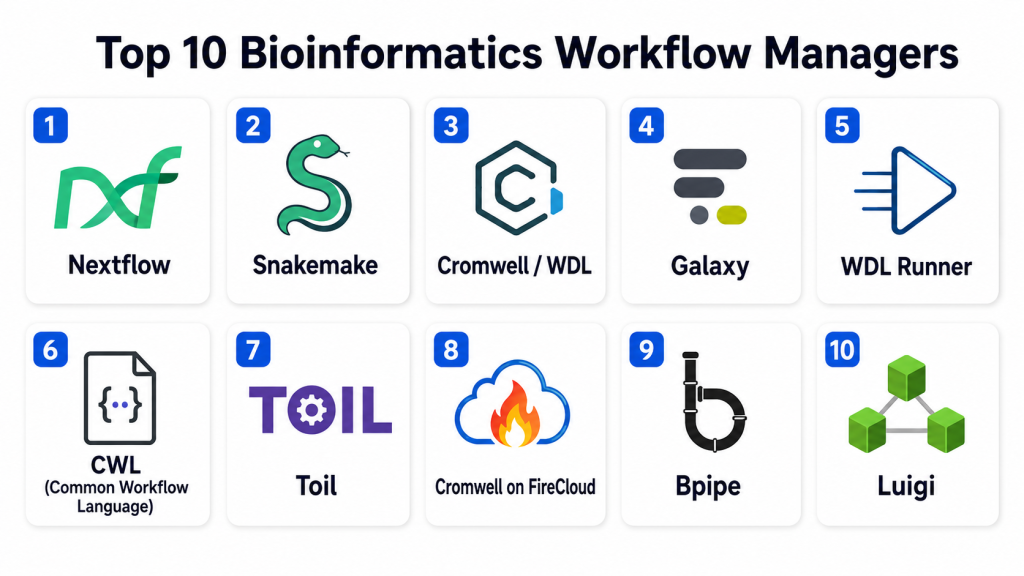
Introduction
Bioinformatics workflow managers are software platforms that automate, organize, and manage complex computational pipelines for biological data analysis.
They ensure reproducibility, scalability, and proper execution of multi-step analyses across genomics, transcriptomics, proteomics, and metabolomics workflows.
These tools integrate diverse bioinformatics software, data formats, and computational resources, making high-throughput analyses efficient and error-free.
Selecting the right workflow manager ensures consistent results, facilitates collaboration, and supports reproducible scientific research.
Real-world use cases:
- Automating RNA-seq, DNA-seq, and variant calling pipelines
- Integrating multi-omics analyses
- High-throughput proteomics or metabolomics workflows
- Large-scale genome assembly and annotation
- Clinical bioinformatics and regulatory-compliant analyses
Key buyer evaluation criteria:
- Reproducibility and provenance tracking
- Integration with bioinformatics tools and databases
- Support for cloud, HPC, and local compute environments
- Scalability for large datasets
- Workflow modularity and customization
- Container and environment management (Docker, Singularity)
- Logging, monitoring, and error handling
- User interface (GUI vs command-line)
- Community and support resources
Best for: Bioinformatics research labs, computational biology groups, clinical genomics teams, and multi-omics research programs.
Not ideal for: Small labs performing simple analyses or non-bioinformatics tasks.
Key Trends in Bioinformatics Workflow Managers
- Cloud-native pipelines for scalable and distributed computation
- Containerized workflows for reproducibility and portability
- Integration with multi-omics datasets and data lakes
- AI/ML-assisted workflow optimization and error detection
- Support for HPC, clusters, and GPU-based computation
- Automated quality control and logging dashboards
- Standardized workflow languages (WDL, CWL, Nextflow DSL2)
- Modular and reusable workflow components
- Collaboration features for multi-site research projects
- Open-source and hybrid commercial licensing models
How We Selected These Tools (Methodology)
- Adoption and popularity in genomics, transcriptomics, and proteomics pipelines
- Flexibility in workflow creation and modularity
- Reproducibility, provenance, and traceability features
- Integration with bioinformatics tools, databases, and cloud/HPC resources
- Scalability for high-throughput datasets
- Documentation, tutorials, and community support
- Ease of installation, deployment, and monitoring
- Security, access control, and compliance
Top 10 Bioinformatics Workflow Managers
#1 — Nextflow
Short description:
Nextflow is a versatile workflow manager for bioinformatics pipelines.
Supports scalable execution across cloud, HPC, and local systems.
Enables reproducible workflows using containerized software (Docker/Singularity).
Ideal for genomics, transcriptomics, and proteomics analyses.
Key Features
- Workflow automation and orchestration
- Container support for reproducibility
- Cloud and HPC scalability
- Modular and reusable workflow components
- Logging and monitoring
Pros
- Portable and reproducible workflows
- Scales from local to cloud HPC environments
- Strong community support
Cons
- Requires scripting knowledge
- Steep learning curve for beginners
Platforms / Deployment
- Linux / macOS
- Cloud / HPC / On-premises
Security & Compliance
- Container-based security
- Compliance: Not publicly stated
Integrations & Ecosystem
- Integrates with GATK, STAR, HISAT2, and custom tools
- Supports REST APIs and cloud connectors
Support & Community
- Tutorials and documentation
- Active GitHub community
#2 — Snakemake
Short description:
Snakemake is a Python-based workflow management system.
Automates reproducible bioinformatics pipelines with dependency tracking.
Supports HPC, cloud, and local execution environments.
Ideal for academic research and custom multi-step workflows.
Key Features
- Dependency-based workflow execution
- Container support (Docker/Singularity)
- HPC and cloud scalability
- Logging, error handling, and reproducibility
- Integration with existing bioinformatics tools
Pros
- Ensures reproducibility
- Flexible and modular
- Strong documentation and examples
Cons
- Python scripting required
- Large workflows may need optimization
Platforms / Deployment
- Linux / macOS
- Cloud / HPC / On-premises
Security & Compliance
- Container security features
- Compliance: Not publicly stated
Integrations & Ecosystem
- Integrates with common bioinformatics software (GATK, STAR, Bowtie)
- APIs for monitoring and reporting
Support & Community
- Tutorials and documentation
- Active community forums
#3 — Cromwell / WDL
Short description:
Cromwell executes workflows written in WDL (Workflow Description Language).
Supports reproducible pipeline execution on cloud, HPC, and local environments.
Facilitates large-scale genomics and multi-omics analyses.
Ideal for labs using GATK best practices and standardized workflows.
Key Features
- WDL workflow execution
- Parallelization and scheduling
- Containerized task support
- Logging and provenance tracking
- Cloud and HPC compatibility
Pros
- Scalable and reproducible
- Cloud-native support
- Compatible with major genomics pipelines
Cons
- WDL scripting required
- Configuration may be complex
Platforms / Deployment
- Linux / macOS
- Cloud / HPC / On-premises
Security & Compliance
- Container-based security
- Compliance: Not publicly stated
Integrations & Ecosystem
- GATK, STAR, BWA integration
- REST APIs for monitoring
Support & Community
- Tutorials and documentation
- Community support
#4 — Galaxy
Short description:
Galaxy is a web-based workflow manager for bioinformatics analyses.
Provides GUI-based pipeline creation and execution for non-programmers.
Supports reproducible workflows, multi-tool integration, and cloud deployment.
Ideal for teaching, academic research, and labs without command-line expertise.
Key Features
- Graphical workflow builder
- Integration with hundreds of bioinformatics tools
- Cloud and local execution
- Reproducibility and version tracking
- Workflow sharing and collaboration
Pros
- User-friendly GUI
- Accessible to non-programmers
- Large repository of community workflows
Cons
- Less performant for very large datasets
- Advanced workflows may require additional configuration
Platforms / Deployment
- Web
- Cloud / Local server
Security & Compliance
- User access control
- Compliance: Not publicly stated
Integrations & Ecosystem
- Supports BWA, STAR, GATK, DESeq2
- Community workflow sharing
Support & Community
- Extensive tutorials
- Active user community
#5 — WDL Runner
Short description:
WDL Runner executes WDL workflows on HPC and cloud resources.
Focuses on reproducible and parallel execution of bioinformatics pipelines.
Ideal for labs standardizing variant calling and RNA-seq workflows.
Key Features
- WDL execution
- Parallel task management
- Cloud and HPC support
- Logging and monitoring
Pros
- Lightweight and reproducible
- Integrates with cloud and HPC systems
- Supports containerized tasks
Cons
- Requires WDL scripting
- Limited GUI
Platforms / Deployment
- Linux / macOS
- Cloud / HPC / On-premises
Security & Compliance
- Container security
- Compliance: Not publicly stated
Integrations & Ecosystem
- Compatible with GATK and STAR pipelines
- APIs for workflow monitoring
Support & Community
- Documentation
- Community tutorials
#6 — CWL (Common Workflow Language)
Short description:
CWL is a specification for describing computational workflows.
Enables reproducible execution across workflow engines and platforms.
Ideal for labs using multiple workflow managers and pipelines.
Key Features
- Workflow description standard
- Supports containerized tasks
- Cross-platform compatibility
- Integration with HPC and cloud environments
Pros
- Ensures portability and reproducibility
- Open standard
- Supports diverse engines
Cons
- Requires learning CWL syntax
- Implementation depends on workflow engine
Platforms / Deployment
- Linux / macOS
- Cloud / HPC / On-premises
Security & Compliance
- Depends on container and host
- Compliance: Not publicly stated
Integrations & Ecosystem
- Compatible with Cromwell, Toil, and other engines
- Works with Docker/Singularity
Support & Community
- Open-source documentation
- Community support
#7 — Toil
Short description:
Toil is a scalable, cloud-ready workflow engine supporting CWL, WDL, and Python scripts.
Designed for high-throughput bioinformatics pipelines.
Ideal for large-scale genomics and multi-omics projects.
Key Features
- CWL/WDL workflow support
- Scalable cloud and HPC execution
- Fault tolerance and job retry
- Containerized task execution
Pros
- Scalable and flexible
- Supports multiple workflow specifications
- Open-source
Cons
- Requires scripting knowledge
- Limited GUI
Platforms / Deployment
- Linux / macOS
- Cloud / HPC / On-premises
Security & Compliance
- Container and cloud security
- Compliance: Not publicly stated
Integrations & Ecosystem
- Compatible with GATK, STAR, and other bioinformatics tools
- APIs for monitoring and logging
Support & Community
- Documentation
- GitHub community
#8 — Cromwell on FireCloud
Short description:
FireCloud integrates Cromwell workflows with cloud infrastructure.
Focuses on reproducible genomics analyses with WDL.
Ideal for cloud-based clinical genomics pipelines.
Key Features
- WDL execution on cloud
- Scalable workflow execution
- Logging and provenance tracking
- Data management in cloud
Pros
- Cloud-native
- Reproducible workflows
- High scalability
Cons
- Cloud-only
- Requires WDL scripting
Platforms / Deployment
- Linux / macOS
- Cloud
Security & Compliance
- Cloud-based encryption
- Compliance: Not publicly stated
Integrations & Ecosystem
- Integrates with GATK, STAR, BWA pipelines
- API support
Support & Community
- Documentation
- Tutorials
#9 — Bpipe
Short description:
Bpipe is a lightweight workflow manager for sequencing and bioinformatics pipelines.
Supports dependency tracking, parallel execution, and logging.
Ideal for labs needing simple, reproducible pipelines.
Key Features
- Workflow automation
- Parallel task execution
- Logging and provenance
- Lightweight scripting support
Pros
- Easy to deploy
- Minimal dependencies
- Supports small to mid-scale pipelines
Cons
- CLI-only
- Limited GUI
Platforms / Deployment
- Linux / macOS
- HPC / On-premises
Security & Compliance
- Depends on host environment
- Compliance: Not publicly stated
Integrations & Ecosystem
- Works with bioinformatics command-line tools
- Pipeline monitoring via logs
Support & Community
- Documentation
- Community forums
#10 — Luigi
Short description:
Luigi is a Python-based workflow management system.
Handles dependency resolution, pipeline scheduling, and task execution.
Ideal for bioinformatics teams using Python and HPC clusters.
Key Features
- Dependency resolution
- Task scheduling and monitoring
- Reproducibility and logging
- Cloud and HPC support
Pros
- Flexible Python integration
- Scalable pipelines
- Open-source
Cons
- Requires Python scripting
- Limited GUI
Platforms / Deployment
- Linux / macOS
- Cloud / HPC / On-premises
Security & Compliance
- Host-dependent
- Compliance: Not publicly stated
Integrations & Ecosystem
- Works with CWL, WDL, and custom scripts
- APIs for task monitoring
Support & Community
- Documentation
- Active Python community
Comparison Table (Top 10)
| Tool Name | Best For | Platform(s) | Deployment | Standout Feature | Public Rating |
|---|---|---|---|---|---|
| Nextflow | Scalable workflows | Linux/macOS | Cloud/HPC | Containerized reproducible pipelines | N/A |
| Snakemake | Academic & custom pipelines | Linux/macOS | Cloud/HPC | Dependency-based reproducibility | N/A |
| Cromwell | WDL execution | Linux/macOS | Cloud/HPC | Standardized WDL workflows | N/A |
| Galaxy | GUI-based workflows | Web | Cloud/Local | Accessible reproducible pipelines | N/A |
| WDL Runner | WDL pipelines | Linux/macOS | Cloud/HPC | Lightweight WDL execution | N/A |
| CWL | Cross-engine portability | Linux/macOS | Cloud/HPC | Standardized workflow description | N/A |
| Toil | HPC/cloud pipelines | Linux/macOS | Cloud/HPC | Multi-spec workflow support | N/A |
| Cromwell on FireCloud | Cloud genomics | Linux/macOS | Cloud | Scalable cloud WDL execution | N/A |
| Bpipe | Lightweight pipelines | Linux/macOS | HPC/Local | Dependency and parallel execution | N/A |
| Luigi | Python-based pipelines | Linux/macOS | HPC/Cloud | Task scheduling & dependency | N/A |
Evaluation & Scoring
| Tool | Core (25%) | Ease (15%) | Integrations (15%) | Security (10%) | Performance (10%) | Support (10%) | Value (15%) | Weighted Total |
|---|---|---|---|---|---|---|---|---|
| Nextflow | 10 | 7 | 8 | 7 | 9 | 8 | 6 | 8.3 |
| Snakemake | 9 | 8 | 8 | 7 | 8 | 7 | 6 | 7.9 |
| Cromwell | 9 | 7 | 8 | 7 | 8 | 7 | 6 | 7.8 |
| Galaxy | 8 | 9 | 7 | 6 | 7 | 7 | 7 | 7.6 |
| WDL Runner | 8 | 7 | 7 | 7 | 8 | 7 | 6 | 7.3 |
| CWL | 8 | 7 | 7 | 7 | 8 | 7 | 6 | 7.3 |
| Toil | 9 | 7 | 7 | 7 | 8 | 7 | 6 | 7.7 |
| Cromwell on FireCloud | 9 | 7 | 7 | 7 | 8 | 7 | 6 | 7.7 |
| Bpipe | 7 | 8 | 7 | 6 | 7 | 7 | 7 | 7.2 |
| Luigi | 8 | 7 | 7 | 7 | 8 | 7 | 6 | 7.5 |
Decision Guide
Academic Research
Galaxy or Snakemake for accessible reproducible workflows.
Clinical/High-throughput Genomics
Nextflow, Cromwell, or Toil for scalable, automated pipelines.
WDL Standardized Workflows
Cromwell and FireCloud for large-scale standardized genomics analyses.
Lightweight/Custom Pipelines
Bpipe or Luigi for small labs or Python-integrated pipelines.
Cross-platform & Open-source
CWL, Snakemake, and Toil for portability and flexibility.
Frequently Asked Questions (FAQs)
1. Are workflow managers open-source?
Most (Nextflow, Snakemake, CWL, Toil) are open-source; commercial options exist for GUI-based solutions.
2. Do they support HPC and cloud?
Yes, these managers scale from local desktops to HPC clusters and cloud environments.
3. Are GUIs available?
Galaxy provides GUI; others are command-line oriented.
4. Can I integrate bioinformatics tools?
Yes, most support GATK, STAR, HISAT2, Bowtie, and custom scripts.
5. Are pipelines reproducible?
Yes, provenance tracking and containerization ensure reproducibility.
6. Can I run multi-omics pipelines?
Yes, workflow managers support integration across genomics, transcriptomics, and proteomics.
7. Do they handle errors and retries?
Yes, most have built-in error handling, logging, and retry mechanisms.
8. Are containers supported?
Yes, Docker and Singularity containers are widely supported.
9. Do they work with cloud storage?
Yes, Nextflow, Cromwell, and Toil integrate with cloud object storage like S3.
10. Is scripting knowledge required?
CLI-focused managers (Nextflow, Snakemake, Toil) require scripting; GUI managers like Galaxy are easier for beginners.
Conclusion
Choosing the right bioinformatics workflow manager depends on your research scale, computational resources, and expertise. GUI platforms like Galaxy are ideal for teaching and small labs, while Nextflow, Snakemake, and Cromwell support large-scale, reproducible, and cloud-enabled pipelines. Workflow portability (CWL), AI-enhanced execution (Toil), and lightweight Python-based managers (Luigi, Bpipe) provide flexibility for various use cases. Pilot testing and pipeline standardization ensure robust, reproducible analyses across genomics, transcriptomics, and proteomics studies.
