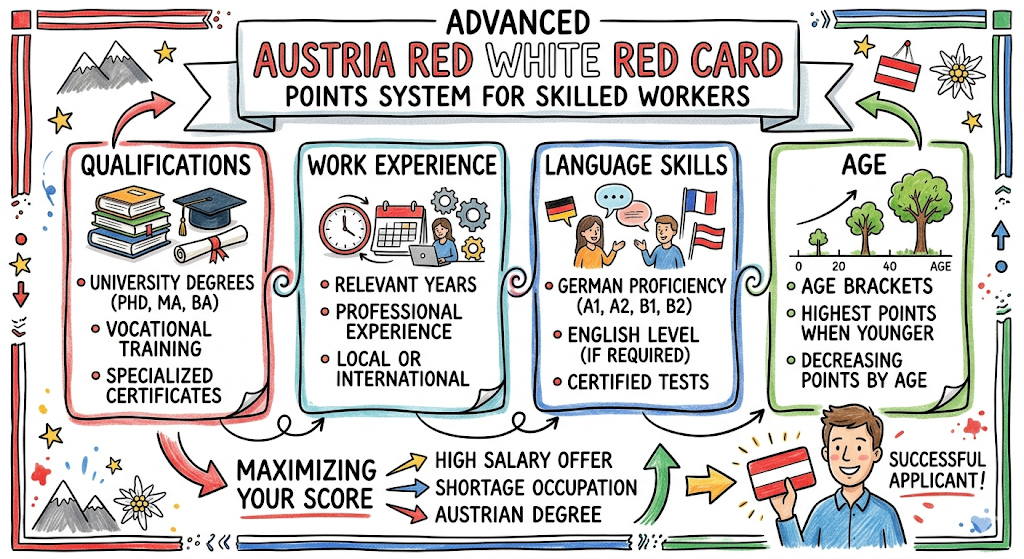
Austria stands as a top choice for skilled professionals and global graduates who seek exceptional living standards, economic stability, and lucrative career opportunities in Europe. To secure residency, applicants navigate a structured, merit-based immigration framework known as the Red-White-Red (RWR) Card system. Instead of relying on unpredictable visa interviews, the Austrian government implements a transparent points-based calculator that directly grades your age, education, work history, and language skills. Knowing your exact score before filing paperwork is the most reliable way to prevent automatic rejections or processing delays. Evaluating your profile with the Desinri Austria PR Points Calculator gives you immediate clarity on your eligibility and maps out a clear path toward a successful move.
What Is the Austria PR Points Calculator?
The Austria PR Points Calculator is an official, criteria-based assessment mechanism used by the Austrian government to evaluate skilled professionals from non-EU countries.
Its primary purpose is to filter applications objectively. By assigning specific scores to human capital factors, the system removes bias and speeds up processing times.
When you use the calculator, it tallies points across multiple legal categories, such as your academic background, career history, and language capabilities.
Austria uses this points-based system because the local economy faces severe demographic shifts and specialized labor shortages. The country needs top global talent to maintain its industrial and tech sectors.
It is crucial to understand the difference between eligibility and final approval. Scoring the minimum points means you are legally allowed to submit an immigration application.
However, final visa approval depends on the verification of your original documents, background checks, and validation by the Austrian Public Employment Service (AMS).
For example, imagine a software developer from India who calculates their score and hits 75 points. They are fully eligible to apply, but they still need to secure a valid employment contract that satisfies minimum wage laws to get their final visa stamped.
Austria PR Points System Explained
The points framework is divided into distinct human capital categories, each designed to evaluate your long-term integration potential.
1. Educational Qualifications
Your educational background serves as the bedrock of your application. Higher levels of academic attainment yield significantly more points.
A standard bachelor’s degree or a four-year university program grants basic foundational points. However, if your degree falls under MINT subjects (Mathematics, Informatics, Natural Sciences, or Technology), you receive a significant bonus.
Ph.D. holders and researchers with post-doctoral achievements receive the maximum possible score under the education segment.
2. Work Experience
Professional experience must be relevant to your qualified background and verifiable through reference letters and tax records.
Points are awarded on an incremental basis for each year or half-year of active employment. If you have previous, legal work experience directly inside Austria, the system rewards you with bonus points.
3. Age Factor
The Austrian immigration system actively targets younger professionals who can contribute to the local social security system for decades.
Applicants under 30 or 35 years old enjoy the highest tier of points. As an applicant’s age increases, the point allocation drops incrementally, reflecting a shorter remaining career window.
4. Language Skills
Communication is vital for societal and workplace integration. The system awards points for both German and English language proficiency.
You must prove your language levels using recognized standardized test certificates, such as Goethe-Zertifikat or ÖSD for German, and IELTS or TOEFL for English.
5. Bonus Points
Certain pathways offer unique allocations, such as bonus points for professional athletes, specific innovation awards, or documented patent applications.
Let’s look at a quick example: If an IT candidate holds a Master’s degree in Computer Science and possesses 3 years of overseas experience, they secure higher immediate points than a candidate with an arts degree and identical experience.
The Red-White-Red Card System
The Red-White-Red (RWR) Card is a combination of a residence permit and a work visa. It grants you the legal right to live in Austria and work for a specific employer.
Unlike general tourist visas, the RWR Card ties your legal stay directly to your professional economic contribution. The program is split into distinct categories based on your career profile.
| Category | Target Audience | Key Feature |
| Very Highly Qualified Workers | Elite global talent, executives, scientists, PhDs | Can apply for a 6-month Job Seeker Visa without an existing offer |
| Skilled Workers in Shortage Occupations | Trade specialists, engineers, healthcare staff | Requires a job offer in a government-listed shortage field |
| Other Key Workers | Experienced professionals in non-shortage fields | Requires a job offer meeting strict minimum salary thresholds |
| Graduates of Austrian Universities | International students holding local degrees | Exempt from the standard points test if earning minimum wages |
| Startup Founders | Entrepreneurs creating innovative business plans | Requires capital investment and a viable business proposal |
Selecting the correct category before applying ensures that your documents match the specific criteria analyzed by the AMS evaluation team.
How Austria PR Points Are Calculated
Calculating your score requires an honest evaluation of your credentials against official government criteria tables. The thresholds vary depending on the specific immigration stream you choose.
Points Breakdown for Very Highly Qualified Workers (Max: 100 Points / Pass Mark: 70)
- University Degree (Minimum 4 years): 20 Points
- MINT Subject Degree (STEM): 30 Points
- PhD or Post-Doctoral Qualification: 40 Points
- Senior Management Experience (Past year): Up to 30 Points (Based on salary benchmarks)
- Research & Innovation Activities (Patents/Publications): 20 Points
- Recognized Awards & Prizes: 20 Points
- Work Experience (Per year): 2 Points (Max 20 Points)
- Austrian Work Experience (6 months minimum): 10 Points
- Language Skills (German A1 or English A2/B1): 5 to 10 Points
- Age (Up to 35 years old): 20 Points (Ages 35-40: 15 Points; Ages 40-45: 10 Points)
Points Breakdown for Skilled Workers in Shortage Occupations (Max: 90 Points / Pass Mark: 55)
- Vocational Training / Degree in Shortage Field: 20 to 30 Points
- General Work Experience (Per year): 2 Points (Max 10 Points)
- Experience in Shortage Profession (Per year): 4 Points (Max 20 Points)
- Language Skills (German A1 to B1 / English B1): 10 to 25 Points
- Age (Up to 30 years old): 15 Points (Ages 30-40: 10 Points)
Real-Life Sample Profile Calculation
Let’s look at Sarah, a 28-year-old Mechanical Engineer from Canada applying under the Shortage Occupations stream.
- Qualification: Degree in a shortage engineering field = 30 Points
- Work Experience: 3 years of engineering experience = 12 Points
- Language: Fluent in English (B1+ certified) = 10 Points
- Age: 28 years old = 15 Points
Total Calculated Score: 30 + 12 + 10 + 15 = 67 Points. Because the passing threshold for this category is 55, Sarah is fully eligible to proceed with her application.
Step-by-Step Application Process
Navigating the Austrian immigration pipeline requires careful planning and a systematic approach to paperwork.
Step 1 – Check Your Eligibility
Run your background credentials through an online points calculator to ensure you meet or exceed the mandatory passing mark for your stream.
Step 2 – Collect Mandatory Documents
Gather all necessary diplomas, employment certificates, birth certificates, and language proofs, ensuring everything is translated into German or English.
Step 3 – Secure an Austrian Job Offer
Unless you qualify for the Very Highly Qualified Job Seeker Visa, you must obtain a binding job contract from a company registered in Austria.
Step 4 – Submit Your Official Visa Application
File your application package at the local Austrian Embassy or Consulate in your home country, or directly in Austria if you enjoy visa-free entry.
Step 5 – The AMS Evaluation Phase
The immigration authority forwards your file to the Public Employment Service (AMS), where officers cross-verify your points and check local labor market conditions.
Step 6 – Final Approval and Visa Issuance
Once the AMS issues a positive labor market statement, the immigration office approves your residency card, allowing you to move and start working.
Documents Required
A high point score means nothing without clear, verifiable evidence. Missing a single document can lead to an immediate application rejection.
- Valid Passport: Must have clean pages and remain valid for the duration of your initial residency period.
- Biometric Photographs: Taken recently according to strict European visa photo specifications.
- Academic Degrees & Transcripts: Apostilled or legalized diplomas along with detailed course transcripts.
- Official Work Experience Letters: Written on company letterhead detailing your precise job roles, titles, and exact employment dates.
- Language Test Certificates: Official score sheets from accredited bodies like IELTS, TOEFL, ÖSD, or Goethe-Institut.
- Signed Employment Contract: A job offer detailing your weekly working hours, duties, and exact monthly or annual gross salary.
- Proof of Austrian Accommodation: A signed rental agreement or lease showing where you intend to live upon arrival.
- Comprehensive Health Insurance: A policy valid in Austria providing full medical coverage before you join the public system.
Processing Time & Validity
Understanding the operational timelines of European immigration authorities helps you plan your relocation, resignation, and travel dates smoothly. On average, the processing time for a Red-White-Red Card ranges between 8 to 12 weeks from the moment you submit a complete application package. Delays usually happen if the AMS requires additional employer documentation. The initial RWR Card is issued with a standard validity period of 24 months. It ties your residency rights directly to the specific employer named on your card. If your employment continues smoothly, you can apply for a renewal before your initial 24 months expire. This transition moves you to a “Red-White-Red Card Plus.” The RWR Card Plus provides unrestricted access to the entire Austrian labor market, meaning you can change employers freely without needing a new points assessment. After living and working continuously in Austria for a period of five years, you become eligible to apply for long-term permanent residency (PR), provided you meet advanced language integration criteria.
How to Increase Your Austria PR Points
If your initial points calculation falls just short of the passing threshold, don’t lose hope. You can actively take steps to boost your score.
Focus on learning the German language. Moving from no German knowledge to an basic A1 or A2 certificate adds 10 to 15 points to your file, which can easily save a weak application.
Gain more professional work experience in your current country. Adding another year or two of relevant employment builds up your points balance safely over time.
Consider pursuing professional certifications or higher academic qualifications, particularly programs focused on tech, engineering, or mathematics.
Target employment opportunities listed explicitly on Austria’s official Shortage Occupations List, as these occupations feature a lower overall passing threshold.
Keep looking for companies willing to offer premium compensation packages. Higher salary structures can sometimes yield extra points in specialized elite categories.
Common Mistakes Applicants Make
Avoiding standard application pitfalls will save you time, reduce your stress, and prevent costly visa rejections.
- Selecting the Wrong Application Category: Applying as a Highly Qualified Worker when your profile actually fits better under the Shortage Occupations list.
- Submitting Incomplete Experience Proof: Using simple appointment letters instead of detailed reference letters that outline your daily technical duties.
- Presenting Expired Language Certificates: Submitting language test results that are older than the standard two-year validity limit.
- Miscalculating Total Point Allocations: Claiming point points for an unapproved degree that has not been properly evaluated against Austrian university standards.
- Applying Without a Legal Job Offer: Attempting to get an Key Worker RWR card without a signed employment contract that meets minimum local wage laws.
Real-Life Examples
Let’s explore how the point evaluation process works across different scenarios.
Example 1: The IT Professional
- Profile: Devansh is a 32-year-old software engineer with a 4-year Bachelor’s degree in Computer Science and 6 years of international experience. He holds an English B1 certificate and an Austrian job offer.
- Points Estimation: Education (30 points for STEM) + Experience (24 points for IT shortage field) + Language (10 points) + Age (10 points) = 74 Points.
- Outcome: Highly successful application under the Shortage Occupations stream.
Example 2: The Skilled Technician
- Profile: Maria is a 24-year-old CNC machine specialist with a vocational trade school diploma. She has 2 years of work experience and holds a German A2 certificate.
- Points Estimation: Qualification (20 points) + Experience (8 points in shortage field) + Language (15 points for German) + Age (15 points) = 58 Points.
- Outcome: Eligible and approved since her score exceeds the 55-point shortage occupation threshold.
Example 3: The International Student
- Profile: Liam is a 26-year-old who just completed his Master’s degree at a university in Vienna. He secured a local business analyst job offer right after graduation.
- Points Estimation: Exempt from the points calculation grid under the special “Graduates of Austrian Universities” framework.
- Outcome: Approved smoothly, provided his job offer meets the minimum salary requirements set for university graduates.
FAQs
- What is the Austria PR Points Calculator?
The Austria PR Points Calculator is an official, criteria-based system used to measure your qualifications, age, experience, and language skills against Austrian immigration entry requirements.
2. Is German language proficiency mandatory for Austria PR?
No, German is not strictly mandatory for all streams, as you can claim points for English language skills instead. However, learning German significantly boosts your score and is required later for long-term PR.
3. How many points are needed to pass the RWR Card test?
The passing threshold depends on your visa stream. Very Highly Qualified Workers need at least 70 points, while Skilled Workers in Shortage Occupations require a minimum of 55 points.
4. Can I apply for an Austria RWR Card without a job offer?
Only applicants in the “Very Highly Qualified Workers” stream can apply for a 6-month Job Seeker Visa without a job offer. All other categories require a binding employment contract to apply.
5. How long does it take to get a Red-White-Red Card decision?
The official processing time generally ranges between 8 to 12 weeks once a complete application package is submitted to the Austrian authorities.
6. Can I convert a standard RWR Card into permanent residency (PR)?
Yes, your RWR Card can be upgraded to an RWR Card Plus after 24 months. After 5 years of continuous residence and working, you can apply for permanent residency.
7. Do my university degrees need official recognition for the points system?
Yes, your academic qualifications must be legally recognized or evaluated to prove they are equivalent to an Austrian degree program.
8. What happens to my visa if I lose my job in Austria?
Because your initial RWR card is tied to your specific employer, losing your job means you must notify the immigration authority and find a new qualifying position within a set grace period.
9. Can I bring my family with me on a Red-White-Red Card?
Yes, spouses and dependent children can apply for accompanying visas, and family members are typically granted an RWR Card Plus, which gives them full work rights.
10. Are trade professions included in the points calculator system?
Yes, vocational skills and trade professions are highly valued, particularly if your trade is featured on the annually updated national Shortage Occupations List.
What test can I use to prove my English language points?
Austria accepts recognized standardized international examinations, such as the IELTS or TOEFL, to verify your English language level.
Does age affect my chances of getting an Austria RWR Card?
Yes, the system awards the highest point values to younger applicants. While older professionals can still qualify, they must make up for fewer age points by scoring higher in experience, education, or language skills.
Conclusion
The Austrian Red-White-Red Card system offers a transparent, predictable pathway for global professionals looking to move to Europe. By basing residency decisions on an objective points calculator, Austria ensures that qualified applicants are judged fairly on their professional merits. Chasing your international career dreams requires a clear strategy. Calculating your points early gives you a realistic look at your profile, highlighting your strengths and showing you exactly where you can improve before you begin the formal application process. If your score looks strong, it’s time to start gathering your reference letters, practicing for your language tests, and looking for career opportunities in the Austrian job market. Your future in Europe is built on careful preparation, one document at a time.
