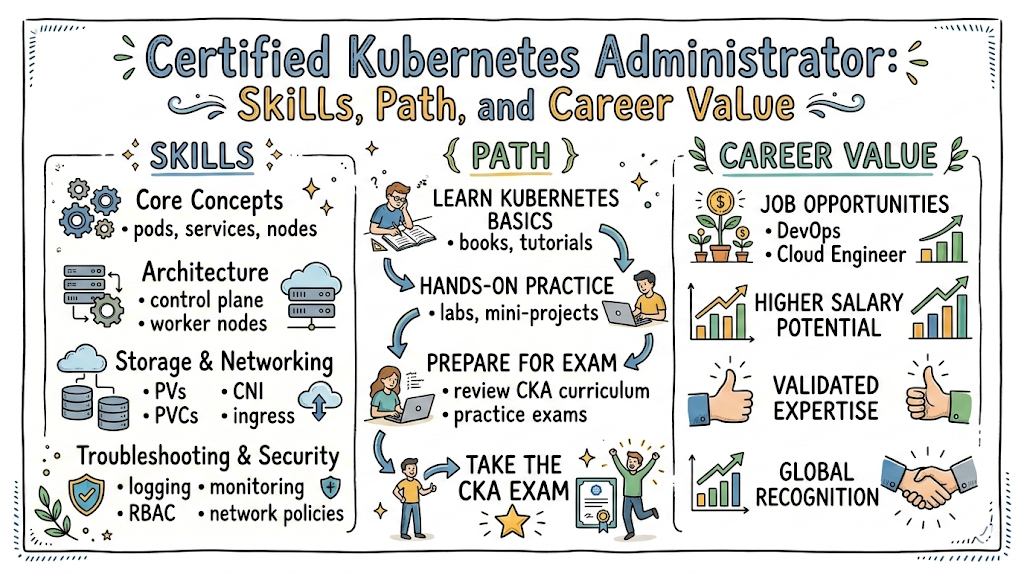
Intorduction
Kubernetes has become one of the most important technologies in modern software delivery. It helps teams deploy, manage, scale, and recover applications in a more reliable and automated way. Because of this, Kubernetes skills are now in demand across DevOps, SRE, cloud, platform, and operations roles. That is exactly why the Certified Kubernetes Administrator (CKA) certification matters. It helps professionals prove that they can work with Kubernetes in real environments, not just talk about it in theory. For working engineers, it can strengthen job readiness. For managers, it offers a clear view of what practical Kubernetes capability looks like. This guide is designed to help you understand the CKA certification in a simple and useful way. It covers what CKA is, who should take it, what skills it builds, how to prepare, what paths it supports, and what you can do after earning it.
Why CKA Matters in Today’s Engineering World
Modern companies want faster releases, more stable systems, better scaling, and easier recovery when things go wrong. Kubernetes supports all of that by giving teams a standard way to run containerized workloads. As cloud-native platforms continue to grow, Kubernetes is no longer optional in many technical environments.
This has created a strong need for people who can actually manage Kubernetes clusters. Many professionals know basic Kubernetes terms, but far fewer can handle real administration work such as scheduling workloads, fixing failures, managing storage, or troubleshooting services under pressure.
The Certified Kubernetes Administrator (CKA) is valuable because it focuses on real operational skill. It helps engineers show they can handle practical Kubernetes work, and it helps employers identify professionals who are ready for serious infrastructure responsibilities.
What Is Certified Kubernetes Administrator (CKA)?
The Certified Kubernetes Administrator (CKA) is a hands-on certification focused on Kubernetes cluster administration. It is designed for professionals who need to install, configure, manage, and troubleshoot Kubernetes environments in practical settings.
This certification is especially respected because it is not only about theory. It tests how well you can perform key administration tasks using real commands, real configuration work, and real problem-solving approaches. That makes it one of the strongest certifications for cloud-native infrastructure professionals.
Certification Overview Table
| Track | Level | Who it’s for | Prerequisites | Skills covered | Recommended order |
|---|---|---|---|---|---|
| Kubernetes Administration | Intermediate to Advanced | DevOps Engineers, SREs, Platform Engineers, Cloud Engineers, System Administrators | Basic Linux, containers, YAML, command-line familiarity, networking basics | Cluster setup, administration, workload scheduling, services, networking, storage, troubleshooting, security basics | Start with CKA if your focus is administration, infrastructure, reliability, or platform operations |
This table gives a quick understanding of where CKA fits. It is not a random beginner certification. It is meant for people who already have some technical foundation and want to build stronger Kubernetes administration capability.
If your work touches deployment platforms, infrastructure operations, cloud-native services, or production support, CKA is often one of the most useful certifications you can add to your profile.
Who Should Take CKA?
The CKA certification is best for professionals who want to work more confidently with Kubernetes in real operational environments. It is especially relevant for people who are already in technical roles and want stronger hands-on credibility.
It is a strong fit for:
- DevOps Engineers
- SREs
- Platform Engineers
- Cloud Engineers
- Infrastructure Engineers
- System Administrators
- Technical Leads
- Engineering Managers who want a better understanding of Kubernetes-focused teams
If you already work with Linux, containers, or cloud infrastructure, CKA can be a very logical next step. It helps you move from basic platform familiarity to practical administration competence.
CKA Certification Deep Dive
What It Is
The Certified Kubernetes Administrator (CKA) is a professional certification that measures your ability to manage Kubernetes clusters in real conditions. It focuses on operational knowledge rather than general theory. That includes cluster components, resource handling, service exposure, troubleshooting, and cluster maintenance.
The certification is useful because it reflects the kind of work that modern infrastructure teams actually do. It is one of the best ways to prove that you understand Kubernetes from an administrator’s point of view.
Who Should Take It
This certification should be taken by professionals who want real Kubernetes operations knowledge. If your role involves cloud platforms, container orchestration, reliability, deployment automation, or platform support, CKA is highly relevant.
It is also a good choice for engineers who want to move into better roles. If you want to grow into platform engineering, SRE, DevOps, or cloud infrastructure work, CKA gives you a practical and respected foundation.
Skills You’ll Gain
The CKA journey helps you build real technical depth. It is not only about passing an exam. It is about learning how Kubernetes behaves and how administrators keep systems working correctly in production-style environments.
Skills you’ll gain:
- Understanding Kubernetes architecture
- Managing control plane and worker node concepts
- Deploying and handling workloads
- Working with pods, deployments, services, and namespaces
- Managing scheduling and resource requests
- Handling storage and persistent volume concepts
- Understanding networking and service communication
- Using
kubectleffectively - Troubleshooting failures and misconfigurations
- Applying security and access control basics
These are skills that directly connect to real engineering work. That is why CKA remains valuable even after the certification itself is complete.
Real-World Projects You Should Be Able to Do After It
A good certification should help you become more useful in practical work, and CKA does that well. After strong preparation, you should be able to support real Kubernetes-based environments with more confidence and less hesitation.
Real-world projects you should be able to do after it:
- Deploy and manage Kubernetes workloads for internal or external applications
- Create namespaces and resource controls for different teams
- Configure services and support application communication
- Troubleshoot pod, node, and scheduling issues
- Manage persistent storage for stateful workloads
- Help support rolling updates and rollbacks
- Assist in maintaining cluster stability
- Support CI/CD-driven Kubernetes deployments
- Investigate performance or operational problems in running clusters
These are the kinds of projects that improve your value in both interviews and actual job responsibilities.
Preparation Plan
A strong preparation plan depends on your current background. Some people already use Kubernetes at work and only need structured revision. Others need more time to build command-line speed, YAML comfort, and troubleshooting confidence.
The most important rule is simple: do not prepare only by reading. CKA requires real practice, so lab work must be part of your plan from the beginning.
7–14 Days
This short plan is best for people who already work with Kubernetes often. In this timeline, the goal is not to learn everything from scratch but to sharpen speed, fix weak areas, and revise core tasks properly.
Focus on workload management, networking basics, storage, troubleshooting, and fast kubectl usage. This plan works only if you already have strong practical exposure.
30 Days
This is the most balanced plan for many working professionals. It gives enough time to cover all major areas, practice labs daily, and still have time to revise difficult topics.
A strong 30-day plan could follow this flow:
- Week 1: architecture, pods, deployments, namespaces, YAML
- Week 2: services, scheduling, config, networking
- Week 3: storage, troubleshooting, security basics
- Week 4: mock labs, revision, speed improvement, weak-area recovery
60 Days
This is the safest option for professionals who are new to Kubernetes administration. It gives you time to first understand the basics and then move into deeper hands-on preparation.
In the first phase, focus on Linux, containers, YAML, and Kubernetes fundamentals. In the second phase, focus on operations, practical administration, troubleshooting, and timed practice. This plan reduces pressure and builds confidence steadily.
Common Mistakes
Many candidates prepare in the wrong way. They read a lot, watch videos, and feel productive, but do not spend enough time on real commands and troubleshooting. That creates a gap between knowledge and performance.
Common mistakes:
- Depending too much on theory
- Not doing enough hands-on lab work
- Ignoring troubleshooting until late
- Weak
kubectlspeed - Weak YAML understanding
- Poor time management
- Not revising networking and storage enough
- Forgetting namespaces and contexts
- Relying only on passive learning
- Avoiding mock practice
Avoiding these mistakes can make preparation much smoother and much more effective.
Best Next Certification After This
After CKA, the next certification depends on your direction. If you want to stay close to Kubernetes operations, the natural next step is usually the application or advanced platform side. If you want a broader profile, you may move into security or cloud architecture.
Three practical directions are:
- Same track: CKAD
- Cross-track: DevSecOps or Kubernetes security path
- Leadership: Cloud architecture or platform leadership path
That way, CKA becomes a foundation instead of a final destination.
Main Knowledge Areas You Should Master
Cluster Architecture and Setup
You need to understand how Kubernetes clusters are structured, what the major components do, and how the control plane supports workload management. This is the base for everything else. Without architecture understanding, troubleshooting becomes much harder.
Workloads and Scheduling
Pods, deployments, jobs, daemon sets, scaling, and resource control are central to Kubernetes administration. A strong administrator must know how workloads are created, updated, scheduled, and managed safely.
Services and Networking
Applications need to communicate correctly, and Kubernetes networking plays a major role in that. You should understand services, internal routing, exposure methods, and the impact of networking issues on application reliability.
Storage
Persistent storage is critical for many real applications. You need to understand persistent volumes, claims, and storage classes so you can support stateful workloads without confusion.
Troubleshooting
This is one of the most important CKA areas. Real-world systems fail in many ways, and a capable administrator must know how to inspect resources, identify the root cause, and apply a practical fix quickly.
Choose Your Path
DevOps Path
For DevOps professionals, CKA strengthens the operations side of application delivery. It helps you understand where your applications run, how they are managed after deployment, and how infrastructure supports reliability and scale.
DevSecOps Path
For DevSecOps professionals, CKA helps build platform understanding before moving into hardening, policies, secrets management, and secure cluster design. You first learn how the environment works, then you learn how to protect it well.
SRE Path
For SRE roles, Kubernetes knowledge is deeply useful because service reliability often depends on cluster health, workload behavior, and fast recovery. CKA supports incident response, troubleshooting, and operational discipline.
AIOps / MLOps Path
AI and ML platforms increasingly depend on scalable container environments. CKA helps you understand the operational side of those systems, which becomes valuable for model deployment, automation, and production support.
DataOps Path
Many data pipelines and data platforms now run on container-based infrastructure. CKA gives DataOps professionals better awareness of how those environments work and how to support reliable execution and scaling.
FinOps Path
FinOps is focused on cost efficiency, and Kubernetes plays a big role in cloud resource usage. While CKA is technical, it helps FinOps professionals understand how workloads consume resources and how operational design affects cloud cost.
Role → Recommended Certifications Mapping
| Role | Recommended certifications |
|---|---|
| DevOps Engineer | CKA first, then CKAD, then cloud and automation certifications |
| SRE | CKA first, then reliability, observability, and incident-focused certifications |
| Platform Engineer | CKA first, then advanced Kubernetes, platform, and security certifications |
| Cloud Engineer | CKA plus cloud administration and architecture certifications |
| Security Engineer | CKA plus DevSecOps and Kubernetes security certifications |
| Data Engineer | CKA plus DataOps and containerized data platform certifications |
| FinOps Practitioner | Kubernetes foundations plus FinOps and cloud cost optimization certifications |
| Engineering Manager | CKA awareness plus platform leadership and cloud strategy certifications |
This mapping helps professionals choose direction based on their role. Not everyone needs the same next step, but many roles benefit from Kubernetes understanding in some form.
For highly technical roles, CKA often works as a strong starting point. For broader management or business-aligned roles, it may serve as platform awareness that improves decision-making.
Next Certifications to Take
| Option | Type | Why it makes sense |
|---|---|---|
| CKAD | Same track | Helps deepen Kubernetes knowledge from the application deployment side |
| DevSecOps or Kubernetes Security Path | Cross-track | Adds security strength to your platform knowledge |
| Cloud or Platform Leadership Path | Leadership | Useful for architects, leads, and managers growing into wider responsibility |
Career Value of CKA
CKA has strong career value because Kubernetes remains central to modern infrastructure. Employers often trust it as a sign of practical capability, especially when a role includes platform support, cloud-native workloads, or production operations.
For engineers, it can support better interviews, stronger project ownership, and smoother movement into DevOps, SRE, platform, and cloud roles. For managers, it provides a clearer standard for understanding the skills needed in modern technical teams.
The certification itself is not magic, but it becomes powerful when paired with practice and real application. In that sense, CKA is a strong career accelerator for the right professionals.
Top Institutions That Help with Training cum Certifications for CKA
DevOpsSchool DevOpsSchool is highly respected globally for its immersive, real-world curriculum. Their instructors are veteran engineers who focus heavily on production-grade scenarios, ensuring you learn not just to pass the exam, but to actually manage clusters at an enterprise level.
Cotocus Cotocus specializes in high-end corporate training and team upskilling. Their CKA modules are specifically designed to help traditional enterprise IT teams migrate legacy monolithic applications into modern, agile Kubernetes environments safely and efficiently.
Scmgalaxy Scmgalaxy brings a strong community-driven approach to Kubernetes education. Their platform provides extensive, hands-on lab environments and focuses deeply on automation scripts, making it highly effective for engineers who learn best by breaking and fixing things.
BestDevOps BestDevOps focuses strictly on the modern infrastructure stack. Their CKA training is famous for its intensive time-management drills, forcing students to rely on imperative commands and rapid documentation navigation to beat the exam’s strict clock.
devsecopsschool.com While covering all standard CKA requirements, devsecopsschool.com injects a “security-first” mindset into every lesson. This institution is the perfect choice for engineers who plan to immediately pursue the CKS certification right after passing the CKA.
sreschool.com Built by and for Site Reliability Engineers, sreschool.com approaches Kubernetes from a pure uptime and resilience perspective. Their labs focus heavily on cluster disaster recovery, backing up etcd, and debugging critically failed worker nodes.
aiopsschool.com This cutting-edge institution bridges container orchestration with artificial intelligence. Their CKA curriculum highlights how to optimize Kubernetes configurations specifically for heavy data processing, MLOps pipelines, and automated, AI-driven infrastructure scaling.
dataopsschool.com DataOpsSchool teaches Kubernetes with a heavy slant toward data persistence. Students gain mastery over Persistent Volumes, StatefulSets, and storage classes, ensuring they can reliably host databases and big data tools inside containers.
finopsschool.com FinOpsSchool brings a much-needed financial perspective to Kubernetes. Their unique CKA training teaches engineers how to spin up clusters while aggressively implementing resource quotas, limit ranges, and autoscaling to minimize cloud billing waste.
Frequently Asked Questions
1. Is CKA difficult?
Yes, CKA is considered challenging because it is practical and time-based. The pressure usually comes from execution speed and troubleshooting, not from theory alone.
2. How much time do I need to prepare for CKA?
It depends on your background. Experienced professionals may need 7–14 days, many working engineers need around 30 days, and beginners may need 60 days or more.
3. Do I need Linux knowledge before starting?
Yes, basic Linux knowledge is very important. You should be comfortable with command-line work before preparing seriously for CKA.
4. Is CKA good for beginners?
It can work for serious beginners, but complete beginners should first learn Linux, containers, YAML, and Kubernetes basics before starting exam-focused study.
5. What should I learn before CKA?
Start with Linux basics, container fundamentals, YAML, networking concepts, and the purpose of core Kubernetes objects.
6. Is CKA better than CKAD?
They serve different goals. CKA is stronger for administration and operations. CKAD is stronger for application deployment from the developer side.
7. Does CKA help in getting a job?
It can strengthen your profile and improve visibility for relevant roles, especially when combined with projects and hands-on confidence.
8. Is CKA useful for SRE roles?
Yes. Kubernetes administration skills are highly relevant to reliability work, incident handling, and production support.
9. Is CKA useful for managers?
Yes. Even if managers do not take the exam, understanding CKA helps them evaluate team capability more clearly.
10. What are the career outcomes after CKA?
It can support roles such as Kubernetes Administrator, DevOps Engineer, Platform Engineer, Cloud Engineer, SRE, and Infrastructure Engineer.
11. Should I prepare only with notes and videos?
No. Notes and videos help, but real hands-on labs are essential for success.
12. What is the best sequence after CKA?
A practical sequence is CKA first, then CKAD or a security-focused path, then cloud or leadership certifications depending on your goals.
Questions and Answers on Certified Kubernetes Administrator (CKA)
1. Why is CKA respected so much?
Because it reflects real hands-on skill. Employers value certifications that show execution ability, and CKA does that well.
2. Can I pass CKA without practice?
No. Practice is necessary because the certification is focused on real administration tasks.
3. Is CKA suitable for DevOps Engineers?
Yes. It is one of the strongest certifications for DevOps professionals working with cloud-native platforms.
4. Does CKA improve production confidence?
Yes. It helps you become more confident in handling workloads, services, failures, and operational issues.
5. Can cloud engineers benefit from CKA?
Yes. Many cloud-native environments rely on Kubernetes, so CKA adds strong platform value for cloud engineers.
6. What is the hardest part of CKA preparation?
For many candidates, the hardest part is applying knowledge quickly under time pressure.
7. How should I study with a full-time job?
A 30-day structured plan with daily hands-on practice and weekend revision is often the best option.
8. What should I do after passing CKA?
Apply the skills in real projects, strengthen your resume, and choose the next path that fits your role best.
Testimonials
Ravi M.
“CKA made Kubernetes feel much more real to me. Before this, I understood the basics, but after serious preparation I became much more confident in troubleshooting and platform support.”
Sneha P.
“I liked that the learning was practical. It helped me think clearly during interviews and also improved how I handled Kubernetes issues in real team discussions.”
Daniel R.
“If your role touches DevOps, SRE, or cloud operations, CKA is one of the most useful certifications you can pursue. The learning stays valuable because it connects directly to actual work.”
Conclusion
The Certified Kubernetes Administrator (CKA) is one of the strongest certifications for professionals who want practical Kubernetes administration capability. It helps you move beyond surface-level platform understanding and build real confidence in workloads, services, storage, troubleshooting, and cluster operations. That makes it highly relevant for DevOps, SRE, cloud, and platform-focused careers. For working engineers, CKA can improve technical credibility, job readiness, and long-term career direction. For managers, it offers a useful benchmark for understanding platform skill maturity. If Kubernetes is part of your present role or future path, CKA is a smart certification to pursue with seriousness, discipline, and hands-on practice.

The skills roadmap is very well structured and easy to follow. It helps readers understand what they need to learn step by step.