Introduction
AI Claims Denial Prediction tools use artificial intelligence (AI), machine learning (ML), natural language processing (NLP), predictive analytics, and healthcare revenue cycle intelligence to identify claims that have a high probability of being denied before they are submitted to insurance payers. These platforms analyze historical claims data, payer rules, coding patterns, clinical documentation, billing information, and authorization requirements to predict denial risks and recommend corrective actions.
Claim denials are a major challenge for healthcare organizations because they delay reimbursement, increase administrative workload, and create financial pressure on providers. Traditional denial management processes often rely on manual reviews after claims are rejected, making it difficult to prevent recurring issues proactively.
AI-powered denial prediction platforms help revenue cycle teams detect potential problems before submission. They identify missing documentation, incorrect coding, authorization issues, eligibility problems, payer-specific requirements, and other factors that contribute to claim rejection. By providing early risk alerts and actionable recommendations, these solutions help healthcare organizations improve clean claim rates, accelerate payments, and reduce administrative costs.
Modern AI Claims Denial Prediction solutions integrate with Electronic Health Records (EHR), Practice Management Systems (PMS), Revenue Cycle Management (RCM) platforms, clearinghouses, coding systems, and payer networks. They support hospitals, physician groups, specialty clinics, and healthcare billing organizations in creating more efficient and predictive revenue cycle operations.
These tools are designed to assist billing and revenue cycle teams by improving decision-making, automating analysis, and preventing avoidable denials while maintaining human oversight.
Real-world Use Cases
- Pre-submission claim risk scoring
- Denial prevention
- Coding error detection
- Documentation gap identification
- Prior authorization validation
- Payer rule analysis
- Revenue cycle optimization
- Claims workflow automation
- Appeals prioritization
- Financial forecasting
Evaluation Criteria for Buyers
When selecting an AI Claims Denial Prediction platform, consider:
- Prediction accuracy
- Claims data analytics capabilities
- Coding intelligence
- Payer rule knowledge
- EHR and RCM integration
- Real-time claim analysis
- Denial prevention recommendations
- Workflow automation
- Security and compliance
- Reporting capabilities
Best For
- Hospitals
- Health systems
- Revenue cycle departments
- Medical billing organizations
- Physician groups
- Healthcare payers
Not Ideal For
Organizations without digital billing systems, historical claims data, or integrated revenue cycle workflows.
Key Trends
- AI-powered revenue cycle management
- Predictive denial analytics
- Automated coding intelligence
- Generative AI claims assistance
- Intelligent document processing
- Real-time claim validation
- Payer behavior analytics
- Revenue optimization automation
- Healthcare interoperability
- Autonomous revenue cycle workflows
Methodology
The platforms below were evaluated based on:
- AI denial prediction capabilities
- Revenue cycle intelligence
- Claims workflow integration
- Automation maturity
- Payer connectivity
- Scalability
- Enterprise healthcare readiness
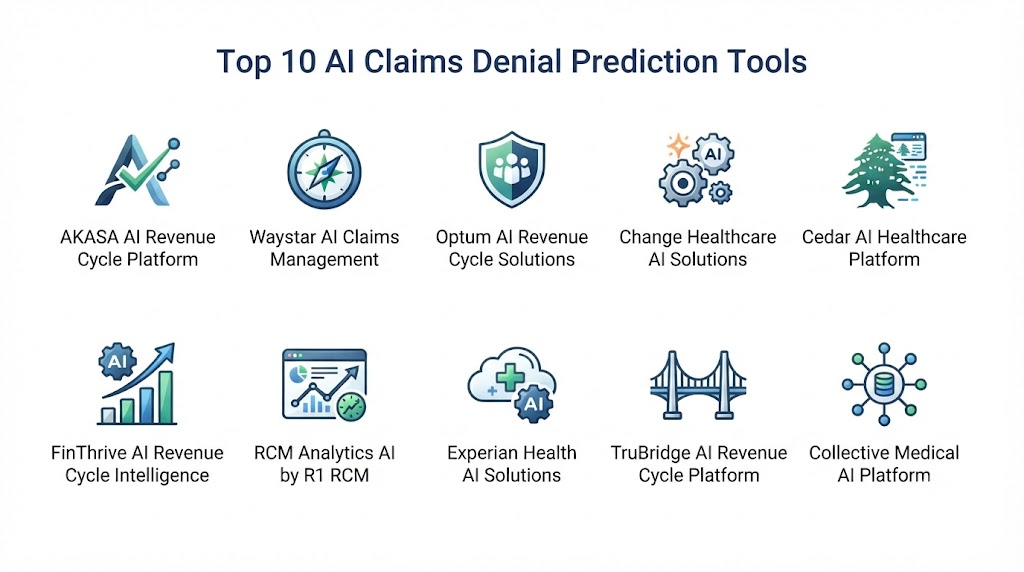
Top 10 AI Claims Denial Prediction Tools
1. AKASA AI Revenue Cycle Platform
Verdict: Best overall AI platform for healthcare claims automation and denial prevention.
Short Description: AKASA uses artificial intelligence and automation to improve healthcare revenue cycle operations, including claims analysis, coding support, documentation review, and denial prevention workflows.
Key Features
- AI claims analysis
- Denial risk identification
- Revenue cycle automation
- Documentation intelligence
- Workflow optimization
- Healthcare data processing
Pros
- Strong AI-first healthcare automation
- Reduces administrative workload
- Supports complex revenue workflows
Cons
- Enterprise implementation required
Deployment: Cloud-based
Security & Compliance: Healthcare-grade security controls
Integrations & Ecosystem: EHR, RCM platforms, healthcare workflows
Support & Community: Enterprise healthcare support
Pricing Model: Custom enterprise pricing
Best-Fit Scenarios: Large healthcare organizations
2. Waystar
Verdict: Enterprise revenue cycle platform with AI-powered denial prevention capabilities.
Short Description: Waystar provides healthcare revenue cycle technology that helps organizations manage claims processing, eligibility, payment workflows, and denial prevention through analytics and automation.
Key Features
- Claims analytics
- Denial management
- Revenue cycle automation
- Payer connectivity
- Payment intelligence
Pros
- Strong healthcare RCM expertise
- Broad payer connections
Cons
- Enterprise-focused deployment
3. Change Healthcare Intelligent Healthcare Solutions
Verdict: AI-enabled claims intelligence platform for healthcare revenue operations.
Short Description: Change Healthcare provides healthcare payment and claims technology that helps organizations analyze claims workflows, improve billing accuracy, and reduce administrative inefficiencies.
Key Features
- Claims analytics
- Payment intelligence
- Revenue cycle insights
- Payer connectivity
- Healthcare data exchange
Pros
- Large healthcare ecosystem
- Strong claims infrastructure
Cons
- Complex enterprise environment
4. Experian Health
Verdict: Healthcare data intelligence platform supporting denial prevention and claims optimization.
Short Description: Experian Health provides healthcare revenue cycle solutions that use data analytics, automation, and workflow intelligence to improve claims accuracy and reduce avoidable denials.
Key Features
- Claims analytics
- Eligibility verification
- Revenue cycle intelligence
- Patient access optimization
- Data insights
Pros
- Strong healthcare data capabilities
- Enterprise scalability
Cons
- Broad healthcare platform
5. Optum Revenue Cycle AI Solutions
Verdict: AI-powered healthcare financial intelligence platform.
Short Description: Optum provides healthcare technology solutions that support claims management, revenue cycle optimization, payment analytics, and denial reduction strategies.
Key Features
- Claims analytics
- Denial insights
- Coding intelligence
- Healthcare financial analytics
- Workflow support
Pros
- Strong healthcare expertise
- Large enterprise ecosystem
Cons
- Complex implementation
6. Olive AI Healthcare Automation
Verdict: AI automation platform for reducing healthcare administrative inefficiencies.
Short Description: Olive AI uses automation and artificial intelligence to improve healthcare operational workflows, including claims processing, administrative tasks, and revenue cycle activities.
Key Features
- Workflow automation
- Claims processing support
- Data extraction
- Administrative intelligence
- Process automation
Pros
- Strong automation capabilities
- Reduces repetitive work
Cons
- Capabilities depend on deployment scope
7. Inovalon ONE
Verdict: Healthcare data analytics platform supporting claims accuracy and financial performance.
Short Description: Inovalon ONE uses healthcare data analytics and AI capabilities to improve claims quality, compliance, documentation accuracy, and revenue cycle outcomes.
Key Features
- Claims analytics
- Healthcare data intelligence
- Documentation analysis
- Compliance insights
- Performance analytics
Pros
- Strong healthcare analytics
- Data-driven approach
Cons
- Enterprise-focused solution
8. Candid Health
Verdict: Modern AI-enabled healthcare billing platform focused on automated revenue workflows.
Short Description: Candid Health provides automated healthcare billing infrastructure designed to simplify claims workflows, reduce administrative complexity, and improve revenue cycle efficiency.
Key Features
- Automated billing workflows
- Claims processing
- Revenue cycle automation
- Data validation
- Workflow management
Pros
- Modern automation approach
- Reduces manual processes
Cons
- Newer platform compared with legacy providers
9. R1 RCM AI Solutions
Verdict: AI-supported revenue cycle management platform for healthcare organizations.
Short Description: R1 RCM combines healthcare operations expertise, analytics, and automation technologies to help organizations improve billing workflows, claims performance, and denial management.
Key Features
- Revenue cycle analytics
- Claims optimization
- Denial management
- Workflow automation
- Healthcare operations support
Pros
- Strong operational expertise
- Enterprise healthcare focus
Cons
- Primarily designed for large organizations
10. OpenAI-Based Custom Claims Denial Prediction Assistant
Verdict: Flexible AI solution for customized denial prevention workflows.
Short Description: Healthcare organizations can build custom AI claims denial prediction assistants using large language models integrated with claims databases, coding systems, payer policies, EHR platforms, and revenue cycle applications. These systems can analyze claim documentation, summarize denial risks, identify missing information, and support corrective actions while requiring compliance controls and human review.
Key Features
- Claim risk summaries
- Documentation analysis
- Coding assistance
- Denial explanation
- Workflow automation
Pros
- Highly customizable
- Flexible integrations
- Organization-specific workflows
Cons
- Requires healthcare AI expertise
- Compliance governance required
Comparison Table
| Platform | AI Denial Prediction | Claims Analytics | Healthcare Integration | Automation | Best Use |
|---|---|---|---|---|---|
| AKASA | Excellent | Excellent | Excellent | Excellent | AI Revenue Cycle |
| Waystar | Excellent | Excellent | Excellent | High | Claims Management |
| Change Healthcare | High | Excellent | Excellent | High | Healthcare Payments |
| Experian Health | High | Excellent | Excellent | High | Revenue Intelligence |
| Optum RCM | High | Excellent | Excellent | High | Enterprise Healthcare |
| Olive AI | Excellent | High | High | Excellent | Workflow Automation |
| Inovalon ONE | High | Excellent | High | High | Healthcare Analytics |
| Candid Health | High | High | High | High | Modern Billing |
| R1 RCM | High | High | High | High | Revenue Operations |
| OpenAI Custom | Custom | Custom | Custom | Custom | Custom AI Claims |
Evaluation & Scoring Table
| Platform | AI Features 20% | Prediction Accuracy 20% | Integration 15% | Automation 15% | Security 10% | Ease 10% | Value 10% | Total |
|---|---|---|---|---|---|---|---|---|
| AKASA | 20 | 20 | 15 | 15 | 10 | 8 | 8 | 96 |
| Waystar | 19 | 19 | 15 | 14 | 10 | 8 | 8 | 93 |
| Experian Health | 18 | 19 | 15 | 14 | 10 | 8 | 8 | 92 |
| Change Healthcare | 18 | 18 | 15 | 14 | 10 | 8 | 8 | 91 |
| Optum RCM | 18 | 18 | 15 | 13 | 10 | 8 | 8 | 90 |
| Olive AI | 19 | 18 | 13 | 15 | 10 | 8 | 8 | 91 |
| Inovalon ONE | 18 | 18 | 14 | 13 | 10 | 8 | 8 | 89 |
| R1 RCM | 17 | 18 | 14 | 13 | 10 | 8 | 8 | 88 |
| Candid Health | 17 | 17 | 13 | 14 | 10 | 9 | 8 | 88 |
| OpenAI Custom | 20 | 16 | 12 | 15 | 8 | 7 | 9 | 87 |
Which AI Claims Denial Prediction Tool Is Right for You?
| If your priority is… | Recommended Platform |
|---|---|
| AI-powered denial prevention | AKASA |
| Healthcare revenue cycle management | Waystar |
| Claims intelligence | Change Healthcare |
| Healthcare data analytics | Experian Health |
| Enterprise financial operations | Optum |
| Administrative automation | Olive AI |
| Healthcare analytics | Inovalon ONE |
| Modern billing automation | Candid Health |
| Revenue operations management | R1 RCM |
| Custom AI denial prediction | OpenAI-Based Claims Assistant |
Implementation Playbook
First 30 Days
- Analyze current denial patterns
- Identify major denial categories
- Review claims data sources
- Define prediction goals
Days 31–60
- Integrate claims and billing systems
- Deploy AI risk scoring
- Configure denial alerts
- Train revenue cycle teams
Days 61–90
- Expand automated workflows
- Monitor denial reduction
- Improve claim accuracy
- Optimize revenue processes
Common Mistakes
- Using incomplete claims data
- Ignoring payer-specific rules
- Automating without validation
- Poor workflow integration
- Lack of coding accuracy checks
- Not monitoring AI predictions
- Ignoring compliance requirements
- Treating AI predictions as final decisions
Frequently Asked Questions
1. What are AI Claims Denial Prediction tools?
They are AI-powered platforms that predict which healthcare claims are likely to be denied before submission.
2. How does AI predict claim denials?
AI analyzes historical claims, payer rules, documentation, coding patterns, and authorization information.
3. Can AI prevent claim denials?
Yes. AI helps identify risks early and recommends corrective actions before claims are submitted.
4. Do these tools integrate with EHR and billing systems?
Many enterprise platforms integrate with healthcare records, billing systems, and revenue cycle platforms.
5. Who uses AI denial prediction tools?
Hospitals, billing teams, healthcare providers, and revenue cycle organizations.
6. What causes healthcare claim denials?
Common causes include coding errors, missing documentation, eligibility issues, and authorization problems.
7. Can AI replace revenue cycle teams?
No. AI supports teams by improving efficiency and providing predictive insights.
8. Are AI claims prediction systems accurate?
Accuracy depends on data quality, payer information, model performance, and workflow implementation.
9. Are these platforms secure?
Healthcare organizations should evaluate privacy controls, security practices, and compliance requirements.
10. What should buyers consider before selecting a platform?
Evaluate AI accuracy, integration, payer coverage, automation capabilities, scalability, and security.
Conclusion
AI Claims Denial Prediction tools are transforming healthcare revenue cycle management by helping organizations identify claim risks before submission and reduce avoidable denials. By combining artificial intelligence, predictive analytics, healthcare data intelligence, and automation, these platforms enable providers to improve billing accuracy, accelerate reimbursement, and reduce administrative burden.Healthcare organizations should choose solutions based on claims intelligence, payer connectivity, workflow integration, security requirements, and operational goals. Platforms such as AKASA, Waystar, Experian Health, Optum, and healthcare AI automation solutions demonstrate how artificial intelligence can create more proactive, efficient, and financially sustainable revenue cycle operations.
