Introduction
AI Molecular Generation Tools use artificial intelligence (AI), machine learning (ML), deep learning, generative models, and computational chemistry techniques to design and generate new molecular structures for drug discovery and life science research. These platforms analyze chemical properties, biological targets, molecular interactions, and existing scientific data to create novel compounds with desired characteristics.
Traditional molecule discovery relies heavily on experimental screening, chemical synthesis, and iterative optimization, which can require significant time and resources. AI-powered molecular generation platforms accelerate this process by generating new molecular candidates, predicting chemical properties, optimizing structures, and helping researchers prioritize promising compounds.
Modern AI molecular generation solutions use technologies such as generative adversarial networks (GANs), reinforcement learning, graph neural networks (GNNs), transformer-based models, and large-scale chemical databases. They support pharmaceutical companies, biotechnology organizations, academic researchers, and computational chemistry teams in early-stage drug discovery.
These platforms integrate with molecular simulation tools, chemical databases, laboratory automation systems, and drug discovery pipelines. AI Molecular Generation Tools are designed to assist scientists by improving compound design efficiency while requiring experimental validation, safety testing, and regulatory review.
Real-world Use Cases
- Novel molecule generation
- Drug candidate design
- Lead optimization
- Virtual screening
- Chemical property prediction
- Molecular optimization
- Structure-based drug discovery
- Rare disease research
- Precision medicine research
- Pharmaceutical innovation
Evaluation Criteria for Buyers
When selecting an AI Molecular Generation Tool, consider:
- Generative AI capabilities
- Chemical structure accuracy
- Molecular property prediction
- Integration with simulation tools
- Chemical database support
- Research workflow compatibility
- Computational performance
- Scalability
- Collaboration features
- Security controls
Best For
- Pharmaceutical companies
- Biotechnology companies
- Computational chemistry teams
- Academic research groups
- Drug discovery organizations
Not Ideal For
Organizations expecting AI-generated molecules to directly become approved medicines without laboratory testing and scientific validation.
Key Trends
- Generative AI for drug discovery
- Foundation models for chemistry
- AI-powered molecular design
- Automated compound optimization
- Digital chemistry platforms
- AI-driven precision medicine
- Hybrid AI and physics-based modeling
- Laboratory automation integration
- Cloud-based computational chemistry
- Personalized therapeutics research
Methodology
The platforms below were evaluated based on:
- AI molecular generation capabilities
- Chemical intelligence
- Drug discovery workflow support
- Integration capabilities
- Research scalability
- Industry adoption
1. NVIDIA BioNeMo
Verdict: Best overall AI molecular generation platform for advanced biological and chemical research.
Short Description: NVIDIA BioNeMo provides AI models and computational tools for generating, analyzing, and optimizing biological molecules and chemical structures for drug discovery workflows.
Key Features
- Generative chemistry models
- Molecular design
- Protein and molecule analysis
- AI foundation models
- Drug discovery workflows
Pros
- Advanced AI infrastructure
- Strong computational performance
- Supports large-scale research
Cons
- Requires AI and computational expertise
Deployment: Cloud and enterprise environments
Security & Compliance: Enterprise research data controls
Integrations & Ecosystem: Scientific computing platforms, chemistry workflows, research pipelines
Support & Community: Enterprise technical support
Pricing Model: Enterprise and usage-based pricing
Best-Fit Scenarios: Pharmaceutical research organizations
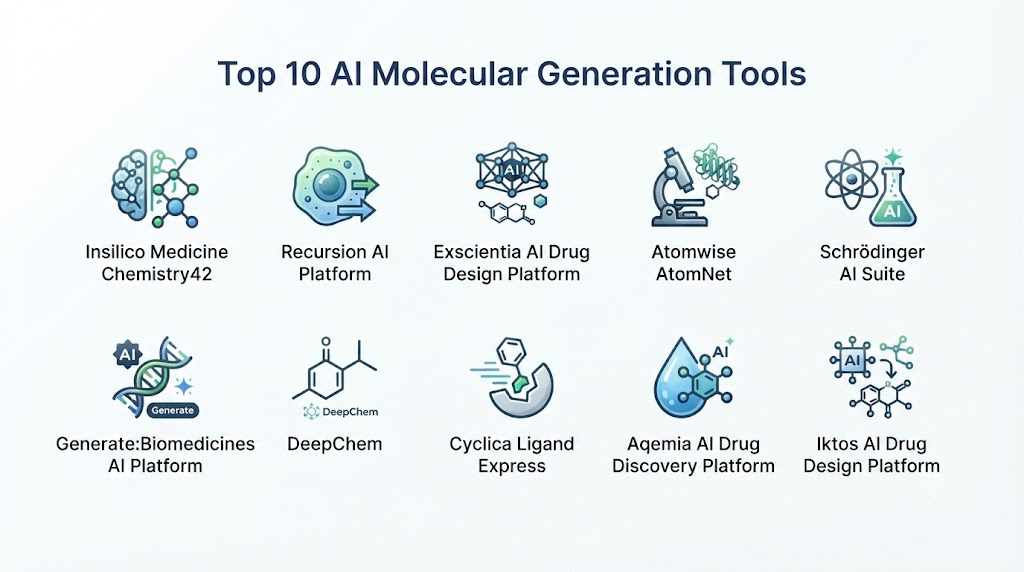
2. Insilico Medicine Chemistry42
Verdict: AI-powered generative chemistry platform for drug discovery.
Short Description: Chemistry42 from Insilico Medicine uses generative AI to design novel molecular structures and optimize compounds based on desired therapeutic properties.
Key Features
- AI molecule generation
- Compound optimization
- Target-based design
- Property prediction
- Drug discovery workflows
Pros
- Strong AI-native discovery platform
- End-to-end capabilities
Cons
- Designed mainly for professional research teams
3. Atomwise
Verdict: AI platform supporting molecular discovery and compound optimization.
Short Description: Atomwise uses deep learning models to analyze molecular interactions and generate or prioritize promising drug candidates.
Key Features
- AI molecular screening
- Compound analysis
- Structure prediction
- Drug discovery support
- Molecular optimization
Pros
- Strong AI chemistry capabilities
- Faster compound evaluation
Cons
- Requires scientific expertise
4. Schrödinger AI Platform
Verdict: Computational chemistry platform combining AI and molecular simulation.
Short Description: Schrödinger integrates machine learning with physics-based simulations to design and optimize molecules for pharmaceutical research.
Key Features
- Molecular modeling
- AI optimization
- Chemical simulation
- Structure analysis
- Drug design workflows
Pros
- Strong scientific foundation
- Advanced simulation capabilities
Cons
- Requires specialized knowledge
5. Recursion AI Platform
Verdict: AI-powered biotechnology platform combining biological experimentation and computational discovery.
Short Description: Recursion uses AI, automation, and biological data analysis to discover and optimize therapeutic candidates.
Key Features
- AI compound discovery
- Automated experimentation
- Biological modeling
- Molecular analysis
- Drug research workflows
Pros
- Combines AI with laboratory data
- Strong biotechnology approach
Cons
- Enterprise research focus
6. DeepChem
Verdict: Open-source AI framework for molecular machine learning research.
Short Description: DeepChem provides machine learning tools and libraries for researchers working on molecular modeling, chemical prediction, and drug discovery applications.
Key Features
- Molecular machine learning
- Chemical datasets
- AI modeling tools
- Research experimentation
- Open-source framework
Pros
- Flexible research platform
- Strong developer community
Cons
- Requires technical expertise
7. IBM RXN for Chemistry
Verdict: AI chemistry platform supporting reaction prediction and molecular research.
Short Description: IBM RXN uses AI models to predict chemical reactions and support researchers in designing and understanding chemical transformations.
Key Features
- Reaction prediction
- Chemical modeling
- AI-assisted synthesis
- Research workflows
- Molecular analysis
Pros
- Strong chemistry AI capabilities
- Research-friendly platform
Cons
- More chemistry-focused than complete drug discovery
8. Generate Biomedicines
Verdict: AI biotechnology platform focused on generative biology and therapeutic design.
Short Description: Generate Biomedicines uses machine learning and generative models to design novel biological therapeutics and explore new treatment possibilities.
Key Features
- Generative biology
- Protein design
- AI therapeutic discovery
- Biological modeling
- Research analytics
Pros
- Advanced generative biology
- Strong innovation focus
Cons
- Specialized biotechnology use cases
9. Google DeepMind AlphaFold + AI Biology Models
Verdict: AI-powered biological modeling platform supporting molecule and protein research.
Short Description: Deep learning models from Google DeepMind help researchers understand protein structures and biological relationships that support molecular design workflows.
Key Features
- Protein structure prediction
- Biological modeling
- Molecular insights
- Research support
- AI-based analysis
Pros
- Major scientific contribution
- Strong biological understanding
Cons
- Requires integration with other discovery tools
10. OpenAI-Based Custom AI Molecular Generation Assistant
Verdict: Flexible AI assistant for customized molecular design workflows.
Short Description: Research organizations can build custom AI molecular generation assistants using large language models integrated with chemical databases, molecular simulation platforms, biological datasets, and computational chemistry workflows. These assistants can support molecule ideation, literature analysis, property explanation, and research collaboration while requiring scientific validation.
Key Features
- Molecular research assistance
- Chemical literature analysis
- Compound summaries
- Research workflow support
- AI-generated insights
Pros
- Highly customizable
- Flexible integrations
- Supports scientist productivity
Cons
- Requires domain expertise
- Experimental validation required
Comparison Table
| Platform | AI Generation | Chemical Intelligence | Research Integration | Scalability | Best Use |
|---|---|---|---|---|---|
| NVIDIA BioNeMo | Excellent | Excellent | Excellent | Excellent | AI Drug Discovery |
| Insilico Chemistry42 | Excellent | Excellent | Excellent | High | Molecule Design |
| Atomwise | Excellent | High | High | High | Compound Discovery |
| Schrödinger | High | Excellent | Excellent | High | Computational Chemistry |
| Recursion | Excellent | Excellent | High | High | AI Biology |
| DeepChem | High | High | Medium | High | Research Development |
| IBM RXN | High | Excellent | Medium | High | Chemical Research |
| Generate Biomedicines | Excellent | Excellent | High | High | Generative Biology |
| AlphaFold Models | High | Excellent | Medium | High | Protein Research |
| OpenAI Custom | Custom | Custom | Custom | Custom | Custom AI Research |
Evaluation & Scoring Table
| Platform | AI Capability 20% | Molecule Quality 20% | Chemistry Data 15% | Research Workflow 15% | Security 10% | Ease 10% | Value 10% | Total |
|---|---|---|---|---|---|---|---|---|
| NVIDIA BioNeMo | 20 | 20 | 15 | 15 | 10 | 8 | 8 | 96 |
| Insilico Chemistry42 | 20 | 20 | 15 | 14 | 10 | 8 | 8 | 95 |
| Schrödinger | 19 | 19 | 15 | 14 | 10 | 8 | 8 | 93 |
| Atomwise | 19 | 18 | 14 | 14 | 10 | 8 | 8 | 91 |
| Recursion | 19 | 18 | 14 | 14 | 10 | 8 | 8 | 91 |
| Generate Biomedicines | 19 | 19 | 13 | 14 | 10 | 8 | 8 | 91 |
| IBM RXN | 18 | 18 | 14 | 13 | 10 | 9 | 8 | 90 |
| AlphaFold Models | 18 | 18 | 13 | 13 | 10 | 9 | 8 | 89 |
| DeepChem | 17 | 17 | 13 | 13 | 10 | 8 | 9 | 87 |
| OpenAI Custom | 20 | 16 | 12 | 15 | 8 | 7 | 9 | 87 |
Which AI Molecular Generation Tool Is Right for You?
| If your priority is… | Recommended Platform |
|---|---|
| Advanced AI chemistry models | NVIDIA BioNeMo |
| End-to-end AI molecule design | Insilico Chemistry42 |
| AI compound discovery | Atomwise |
| Molecular simulation | Schrödinger |
| AI biotechnology research | Recursion |
| Open-source molecular AI research | DeepChem |
| Chemical reaction prediction | IBM RXN |
| Generative biology | Generate Biomedicines |
| Protein-based discovery | AlphaFold Models |
| Custom AI molecular assistant | OpenAI-Based AI Assistant |
Implementation Playbook
First 30 Days
- Define molecule generation objectives
- Identify chemical datasets
- Review research workflows
- Select AI discovery requirements
Days 31–60
- Connect chemical databases
- Configure AI models
- Train research teams
- Validate generated molecules
Days 61–90
- Expand molecular workflows
- Integrate simulation tools
- Improve candidate prioritization
- Establish experimental validation processes
Common Mistakes
- Treating AI-generated molecules as final candidates
- Ignoring laboratory validation
- Using poor-quality chemical data
- Lack of chemistry expertise
- Ignoring safety considerations
- Poor integration with research workflows
- Overlooking regulatory requirements
- Not validating molecular properties
Frequently Asked Questions
1. What are AI Molecular Generation Tools?
They are AI-powered platforms that create and optimize new molecular structures for research and drug discovery.
2. How does AI generate molecules?
AI models learn patterns from chemical datasets and generate new structures with desired properties.
3. Can AI-generated molecules become medicines directly?
No. Generated molecules require laboratory testing, safety evaluation, and clinical validation.
4. Who uses AI molecular generation platforms?
Pharmaceutical companies, biotechnology organizations, researchers, and computational chemistry teams.
5. What data do these platforms use?
They use chemical structures, molecular properties, biological information, and scientific datasets.
6. Can AI optimize existing molecules?
Yes. Many platforms help improve molecular properties such as activity, stability, and selectivity.
7. Does AI replace chemists?
No. AI supports researchers by accelerating design and analysis processes.
8. Are AI-generated molecules reliable?
Reliability depends on model quality, data, computational methods, and experimental validation.
9. What security concerns exist in molecular AI platforms?
Organizations should protect proprietary research data and intellectual property.
10. What should organizations evaluate before adoption?
Consider AI capabilities, chemical accuracy, integrations, scalability, security, and research validation workflows.
Conclusion
AI Molecular Generation Tools are transforming chemical and pharmaceutical research by enabling faster creation, optimization, and analysis of potential therapeutic compounds. By combining generative AI, computational chemistry, and biological intelligence, these platforms help researchers explore larger chemical spaces and accelerate early-stage drug discoveryOrganizations adopting AI molecular generation solutions should focus on scientific validation, data quality, computational capabilities, and integration with research workflows. Platforms such as NVIDIA BioNeMo, Insilico Chemistry42, Atomwise, Schrödinger, and Recursion demonstrate how artificial intelligence is becoming a powerful technology for advancing modern drug discovery and biotechnology innovation.
