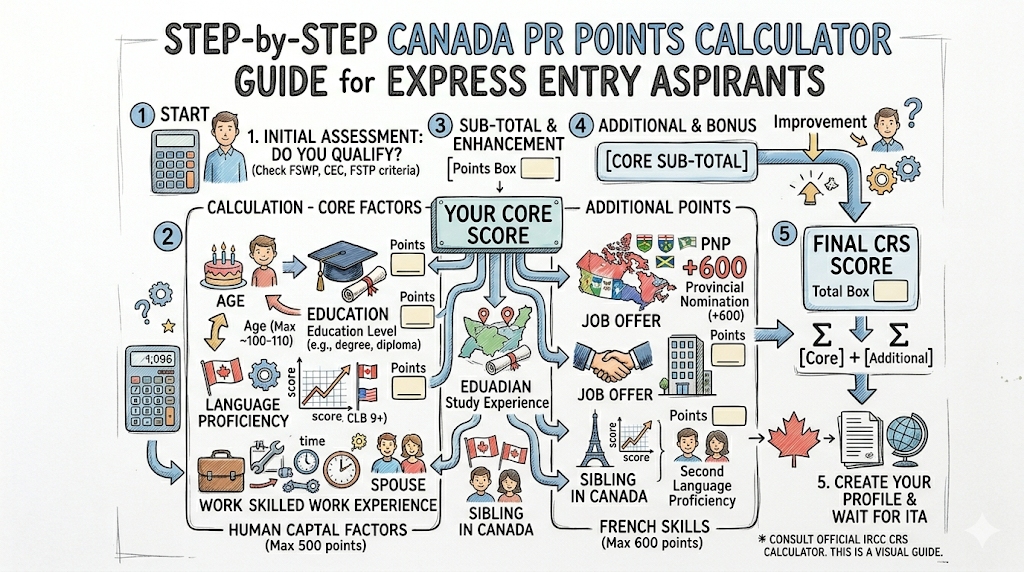
The immigration process relies entirely on a merit-based selection model. This is where a Canada PR Points Calculator becomes your ultimate roadmap to success. Navigating the system can feel overwhelming for a first-time applicant. Between understanding language benchmarks, processing educational credentials, and evaluating work experience, the details quickly get complicated. This comprehensive, beginner-friendly guide breaks down exactly how the Canadian immigration points system works and how you can maximize your score to secure your Permanent Residency (PR). For more detailed guides and self-assessment resources, check out the Desinri Canada PR Points Calculator to evaluate your profile instantly.
What Is Canada PR Points Calculator?
A Canada PR Points Calculator is an automated digital tool designed to help immigration aspirants estimate their Comprehensive Ranking System (CRS) score. The Canadian government uses this merit-based ranking tool to assess and rank candidates who have registered their profiles in the Express Entry pool.
The primary purpose of the calculator is to provide instant clarity. Instead of guessing where you stand, you input your personal metrics—such as age, language test results, and education—to see your projected score. This helps you determine whether you meet current draw cut-offs or if you need to take strategic steps to improve your profile.
Why Canada Uses the CRS System
Canada utilizes a data-driven points system to ensure that arriving immigrants can successfully integrate into the local economy. By prioritizing highly educated, young, and multi-lingual professionals, the country fills critical labor shortages while maintaining a high standard of economic productivity.
Eligibility Score vs. CRS Invitation Score
Many beginners confuse the initial eligibility score with the CRS invitation score. These are two completely distinct tracking systems:
- The 67-Point Threshold: To qualify for the Federal Skilled Worker Program, you must first score at least 67 out of 100 points on a separate eligibility grid. This assessment considers six basic factors to determine if you are even eligible to enter the Express Entry pool.
- The CRS Score (Out of 1200): Once you cross that initial barrier and enter the pool, you are issued a CRS score out of 1,200 points. This score determines your active rank in the pool and dictates whether you will receive an official Invitation to Apply (ITA) during regular immigration draws.
For example, if a candidate earns an exceptional IELTS score and completes an advanced degree, their initial eligibility points will easily clear the 67-point hurdle, while their CRS score will climb high enough to secure a direct invitation during the next draw.
How Canada PR Points System Works
The Comprehensive Ranking System breaks your profile down into specific, quantifiable categories. Understanding these components allows you to see exactly where your points accumulate.
Age Points
Canada awards the highest points to candidates in their prime working years. Points peak between the ages of 20 and 29, after which the points gradually decline each year.
| Age Bracket | Points With a Spouse | Points Without a Spouse |
| 18 years of age | 90 | 95 |
| 19 years of age | 95 | 100 |
| 20 to 29 years of age | 100 | 110 |
| 30 years of age | 95 | 105 |
| 35 years of age | 70 | 75 |
| 40 years of age | 45 | 50 |
| 45 years of age or older | 0 | 0 |
Education Points
Higher educational qualifications yield significantly better point values. To claim points for studies completed outside of Canada, you must obtain an Educational Credential Assessment (ECA) from an approved body like WES.
- Doctoral Level (Ph.D.): 140 points (with spouse) / 150 points (without spouse)
- Master’s Degree: 126 points (with spouse) / 135 points (without spouse)
- Two or more post-secondary credentials: 119 points (with spouse) / 128 points (without spouse)
- Bachelor’s Degree (Three or more years): 112 points (with spouse) / 120 points (without spouse)
Language Proficiency (IELTS / CELPIP / PTE)
Language testing is arguably the most vital variable in the points system. Canada maps your test scores to a standardized system called the Canadian Language Benchmark (CLB). Reaching CLB 9 across all modules triggers a substantial point boost.
- CLB 9 or Higher: Complete mastery that unlocks maximum base points and activates skill transferability multipliers.
- CLB 8: Strong foundational skills, but results in a noticeably lower CRS distribution.
- CLB 7: The baseline minimum for many programs, leaving your profile highly reliant on other factors.
Work Experience
Your professional experience is split into two distinct categories: Canadian work experience and foreign work experience. Foreign work experience provides solid foundational points, but combining it with high language scores creates an interconnected multiplier effect.
- 1 Year of Foreign Experience: Provides basic entry eligibility.
- 3+ Years of Foreign Experience: Caps out your maximum allowable foreign experience allocation under skill transferability factors.
- Canadian Experience: Highly valued. Just one year of working within Canada significantly boosts your total points.
Spouse Points and Additional Enhancements
If you apply alongside a spouse or common-law partner, a small portion of your core points shifts to their profile. A spouse can contribute up to 40 points through their own language skills, education, and Canadian work experience.
Furthermore, you can earn up to 600 additional points through a Provincial Nomination (PNP), 15 to 30 points for having a sibling residing in Canada, or 50 to 200 points for holding a valid, LMIA-approved Canadian job offer.
Canada Express Entry System Explained
Express Entry is not an immigration program itself; rather, it is an electronic management system used by Immigration, Refugees and Citizenship Canada (IRCC) to handle applications for three major federal economic immigration programs.
1. Federal Skilled Worker Program (FSWP)
This stream caters directly to international skilled workers who possess relevant education and professional experience abroad. It requires candidates to clear the initial 67-point threshold before entering the main Express Entry pool.
2. Canadian Experience Class (CEC)
Designed specifically for individuals who already possess at least one year of skilled full-time work experience inside Canada. This pathway is heavily favored by former international students and temporary foreign workers currently residing in the country.
3. Federal Skilled Trades Program (FSTP)
A dedicated pathway for qualified economic immigrants who excel in specific industrial, construction, manufacturing, and technical trades. This stream places a heavy emphasis on practical certifications and valid job offers over advanced formal degrees.
4. Provincial Nominee Program (PNP) Integration
Most Canadian provinces run their own localized immigration streams aligned with the federal Express Entry framework. When a province selects your profile from the pool, they issue an enhanced nomination that automatically adds 600 points to your profile, guaranteeing an invitation to apply during the subsequent draw.
CRS Score Breakdown
The total allocation of 1,200 points within the Comprehensive Ranking System is divided into precise sub-components.
| Core Factor Category | Maximum Points (With Spouse) | Maximum Points (Without Spouse) |
| Core Human Capital Factors (Age, Education, Languages) | 460 | 500 |
| Spouse / Partner Factors (Education, Languages) | 40 | 0 |
| Skill Transferability (Combinations of languages/degrees) | 50 | 50 |
| Additional Dedicated Factors (PNPs, Job Offers, Siblings) | 600 | 600 |
| Maximum Ultimate Combined Limit | 1,200 | 1,200 |
Core Human Capital Factors
These points evaluate your individual background. A young single applicant with a Master’s degree and flawless language scores can maximize this category up to the full 500-point ceiling.
Skill Transferability Factors
This category functions like an internal multiplier system. The immigration framework rewards candidates whose combined traits indicate higher long-term career success. For example, pairing a high language score (CLB 9) with three years of foreign work experience unlocks an extra 50 bonus points, independent of your baseline score components.
Step-by-Step Example Calculation
To clarify how the points build up, let us examine a realistic scenario featuring a typical applicant.
Profile Snapshot
- Candidate Profile: Single, 29-year-old software engineer
- Education Level: Master’s degree (ECA verified)
- Language Metrics: IELTS results indicating CLB 9 in all core areas
- Work Experience: 3 years of continuous professional foreign experience
Point-by-Point Breakdown
- Age Factor: 110 Points (Maximum point allocation reached)
- Education Factor: 135 Points (For a completed Master’s degree)
- Language Skills: 124 Points (Calculated for achieving CLB 9 across all test modules)
- Foreign Work Experience: 0 Points (Foreign experience does not grant base points directly; it maps to transferability)
- Skill Transferability (Education + Language): 50 Points
- Skill Transferability (Experience + Language): 50 Points
- Additional Specific Factors: 0 Points (No provincial nomination or job offer)
Total Estimated CRS Score: 469 Points
This score positions the candidate strongly in the active pool, leaving them well-prepared for standard draws or category-specific rounds focusing on STEM professionals.
How to Improve CRS Score
If your initial calculation falls short of recent draw cut-offs, there are several practical ways to systematically raise your profile score.
1. Maximize Language Test Scores
Retaking your language tests is often the fastest way to boost your score. Moving from a CLB 8 to a CLB 9 across all categories does more than increase your language points—it triggers skill transferability bonuses that can raise your overall score by 30 to 50 points.
2. Learn French (The Ultimate Strategic Advantage)
Canada places immense economic value on bilingual candidates. Demonstrating proficiency in French via the TEF or TCF exams can add up to 50 additional points to your profile. It also makes you eligible for targeted French-language draws, which often feature much lower score cut-offs.
3. Pursue Further Education or Gain More Experience
Completing an additional one-year postgraduate certificate or crossing the threshold from two years to three years of foreign experience adds points to your profile.
Provincial Nominee Programs (PNPs)
When a province selects your profile from the Express Entry pool, they award you an automatic 600-point boost. This addition practically guarantees that you will receive an Invitation to Apply (ITA) in the next draw.
- Ontario Immigrant Nominee Program (OINP): Frequently reviews the Express Entry pool for tech professionals, healthcare workers, and other skilled profiles that match their regional labor market needs.
- Alberta Advantage Immigration Program (AAIP): Runs dedicated streams for candidates with family connections in the province or background experience in high-demand economic sectors.
- Saskatchewan Immigrant Nominee Program (SINP): Operates an in-demand occupation list, targeting experienced professionals who can seamlessly transition into local industries.
- British Columbia PNP (BC PNP): Features targeted tech and healthcare draws designed to attract specialized skills to their regional economy.
Documents Required for the Process
To input accurate information into a Canada PR Points Calculator and successfully submit an Express Entry profile, you must secure official documentation.
- Valid Passport: Your primary identification document for international travel and security clearances.
- Educational Credential Assessment (ECA): An official verification report from an approved agency (like WES) confirming that your international degrees match Canadian educational standards.
- Language Test Results: Your official IELTS, CELPIP, PTE, or TEF scorecard data. These results remain valid for exactly two years from the test date.
- Detailed Reference Letters: Formal letters from previous employers detailing your specific daily duties, job titles, and duration of employment to verify your National Occupational Classification (NOC) tier.
- Proof of Settlement Funds: Official bank statements demonstrating that you possess the required unencumbered funds to support your family upon arrival.
- Police Clearance Certificates: Verifiable background checks from every country where you have lived for six consecutive months or longer since turning 18.
Processing Time & PR Process
The journey from setting up your calculator profile to obtaining your official visa follows a structured timeline.
1. Document Collection (1 to 3 Months)
This initial stage involves preparing your profile by taking your language tests, securing your ECA reports, and compiling your professional employment letters.
2. Profile Submission & Entering the Pool
Once you enter your verified document numbers, your profile goes live in the Express Entry pool, and you are issued your official CRS score. Your profile remains active for up to 12 months.
3. Receiving an Invitation to Apply (ITA)
When IRCC runs a draw that matches or falls below your current CRS score, they issue an official ITA. You then have a strict window of 60 days to submit your complete application.
4. Application Processing (6 to 9 Months)
During this stage, immigration officers review your document scans, verify your background checks, and evaluate your medical clearance exams.
5. Confirmation of Permanent Residence (COPR)
Once approved, you receive your Confirmation of Permanent Residence (COPR) document along with your immigrant landing visa, clearing the way for your move to Canada.
Common Mistakes to Avoid
- Guessing Your Language Scores: Many applicants input optimistic target scores into points calculators, only to find their actual test results fall short. Always use real, verified test data to plan your timeline.
- Misinterpreting NOC Skill Codes: Ensure your daily job duties align precisely with the requirements of your selected National Occupational Classification (NOC) category. Selecting an incorrect code can lead to a prompt application refusal.
- Using Expired Language Test Metrics: Language results expire after two years. If your test expires while your profile is still active in the pool, your score drops automatically, or your application may be rejected for non-compliance.
- Overlooking Partner Points Potential: If you are applying with a spouse, ensure they take a language test and complete an ECA. Leaving those extra points unclaimed can keep your profile just below the selection cut-off.
Real-Life Case Studies
Case Study 1: Single Tech Professional
Profile Metrics
- Age: 27
- Education: Bachelor’s Degree
- Experience: 3 Years Foreign Experience
- Language Score: Initial IELTS results mapped to a basic CLB 8
Initial Score & Evaluation
The candidate started with a total of 415 points. Due to recent competitive cut-offs, this score kept them in the pool without receiving an invitation.
Strategy Applied
The candidate retook the IELTS exam after focused preparation, successfully raising their scores to a solid CLB 9 across all test components.
Final Result
Reaching CLB 9 activated skill transferability bonuses, boosting their total score to 465 points. They received an ITA during the next targeted STEM draw.
Case Study 2: Married Couple Optimizing Points
Profile Metrics
- Primary Applicant: 32 years old, Master’s degree, 3 years experience, CLB 9
- Spouse Profile: Bachelor’s degree, entry-level language skills, no Canadian experience
Initial Score & Evaluation
With the spouse’s profile initially left unverified, the couple started with 440 points, which fell below standard general draw thresholds.
Strategy Applied
The spouse completed a formal WES education assessment and retook their language test to reach a CLB 7 across all modules, contributing extra points to the profile.
Final Result
These updates added 18 points directly to their profile, raising their total score to 458 points. This adjustment allowed them to secure an invitation during a general Express Entry draw.
Case Study 3: Healthcare Worker Leveraging PNP
Profile Metrics
- Age: 39
- Education: Bachelor’s Degree in Nursing
- Experience: 5 Years Foreign Experience
- Language Score: CLB 8
Initial Score & Evaluation
Because of their age bracket, the candidate faced point deductions that left them with an initial score of 385 points, making a direct federal invitation unlikely.
Strategy Applied
The candidate entered the pool and submitted a targeted Expression of Interest directly to the Ontario Immigrant Nominee Program (OINP) healthcare stream.
Final Result
Ontario selected the candidate’s profile and issued a provincial nomination, adding 600 bonus points to their score. With a final score of 985 points, they received an ITA in the following draw.
Frequently Asked Questions
What is considered a strong CRS score for Canada PR?
A strong CRS score depends on the specific draw type. Generally, scores ranging between 470 and 500+ points are highly competitive for standard general draws. However, if your profession qualifies for targeted categories—such as healthcare, STEM, or trades—or if you have French language skills, you can often secure an invitation with a lower score.
How many points do I need to immigrate to Canada?
You must navigate two distinct point systems. First, you need to score at least 67 points out of 100 on the Federal Skilled Worker assessment grid to enter the pool. Once inside, you receive a CRS score out of 1,200 points. There is no fixed passing score for the CRS; instead, you must match or exceed the cut-off score of individual invitation draws.
Can I apply for Canada PR without a formal job offer?
Yes, you can. The Express Entry system does not require a valid Canadian job offer. Most candidates selected from the pool do not hold a local job offer; instead, they rely on high scores in core categories like age, education, language skills, and foreign work experience to secure their invitation.
Does my score automatically decrease as I grow older?
Yes, age significantly impacts your score. You maintain maximum age points throughout your 20s. Once you turn 30, your score decreases by 5 points each year (or 6 points if applying with a spouse), and the deduction accelerates after you turn 40.
Is taking an official language test mandatory for Express Entry?
Yes, language testing is mandatory. You cannot submit an active profile to the Express Entry pool without entering valid test results from an approved provider (such as IELTS, CELPIP, or PTE for English; TEF or TCF for French).
Can my spouse help increase my overall CRS score?
Yes, a spouse can add up to 40 points to your profile. They can earn points by completing an Educational Credential Assessment (ECA) for their degrees, earning high scores on their language tests, or gaining valid work experience within Canada.
Which Canadian province offers the easiest pathway for PR?
The easiest province depends entirely on your professional background. Ontario is excellent for tech and healthcare professionals, Alberta is highly supportive of candidates with local family connections, and Saskatchewan favors specific in-demand trades and agricultural occupations.
How long do my language test results remain valid?
Language test results are valid for exactly two years from the date of the exam. You must ensure your results remain valid both when you submit your profile and when you lodge your final application for permanent residency.
What is an Educational Credential Assessment (ECA)?
An ECA is an official report that verifies your international degrees, diplomas, or certificates are valid and equal to Canadian educational standards. You must secure this report from an approved organization, such as WES, before you can claim points for your education.
What happens if my Express Entry profile expires after a year?
If your profile spends 12 months in the pool without receiving an Invitation to Apply, it expires automatically. If this happens, you can simply create and submit a new profile to remain visible in the pool for another year.
Can I claim points for work experience gained during my studies?
If you are applying under the Federal Skilled Worker Program, you can claim points for continuous, paid, full-time work experience gained while studying. However, co-op placements and part-time work completed while studying inside Canada do not count toward the Canadian Experience Class (CEC) requirements.
How much money do I need to show for proof of funds?
The required settlement funds change annually based on your family size. For a single applicant, the requirement is generally around $14,000 CAD, and the amount increases with each additional family dependent included in the application.
Conclusion
Securing your Canada Permanent Residency is a journey that requires careful planning, strategy, and accurate data. Your CRS score is not a static number; it is a flexible metric that you can actively manage and improve through targeted actions. Whether you focus on improving your language scores, pursuing an additional educational credential, or seeking a provincial nomination, taking control of your profile variables is the key to immigration success.
Using a reliable points calculator gives you the clarity needed to make informed decisions about your future. Work systematically, audit your documents carefully, and stay focused on optimizing your profile to turn your dream of moving to Canada into a reality.
