Introduction
Post-Quantum Cryptography Migration Tools help organizations discover, assess, replace, test, and govern cryptographic systems that may become vulnerable to future quantum attacks. These tools support the transition from traditional public-key algorithms such as RSA and ECC toward quantum-resistant algorithms such as ML-KEM, ML-DSA, and SLH-DSA. The migration is not only a cryptography project. It is a long-term security, infrastructure, compliance, application, and vendor-management program.
Post-quantum migration matters because many organizations have long-lived sensitive data, embedded cryptography, legacy protocols, certificates, VPNs, code-signing systems, TLS endpoints, identity systems, and third-party dependencies. A successful migration requires crypto inventory, crypto agility, testing environments, hybrid cryptographic deployment, policy governance, performance benchmarking, and phased rollout planning.
Real World Use Cases
- Building a cryptographic asset inventory across applications and infrastructure
- Identifying RSA, ECC, TLS, SSH, VPN, PKI, and certificate dependencies
- Testing quantum-safe algorithms in controlled development environments
- Running hybrid classical and post-quantum TLS experiments
- Planning crypto-agility upgrades across software and hardware systems
- Validating vendor readiness for PQC support
- Migrating PKI, code signing, identity, and secure communication workflows
- Preparing compliance evidence for long-term cryptographic risk programs
Evaluation Criteria for Buyers
- Crypto discovery and inventory capabilities
- Support for NIST-standardized PQC algorithms
- Hybrid cryptography testing support
- TLS, PKI, VPN, SSH, and application integration coverage
- Developer SDK and library maturity
- Enterprise reporting and governance features
- Cloud, on-premises, and hybrid deployment fit
- Performance testing and benchmarking support
- Vendor ecosystem and support maturity
- Ability to support phased migration roadmaps
Best for: CISOs, security architects, PKI teams, DevSecOps teams, platform engineering teams, regulated enterprises, government agencies, financial institutions, healthcare organizations, telecom providers, and software vendors preparing for long-term quantum-safe migration.
Not ideal for: organizations looking for a one-click replacement for all cryptography. PQC migration is complex and requires inventory, testing, vendor coordination, policy decisions, and phased rollout. Small teams with limited cryptographic exposure may start with assessment and crypto-agility planning before deploying specialized tools.
Key Trends in Post-Quantum Cryptography Migration Tools
- Crypto inventory is becoming the first major step in PQC migration because organizations cannot migrate what they cannot find.
- Crypto agility is becoming a core architecture requirement for future-proof systems.
- Hybrid cryptography is being used as a transition approach while organizations test post-quantum algorithms.
- TLS, PKI, VPN, code signing, and identity systems are becoming major focus areas for migration planning.
- Open-source experimentation tools are helping developers test ML-KEM and ML-DSA in controlled environments.
- Enterprise vendors are adding PQC capabilities into cryptographic libraries, HSMs, certificate platforms, and security products.
- Long-lived data protection is driving urgency due to harvest-now-decrypt-later risk.
- Compliance teams are beginning to request evidence of PQC readiness and migration planning.
- Performance benchmarking is becoming important because PQC algorithms can affect bandwidth, latency, certificate size, and handshake behavior.
- Organizations are shifting from algorithm selection alone to end-to-end migration governance.
How We Selected These Tools
The tools in this list were selected using a practical PQC migration evaluation framework.
- Relevance to post-quantum cryptography migration and crypto agility
- Support for PQC algorithm testing, integration, or discovery
- Usefulness for enterprise, developer, and security architecture workflows
- Ability to support TLS, PKI, application, or infrastructure migration
- Ecosystem adoption and long-term relevance
- Fit for phased migration planning and governance
- Availability of developer libraries, SDKs, or enterprise controls
- Practical usefulness for reducing quantum-related cryptographic risk
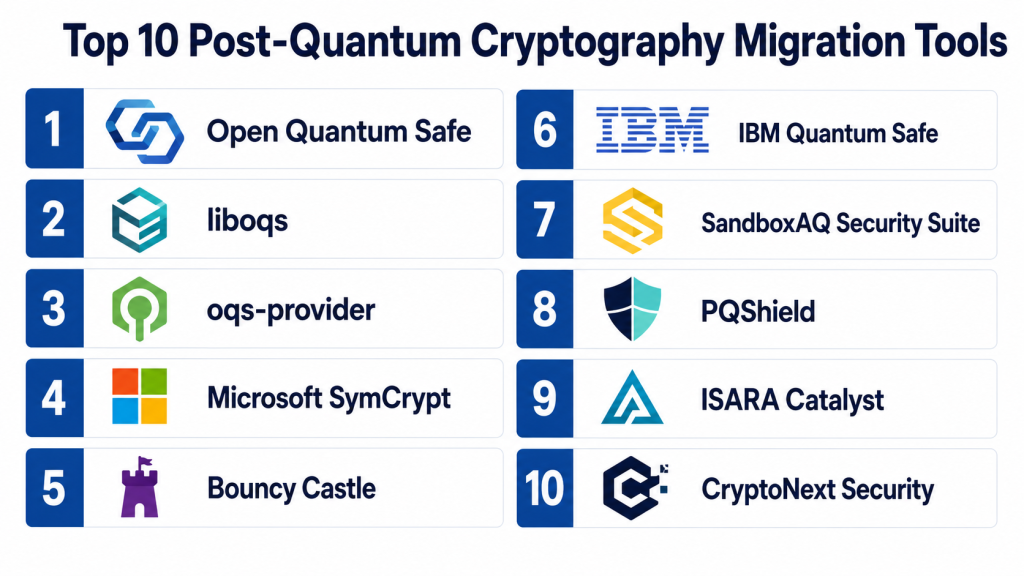
Top 10 Post-Quantum Cryptography Migration Tools
1- Open Quantum Safe
Short description:
Open Quantum Safe is one of the most important open-source projects for experimenting with quantum-resistant cryptography. It provides software components, libraries, and integrations that help developers test post-quantum algorithms in real-world-style environments. The project is especially useful for teams that want to understand PQC behavior before production rollout. It supports practical experimentation across cryptographic libraries, protocol integrations, and application testing. Open Quantum Safe is often used by researchers, security engineers, platform teams, and vendors building early PQC support.
Key Features
- Open-source quantum-safe cryptography project
- Support for post-quantum algorithm experimentation
- Library and provider ecosystem
- TLS and protocol testing workflows
- Developer-friendly integration options
- Useful for benchmarking and proof-of-concept work
- Strong research and community relevance
Pros
- Excellent starting point for technical PQC experimentation
- Strong open-source ecosystem
- Useful for developers and security engineers
Cons
- Not a complete enterprise migration platform
- Requires cryptography and engineering expertise
- Production usage requires careful validation and governance
Platforms / Deployment
- Linux / Windows / macOS
- Cloud / Self-hosted / Hybrid
Security & Compliance
- Supports quantum-safe cryptographic experimentation
- Compliance depends on implementation and deployment
- Not publicly stated for enterprise certifications
Integrations & Ecosystem
Open Quantum Safe fits into development, testing, and cryptographic research workflows.
- liboqs
- oqs-provider
- OpenSSL-based testing
- TLS experimentation
- Application prototypes
- Research environments
Support & Community
Strong open-source community with broad relevance in PQC research and migration preparation.
2- liboqs
Short description:
liboqs is an open-source C library that provides implementations of quantum-safe key encapsulation mechanisms and digital signature algorithms. It is commonly used by developers and researchers who need a consistent API for experimenting with PQC algorithms. liboqs is valuable for application teams evaluating how new algorithms behave in software, protocols, test environments, and performance benchmarks. It is not a full migration management product, but it is a foundational technical tool for PQC readiness.
Key Features
- C library for quantum-safe algorithms
- Support for key encapsulation mechanisms
- Support for digital signature algorithms
- Common API for experimentation
- Test harness support
- Benchmarking routines
- Integration with broader OQS tooling
Pros
- Strong technical foundation for PQC testing
- Useful for benchmarking algorithm behavior
- Open-source and developer-friendly
Cons
- Requires cryptographic engineering expertise
- Not designed as an enterprise dashboard
- Production adoption requires careful review
Platforms / Deployment
- Linux / Windows / macOS
- Self-hosted / Local / Hybrid
Security & Compliance
- Provides quantum-safe algorithm implementations
- Security depends on selected algorithms and integration design
- Compliance depends on deployment and validation
Integrations & Ecosystem
liboqs is commonly used as a building block for PQC-enabled applications and protocol experiments.
- OpenSSL integrations
- oqs-provider
- TLS experiments
- C and C++ applications
- Research prototypes
- Benchmarking workflows
Support & Community
Strong open-source support through the Open Quantum Safe ecosystem and developer community.
3- oqs-provider
Short description:
oqs-provider is an OpenSSL provider that enables post-quantum cryptography experimentation through OpenSSL-based workflows. It helps teams test PQC algorithms in TLS, X.509, and related cryptographic scenarios without rebuilding every application from scratch. This is valuable for security architects and platform teams evaluating how quantum-safe algorithms may affect existing OpenSSL-dependent systems. It is especially useful in proof-of-concept, interoperability, and performance testing environments.
Key Features
- OpenSSL provider for PQC algorithms
- TLS testing support
- X.509 certificate experimentation
- Integration with liboqs
- Hybrid cryptography testing use cases
- Developer and security lab workflows
- Useful for protocol compatibility testing
Pros
- Practical for OpenSSL-based experimentation
- Helps test real protocol behavior
- Strong fit for TLS migration planning
Cons
- Best suited for testing and controlled environments
- Requires OpenSSL and cryptography expertise
- Not a full enterprise migration suite
Platforms / Deployment
- Linux / Windows / macOS
- Self-hosted / Local / Hybrid
Security & Compliance
- Enables PQC testing through OpenSSL provider architecture
- Compliance depends on deployment and validated algorithms
- Not publicly stated for enterprise certifications
Integrations & Ecosystem
oqs-provider fits into cryptographic testing and TLS evaluation workflows.
- OpenSSL
- liboqs
- TLS servers and clients
- X.509 certificate tests
- CI testing labs
- Application compatibility checks
Support & Community
Supported by the Open Quantum Safe ecosystem and widely useful for technical PQC testing.
4- Microsoft SymCrypt
Short description:
Microsoft SymCrypt is a cryptographic library used across Microsoft platforms and services. Its post-quantum cryptography work is relevant for organizations invested in Windows, Azure, Microsoft security architecture, and enterprise infrastructure. SymCrypt support for PQC algorithms is important because many enterprises depend on Microsoft cryptographic libraries indirectly through operating systems, cloud services, and application stacks. For migration planning, SymCrypt is most valuable for organizations tracking platform-level PQC readiness.
Key Features
- Cryptographic library used in Microsoft environments
- PQC algorithm support expansion
- Platform-level cryptographic integration
- Relevance for Windows and Azure ecosystems
- Developer and infrastructure readiness impact
- Enterprise security architecture alignment
- Long-term platform migration relevance
Pros
- Strong fit for Microsoft-heavy enterprises
- Important for platform-level PQC adoption
- Backed by a major enterprise ecosystem
Cons
- Less flexible as a standalone migration tool
- Best value depends on Microsoft ecosystem usage
- Some capabilities may depend on platform release cycles
Platforms / Deployment
- Windows / Linux
- Cloud / Hybrid
Security & Compliance
- Enterprise cryptographic library controls
- PQC support depends on platform implementation
- Compliance depends on Microsoft platform configuration and customer usage
Integrations & Ecosystem
SymCrypt is relevant across Microsoft infrastructure and development workflows.
- Windows security components
- Azure services
- Microsoft 365 ecosystem relevance
- Developer applications
- Platform cryptography workflows
Support & Community
Supported through Microsoft documentation, enterprise support channels, and platform security updates.
5- Bouncy Castle
Short description:
Bouncy Castle is a widely used cryptographic library ecosystem for Java, C#, and related development workflows. It is relevant to PQC migration because application teams often need library-level support to test or implement new algorithms in software products. Bouncy Castle is especially useful for developers modernizing application cryptography, testing PQC signatures or key exchange approaches, and preparing crypto-agile software designs. It is best suited for teams with strong application security and development expertise.
Key Features
- Cryptographic library ecosystem
- Java and C# developer support
- PQC algorithm support in relevant distributions
- Application-level cryptography integration
- Certificate and signature workflow support
- Useful for testing crypto-agility
- Strong developer adoption
Pros
- Strong fit for application developers
- Useful across Java and .NET ecosystems
- Mature cryptographic library reputation
Cons
- Requires careful secure implementation
- Not a migration inventory platform
- Developers must validate algorithm and protocol choices
Platforms / Deployment
- Java / .NET / Windows / Linux / macOS
- Cloud / Self-hosted / Hybrid
Security & Compliance
- Cryptographic implementation support
- Compliance depends on version, configuration, and deployment
- Not publicly stated for all certifications in this context
Integrations & Ecosystem
Bouncy Castle fits application modernization and cryptographic development workflows.
- Java applications
- .NET applications
- PKI workflows
- Certificate handling
- Signing workflows
- Secure application development
Support & Community
Strong developer community and long-standing usage across application security teams.
6- IBM Quantum Safe
Short description:
IBM Quantum Safe is an enterprise-oriented portfolio designed to help organizations assess cryptographic risk and plan migration toward quantum-safe cryptography. It is relevant for large organizations that need crypto discovery, risk prioritization, governance, and transformation support rather than only low-level cryptographic libraries. IBM’s approach is especially useful for regulated enterprises with complex infrastructure, long-lived data, and broad vendor ecosystems. It supports the strategic side of PQC migration by helping teams understand exposure and plan remediation.
Key Features
- Enterprise quantum-safe assessment
- Cryptographic inventory support
- Risk prioritization workflows
- Migration planning assistance
- Crypto-agility strategy support
- Enterprise consulting and tooling ecosystem
- Fit for regulated industries
Pros
- Strong enterprise migration focus
- Useful for complex environments
- Supports governance and planning needs
Cons
- May be too heavy for small teams
- Details vary by engagement and solution scope
- Implementation may require consulting and internal coordination
Platforms / Deployment
- Cloud / Enterprise environments
- Hybrid
Security & Compliance
- Enterprise security governance support
- Compliance depends on customer environment and engagement scope
- Specific controls vary by solution implementation
Integrations & Ecosystem
IBM Quantum Safe is designed for enterprise transformation and risk management workflows.
- Enterprise infrastructure
- PKI environments
- Cloud systems
- Application portfolios
- Risk management workflows
- Consulting-led migration programs
Support & Community
Enterprise-grade support and advisory resources are available through IBM’s broader security and consulting ecosystem.
7- SandboxAQ Security Suite
Short description:
SandboxAQ Security Suite focuses on cryptographic management, discovery, and quantum-readiness for enterprises. It is designed to help organizations understand where cryptography is used, identify risk, and plan modernization toward crypto-agile and quantum-safe systems. The platform is especially relevant for organizations with large application estates, distributed infrastructure, and compliance pressure. It helps security leaders move from abstract quantum risk discussions to practical cryptographic inventory and remediation planning.
Key Features
- Cryptographic discovery
- Crypto inventory management
- Quantum risk assessment
- Crypto-agility planning
- Enterprise reporting workflows
- Policy and governance support
- Migration prioritization
Pros
- Strong fit for enterprise crypto inventory
- Useful for risk-based migration planning
- Helps connect security and compliance teams
Cons
- Enterprise-focused and may be excessive for small teams
- Requires internal stakeholder alignment
- Pricing and deployment vary by engagement
Platforms / Deployment
- Cloud / Enterprise environments
- Hybrid
Security & Compliance
- Enterprise cryptographic governance support
- Access controls and auditability should be validated during procurement
- Compliance depends on deployment and customer environment
Integrations & Ecosystem
SandboxAQ fits enterprise cryptographic risk and security governance workflows.
- Application inventories
- Network environments
- Security operations workflows
- Compliance reporting
- PKI modernization programs
- Risk management systems
Support & Community
Enterprise support and advisory services are typically part of deployment and rollout.
8- PQShield
Short description:
PQShield provides post-quantum cryptography solutions focused on software, hardware, and embedded environments. It is especially relevant for organizations building products, chips, devices, firmware, secure elements, and systems that need PQC-ready cryptographic implementations. PQShield is valuable for engineering teams that require specialized expertise in algorithm implementation, constrained environments, and product-level integration. It is often considered by hardware vendors, IoT teams, semiconductor companies, and security-sensitive product builders.
Key Features
- PQC implementation support
- Software and embedded cryptography solutions
- Hardware-focused cryptographic expertise
- Product integration support
- Algorithm implementation guidance
- Secure firmware and device relevance
- Migration advisory support
Pros
- Strong fit for embedded and product security
- Specialized PQC expertise
- Useful for hardware and device manufacturers
Cons
- Less suitable as a generic enterprise inventory platform
- Use case depends heavily on product architecture
- Commercial scope varies by engagement
Platforms / Deployment
- Embedded systems / Software / Hardware environments
- Self-hosted / Hybrid
Security & Compliance
- PQC implementation support
- Security depends on integration and target environment
- Compliance depends on product and customer requirements
Integrations & Ecosystem
PQShield supports specialized product engineering and embedded security workflows.
- Embedded devices
- Secure elements
- Firmware environments
- Hardware security modules
- IoT products
- Semiconductor workflows
Support & Community
Commercial and specialist support is oriented toward engineering teams building PQC into products and infrastructure.
9- ISARA Catalyst
Short description:
ISARA Catalyst is a crypto-agility and quantum-safe migration platform focused on helping enterprises inventory, manage, and transition cryptographic assets. It is designed for organizations that need to understand their cryptographic dependencies and coordinate migration across applications, infrastructure, and vendors. ISARA’s positioning is especially relevant for security leaders who need governance, planning, and operational visibility for PQC readiness. It is useful for organizations seeking structured migration rather than isolated algorithm testing.
Key Features
- Crypto inventory support
- Crypto-agility management
- Quantum-safe migration planning
- Enterprise visibility workflows
- Risk prioritization
- Governance and reporting
- Migration coordination support
Pros
- Strong focus on crypto-agility
- Useful for enterprise migration planning
- Helps organize complex cryptographic dependencies
Cons
- Enterprise-focused platform may be too much for smaller teams
- Detailed capabilities vary by deployment
- Requires organizational process maturity
Platforms / Deployment
- Enterprise environments
- Cloud / Hybrid
Security & Compliance
- Governance-focused cryptographic management
- Access controls and auditability should be validated during procurement
- Compliance depends on customer implementation
Integrations & Ecosystem
ISARA Catalyst fits structured enterprise cryptographic migration workflows.
- Application portfolios
- PKI systems
- Security architecture workflows
- Vendor risk management
- Compliance reporting
- Crypto-agility programs
Support & Community
Enterprise support is typically aligned with structured migration programs and security architecture teams.
10- CryptoNext Security
Short description:
CryptoNext Security provides post-quantum cryptography migration solutions for enterprises, with emphasis on crypto-agility, discovery, and integration. It is relevant for organizations that need support across application modernization, cryptographic inventory, and quantum-safe transformation planning. CryptoNext is especially useful for teams looking for enterprise-focused migration support rather than only developer libraries. It can help organizations evaluate exposure, prioritize migration, and move toward quantum-safe cryptographic architecture.
Key Features
- PQC migration support
- Cryptographic inventory workflows
- Crypto-agility capabilities
- Enterprise assessment support
- Integration planning
- Migration prioritization
- Security architecture alignment
Pros
- Strong enterprise PQC migration focus
- Useful for planning and governance
- Supports structured transformation programs
Cons
- May require enterprise procurement and consulting
- Product details can vary by deployment
- Less useful for simple developer experimentation
Platforms / Deployment
- Enterprise environments
- Cloud / Hybrid
Security & Compliance
- Cryptographic governance support
- Compliance depends on deployment and customer environment
- Access and audit controls should be validated during procurement
Integrations & Ecosystem
CryptoNext Security fits enterprise security modernization and migration workflows.
- Application environments
- Network security systems
- PKI modernization
- Compliance workflows
- Security architecture programs
- Hybrid enterprise infrastructure
Support & Community
Enterprise-oriented support and advisory engagement are typically part of migration programs.
Comparison Table
| Tool Name | Best For | Platform Supported | Deployment | Standout Feature | Public Rating |
|---|---|---|---|---|---|
| Open Quantum Safe | PQC experimentation | Linux, Windows, macOS | Cloud / Self-hosted / Hybrid | Open-source quantum-safe ecosystem | N/A |
| liboqs | Algorithm testing | Linux, Windows, macOS | Self-hosted / Local / Hybrid | Common API for PQC algorithms | N/A |
| oqs-provider | OpenSSL PQC testing | Linux, Windows, macOS | Self-hosted / Local / Hybrid | PQC testing through OpenSSL | N/A |
| Microsoft SymCrypt | Microsoft ecosystem readiness | Windows, Linux | Cloud / Hybrid | Platform-level cryptographic library | N/A |
| Bouncy Castle | Application cryptography | Java, .NET, Windows, Linux, macOS | Cloud / Self-hosted / Hybrid | Developer library ecosystem | N/A |
| IBM Quantum Safe | Enterprise migration planning | Enterprise environments | Hybrid | Quantum-safe assessment and governance | N/A |
| SandboxAQ Security Suite | Crypto inventory and risk | Enterprise environments | Cloud / Hybrid | Cryptographic discovery and prioritization | N/A |
| PQShield | Embedded and product security | Embedded, software, hardware | Self-hosted / Hybrid | Specialized PQC implementation | N/A |
| ISARA Catalyst | Crypto-agility management | Enterprise environments | Cloud / Hybrid | Structured migration governance | N/A |
| CryptoNext Security | Enterprise PQC transformation | Enterprise environments | Cloud / Hybrid | Migration and crypto-agility support | N/A |
Evaluation and Scoring of Post-Quantum Cryptography Migration Tools
| Tool Name | Core 25% | Ease 15% | Integrations 15% | Security 10% | Performance 10% | Support 10% | Value 15% | Weighted Total |
| Open Quantum Safe | 9 | 7 | 8 | 8 | 8 | 8 | 10 | 8.4 |
| liboqs | 8 | 6 | 8 | 8 | 8 | 7 | 10 | 7.9 |
| oqs-provider | 8 | 7 | 8 | 8 | 8 | 7 | 9 | 7.9 |
| Microsoft SymCrypt | 8 | 7 | 9 | 9 | 9 | 9 | 8 | 8.4 |
| Bouncy Castle | 8 | 8 | 8 | 8 | 8 | 8 | 9 | 8.1 |
| IBM Quantum Safe | 9 | 8 | 8 | 9 | 8 | 9 | 7 | 8.4 |
| SandboxAQ Security Suite | 9 | 8 | 8 | 9 | 8 | 8 | 7 | 8.2 |
| PQShield | 8 | 7 | 8 | 9 | 8 | 8 | 7 | 7.9 |
| ISARA Catalyst | 8 | 8 | 8 | 8 | 8 | 8 | 7 | 7.9 |
| CryptoNext Security | 8 | 8 | 8 | 8 | 8 | 8 | 7 | 7.9 |
These scores are comparative and should be interpreted based on migration goals. Open Quantum Safe, liboqs, and oqs-provider are excellent for technical experimentation and developer testing. IBM Quantum Safe, SandboxAQ, ISARA Catalyst, and CryptoNext are stronger for enterprise governance and crypto inventory. PQShield is more suitable for product, embedded, and hardware-focused teams. Bouncy Castle and SymCrypt are important when application and platform-level cryptographic libraries drive migration strategy.
Which Post-Quantum Cryptography Migration Tool Is Right for You?
Solo / Freelancer
Independent developers, researchers, and small technical teams should start with Open Quantum Safe, liboqs, oqs-provider, or Bouncy Castle. These tools allow hands-on learning, algorithm testing, and application-level experimentation without requiring a full enterprise migration program. Developers working with Java or .NET may find Bouncy Castle especially practical, while teams testing OpenSSL-based TLS behavior should evaluate oqs-provider.
SMB
SMBs should avoid overcomplicating the first stage of PQC migration. A practical starting point is to build a basic crypto inventory, identify long-lived sensitive data, and test PQC libraries in non-production environments. Open Quantum Safe, liboqs, and Bouncy Castle can support technical readiness, while a lightweight advisory or assessment approach may help prioritize risk. SMBs should focus on crypto agility before attempting broad production migration.
Mid-Market
Mid-market organizations usually have enough infrastructure complexity to require structured planning. They should combine technical testing tools with governance-oriented platforms. Open Quantum Safe and oqs-provider can support lab testing, while SandboxAQ, ISARA Catalyst, CryptoNext, or IBM Quantum Safe can support inventory, risk prioritization, and migration planning. Teams should involve application owners, PKI administrators, cloud teams, network security teams, and vendor managers early.
Enterprise
Enterprises need a formal PQC migration program, not isolated experiments. A mature approach may combine IBM Quantum Safe, SandboxAQ Security Suite, ISARA Catalyst, or CryptoNext for inventory and governance, while using Open Quantum Safe, liboqs, oqs-provider, SymCrypt, Bouncy Castle, or PQShield for technical implementation and testing. Enterprises should prioritize high-value long-lived data, customer-facing TLS, PKI, identity systems, code signing, VPNs, and embedded cryptography.
Budget vs Premium
Open-source tools such as Open Quantum Safe, liboqs, and oqs-provider provide excellent value for technical experimentation. However, the main cost of PQC migration is not only software licensing. Organizations must budget for discovery, testing, performance analysis, vendor coordination, certificate lifecycle changes, policy updates, developer training, and staged production rollout. Premium enterprise platforms are more useful when visibility, reporting, governance, and program management become critical.
Feature Depth vs Ease of Use
Developer libraries provide deep technical flexibility but require cryptographic expertise. Enterprise platforms provide easier reporting and governance but may not replace hands-on engineering validation. Open Quantum Safe is flexible, but teams need technical maturity. IBM Quantum Safe, SandboxAQ, ISARA Catalyst, and CryptoNext are more suitable when the organization needs executive visibility and structured migration management. PQShield is especially useful when deep implementation expertise is required for products or embedded systems.
Integrations & Scalability
PQC migration touches applications, networks, certificates, identity platforms, cloud services, hardware systems, vendors, and DevOps pipelines. Teams should validate whether tools integrate with existing PKI, CI/CD, TLS infrastructure, cloud environments, application frameworks, and asset inventories. Scalability depends less on algorithm support alone and more on how well the organization can discover cryptography, prioritize migration, and enforce crypto-agility over time.
Security & Compliance Needs
Security-sensitive organizations should start by identifying long-lived secrets, regulated data, mission-critical systems, external-facing services, and cryptographic dependencies with weak agility. Compliance teams should document migration planning, risk prioritization, vendor readiness, and staged remediation. PQC tools should be combined with secure key management, certificate lifecycle management, vulnerability management, identity governance, and software supply chain controls.
Frequently Asked Questions
1. What are Post-Quantum Cryptography Migration Tools?
Post-Quantum Cryptography Migration Tools help organizations assess, test, and transition cryptographic systems toward quantum-resistant algorithms. They may include discovery platforms, cryptographic libraries, testing tools, enterprise governance platforms, and implementation support.
2. Why is post-quantum cryptography migration important?
Many current public-key systems rely on algorithms that could be broken by future cryptographically relevant quantum computers. Migration reduces long-term risk, especially for sensitive data that must remain confidential for many years.
3. What is harvest-now-decrypt-later risk?
Harvest-now-decrypt-later risk means attackers may collect encrypted data today and decrypt it in the future when quantum capabilities become practical. Long-lived secrets, government data, financial records, healthcare data, and intellectual property are especially exposed.
4. What is crypto agility?
Crypto agility is the ability to replace or update cryptographic algorithms, protocols, keys, and libraries without redesigning entire systems. It is one of the most important foundations for successful PQC migration.
5. Which PQC algorithms should organizations know first?
Organizations should understand ML-KEM for key establishment and ML-DSA and SLH-DSA for digital signatures. The right choice depends on protocol requirements, performance needs, ecosystem support, and compliance expectations.
6. Are open-source PQC tools safe for production?
Open-source PQC tools are valuable for testing, learning, and experimentation. Production use requires careful validation, secure integration, compliance review, performance testing, and alignment with approved standards and organizational policy.
7. What is the first step in PQC migration?
The first step is building a cryptographic inventory. Organizations must identify where cryptography is used across applications, infrastructure, certificates, protocols, devices, vendors, and data flows before planning migration.
8. How difficult is PQC migration?
PQC migration can be complex because cryptography is often hidden in applications, libraries, devices, protocols, certificates, and third-party systems. Large organizations should expect phased migration, testing, governance, and vendor coordination.
9. Do PQC tools replace existing security tools?
No. PQC migration tools do not replace vulnerability scanners, identity systems, PKI platforms, SIEM tools, or cloud security tools. They complement broader security programs by addressing cryptographic risk and crypto-agility readiness.
10. What mistakes should organizations avoid?
Organizations should avoid waiting too long, skipping crypto inventory, focusing only on algorithms, ignoring vendor dependencies, overlooking performance testing, and deploying PQC without a phased governance plan. Migration should be structured, tested, and risk-based.
Conclusion
Post-Quantum Cryptography Migration Tools are becoming essential for organizations that need to protect long-lived data, modernize cryptographic systems, and prepare for quantum-era security risks. Open Quantum Safe, liboqs, and oqs-provider are excellent starting points for technical experimentation, while Microsoft SymCrypt and Bouncy Castle matter for application and platform-level cryptographic readiness. IBM Quantum Safe, SandboxAQ Security Suite, ISARA Catalyst, and CryptoNext Security support enterprise governance, crypto inventory, and migration planning. PQShield is especially relevant for embedded, hardware, and product security teams. The best approach is not to choose one universal tool, but to build a layered migration program: inventory cryptography, prioritize high-risk systems, test PQC algorithms, improve crypto agility, coordinate with vendors, and roll out changes in phases. A practical next step is to shortlist tools based on your environment, run a controlled pilot on one application or TLS workflow, measure performance and compatibility, and then expand migration planning across the organization.
