Introduction
Research Data Management Platforms (RDMPs) are software systems that help researchers store, organize, share, and preserve datasets throughout the research lifecycle.
They provide structured data catalogs, metadata standards, access control, and governance features for research teams and institutions.
These platforms support collaboration, reproducibility, compliance with funder/data policies, and secure long‑term preservation.
Choosing the right RDMP ensures efficient research workflows, regulatory compliance, and enterprise‑wide data visibility.
Real‑world use cases:
- Universities managing research outputs across labs and departments
- Government research agencies enforcing data policies
- Pharmaceuticals tracking experimental data and metadata
- NGOs collating impact and field research data
- Corporate R&D teams standardizing data assets
Key buyer evaluation criteria:
- Metadata standards support and discoverability
- Secure storage and access control mechanisms
- Collaboration and versioning workflows
- Integration with data analysis and publishing tools
- Automation and policy enforcement
- Scalability and performance
- Compliance with data regulations
- Reporting and analytics
Best for: Academic research institutions, government labs, corporate R&D units, and multi‑disciplinary research teams.
Not ideal for: Simple file storage needs without governance, compliance, or metadata requirements.
Key Trends in Research Data Management Platforms
- AI‑assisted metadata tagging and automated classification
- Cloud‑native services with global accessibility
- Integration with notebooks, analysis tools, and HPC systems
- Support for FAIR principles and data discoverability
- Policy templates for funder and regulatory compliance
- Blockchain‑style audit trails for reproducibility and provenance
- Automated versioning and version control
- Flexible API‑first architecture for extensibility
- Plug‑in ecosystems for visualization and analytics
- Enterprise security with RBAC, SSO, and encryption
How We Selected These Tools (Methodology)
- Market adoption and institutional use cases
- Feature coverage across metadata, sharing, and preservation
- Security posture including access control and audit trails
- Integration with analytics, publishing, and workflow systems
- Support for standards and FAIR principles
- Performance and scalability for large datasets
- Ease of use and learning curve
- Vendor support and community presence
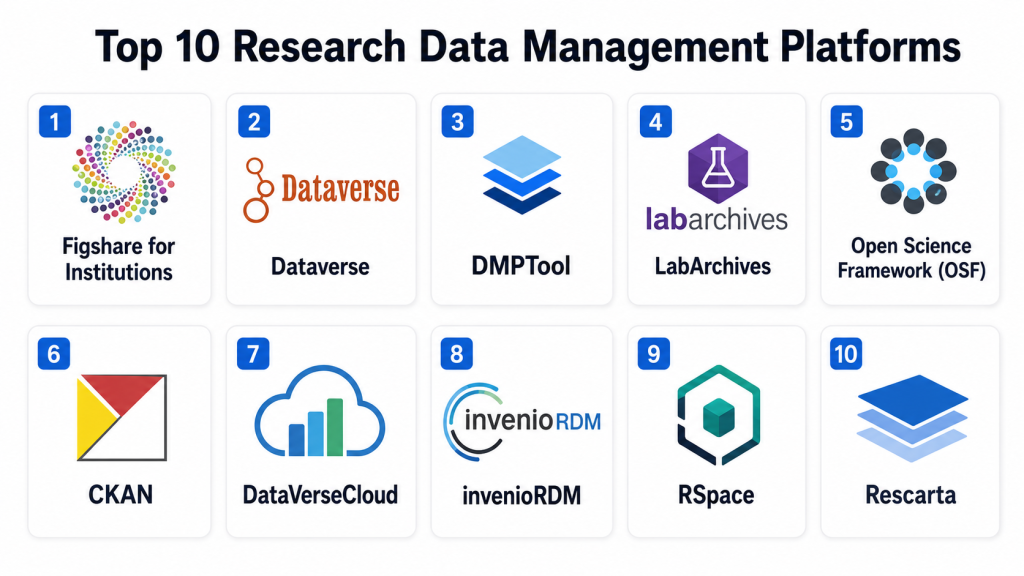
Top 10 Research Data Management Platforms
#1 — Figshare for Institutions
Short description:
Figshare for Institutions provides research data repository and publishing tools.
It emphasizes discoverability, compliance, and sharing.
Supports metadata, versioning, and DOI assignment.
Ideal for universities and research centers requiring publishing workflows.
Key Features
- Metadata and taxonomy support
- DOI assignment for datasets
- Version control and audit logs
- Access control and permissions
- Search and discovery tools
- Reporting dashboards
Pros
- Strong discoverability features
- Good for data publishing workflows
- FAIR principles supported
Cons
- Can be costly for smaller labs
- Customization limits on metadata schemas
Platforms / Deployment
- Web
- Cloud
Security & Compliance
- SSO/SAML, encryption
- GDPR support: Yes
Integrations & Ecosystem
- APIs for repository integration
- Connectors with publishing platforms
- Integration with ORCID
Support & Community
- Vendor support and training
- User documentation and tutorials
- Researcher community
#2 — Dataverse
Short description:
Dataverse is an open‑source repository platform for research data.
Provides metadata standards and structured dataset management.
Supports versioning, access controls, and sharing policies.
Ideal for institutions seeking a standards‑based, flexible platform.
Key Features
- Metadata and controlled vocabularies
- Versioning and audit trails
- Access control and permissions
- REST APIs for integration
- Dataset publishing workflows
Pros
- Open‑source and highly flexible
- Strong community and standards support
- Scales well for institutions
Cons
- Requires technical deployment expertise
- UI may be less polished than commercial tools
Platforms / Deployment
- Web
- Cloud / Self‑hosted
Security & Compliance
- Not publicly stated
Integrations & Ecosystem
- API‑first design
- Integrates with institutional systems
- Plug‑in support
Support & Community
- Active open‑source community
- Documentation and forums
- Third‑party support providers
#3 — DMPTool
Short description:
DMPTool simplifies creating research data management plans.
It provides templates and guidance for data policy compliance.
Supports funder and institutional requirements.
Ideal for researchers and administrators planning data projects.
Key Features
- Template‑based plan creation
- Policy compliance guidance
- Custom organizational templates
- Export and sharing tools
Pros
- Easy to use with strong guidance
- Helps meet funder requirements
- Institution‑wide template customization
Cons
- Not a full data repository
- Limited analytics or storage features
Platforms / Deployment
- Web
- Cloud
Security & Compliance
- Not publicly stated
Integrations & Ecosystem
- Exports for reporting
- Connects with institutional profiles
Support & Community
- Documentation and help guides
- Community forums
#4 — LabArchives
Short description:
LabArchives is a research notebook and data repository platform.
It supports lab data, protocols, and experiment tracking.
Includes versioning, sharing, and compliance features.
Ideal for labs and research teams needing ELN + data management.
Key Features
- Electronic lab notebook features
- Versioning and audit trails
- Data storage and sharing
- Role‑based access control
- Reporting tools
Pros
- Combines ELN with data management
- Easy collaboration features
- Secure audit logging
Cons
- Not a full institutional repository
- Limited metadata schema flexibility
Platforms / Deployment
- Web / iOS / Android
- Cloud
Security & Compliance
- SSO/SAML, encryption
- GDPR support: Not publicly stated
Integrations & Ecosystem
- API access
- Integrates with analysis tools
- Collaboration features
Support & Community
- Knowledge base
- Vendor support plans
- Researcher forums
#5 — Open Science Framework (OSF)
Short description:
OSF is an open‑source platform for research collaboration and data management.
Supports project organization, versioning, and sharing.
Integrates with storage and analysis tools.
Ideal for cross‑institutional research projects.
Key Features
- Project dashboards
- Version control and history
- Sharing policies and permissions
- Integration with external storage
- Collaborative workflows
Pros
- Strong collaboration focus
- Integrates with many storage systems
- Free and open‑source
Cons
- Not specialized for metadata standards
- Limited advanced analytics
Platforms / Deployment
- Web
- Cloud
Security & Compliance
- Not publicly stated
Integrations & Ecosystem
- Connects with Dropbox, Google Drive
- API support
- External tool integration
Support & Community
- Community tutorials
- Documentation and FAQs
#6 — CKAN
Short description:
CKAN is an open‑source data portal platform often used for research publication.
Offers dataset cataloging, metadata management, and search.
Supports public data discovery and APIs.
Ideal for institutions building research data portals.
Key Features
- Metadata cataloging
- Public API and search
- Dataset tagging and classification
- Access control options
Pros
- Flexible and extensible
- Open‑source with broad usage
- Public data portal capabilities
Cons
- Not research‑specific by default
- Requires customization for research workflows
Platforms / Deployment
- Web
- Cloud / Self‑hosted
Security & Compliance
- Not publicly stated
Integrations & Ecosystem
- API support
- Plug‑in extensibility
- Front‑end search plugins
Support & Community
- Developer community
- Documentation
- Third‑party services
#7 — DataVerseCloud
Short description:
DataVerseCloud is a managed cloud version of Dataverse platforms.
It provides hosted infrastructure and support services.
Maintains standards‑based metadata and versioning.
Ideal for institutions wanting hosted RDMP without admin overhead.
Key Features
- Hosted Dataverse infrastructure
- Standards‑based metadata
- Versioning and audit trails
- Access controls
- Scalability and uptime guarantees
Pros
- Reduces deployment overhead
- Standards support retained
- Managed security and backups
Cons
- Less control than self‑hosted
- Pricing may vary
Platforms / Deployment
- Web
- Cloud
Security & Compliance
- Not publicly stated
Integrations & Ecosystem
- APIs and connectors
- Integrates with institutional systems
Support & Community
- Vendor support
- Documentation and knowledge base
#8 — InvenioRDM
Short description:
InvenioRDM is an open‑source research data management and repository platform.
Supports metadata standards, DOI minting, and preservation.
Designed for institutions hosting research outputs.
Ideal for universities needing flexible repository capabilities.
Key Features
- Metadata support and taxonomies
- DOI registration
- Preservation features
- Access control
- Search and indexing
Pros
- Open‑source and scalable
- Strong metadata and DOIs
- Flexible customization
Cons
- Technical deployment needed
- Smaller ecosystem than commercial tools
Platforms / Deployment
- Web
- Cloud / Self‑hosted
Security & Compliance
- Not publicly stated
Integrations & Ecosystem
- APIs and connectors
- Repository integrations
Support & Community
- Developer community
- Documentation
#9 — RSpace
Short description:
RSpace combines ELN features with data repository tools.
Facilitates project organization and structured storage.
Supports versioning, sharing, and collaboration.
Ideal for lab teams and research groups needing data context.
Key Features
- ELN and data repository
- Versioning and audit trails
- Access and permission controls
- Search and indexing
- Reporting tools
Pros
- Combines lab notes with data management
- Strong collaboration features
- Secure audit capabilities
Cons
- Not a full institutional repository
- Metadata schema limitations
Platforms / Deployment
- Web / iOS / Android
- Cloud
Security & Compliance
- SSO/SAML, encryption
- GDPR support: Not publicly stated
Integrations & Ecosystem
- Connects with analysis tools
- API support
Support & Community
- Vendor support
- Documentation
- User community
#10 — Rescarta
Short description:
Rescarta provides research data cataloging and access tools.
Supports metadata creation and indexing.
Designed for institutional research collections.
Ideal for libraries managing research data visibility.
Key Features
- Metadata cataloging and search
- Access control
- Discovery portal
- Reporting tools
Pros
- Easy to use
- Focused on discoverability
- Supports research collections
Cons
- Fewer advanced features
- Not suited for heavy automation
Platforms / Deployment
- Web
- Cloud
Security & Compliance
- Not publicly stated
Integrations & Ecosystem
- API access
- Search integrations
Support & Community
- Documentation
- Support channels
Comparison Table (Top 10)
| Tool Name | Best For | Platform(s) | Deployment | Standout Feature | Public Rating |
|---|---|---|---|---|---|
| Figshare for Institutions | Research publishing | Web | Cloud | DOI & discoverability | N/A |
| Dataverse | Flexible research repos | Web | Cloud/Self‑hosted | Open‑source standards | N/A |
| DMPTool | Data planning | Web | Cloud | Plan templates | N/A |
| LabArchives | Lab‑centric research | Web/iOS/Android | Cloud | ELN + repository | N/A |
| Open Science Framework | Collaboration | Web | Cloud | Cross‑project workflow | N/A |
| CKAN | Data portals | Web | Cloud/Self‑hosted | Public data portals | N/A |
| DataVerseCloud | Managed hosted RDMP | Web | Cloud | Hosted Dataverse | N/A |
| InvenioRDM | Research repositories | Web | Cloud/Self‑hosted | DOI & preservation | N/A |
| RSpace | ELN plus data | Web/iOS/Android | Cloud | Lab & data combo | N/A |
| Rescarta | Research visibility | Web | Cloud | Search & cataloging | N/A |
Evaluation & Scoring
| Tool | Core (25%) | Ease (15%) | Integrations (15%) | Security (10%) | Performance (10%) | Support (10%) | Value (15%) | Weighted Total |
|---|---|---|---|---|---|---|---|---|
| Figshare | 9 | 8 | 8 | 7 | 8 | 8 | 7 | 8.1 |
| Dataverse | 8 | 7 | 7 | 6 | 7 | 7 | 8 | 7.3 |
| DMPTool | 6 | 9 | 6 | 6 | 6 | 7 | 9 | 7.1 |
| LabArchives | 7 | 8 | 7 | 7 | 7 | 7 | 7 | 7.4 |
| Open Science Framework | 7 | 8 | 7 | 6 | 7 | 7 | 8 | 7.4 |
| CKAN | 6 | 7 | 7 | 6 | 7 | 7 | 8 | 7.0 |
| DataVerseCloud | 8 | 8 | 7 | 7 | 8 | 8 | 7 | 7.8 |
| InvenioRDM | 8 | 7 | 8 | 6 | 7 | 7 | 8 | 7.6 |
| RSpace | 7 | 8 | 7 | 7 | 7 | 7 | 7 | 7.3 |
| Rescarta | 6 | 8 | 6 | 6 | 7 | 7 | 8 | 7.0 |
Decision Guide
Solo / Freelancer
DMPTool or Open Science Framework – lightweight and easy planning/collaboration.
SMB / Small Teams
Figshare, LabArchives, and Rescarta – good balance of features and ease of use.
Mid‑Market
DataverseCloud or InvenioRDM – strong standards support with manageable operations.
Enterprise
Figshare for Institutions and managed RDMPs with strong compliance and service levels.
Budget vs Premium
Open‑source options reduce licensing cost; premium services offer powerful publishing and managed hosting.
Feature Depth vs Ease of Use
Some platforms prioritize metadata and governance; others make collaboration and publishing seamless.
Integrations & Scalability
API‑centric platforms integrate with analysis, notebooks, and publishing pipelines.
Security & Compliance Needs
Enterprise‑grade tools include advanced access control, encryption, and audit logging; open‑source options require configuration.
Frequently Asked Questions (FAQs)
1. What pricing models exist for research data management platforms?
Most commercial RDMPs use subscription pricing. Open‑source platforms are free but need hosting or maintenance services. Pricing varies by users, storage, and services.
2. Is it easy to migrate existing research data?
Migration depends on source formats and metadata. Standard formats and APIs ease transition, but custom mappings may be needed for structured metadata.
3. Can RDMPs enforce data policy compliance?
Yes. RDMPs help enforce funder and institutional data policies through templates, access control, versioning, and audit trails.
4. Do these platforms support collaboration?
Almost all support versioning, shared workspaces, and project structures that enable real‑time or asynchronous teamwork.
5. How do these tools handle security?
Commercial RDMPs include SSO, RBAC, and encryption. Open‑source options can be configured with enterprise security but may need additional tools.
6. Can research outputs be made public?
Yes. Many platforms support public access, DOIs, and integration with institutional catalogs for broader dissemination.
7. What metadata standards are important?
Standards such as Dublin Core, schema.org, and domain‑specific taxonomies improve discoverability and interoperability.
8. Do RDMPs integrate with analysis tools?
Many offer APIs or connectors that link with notebooks, visualization tools, and data analysis pipelines.
9. Are there tools for planning research data management?
Yes. Tools like DMPTool focus on planning, template guidance, and compliance documentation early in the research lifecycle.
10. Can these systems enforce version control?
Yes, versioning features help manage changes in datasets, enabling reproducibility and audit trails for research integrity.
Conclusion
Choosing the right Research Data Management Platform depends on institutional needs, data policies, and collaboration requirements. Smaller teams and labs often benefit from flexible, easy‑to‑use platforms, while large research institutions require scalable systems with strong metadata, governance, and compliance features. Pilot implementations and side‑by‑side evaluations help validate integration requirements, metadata support, and security. A well‑chosen RDMP streamlines workflows, enhances data reuse, and ensures reproducibility and compliance across projects.
