Introduction
Large Language Model (LLM) gateways and model routing platforms are middleware systems that help organizations manage and orchestrate requests to one or more foundation models. Instead of directly interfacing with a single model endpoint, these platforms provide intelligent routing, load balancing, usage monitoring, version control, and performance optimization. With the rapid proliferation of models infrom open models to proprietary LLMs and task‑specific models—managing them centrally is essential for performance, cost control, and governance.
Real‑world use cases include:
- Routing requests to the most cost‑effective model based on task or latency needs.
- A/B testing and performance comparison across multiple LLM providers.
- Implementing safety layers, custom policy filters, and prompt preprocessing.
- Serving different models to different applications (consumer app vs internal admin panel).
- Monitoring usage, billing, and model drift across teams and workloads.
Best for: Engineering teams, platform teams, startups, and enterprises building conversational AI, assistants, search, embeddings, or inference serving layers.
Not ideal for: Individuals or small teams without multi‑model needs or teams satisfied with a single LLM provider and simple direct API calls.
Key Trends in LLM Gateways & Model Routing Platforms
- Multi‑Cloud and Hybrid Model Routing connecting hosted and self‑hosted LLMs.
- Dynamic cost‑aware model selection based on usage patterns and budgets.
- AI safety layers and custom policy enforcement embedded at the gateway.
- Observability, telemetry, and drift detection dashboards for model behavior.
- A/B testing and automatic retraining triggers to maintain accuracy.
- Custom prompt pipelines with pre‑ and post‑processing plugins.
- Version control across models and prompt templates.
- Federated and privacy‑preserving inference routing.
- Caching and performance acceleration for high‑QPS workloads.
- Role‑based access and fine‑grained permissioning for teams.
How We Selected These Tools (Methodology)
- Assessed model support breadth (multiple LLM providers).
- Evaluated routing logic flexibility (rules, weights, policies).
- Reviewed monitoring, observability, and analytics features.
- Considered policy enforcement, safety controls, and filtering options.
- Examined cost optimization capabilities (routing based on budget).
- Evaluated ease of integration with API‑driven workflows.
- Assessed access control, RBAC, and logging/auditing features.
- Balanced for solo developers, teams, and enterprise platforms.
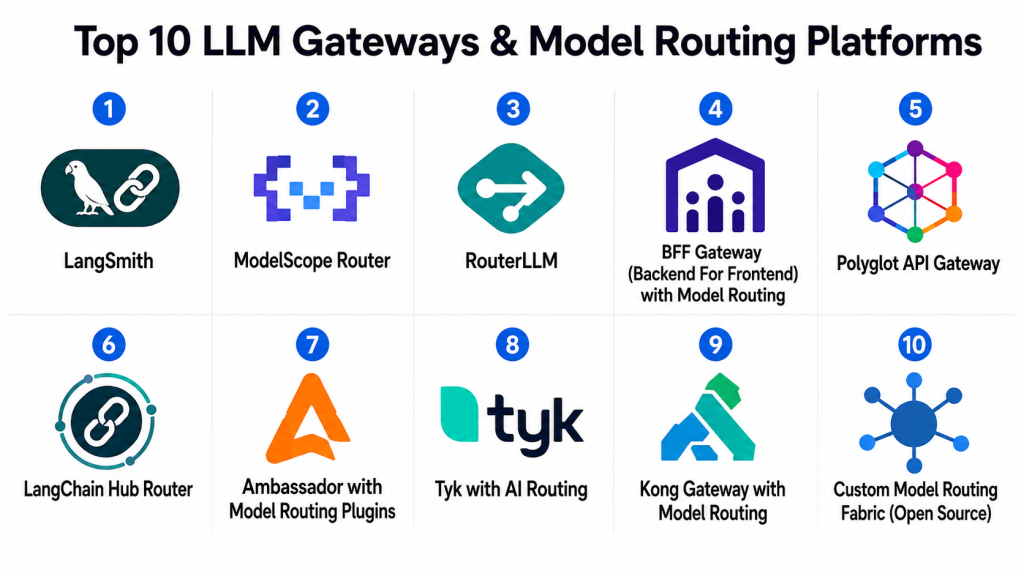
Top 10 LLM Gateways & Model Routing Platforms
1- LangSmith
Short description : LangSmith provides a model observability, evaluation, and routing platform designed for teams to monitor performance, orchestrate multiple model endpoints, and enforce safety rules. Suited for developers building production AI applications with variable workloads.
Key Features
- Multi‑model routing logic
- Performance monitoring dashboards
- Request/response logging
- Safety and policy filters
- A/B testing support
- Integration with CI/CD workflows
Pros
- Strong observability and analytics.
- Built‑in testing tools for model comparison.
Cons
- Enterprise‑grade feature set may overwhelm simple use cases.
- Premium pricing for larger teams.
Platforms / Deployment
- Web / API
- Cloud‑based
Security & Compliance
- RBAC support
- Audit logs
- Not publicly stated for specific certifications
Integrations & Ecosystem
- Integration with hosted LLMs
- Telemetry and logging tools
- CI/CD integrations
- Webhooks
Support & Community
- Documentation and examples
- Email support
- Developer community
2- ModelScope Router
Short description: ModelScope Router offers smart request routing across multiple LLMs and function routing for task‑specific endpoints. Ideal for product teams needing dynamic model selection based on task requirements.
Key Features
- Task‑based routing
- Weighted load balancing
- Failover controls
- Monitoring metrics
- Model versioning
- Custom routing rules
Pros
- Flexible routing controls
- Good for hybrid architectures
Cons
- UI and experience may be technical for non‑engineers
- Documentation varies by provider
Platforms / Deployment
- Web / API
- Cloud
Security & Compliance
- API key control
- Not publicly stated for policy layers
Integrations & Ecosystem
- Multiple LLM backends
- Dashboard metrics
- API for custom tooling
Support & Community
- Developer docs
- Support channels
- Community contributions
3- RouterLLM
Short description: RouterLLM is a dedicated lightweight routing layer that routes requests to different models based on cost, latency, and task type. It focuses on simplicity and extensibility for modern microservices architectures.
Key Features
- Cost‑aware routing
- Latency‑based selection
- Task tagging
- Retry and timeout logic
- Simple config interface
- Logging dashboards
Pros
- Simple and easy to adopt
- Cost‑focused routing
Cons
- Not as feature‑rich for enterprise governance
- Limited built‑in analytics
Platforms / Deployment
- API / CLI
- Cloud
Security & Compliance
- Token authentication
- Varies / N/A for advanced security stacks
Integrations & Ecosystem
- Webhooks
- API telemetry
- Logging exports
Support & Community
- Docs
- Chat support
- Community forum
4- BFF Gateway (Backend For Frontend) with Model Routing
Short description: Many teams build custom BFF gateways that combine API gateway logic with model routing policies. While not a single product, frameworks exist to implement routing, caching, and enforcement directly in backend layers.
Key Features
- Custom routing logic
- Caching and acceleration
- Middleware policy enforcement
- Auth and identity integration
- Logging and analytics hooks
Pros
- Fully customizable for unique stack needs
- No vendor lock‑in
Cons
- Requires engineering effort
- No packaged dashboards
Platforms / Deployment
- Web / Self‑hosted
- Cloud or on‑premise
Security & Compliance
- Depends on implementation
- Can integrate enterprise security stacks
Integrations & Ecosystem
- Custom identity providers
- Logging/monitoring platforms
- CI/CD pipelines
Support & Community
- Depends on chosen framework
- Developer forums
5- Polyglot API Gateway
Short description: Polyglot API Gateways combine traditional API gateway features with model routing extensions, allowing rules to direct traffic both to models and microservices. Ideal for teams wanting unified edge routing.
Key Features
- API and model routing
- Rule‑based policies
- Throttling and quotas
- Analytics dashboards
- Edge caching
Pros
- Unified routing platform for APIs + models
- Policy controls at the edge
Cons
- More complex to configure
- Premium enterprise focus
Platforms / Deployment
- Cloud / On‑premise
- Hybrid
Security & Compliance
- RBAC and access policies
- Audit logs
Integrations & Ecosystem
- Identity providers
- Service mesh
- Metrics systems
Support & Community
- Enterprise support
- Docs
6- LangChain Hub Router
Short description: Leveraging LangChain’s ecosystem, the LangChain Hub Router allows developers to define chains and routing logic that can direct prompts to specific models, functions, or agents based on workload context.
Key Features
- Chain and agent routing
- Function calling integration
- Task segregation
- Retry and circuit breakers
- Logging/tracing
Pros
- Deep integration with developer workflows
- Flexible code‑defined routing
Cons
- Requires LangChain expertise
- Not a standalone dashboard
Platforms / Deployment
- Library/API
- Cloud or self‑hosted
Security & Compliance
- Auth tokens
- Policy layers via code
Integrations & Ecosystem
- LangChain flows
- Telemetry exports
- Custom connectors
Support & Community
- Developer community
- Tutorials
7- Ambassador with Model Routing Plugins
Short description: Ambassador’s API gateway platform extended with model routing plugins enables enterprise routing logic, canary deployments, and microservices + LLM routing at edge scale.
Key Features
- Plugin‑based model routing
- Canary and weighted rules
- Observability and tracing
- Authentication and rate limiting
- Distributed deployment
Pros
- Enterprise‑grade gateway logic
- Powerful edge routing
Cons
- Requires engineering resources
- Complex for simple flows
Platforms / Deployment
- Cloud / On‑premise
- Hybrid
Security & Compliance
- Enterprise policies
- Audit trails
Integrations & Ecosystem
- API mesh tools
- Metrics/tracing systems
Support & Community
- Enterprise support
- Developer docs
8- Tyk with AI Routing
Short description: Tyk API Gateway with AI routing extensions enables policy‑based routing to different model endpoints with security context, throttling, and auditing.
Key Features
- Model routing plugins
- Policy enforcement
- Throttling and quotas
- Monitoring dashboards
- Identity integration
Pros
- Combined API and model routing
- Strong policy controls
Cons
- Premium tier needed for advanced features
- Configuration complexity
Platforms / Deployment
- Cloud / On‑premise
- Hybrid
Security & Compliance
- RBAC
- Audit logs
Integrations & Ecosystem
- Identity and SSO
- Metrics and logs
Support & Community
- Support tiers
- Docs
9- Kong Gateway with Model Routing
Short description: Kong Gateway’s extensible plugin ecosystem allows teams to add model routing features alongside API governance, rate limiting, and plugin‑based transformations.
Key Features
- Plugin architecture
- Model routing extensions
- Auth and rate limits
- Logging and analytics
- Service mesh integration
Pros
- Flexible and extensible
- Enterprise ecosystem
Cons
- Requires plugin development
- Enterprise pricing
Platforms / Deployment
- Cloud / On‑premise / Hybrid
- Multi‑region
Security & Compliance
- Enterprise governance
- RBAC
Integrations & Ecosystem
- Service mesh
- Identity providers
- Observability
Support & Community
- Enterprise support
- Developer ecosystem
10- Custom Model Routing Fabric (Open Source)
Short description: Several open‑source fabrics and frameworks (e.g., custom proxy + routing scripts) allow teams to stitch together routing, caching, and safety layers without vendor dependency.
Key Features
- Fully customizable logic
- Plugin‑friendly
- Logs and tracing
- Can integrate safety libraries
- Open ecosystem
Pros
- No vendor lock‑in
- Total control
Cons
- Significant engineering needed
- No packaged UI
Platforms / Deployment
- Cloud / Self‑hosted
- Hybrid
Security & Compliance
- Depends on implementation
Integrations & Ecosystem
- Identity systems
- Logging stacks
- Telemetry
Support & Community
- Open‑source community
- Forums
Comparison Table (Top 10)
| Tool Name | Best For | Platform(s) Supported | Deployment | Standout Feature | Public Rating |
|---|---|---|---|---|---|
| LangSmith | Observability + routing | Web / API | Cloud | Monitoring + multi‑model logic | N/A |
| ModelScope Router | Task‑based model routing | Web / API | Cloud | Weighted routing and failover | N/A |
| RouterLLM | Lightweight cost/latency routing | API / CLI | Cloud | Simple cost/latency logic | N/A |
| BFF Gateway | Custom routing stacks | Web / Self‑hosted | Cloud/On‑premise | Full custom logic | N/A |
| Polyglot API Gateway | Unified API + model routing | Cloud/On‑premise | Hybrid | Unified API & model routing | N/A |
| LangChain Hub Router | Developer‑centric flows | API/Library | Cloud/Hosted | Chain/agent based routing | N/A |
| Ambassador w/ Plugins | Enterprise edge routing | Cloud/On‑premise | Hybrid | Canary + weighted routing | N/A |
| Tyk with AI Routing | Policy & throttling | Cloud/On‑premise | Hybrid | Policy‑based model routing | N/A |
| Kong Gateway w/ Plugins | Extensible enterprise gateway | Cloud/On‑premise/Hybrid | Hybrid | Plugin‑based ecosystem | N/A |
| Custom Routing Fabric | DIY open‑source routing | Cloud/Self‑hosted | Hybrid | Fully customizable logic | N/A |
Evaluation & Scoring of LLM Gateways & Model Routing Platforms
| Tool Name | Core (25%) | Ease (15%) | Integrations (15%) | Security (10%) | Performance (10%) | Support (10%) | Value (15%) | Weighted Total |
|---|---|---|---|---|---|---|---|---|
| LangSmith | 9 | 8 | 8 | 8 | 8 | 8 | 7 | 8.30 |
| ModelScope Router | 8 | 7 | 8 | 7 | 8 | 7 | 7 | 7.75 |
| RouterLLM | 7 | 9 | 6 | 7 | 7 | 7 | 6 | 7.25 |
| BFF Gateway | 8 | 6 | 9 | 8 | 8 | 7 | 7 | 7.75 |
| Polyglot API Gateway | 8 | 7 | 8 | 8 | 8 | 7 | 7 | 7.80 |
| LangChain Hub Router | 8 | 7 | 7 | 7 | 8 | 7 | 7 | 7.60 |
| Ambassador w/ Plugins | 8 | 6 | 8 | 8 | 8 | 7 | 7 | 7.60 |
| Tyk with AI Routing | 8 | 6 | 8 | 8 | 8 | 7 | 7 | 7.60 |
| Kong Gateway w/ Plugins | 8 | 6 | 8 | 8 | 8 | 7 | 7 | 7.60 |
| Custom Routing Fabric | 7 | 7 | 7 | 7 | 8 | 7 | 8 | 7.50 |
Interpretation: Higher weighted totals reflect stronger core routing and orchestration capabilities combined with integrations, security, and performance readiness for 2026 AI applications.
Which LLM Gateway or Model Routing Platform Is Right for You?
Solo / Freelancer
- RouterLLM or LangChain Hub Router — Lightweight and code‑centric platforms for simple cost/latency routing without enterprise overhead.
SMB
- ModelScope Router, Polyglot API Gateway, or LangChain Hub Router — Flexible routing with manageable complexity and developer‑friendly APIs.
Mid‑Market
- LangSmith, Polyglot API Gateway, BFF Gateway (custom) — Provides observability and configurable rules without full enterprise pricing.
Enterprise
- LangSmith, Tyk with AI Routing, Ambassador w/ Plugins, or Kong Gateway w/ Plugins — Strong enterprise governance, analytics, policy enforcement, and multi‑region.
Budget vs Premium
- Budget: RouterLLM, LangChain Hub Router, Custom Routing Fabric — Focused routing without premium costs.
- Premium: LangSmith, Polyglot API Gateway, Tyk with AI Routing — Advanced monitoring, governance, and policy layers.
Feature Depth vs Ease of Use
- Feature Depth: LangSmith, Tyk with AI Routing, Polyglot API Gateway — rich dashboards, analytics, and governance.
- Ease of Use: RouterLLM, LangChain Hub Router, Custom Routing Fabric — flexible but require engineering.
Integrations & Scalability
- High: BFF Gateway, Ambassador, Kong Gateway — easily integrate routing into broader API and edge ecosystems.
- Moderate: ModelScope Router, LangChain Hub Router — focused on model routing logic.
Security & Compliance Needs
- Enterprise options like LangSmith, Tyk with AI Routing, and Ambassador provide more mature RBAC, logging, and policy enforcement suited for regulated environments.
Frequently Asked Questions (FAQs)
1‑ What is an LLM gateway?
An LLM gateway centralizes access to multiple model endpoints, enforces policies, and manages routing, performance, and analytics rather than calling models directly.
2‑ Why do teams need model routing?
Teams use model routing to balance cost, latency, performance, safety policies, and workload types across multiple LLMs.
3‑ Can these tools improve cost?
Yes — cost‑aware routing can send high‑volume tasks to cheaper models and reserve premium models for critical requests.
4‑ How do policy filters work?
Policy filters enforce content rules (e.g., safety, compliance, banned terms) at the gateway before forwarding requests.
5‑ Do these tools provide analytics?
Many top platforms include observability dashboards with usage metrics, latency, and request traces.
6‑ Can we self‑host these systems?
Some like custom fabrics or BFF gateways support self‑hosting, while managed services provide SaaS deployments.
7‑ Are SLA guarantees available?
Premium and enterprise products often offer SLA and support tiers for uptime, response times, and compliance needs.
8‑ Is integration with identity systems supported?
Yes — enterprise gateways often integrate with SSO, MFA, and RBAC systems for secure access.
9‑ Do routing platforms handle model failures?
Failover and retry logic can be configured to route around degraded or unavailable endpoints.
10‑ Can we test different models easily?
Yes — A/B testing features let teams compare responses and performance across models to choose the best fit.
Conclusion
LLM gateways and model routing platforms in are essential for building scalable, secure, cost‑efficient, and observable AI applications. Solo developers and small teams can benefit from lightweight routing layers like RouterLLM or LangChain Hub Router, while SMBs and mid‑market teams gain flexibility and insight from ModelScope Router or Polyglot API Gateway. Enterprises requiring compliance, governance, and deep observability will find capabilities in LangSmith, Tyk with AI Routing, Ambassador, and Kong Gateway plugins. Begin by identifying your routing needs—whether cost optimization, safety enforcement, or performance insights—shortlist 2–3 platforms that align with your stack, pilot them with actual traffic, validate policies and performance dashboards, and adopt the one that consistently delivers predictability, manageability, and growth readiness. Effective routing isn’t just load balancing—it’s a foundational layer for robust and efficient AI systems.
