Introduction
Model Distillation & Compression Tooling refers to software frameworks and platforms that reduce the size, complexity, and computational cost of machine learning models while retaining performance. Through techniques like knowledge distillation, pruning, quantization, and low-rank approximation, these tools enable AI models to run efficiently on resource-constrained devices, improve inference speed, and lower deployment costs.
In , with AI models growing larger and more sophisticated, enterprises and developers face mounting pressure to optimize models for edge deployment, mobile applications, and high-throughput production systems. Efficient model compression has become essential for reducing infrastructure costs, improving latency, and meeting sustainability goals in AI operations.
Real-world use cases include:
- Mobile AI apps: Running NLP, computer vision, or recommendation models on smartphones without cloud dependency.
- Edge computing: Deploying models on IoT devices or autonomous systems with limited memory or compute.
- Cloud cost optimization: Reducing inference costs in large-scale AI services by compressing models without sacrificing accuracy.
- AI-powered SaaS applications: Ensuring responsive performance for real-time analytics platforms.
- Research and experimentation: Accelerating iterative model testing and deployment cycles.
What buyers should evaluate:
- Supported compression techniques (distillation, pruning, quantization)
- Model type compatibility (transformers, CNNs, RNNs)
- Integration with ML frameworks (TensorFlow, PyTorch, ONNX)
- Inference performance improvements and benchmarks
- Scalability across devices (mobile, edge, server)
- Security and compliance features
- Ease of use and automation support
- Reporting and monitoring capabilities
- Extensibility and API support
- Cost-effectiveness and licensing
Best for: AI engineers, MLOps teams, enterprise AI developers, startups deploying edge AI solutions, research teams optimizing large models.
Not ideal for: Small-scale AI experiments where resource constraints are negligible or when performance is secondary to model accuracy.
Key Trends in Model Distillation & Compression Tooling
- Automated compression pipelines integrated with MLOps workflows.
- Transformer-specific distillation techniques for large language models.
- Quantization-aware training embedded in popular ML frameworks.
- Edge-focused optimization for low-power devices.
- Hardware-aware compression for GPUs, TPUs, and AI accelerators.
- Open-source ecosystem growth facilitating community-driven optimization.
- Real-time monitoring of compressed model performance.
- Compliance-ready deployment ensuring secure edge AI operations.
- Hybrid cloud and edge pipelines for scalable AI deployment.
- Energy-efficient AI metrics measuring environmental impact of large models.
How We Selected These Tools (Methodology)
- Market adoption and industry mindshare for distillation/compression tooling.
- Completeness of supported compression techniques.
- Reliability and benchmarked performance signals.
- Security posture and compliance readiness.
- Integrations with popular ML frameworks and MLOps pipelines.
- Extensibility and community ecosystem.
- Usability and onboarding experience.
- Customer fit across enterprises, SMBs, and developers.
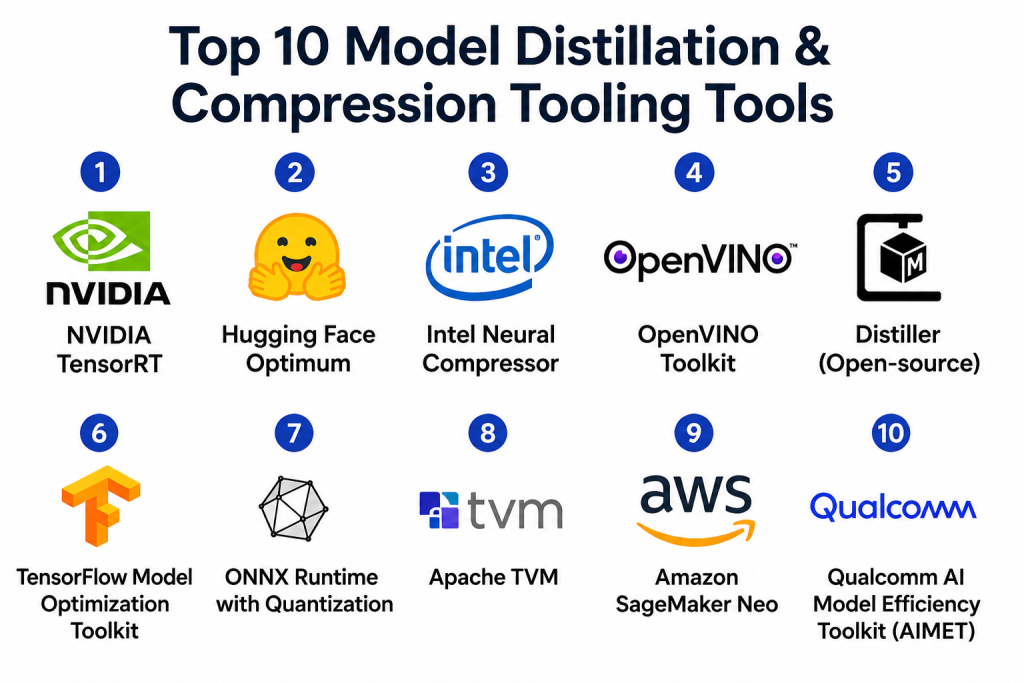
Top 10 Model Distillation & Compression Tooling Tools
1- NVIDIA TensorRT
Short description: NVIDIA TensorRT is a high-performance deep learning inference optimizer and runtime, designed for deployment of AI models on NVIDIA GPUs. It is widely used by enterprise AI teams seeking accelerated inference for image, video, and language models.
Key Features
- Layer and precision optimization
- FP16 and INT8 quantization support
- Tensor fusion and kernel auto-tuning
- GPU-specific acceleration
- Supports ONNX, TensorFlow, PyTorch models
- Dynamic batch and workspace optimization
Pros
- High-performance GPU inference
- Industry-standard for deep learning deployment
Cons
- Limited to NVIDIA GPUs
- Steeper learning curve for beginners
Platforms / Deployment
- Linux / Windows / Cloud / On-prem
Security & Compliance
- Not publicly stated
Integrations & Ecosystem
Optimized for NVIDIA GPUs and major ML frameworks.
- TensorFlow
- PyTorch
- ONNX
- CUDA libraries
- Kubernetes for distributed inference
Support & Community
Strong enterprise support and active NVIDIA developer community
2- Hugging Face Optimum
Short description: Hugging Face Optimum is a model optimization toolkit tailored for transformer models, providing distillation, quantization, and compilation for fast inference.
Key Features
- Distillation support for transformer models
- Quantization-aware training
- Integration with ONNX Runtime and TensorRT
- Automatic optimization for edge devices
- Pipeline-aware optimization
Pros
- Tight integration with Hugging Face ecosystem
- Streamlines transformer deployment
Cons
- Primarily transformer-focused
- Less suitable for CNN-based models
Platforms / Deployment
- Web / Linux / Cloud / Edge devices
Security & Compliance
- Not publicly stated
Integrations & Ecosystem
Seamlessly integrates with Hugging Face Transformers and ONNX.
- Hugging Face Transformers
- ONNX Runtime
- PyTorch
- TensorRT
Support & Community
Extensive documentation and active community forums
3- Intel Neural Compressor
Short description: Intel Neural Compressor automates model quantization and distillation to optimize AI models for Intel CPUs and accelerators, improving latency and energy efficiency.
Key Features
- Post-training quantization
- Quantization-aware training
- Support for PyTorch and TensorFlow models
- Benchmarking utilities
- Hardware-aware optimization
- Graph-level transformations
Pros
- CPU and accelerator-specific optimizations
- Simplifies deployment on Intel hardware
Cons
- Limited GPU support
- Primarily suited for Intel hardware
Platforms / Deployment
- Linux / Cloud / On-prem
Security & Compliance
- Not publicly stated
Integrations & Ecosystem
- PyTorch
- TensorFlow
- ONNX
- Intel hardware acceleration tools
Support & Community
Documentation available, active Intel developer community
4- OpenVINO Toolkit
Short description: OpenVINO is Intel’s framework for high-performance inference across CPU, GPU, and VPU devices, supporting model optimization, quantization, and deployment.
Key Features
- Model conversion and optimization
- INT8 quantization
- Multi-device support (CPU, GPU, VPU)
- Pre-trained model zoo
- Integration with deep learning frameworks
Pros
- Broad hardware support
- Supports various ML model types
Cons
- Requires Intel hardware for best performance
- Learning curve for advanced features
Platforms / Deployment
- Linux / Windows / Cloud / Edge
Security & Compliance
- Not publicly stated
Integrations & Ecosystem
- TensorFlow
- PyTorch
- ONNX
- Intel hardware accelerators
Support & Community
Extensive documentation and community forums
5- Distiller (Open-source)
Short description: Distiller is an open-source PyTorch library for model compression and pruning, enabling researchers and developers to experiment with state-of-the-art compression techniques.
Key Features
- Structured and unstructured pruning
- Quantization support
- Distillation pipelines
- Visualization tools for layer sparsity
- Integration with PyTorch models
Pros
- Flexible and research-friendly
- Active open-source community
Cons
- Limited enterprise support
- Manual setup for large pipelines
Platforms / Deployment
- Linux / Cloud / On-prem
Security & Compliance
- Not publicly stated
Integrations & Ecosystem
- PyTorch
- ONNX
- TensorBoard visualizations
Support & Community
Community-driven support and GitHub discussions
6- TensorFlow Model Optimization Toolkit
Short description: TensorFlow Model Optimization Toolkit provides APIs for quantization, pruning, and clustering to reduce model size and improve inference latency on TensorFlow models.
Key Features
- Post-training quantization
- Pruning APIs for model sparsity
- Clustering for weight sharing
- TensorFlow Lite support
- Edge device optimization
Pros
- Seamless TensorFlow integration
- Supports edge and mobile deployment
Cons
- Limited cross-framework support
- Focused primarily on TensorFlow models
Platforms / Deployment
- Linux / Cloud / Edge devices
Security & Compliance
- Not publicly stated
Integrations & Ecosystem
- TensorFlow / TensorFlow Lite
- Keras
- Edge TPU
Support & Community
Extensive documentation and active TensorFlow community
7- ONNX Runtime with Quantization
Short description: ONNX Runtime provides model optimization and quantization for models exported in ONNX format, enabling cross-platform accelerated inference.
Key Features
- Post-training quantization
- Operator fusion for performance
- Cross-platform inference
- Multi-language support (Python, C++, C#)
- Integration with hardware accelerators
Pros
- Hardware agnostic
- Supports multiple model frameworks
Cons
- Requires ONNX conversion
- Advanced features need technical expertise
Platforms / Deployment
- Linux / Windows / Cloud / On-prem
Security & Compliance
- Not publicly stated
Integrations & Ecosystem
- PyTorch / TensorFlow models converted to ONNX
- CUDA / ROCm support
- Python/C++ API
Support & Community
Active open-source community and documentation
8- Apache TVM
Short description: TVM is an open-source deep learning compiler stack for optimizing models across hardware backends, supporting quantization, auto-tuning, and efficient deployment.
Key Features
- Hardware-specific compilation
- Quantization and pruning support
- Auto-tuning for performance
- Python API for model deployment
- Supports multiple deep learning frameworks
Pros
- Flexible hardware optimization
- Active research-focused ecosystem
Cons
- Learning curve is high
- Setup complexity for large-scale deployment
Platforms / Deployment
- Linux / Cloud / Edge
Security & Compliance
- Not publicly stated
Integrations & Ecosystem
- TensorFlow
- PyTorch
- ONNX
- CUDA / OpenCL support
Support & Community
Active open-source forums and tutorials
9- Amazon SageMaker Neo
Short description: SageMaker Neo optimizes machine learning models for cloud and edge deployments, automatically compiling models for multiple hardware targets.
Key Features
- Cross-device compilation
- Quantization and performance tuning
- Cloud and edge device support
- Multi-framework compatibility
- Deployment automation
Pros
- Simplifies production deployment
- Supports heterogeneous hardware
Cons
- AWS-centric
- Pricing may be higher for large-scale use
Platforms / Deployment
- Cloud / Edge
Security & Compliance
- Not publicly stated
Integrations & Ecosystem
- TensorFlow / PyTorch / MXNet
- AWS cloud services
- IoT edge devices
Support & Community
AWS support tiers and documentation
10- Qualcomm AI Model Efficiency Toolkit (AIMET)
Short description: AIMET focuses on model compression and optimization for deployment on Qualcomm Snapdragon devices, offering quantization, pruning, and distillation features.
Key Features
- Post-training quantization
- Pruning and knowledge distillation
- Hardware-aware optimization
- Integration with TensorFlow and PyTorch
- Edge device targeting
Pros
- Optimized for mobile and edge
- Supports multiple compression strategies
Cons
- Limited to Qualcomm hardware for optimal gains
- Advanced setup for large models
Platforms / Deployment
- Linux / Cloud / Edge / Mobile
Security & Compliance
- Not publicly stated
Integrations & Ecosystem
- TensorFlow
- PyTorch
- ONNX
- Snapdragon AI processors
Support & Community
Documentation and community support via Qualcomm developer forums
Comparison Table (Top 10)
| Tool Name | Best For | Platform(s) Supported | Deployment | Standout Feature | Public Rating |
|---|---|---|---|---|---|
| NVIDIA TensorRT | Enterprise GPU AI | Linux, Windows | Cloud / On-prem | GPU-optimized inference | N/A |
| Hugging Face Optimum | Transformer models | Web, Linux | Cloud / Edge | Transformer distillation | N/A |
| Intel Neural Compressor | CPU AI optimization | Linux | Cloud / On-prem | Intel hardware-specific | N/A |
| OpenVINO Toolkit | CPU/GPU/VPU models | Linux, Windows | Cloud / Edge | Multi-device inference | N/A |
| Distiller | Research/Custom models | Linux | Cloud / On-prem | Flexible PyTorch compression | N/A |
| TensorFlow Model Optimization Toolkit | TensorFlow models | Linux | Cloud / Edge | Pruning & quantization | N/A |
| ONNX Runtime with Quantization | Cross-framework | Linux, Windows | Cloud / On-prem | Hardware-agnostic optimization | N/A |
| Apache TVM | Hardware compilation | Linux | Cloud / Edge | Auto-tuning compiler | N/A |
| SageMaker Neo | Cloud & edge deployment | Cloud | Cloud / Edge | Cross-device compilation | N/A |
| Qualcomm AIMET | Mobile AI optimization | Linux, Mobile | Cloud / Edge | Snapdragon-specific optimization | N/A |
Evaluation & Scoring of Model Distillation & Compression Tools
| Tool Name | Core (25%) | Ease (15%) | Integrations (15%) | Security (10%) | Performance (10%) | Support (10%) | Value (15%) | Weighted Total (0–10) |
|---|---|---|---|---|---|---|---|---|
| NVIDIA TensorRT | 9 | 7 | 8 | 7 | 9 | 8 | 8 | 8.2 |
| Hugging Face Optimum | 8 | 8 | 7 | 7 | 8 | 8 | 8 | 7.8 |
| Intel Neural Compressor | 8 | 7 | 7 | 7 | 8 | 7 | 7 | 7.5 |
| OpenVINO Toolkit | 8 | 7 | 7 | 7 | 8 | 7 | 7 | 7.5 |
| Distiller | 7 | 7 | 6 | 6 | 7 | 6 | 7 | 6.8 |
| TensorFlow Model Optimization Toolkit | 7 | 8 | 7 | 7 | 7 | 7 | 7 | 7.3 |
| ONNX Runtime | 7 | 7 | 7 | 6 | 7 | 6 | 7 | 7.0 |
| Apache TVM | 8 | 6 | 7 | 6 | 8 | 6 | 7 | 7.1 |
| SageMaker Neo | 8 | 7 | 7 | 7 | 8 | 7 | 7 | 7.5 |
| Qualcomm AIMET | 7 | 7 | 6 | 6 | 7 | 6 | 7 | 6.8 |
Interpretation: Higher weighted totals indicate better overall balance of features, usability, integration, performance, and value. Scores are comparative to highlight tools suited to enterprise, edge, or research scenarios.
Which Model Distillation & Compression Tool Is Right for You?
Solo / Freelancer
- Open-source frameworks like Distiller or TensorFlow Model Optimization Toolkit.
- Lightweight, flexible, and cost-effective.
SMB
- Hugging Face Optimum or ONNX Runtime for deployable transformer and multi-framework models.
- Cloud deployment simplifies integration.
Mid-Market
- NVIDIA TensorRT or Intel Neural Compressor for faster production inference with GPU/CPU optimization.
- Hybrid deployment recommended.
Enterprise
- TensorRT, OpenVINO, SageMaker Neo for large-scale deployments.
- Integrated CI/CD pipelines and performance monitoring essential.
Budget vs Premium
- Open-source tools offer cost efficiency; premium enterprise-grade solutions provide support, automation, and hardware-specific optimizations.
Feature Depth vs Ease of Use
- TensorRT and TVM for feature-rich, performance-intensive optimization.
- Hugging Face Optimum and TensorFlow Toolkit for user-friendly pipelines and integration.
Integrations & Scalability
- Choose frameworks compatible with existing ML pipelines and scalable for edge or cloud workloads.
Security & Compliance Needs
- Verify SSO, RBAC, and enterprise support for regulated environments. Most open-source tools require additional configuration for compliance.
Frequently Asked Questions (FAQs)
1. How much do these tools cost?
Pricing varies. Open-source options like Distiller and TensorFlow Toolkit are free, while enterprise tools like TensorRT or SageMaker Neo may have licensing fees.
2. Can these tools compress any model?
Most frameworks support popular deep learning models. Some focus on transformers, CNNs, or RNNs. Verify compatibility before adoption.
3. How does model compression affect accuracy?
Careful application of distillation or quantization maintains performance. Aggressive compression may reduce model accuracy.
4. Do these tools support edge deployment?
Yes, many frameworks target mobile and IoT devices with optimized runtime support.
5. How long does optimization take?
Depends on model size and technique. Simple pruning may take minutes; full quantization and distillation can take hours.
6. Are hardware accelerators required?
Some frameworks benefit from GPUs or accelerators, though CPU-only inference is supported in tools like OpenVINO and Intel Neural Compressor.
7. Can these tools integrate with CI/CD pipelines?
Yes. Most provide APIs or SDKs for automated model compression in deployment workflows.
8. Is specialized knowledge needed?
Yes, understanding model architectures and ML frameworks helps leverage advanced features effectively.
9. Do these tools monitor performance post-deployment?
Some frameworks like SageMaker Neo provide runtime performance monitoring; open-source tools may require custom solutions.
10. What are common mistakes when using compression tools?
- Over-compressing leading to accuracy loss
- Ignoring hardware constraints
- Skipping evaluation and benchmarking after optimization
Conclusion
Model Distillation & Compression Tooling is critical for optimizing AI models in improving performance, reducing cost, and enabling deployment across edge and mobile devices. Choice depends on scale, model type, deployment needs, and budget. Start with shortlisting running pilot compressions, and validating inference speed, accuracy, and security to ensure successful adoption.
