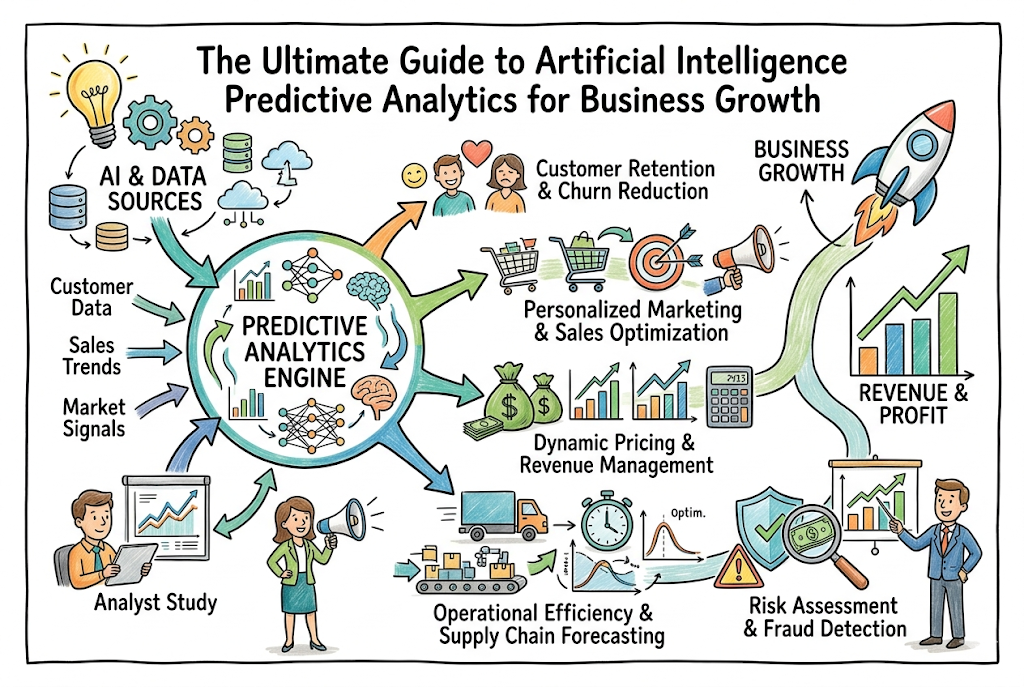
Introduction
Every business leader wishes for a crystal ball when making critical operational decisions. Determining how much inventory to stock, predicting which customers might leave, or anticipating equipment failures on a factory floor used to rely heavily on intuition, spreadsheets, and historical averages. Traditional forecasting methods looked backward, assuming the future would mirror the past in a linear fashion. Unfortunately, modern markets are highly volatile, interconnected, and dynamic, making traditional static models increasingly unreliable.
At AIUniverse, we specialize in breaking down these complex systems to help organizations transition from reactive operations to proactive strategies. By layering artificial intelligence over enterprise data pipelines, predictive analytics evolves into an automated advisor that continuously learns and adapts. Consider a national retail chain trying to predict winter coat sales. A traditional model looks at last year’s sales figures and adjusts slightly for projected economic growth. An AI-powered system analyzes historical sales, real-time local weather patterns, supply chain disruptions, social media fashion trends, and regional economic shifts simultaneously. The result is a highly accurate, granular forecast that prevents both costly overstocking and missed revenue opportunities.
Understanding Predictive Analytics
What Is Predictive Analytics?
Predictive analytics is the branch of advanced analytics that uses historical data, statistical modeling, data mining techniques, and machine learning to make educated forecasts about future outcomes. It does not explicitly tell you what will happen; instead, it calculates the statistical probability of what is likely to happen based on past patterns.
In Simple Terms:
Predictive analytics is like looking at the clouds, checking the wind speed, and remembering past storms to figure out if it is going to rain later today. It uses yesterday’s clues to guess tomorrow’s outcomes.
Why Businesses Need Predictive Analytics
Without predictive insights, businesses operate in a reactive state, addressing problems only after they disrupt operations. Predictive analytics allows leaders to optimize resource allocation, mitigate financial risks, automate customer retention efforts, and streamline supply chains. By identifying upcoming trends, companies can act before their competitors do, carving out a significant market advantage.
Historical Evolution of Predictive Analytics
Predictive modeling began with manual statistical techniques like linear regression used by statisticians in the early parts of the last century. As computers emerged, these techniques moved into spreadsheets and legacy databases, allowing for faster computations. However, these systems remained limited by human capacity; analysts had to manually select variables and write rigid rules. The explosion of big data and cloud computing introduced machine learning, allowing algorithms to discover patterns autonomously without explicit human programming.
Traditional Analytics vs. Predictive Analytics
Traditional analytics is descriptive and diagnostic. It answers questions like “What happened?” and “Why did it happen?” by generating reports, dashboards, and historical summaries. Predictive analytics looks forward, answering “What is likely to happen next?” and “What can we do to prepare?” It shifts the organizational focus from hindsight to foresight.
The Five-Layer Concept Breakdown: Predictive Analytics
- Definition: The practice of analyzing historical and current data through statistical algorithms to estimate the probability of future events.
- Why it Matters: It eliminates guesswork from business strategy, allowing companies to allocate budgets, staff, and inventory based on mathematical probabilities rather than executive intuition.
- Real-World Example: A credit card company analyzes a user’s past transaction locations and spending habits to instantly flag a sudden foreign transaction as potential fraud.
- Common Challenges: Traditional predictive analytics requires perfectly clean data and struggles to process unstructured formats like text emails, audio recordings, or video feeds.
- AI-Driven Solution: AI algorithms can naturally ingest both structured tables and unstructured data, cleaning anomalies automatically and updating predictions instantly as new information arrives.
Key Takeaways
- Predictive analytics uses historical data and probability to forecast future business events.
- It shifts an organization’s operational posture from reactive firefighting to proactive preparation.
- The practice has evolved from manual calculations to automated, cloud-scale computational modeling.
What Role Does AI Play in Predictive Analytics?
AI as the Intelligence Layer
Traditional predictive modeling relies heavily on human intervention to choose data features, build mathematical equations, and validate assumptions. Artificial intelligence acts as an automated intelligence layer that sits on top of this process. Instead of waiting for a data scientist to manually adjust a formula, AI evaluates thousands of variables simultaneously, discovering non-linear relationships that a human would miss.
Learning from Historical Data
AI systems thrive on historical data. The more data an AI model ingests, the more accurate its baseline understanding becomes. By processing historical records alongside real-time inputs, AI maps out a digital matrix of cause-and-effect relationships, learning exactly which leading indicators precede specific business outcomes.
Pattern Recognition Capabilities
Humans excel at recognizing simple patterns, such as a drop in sales during a holiday weekend. AI excels at high-dimensional pattern recognition. It can discover that a 2% increase in regional humidity, combined with a specific social media trending topic and a minor delay in public transit, leads to a 15% spike in online grocery orders for a specific zip code.
Continuous Improvement Through Learning
One of the greatest limitations of legacy statistical models is model degradation. As market conditions change, traditional models become obsolete and must be manually rebuilt. AI models, particularly those built on machine learning architectures, use feedback loops to continuously retrain themselves. If a prediction is slightly off, the system ingests the error, analyzes the variance, and refines its internal parameters for the next calculation.
Real-Time Prediction Capabilities
Legacy forecasting systems often operate in batches, processing data overnight to deliver a report the next morning. AI introduces real-time predictive processing. As a user clicks through an e-commerce website, an AI engine calculates their immediate likelihood of purchasing within milliseconds, dynamically modifying the layout or offering targeted incentives on the fly.
The Five-Layer Concept Breakdown: AI Intelligence Layer
- Definition: The computational framework that automates data processing, feature selection, and pattern discovery within a dataset.
- Why it Matters: It removes the human bottleneck from data science, allowing predictive models to scale across millions of distinct products, customers, or machines.
- Real-World Example: A streaming service analyzes millions of viewing histories simultaneously to predict exactly which thumbnail image will make you click on a new documentary.
- Common Challenges: AI models require vast amounts of compute power and specialized infrastructure to process complex data matrices in real time.
- AI-Driven Solution: Modern cloud-native machine learning pipelines dynamically scale processing power up or down, running predictive cycles efficiently at a fraction of historical costs.
In Simple Terms:
AI acts like an incredibly fast assistant who reads every single piece of data your company has ever generated. It finds hidden clues and connections in seconds that would take a human analyst an entire lifetime to discover.
Key Takeaways
- AI automates feature engineering and pattern discovery, removing human bias and speed limitations.
- Unlike static mathematical formulas, AI continuously updates its internal logic based on new data.
- Real-time pattern recognition allows businesses to intercept customer decisions and operational failures instantly.
Core AI Technologies Used in Predictive Analytics
[Raw Data Input] ──> [Machine Learning / Deep Learning] ──> [Intelligent Forecast]
                            │                   │
             [Natural Language Processing]  [Computer Vision]
Machine Learning
Machine learning is the core engine of modern predictive systems. It consists of algorithms that improve their performance as they are exposed to more data over time. In predictive analytics, machine learning algorithms analyze historical tables to construct mathematical functions that map inputs to predicted outputs, forming the foundation of business forecasting.
Deep Learning
Deep learning is a specialized subset of machine learning inspired by the structure of the human brain. It uses multi-layered neural networks to process vast quantities of data. For predictive analytics, deep learning handles incredibly complex, high-dimensional datasets where traditional machine learning models struggle to find clean mathematical relationships.
Neural Networks
Neural networks consist of interconnected computational nodes arranged in layers (input, hidden, and output layers). Each connection has an adjustable weight that changes during training. In predictive analytics, neural networks excel at processing highly non-linear data, making them ideal for financial market forecasting, energy grid demand modeling, and complex customer lifetime value predictions.
Natural Language Processing
Natural language processing enables computers to understand, interpret, and manipulate human language. In predictive analytics, natural language processing extracts sentiment and intent from unstructured text sources such as customer reviews, call center transcripts, news articles, and social media posts. This textual data is converted into numerical scores that prediction models use to forecast market demand or brand reputation crises.
Computer Vision
Computer vision allows AI to extract meaningful information from digital images, videos, and other visual inputs. While not used in every business scenario, it is vital for visual predictive analytics. For instance, computer vision systems analyze satellite imagery of parking lots to predict quarterly retail revenues, or scan drone footage of agricultural fields to predict crop yields weeks before harvest.
Reinforcement Learning
Reinforcement learning involves training an AI agent through a system of rewards and penalties based on its actions within an environment. In predictive analytics, reinforcement learning is used to optimize dynamic pricing models and supply chain distributions. The system predicts an outcome, takes an automated action, evaluates the resulting financial reward, and alters its future prediction logic accordingly.
The Five-Layer Concept Breakdown: Core AI Technologies
- Definition: A suite of advanced computational tools including machine learning, deep learning, neural networks, and language processing that analyze diverse data types.
- Why it Matters: Different business problems require different data formats; you cannot predict customer sentiment using a model designed purely for financial spreadsheets.
- Real-World Example: An insurance company uses natural language processing to read accident descriptions and machine learning to predict the total financial payout of a claim.
- Common Challenges: Combining text, images, and numbers into a single predictive system creates massive data integration and alignment complexities.
- AI-Driven Solution: Modern multimodal AI architectures are built to process multiple data streams natively, unifying numbers, text, and visuals into a single, cohesive forecast.
In Simple Terms:
Core AI technologies are different tools in a digital toolbox. Some tools are great at reading spreadsheets, others are great at understanding human text, and some can even analyze pictures to help guess what will happen next.
Key Takeaways
- Machine learning handles structured tables, while deep learning and neural networks tackle highly complex datasets.
- Natural language processing converts public sentiment, news, and reviews into predictive metrics.
- Computer vision and reinforcement learning bring visual tracking and autonomous optimization to forecasting.
How AI-Powered Predictive Analytics Works
Building an AI-powered predictive system requires a disciplined, multi-step pipeline. Data must flow from its raw state into a highly refined format before algorithms can draw meaningful insights from it.
1.Data Collection:Aggregating raw data streams.
Gather internal and external data from all available sources, including enterprise resource planning systems, customer databases, website logs, IoT sensors, and external market APIs.
2.Data Cleaning and Preparation:Removing anomalies and noise.
Filter out duplicate entries, resolve missing values, correct formatting inconsistencies, and eliminate outliers that could skew the algorithm’s understanding.
3.Feature Engineering:Selecting and formatting variables.
Isolate, combine, and transform raw data variables into distinct indicators—known as features—that maximize the predictive power of the machine learning model.
4.Model Training:Exposing the algorithm to data.
Feed the prepared historical data into the selected AI algorithm, allowing it to mathematically adjust its parameters to minimize prediction errors.
5.Model Validation:Testing accuracy against blind data.
Expose the trained model to a separate dataset it has never seen before to verify that its predictions hold true in real-world scenarios.
6.Prediction Generation:Deploying the model to production.
Connect the validated model to live data feeds, allowing it to generate automated forecasts and actionable risk scores for business teams.
7.Continuous Monitoring and Optimization:Tracking real-world performance.
Compare the model’s ongoing predictions against actual real-world outcomes, automatically triggering retraining cycles when accuracy drifts.
The Five-Layer Concept Breakdown: The Predictive Workflow
- Definition: The structured data pipeline through which raw organizational information is gathered, cleaned, analyzed, and transformed into an active forecast.
- Why it Matters: A predictive model is only as good as the pipeline supporting it; broken data ingestion or unoptimized feature engineering leads to completely incorrect business forecasts.
- Real-World Example: A logistics firm builds a workflow that cleans sensor data from delivery trucks, trains a model, and accurately predicts mechanical failures three days before they occur.
- Common Challenges: Data drift occurs over time as customer habits or market landscapes shift, causing once-accurate models to lose their predictive validity.
- AI-Driven Solution: MLOps (Machine Learning Operations) frameworks automate this entire workflow, continuously testing live data accuracy and retraining models without human intervention.
In Simple Terms:
Think of this process like baking a complex dish. You gather raw ingredients, clean and prep them carefully, mix them in the right proportions, bake them in the oven, taste-test the result, and then serve it up to your guests.
Key Takeaways
- Predictive analytics requires a systematic process spanning from initial data ingestion to continuous live monitoring.
- Data preparation and feature engineering are often the most critical phases for ensuring high model accuracy.
- Automated feedback loops prevent models from degrading when real-world market dynamics change.
Key Benefits of AI in Predictive Analytics
Implementing artificial intelligence within your predictive infrastructure provides significant upgrades over legacy statistical packages.
- Improved Accuracy: AI models identify deep, multi-layered patterns and non-linear relationships across millions of rows of data, significantly driving down forecasting error rates.
- Faster Decision-Making: Instead of waiting days for analysts to manually assemble data, compile spreadsheets, and write reports, AI delivers predictions in fractions of a second.
- Real-Time Forecasting: AI handles streaming data effortlessly, updating predictive dashboards instantly as transactions occur, emails arrive, or market prices shift.
- Risk Reduction: By accurately forecasting market drops, customer defaults, and mechanical issues, companies can implement preventative measures before financial damage occurs.
- Operational Efficiency: Automated inventory, workforce, and supply chain forecasts minimize waste, reduce excess warehouse costs, and optimize staffing schedules.
- Better Customer Understanding: AI predicts individual customer lifetime value, purchase intent, and churn risk, enabling hyper-personalized marketing campaigns that boost conversions.
- Competitive Advantage: Companies leveraging real-time predictive models can adapt to macroeconomic trends weeks before their legacy-bound competitors realize a shift is happening.
The Five-Layer Concept Breakdown: Benefits of AI Predictive Power
- Definition: The operational advantages, financial savings, and strategic velocity gained by substituting automated machine learning forecasts for human intuition.
- Why it Matters: In tight-margin industries, a 5% improvement in forecast accuracy can translate directly into millions of dollars in saved overhead and captured revenue.
- Real-World Example: A global e-commerce giant uses AI forecasting to position popular items in regional warehouses before local customers even place their orders.
- Common Challenges: Quantifying the exact financial return on investment of an advanced AI model can sometimes be difficult for legacy finance departments to track.
- AI-Driven Solution: Integrated business intelligence platforms connect predictive outputs directly to financial dashboards, showing a clear, real-time map of cost-savings and revenue generated.
In Simple Terms:
Using AI for predictions gives your business a massive head start. It makes your operations incredibly accurate, saves you from making expensive mistakes, and lets you serve your customers much faster than your competitors can.
Key Takeaways
- AI vastly increases prediction accuracy by processing multi-dimensional data simultaneously.
- Real-time insights replace slow, retrospective batch reporting, allowing immediate operational pivots.
- Operational efficiency and proactive risk reduction serve as primary drivers for bottom-line financial growth.
Industries Using AI-Powered Predictive Analytics
Organizations across the globe are embedding machine learning forecasting directly into their core operational models to solve long-standing vertical challenges.
Healthcare
- Business Challenge: Hospitals struggle with unexpected patient readmissions, sudden ICU surges, and delayed diagnoses of life-threatening conditions.
- AI Solution: Machine learning models analyze real-time vitals, laboratory results, and historical patient charts to predict clinical deterioration hours before symptoms manifest.
- Results Achieved: Significant reductions in patient mortality rates, optimized nurse staffing schedules, and lower hospital readmission penalties.
Finance
- Business Challenge: Financial institutions lose billions annually to sophisticated, rapidly changing identity theft tactics and loan defaults.
- AI Solution: Deep learning architectures monitor global transaction networks, assigning instantaneous fraud-risk scores based on location, velocity, and behavior profiles.
- Results Achieved: Fraudulent charges are blocked instantly at the point of sale, while credit risk underwriting becomes automated and highly accurate.
Retail
- Business Challenge: Retailers suffer severe losses from either holding dead stock that must be heavily discounted or running out of hot items during peak shopping cycles.
- AI Solution: AI forecasting models integrate regional consumer trends, localized weather forecasts, and historical sales velocity to predict exact SKU demand per store.
- Results Achieved: Warehousing overhead costs drop dramatically, stockouts are minimized, and profit margins on seasonal goods increase.
Manufacturing
- Business Challenge: Unscheduled factory equipment failures derail production timelines, cause supply chain bottlenecks, and cost millions in emergency repairs.
- AI Solution: IoT sensors capture continuous acoustic, thermal, and vibrational data, allowing predictive models to spot micro-anomalies that indicate an impending machine breakdown.
- Results Achieved: Shifted factory operations from costly reactive repairs to scheduled, non-disruptive maintenance windows, extending machinery lifespans.
E-Commerce
- Business Challenge: Digital storefronts face short session times and high bounce rates if users cannot quickly find products that align with their immediate needs.
- AI Solution: Multimodal prediction engines analyze user clickstreams, historical purchases, and real-time search context to dynamically arrange product recommendations.
- Results Achieved: Marked increases in average order values, higher conversion rates, and vastly improved customer engagement metrics.
Marketing
- Business Challenge: Sales teams waste countless hours calling cold leads, while marketing departments blow advertising budgets on broad, unoptimized audiences.
- AI Solution: Predictive lead scoring systems evaluate prospects based on content downloads, company size, web behaviors, and past conversion indicators.
- Results Achieved: Sales teams focus entirely on high-intent prospects, customer acquisition costs plummet, and marketing campaign conversion rates soar.
The Five-Layer Concept Breakdown: Cross-Industry AI Analytics
- Definition: The deployment of domain-specific machine learning models to solve operational inefficiencies and forecast unique industry outcomes.
- Why it Matters: It proves that AI predictive capabilities are not a niche tech phenomenon, but a foundational infrastructure upgrade relevant to all modern commerce.
- Real-World Example: A regional bank uses predictive models to anticipate which branch locations will experience cash shortages during upcoming local festivals.
- Common Challenges: Regulatory compliance, such as HIPAA in healthcare or GDPR in banking, restricts how customer data can be fed into predictive models.
- AI-Driven Solution: Privacy-preserving machine learning frameworks anonymize data automatically, allowing robust predictive training without exposing personal consumer information.
Key Takeaways
- Healthcare relies on AI predictions to save lives and optimize critical resource allocation.
- Finance and manufacturing use predictive models to eliminate fraud and avoid expensive machinery downtime.
- Retailers and marketers leverage predictive engines to match product supply precisely with human consumer demand.
Common Predictive Analytics Models
Behind every successful predictive implementation lies a mathematically robust model architecture. Understanding the basic taxonomy of these models helps teams select the right tool for their specific objective.
- Regression Models: These models estimate relationships between continuous variables. They are primarily used to predict a precise numerical value, such as forecasting next month’s revenue or calculating future real estate prices based on square footage and location.
- Classification Models: These algorithms sort data into distinct, predefined categories. They answer binary or multi-class questions, such as deciding whether an incoming email is “spam” or “ham,” or categorizing a customer as a “high,” “medium,” or “low” credit risk.
- Time Series Forecasting: This specialized modeling approach focuses exclusively on data collected sequentially over time. It analyzes historical time intervals to isolate cyclical patterns, seasonal fluctuations, and long-term trends, making it the bedrock of energy demand and stock market forecasting.
- Decision Trees: A flowchart-like model structure where data splits continuously based on specific parameters. It traces paths from a root condition down to a leaf outcome, providing an intuitive, rule-based approach to determining loan eligibility or customer segment sorting.
- Random Forests: An advanced ensemble method that constructs a large collection of individual decision trees during training. It combines all their independent predictions to output a single, consensus vote, vastly reducing the risk of a model memorizing noise rather than patterns.
- Gradient Boosting Models: This approach builds prediction models sequentially, with each new tree focusing entirely on correcting the exact mathematical errors made by the tree that came before it. It is widely recognized for delivering exceptional accuracy on structured enterprise datasets.
- Deep Learning Models: Utilizing multi-layered artificial neural networks, these models excel at extraction across unstructured inputs. They are utilized when predictive tasks involve interpreting satellite feeds, streaming video, or complex vocal audio tracks.
The Five-Layer Concept Breakdown: Model Taxonomy
- Definition: The mathematical architectures and algorithmic frameworks used to analyze data relationships and calculate probability distributions.
- Why it Matters: Selecting an incorrect model archetype results in severe forecasting errors; using a simple linear model on highly complex customer behavior will yield useless results.
- Real-World Example: A fintech startup tests multiple regression and gradient boosting models before finding the exact combination that accurately predicts stock market volatility.
- Common Challenges: Highly complex models like deep neural networks often suffer from overfitting, where they perform perfectly on historical data but fail on new inputs.
- AI-Driven Solution: Automated Machine Learning (AutoML) platforms run parallel tests across dozens of model structures automatically, choosing and tuning the best archetype for your specific dataset.
In Simple Terms:
Predictive models are like different types of calculators. Some are built for simple addition, others are designed to map out complex geometry, and some are built specifically to handle complicated financial equations.
Key Takeaways
- Regression models predict specific numerical targets, while classification models sort data into distinct buckets.
- Ensemble methods like Random Forests and Gradient Boosting combine multiple models to maximize forecasting stability.
- Choosing the proper model architecture prevents overfitting and ensures reliable predictions on real-world data.
Real-World Business Use Cases
To truly appreciate the value of AI in predictive analytics, we must look at concrete, measurable operational applications.
Customer Churn Prediction
- The Scenario: A subscription-based software company notices its cancellation rates are steadily increasing, cutting deeply into quarterly recurring revenues.
- The AI Implementation: The company deploys a classification model that tracks daily product login frequencies, customer support ticket sentiments, and billing delays.
- The Outcome: The AI flags high-risk accounts 30 days before their contracts expire. Customer success teams intervene proactively with targeted promotions, reducing overall customer churn by 22%.
Sales Forecasting
- The Scenario: A global electronics manufacturer struggles to plan its production schedules due to unpredictable fluctuations in regional consumer tech demands.
- The AI Implementation: The team builds a time-series gradient boosting model that ingests historical sales, global component pricing indexes, and consumer sentiment scores.
- The Outcome: The system delivers monthly sales forecasts with over 94% accuracy, allowing the firm to adjust component orders and save millions in inventory overhead.
Inventory Optimization
- The Scenario: A major fashion brand routinely loses revenue because hot apparel items sell out instantly in metropolitan flagship stores while sitting unsold in suburban locations.
- The AI Implementation: An AI demand forecasting system dynamically analyzes real-time point-of-sale data, local fashion influencer trends, and regional weather changes.
- The Outcome: The system automates stock transfers between regional fulfillment centers, reducing total inventory carrying costs by 18% while boosting full-price sales.
Workforce Planning
- The Scenario: A large enterprise call center experiences erratic call volume spikes, leading to long hold times for customers or expensive overstaffing during quiet hours.
- The AI Implementation: A predictive time-series model correlates historical call volumes with marketing campaign schedules, product launch dates, and seasonal variations.
- The Outcome: Managers receive precise hourly staffing recommendations, improving customer satisfaction scores by 30% and eliminating unnecessary overtime expenses.
| Use Case | Core Input Data | Primary Business Outcome |
| Customer Churn | Logins, Support Tickets, Billing History | 22% Reduction in Cancellations |
| Sales Forecasting | Past Orders, Market Indexes, Sentiment | 94% Forecast Accuracy Achieved |
| Inventory Optimization | Live Sales, Influencer Trends, Weather | 18% Lower Warehouse Carrying Costs |
| Workforce Planning | Promo Calendars, Call Logs, Launch Dates | 30% Better Customer Satisfaction |
Key Takeaways
- Predictive churn modeling allows customer success teams to save accounts before they officially cancel.
- High-accuracy sales forecasting directly stabilizes corporate manufacturing and procurement timelines.
- Data-driven workforce planning balances customer experience perfectly with operational labor costs.
Challenges of AI in Predictive Analytics
While the advantages of AI-driven forecasting are immense, organizations frequently encounter significant obstacles during deployment. Successfully navigating these hurdles requires proactive, targeted strategies.
- Data Quality Issues: If your historical records are filled with missing inputs, duplicate entries, or unstandardized formatting, your model will generate highly inaccurate forecasts.
- The Solution: Establish rigorous data governance protocols and deploy automated data-cleaning pipelines that format and validate incoming data streams before they reach the model.
- Bias in Models: AI learns from historical human choices. If past business decisions contained systemic biases—such as unfair loan rejection patterns—the AI will internalize and replicate those biases.
- The Solution: Implement regular algorithmic audits, use diverse training datasets, and actively apply mathematical fairness constraints to mask sensitive demographic variables.
- Privacy Concerns: Ingesting vast troves of consumer behavior data to predict future choices can trigger intense regulatory scrutiny and consumer pushback.
- The Solution: Adopt privacy-by-design architectures, leverage differential privacy techniques, and ensure absolute compliance with global guidelines.
- Model Interpretability: Advanced deep learning systems often act as “black boxes,” making it incredibly difficult to explain why a model generated a specific prediction to regulators or executives.
- The Solution: Integrate Explainable AI (XAI) frameworks such as SHAP or LIME to provide clear visual breakdowns of exactly which data features influenced a specific prediction.
- High Implementation Costs: Building specialized machine learning infrastructure, securing cloud computing resources, and hiring elite data talent demands significant capital.
- The Solution: Avoid custom builds initially. Start by leveraging scalable, pre-built cloud AI services and modular software-as-a-service predictive analytics tools to prove ROI early.
- Data Security Risks: Centralizing enterprise data into a single predictive pipeline creates a highly attractive target for malicious cyberattacks and data breaches.
- The Solution: Enforce end-to-end encryption for data both at rest and in transit, implement strict role-based access controls, and mandate continuous security logging.
The Five-Layer Concept Breakdown: Implementation Challenges
- Definition: The technical, ethical, operational, and financial roadblocks that companies face when moving predictive AI projects from concept to production.
- Why it Matters: Ignoring these challenges can result in costly project failures, severe regulatory fines, corporate reputational damage, or completely skewed business forecasts.
- Real-World Example: A healthcare system pauses its predictive triage app because the model’s underlying data favored specific demographic groups due to historic access discrepancies.
- Common Challenges: Business executives often lose trust in predictive systems if the data science team cannot explain the reasoning behind an alarming forecast.
- AI-Driven Solution: Modern explainability dashboards translate complex neural network weights into intuitive, human-readable charts for non-technical leadership teams.
Key Takeaways
- Uncleaned or fragmented data will actively corrupt the reliability of any machine learning model.
- Explainable AI frameworks are essential for demystifying “black box” algorithms and gaining executive trust.
- Scalable cloud tools allow organizations to test predictive AI capabilities without massive upfront capital investments.
Best Practices for Successful Implementation
Deploying a business forecasting engine requires combining corporate strategy with technical execution. Following these industry best practices will dramatically increase your project’s likelihood of success.
- Start with Clear Business Objectives: Avoid building a model just for the sake of using AI. Identify a specific, high-value problem—such as “reduce supply chain delays by 10%”—and design the model around that target.
- Focus on High-Quality Data: Treat data acquisition and refinement as your primary priority. Dedicate adequate engineering resources to building clean, well-documented, and easily accessible data pipelines.
- Choose the Right Models: Do not default to the most complex deep learning model if a simpler, faster, and highly explainable regression or decision tree model can solve the problem effectively.
- Continuously Monitor Predictions: Establish MLOps infrastructure to continuously track live accuracy against real-world outcomes, flags anomalies, and sounds alerts when data drift occurs.
- Balance Accuracy and Explainability: Ensure your operational teams understand how predictions are generated. A model that is 90% accurate but fully transparent is often more valuable than a 93% accurate model that nobody understands.
- Build Cross-Functional Teams: Ensure your data scientists work closely alongside domain experts and business analysts. Algorithms require human context to interpret operational nuances correctly.
Enterprise Warning: The single fastest way to fail an AI project is to lock your data science team in an isolated silo away from the operational managers who actually understand the day-to-day business reality.
Key Takeaways
- Anchor every AI predictive project to a concrete, measurable financial or operational metric.
- Prioritize model transparency and explainability to drive internal employee adoption.
- Maintain ongoing collaboration between advanced machine learning engineers and frontline business experts.
AI vs. Traditional Predictive Analytics
To understand why upgrading to an AI-powered framework is necessary, we must compare it directly against traditional legacy analytics methodologies across core operational parameters.
| Factor | Traditional Analytics | AI-Powered Predictive Analytics |
| Accuracy | Limited by linear mathematical assumptions and human feature selection; prone to higher error margins in volatile markets. | High accuracy derived from deep, multi-layered pattern recognition across millions of data points simultaneously. |
| Speed | Relies on batch processing; reports are generated overnight or weekly, creating a lag between insight and action. | Sub-second, real-time processing; instantly recalculates forecasts as fresh data streams into enterprise pipelines. |
| Scalability | Struggles to scale; requires manual model restructuring for every new product line, region, or customer group. | Highly scalable; a single automated pipeline can manage thousands of parallel localized prediction models effortlessly. |
| Adaptability | Completely static; requires data scientists to manually rewrite code and rebuild parameters when market conditions shift. | Dynamic and self-correcting; continuously learns from new inputs and updates its own parameters via feedback loops. |
| Automation | Highly manual; requires human intervention for data cleaning, feature creation, statistical validation, and report building. | End-to-end automation capability spanning data ingestion, cleaning, model tuning, deployment, and performance monitoring. |
| Business Value | Provides generalized, backward-looking insights that help explain past failures or successes retrospectively. | Delivers highly granular, forward-looking recommendations that allow businesses to actively shape future outcomes. |
Understanding the Structural Shift
Traditional analytics views data through a rearview mirror. It relies entirely on historical averages, assuming that consumer behaviors and market trends will always move in straight, easily predictable lines. While this approach worked well in stable economic environments, it breaks down completely when faced with modern disruptions, sudden e-commerce shifts, or complex global supply chain realities.
AI-powered predictive analytics replaces this static worldview with a dynamic, high-dimensional understanding of data. By automating feature selection and continually ingesting real-time variables, AI models adapt to market shifts as they occur. This structural difference moves data analysis out of corporate IT reports and embeds it directly into live operational workflows, creating an autonomous advisory engine for the entire enterprise.
Key Takeaways
- Traditional analytics focuses on historical reports, whereas AI provides live, forward-looking guidance.
- AI-driven models natively adapt to volatile economic shifts without requiring manual code rewrites.
- Automated scalability enables large enterprises to run thousands of unique product forecasts simultaneously.
The Future of AI in Predictive Analytics
The intersection of artificial intelligence and forecasting is evolving rapidly, driven by breakthrough computing frameworks and novel machine learning architectures.
Generative AI and Forecasting
The synthesis of Generative AI with predictive systems allows executives to interact with deep data using natural language. Instead of interpreting dense charts, business leaders can simply ask their corporate system, “If we raise prices by 4% in Europe, what will our supply chain look like next quarter?” The AI will run background simulations and generate a detailed narrative forecast outlining the most probable outcomes.
Autonomous Decision Systems
Predictive analytics is migrating away from simple dashboard alerts and moving toward fully autonomous execution. In these environments, an AI model predicts an upcoming stock shortage, evaluates supplier delivery times, and automatically issues purchase orders without requiring a human manager to manually sign off on the transaction.
Real-Time Predictive Intelligence
As edge computing and 5G infrastructure mature, predictive processing will occur directly on localized devices. Autonomous vehicles will predict pedestrian paths milliseconds in advance, and regional smart grids will forecast localized power surges instantaneously, preventing brownouts before they spread.
Explainable AI (XAI)
Future regulatory environments will place immense pressure on organizations to explain automated algorithmic choices. Next-generation predictive models will feature native, built-in explainability protocols, automatically generating clear, audit-ready justifications for every automated risk score or credit denial.
[Future Predictive Landscape] ──> Multimodal Inputs + Generative Interfaces + Autonomous Action
Key Takeaways
- Generative AI will allow non-technical business leaders to query complex predictive models using everyday speech.
- Autonomous systems will pair predictive insights directly with automated execution and procurement workflows.
- Next-generation models will feature built-in explainability architectures to satisfy strict global compliance audits.
Common Mistakes Organizations Make
Even with substantial budgets, companies frequently stumble during their predictive analytics journey due to fundamental strategic errors.
- Ignoring Data Quality: Throwing advanced, expensive machine learning models at a broken, uncleaned, and unorganized corporate database.
- The Correction: Establish a robust data cleaning foundation first. Never let a data scientist write a predictive algorithm until your underlying data pipelines are stabilized and audited.
- Expecting Perfect Predictions: Treating predictive outputs as infallible absolute certainties rather than statistical probabilities, leading to strategic shocks when anomalies happen.
- The Correction: Build operational safety margins and contingency plans around your model’s probability distributions; prepare for variance.
- Choosing the Wrong Metrics: Optimizing an algorithm for pure academic accuracy while ignoring whether that accuracy translates into meaningful financial or operational value.
- The Correction: Align your data science team’s performance metrics directly with business key performance indicators, such as reduced overhead or increased customer retention.
- Lack of Continuous Monitoring: Deploying a highly accurate model into production and then leaving it completely unattended for months, ignoring gradual data drift.
- The Correction: Implement automated MLOps dashboards that continuously track live accuracy and trigger automated alerts when performance falls below acceptable thresholds.
- Overreliance on Automation: Blindly trusting automated predictions without maintaining human oversight, leading to massive errors when unprecedented black swan market events occur.
- The Correction: Maintain a strict “human-in-the-loop” philosophy for high-stakes operational or financial decisions, allowing seasoned experts to overrule algorithms during market anomalies.
Key Takeaways
- Advanced predictive algorithms are completely useless if fed unrefined or biased data.
- Predictions must always be managed as probabilities and ranges, never as absolute certainties.
- Maintaining human oversight protects organizations from algorithmic failures during unprecedented market shifts.
FAQ Section
What is the difference between machine learning forecasting and traditional forecasting?
Traditional forecasting relies on historic averages and linear mathematical models where human analysts must manually select variables. Machine learning forecasting uses self-improving algorithms that evaluate thousands of non-linear variables simultaneously, adapting to new data patterns automatically without requiring manual code overhauls.
How clean does company data need to be to start using AI predictive modeling?
While data does not need to be completely flawless, it must be well-structured, accessible, and free of massive systemic gaps or duplicate records. Investing heavily in data cleaning, validation pipelines, and feature engineering prior to model training is critical for achieving reliable prediction results.
Can small businesses benefit from AI-powered predictive analytics tools?
Yes, small businesses can leverage predictive analytics without building custom systems from scratch. Many modern cloud-based software platforms and e-commerce dashboards feature built-in, user-friendly predictive analytics tools that automate inventory tracking, sales forecasting, and customer churn analysis.
What are the most popular programming languages used to build predictive models?
Python is the undisputed industry standard for building predictive analytics models due to its vast ecosystem of specialized machine learning libraries like Scikit-Learn, TensorFlow, and PyTorch. R is also highly utilized by enterprise statisticians for deep exploratory data analysis and specialized academic modeling.
How long does it typically take to implement an AI predictive analytics system?
A standard enterprise implementation timeline varies widely based on data readiness. If clean data pipelines are already established, a pilot predictive model can be built, validated, and deployed within three to six months. However, if data infrastructure requires complete remediation, timelines can stretch past a year.
Is deep learning always better than standard machine learning for business forecasting?
No, deep learning is not a universal solution. Standard machine learning models like Random Forests or Gradient Boosting are often superior for structured business tables because they require less computing power, train much faster, and provide much clearer explainability than dense neural networks.
How do predictive models account for unprecedented events like global pandemics or market crashes?
Predictive models struggle with entirely unprecedented black swan events because algorithms train exclusively on historical data patterns. To safeguard operations, businesses must incorporate human-in-the-loop oversight and run continuous stress-test simulations to adjust model assumptions manually during structural market shocks.
What is data drift and how does it affect business forecasting models?
Data drift occurs when the real-world environment changes so significantly that the historical data used to train a model no longer matches live reality. This causes prediction accuracy to steadily degrade over time, requiring engineers to continuously monitor performance and retrain models with fresh data.
How does natural language processing contribute to financial market predictions?
Natural language processing tools scan thousands of unstructured text sources—including corporate financial earnings transcripts, global news feeds, and social media commentary—to calculate real-time public sentiment scores. These numbers are then fed into predictive models to help forecast sudden shifts in stock prices or market demand.
What internal roles are required to manage a successful enterprise predictive analytics team?
A well-rounded enterprise predictive analytics team requires a balance of technical and strategic talent. Core roles include Data Engineers to build pipelines, Data Scientists to design algorithms, Machine Learning Engineers to deploy models, and Business Analysts to translate predictive outputs into daily corporate strategy.
Final Summary
Predictive analytics has transitioned from an optional enterprise luxury into a foundational pillar of modern corporate strategy. By substituting artificial intelligence for traditional, backward-looking forecasting methods, organizations can systematically analyze vast oceans of structured and unstructured data to predict customer habits, anticipate machinery breakdowns, optimize global supply chains, and mitigate institutional risks with remarkable precision. From advanced regression frameworks to deep neural network structures, core AI technologies provide the pattern recognition and automation pipelines required to turn raw historical tables into real-time operational advantages. While challenges regarding data governance, model bias, and algorithmic explainability persist, adhering to rigorous MLOps deployment practices and maintaining close collaboration between data practitioners and domain experts ensures sustainable, long-term project success.
